Skip to content
Watt Warden

Power Stations

The Best 1000Wh Power Stations (2026)

One kilowatt-hour is the size that covers a refrigerator overnight, and the size where the electronics stop being a premium. Most people who buy well buy here.

By Sawyer V.Updated Published How we work this out
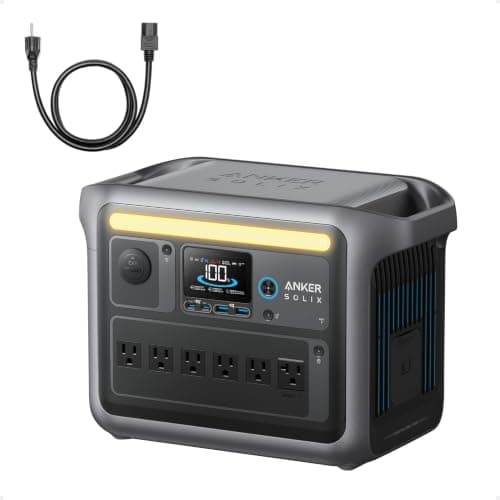
Anker SOLIX C1000

Watt & Warden earns a commission on qualifying purchases made through links on this page, at no extra cost to you. It never changes a ranking, and our picks include products we tell you to skip. Full disclosure.

Quick picks

#ProductBest forPrice
1
Anker SOLIX C1000

Best overall

Anker SOLIX C1000

1,056Wh of LiFePO4 with an 1,800W inverter, 2,400W surge and a 58-minute full recharge.

Recharging fully in the window the power comes back
$499.99 · Check price on Amazon

#ad how this is funded · price as of October 21, 2026 · $599.99 17% off

2
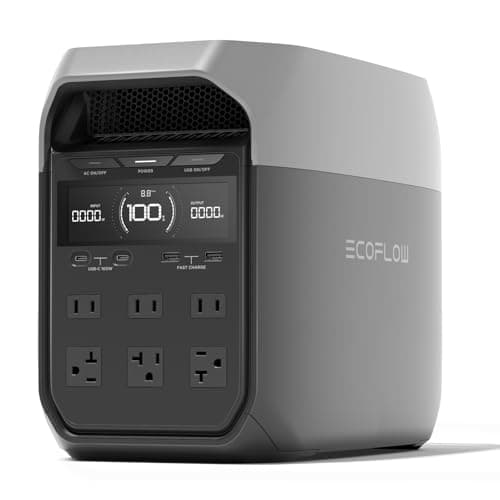
EcoFlow DELTA 3

Best if you may want more later

EcoFlow DELTA 3

1,024Wh and 1,800W now, with the option of adding battery capacity.

Starting here and expanding if a real outage proves you short
$629.00 · Check price on Amazon

#ad how this is funded · price as of October 21, 2026 · $699.00 10% off

3
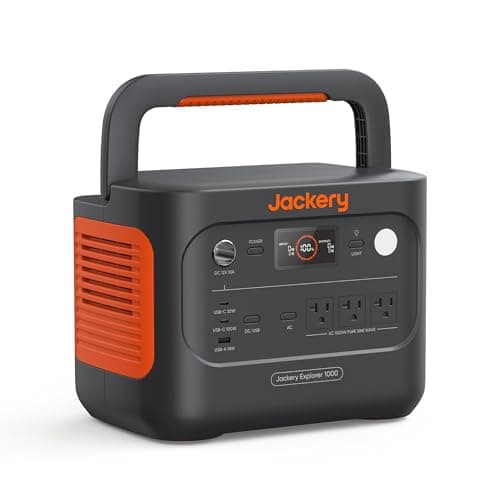
Jackery Explorer 1000 v2

Best for weight

Jackery Explorer 1000 v2

1,070Wh in a package light enough to move one-handed.

Carrying it between floors rather than wheeling it
$499.00 · Check price on Amazon

#ad how this is funded · price as of October 21, 2026 · $559.00 11% off

4
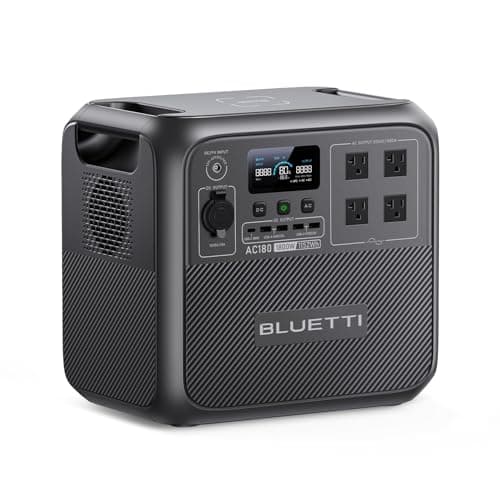
BLUETTI AC180

Best surge behavior

BLUETTI AC180

1,152Wh with 1,800W continuous and a lift mode for high-surge appliances.

A big starting load on a mid-size battery
$449.00 · Check price on Amazon

#ad how this is funded · price as of October 21, 2026 · $499.00 10% off

Prices come from the retailer at page-build time and change constantly. Where no live price is available the button reads “Check price” rather than showing a number we cannot stand behind.

Why this is the band to buy

Two reasons, and they point the same way.

It covers the load people actually care about. A refrigerator is the appliance that turns an outage from an inconvenience into a loss, and a kilowatt-hour runs one overnight with room for lighting and the network alongside.

Cost per watt-hour bottoms out here. Below about 500Wh the fixed cost of the inverter and electronics is spread over very little capacity. Above about 3,000Wh you start paying for split-phase output and expansion hardware. The middle is where the money goes furthest — the cost page covers that shape.

What a kilowatt-hour runs

LoadAverage drawHours from 1,056 Wh
Refrigerator150 W cycling averageAbout 6 hours continuous, far longer in blocks
Router, modem and a laptop85 WAbout 10.5 hours
Fridge, network and LED lightingAbout 250 WAbout 3.6 hours continuous
CPAP without humidifier30-40 WAbout three nights
Furnace blower, cycling200-330 W average2.7-4.5 hours
Space heater on low750 WAbout 72 minutes
Window air conditioner1,200 WUnder an hour

Hours are capacity x 0.85 / draw, using the inverter efficiency figure on the methodology page. Refrigerator draw is the 150W cycling average used throughout this site.

The refrigerator row deserves the caveat. Six hours is the continuous figure; in practice a closed fridge holds temperature for hours between compressor runs, so running it in blocks stretches a kilowatt-hour across a much longer outage — the refrigerator roundup covers that properly.

Three specifications separate units in this band

Capacity is effectively identical across the band — 1,024 to 1,152Wh is noise. What actually differs is these.

1. Recharge speed. Anywhere from under an hour to six hours from a wall outlet. This is the most underrated specification in the category, because outage restoration is usually intermittent before it becomes permanent.

2. Surge rating. Continuous output is 1,800W across most of the band; surge varies from about 2,000W to 2,400W and above. That is what decides whether a refrigerator or a sump pump actually starts — the starting watts page covers why.

3. Weight and expandability. Whether it moves, and whether it grows.

Chemistry is not on the list because everything worth buying in this band is now LiFePO4. If you find one that is not, that is the deciding factor and the answer is no — the chemistry page covers the cycle gap.

Is this the right band for you?

If your situation isBand
Devices, lighting and the router only500Wh — see that roundup
A refrigerator and the critical list, outages of hours1,000Wh — this page
Fridge and freezer through a long outage2,000Wh — see that roundup
A full day of critical loads, or a well pump3,000Wh — see that roundup
Anything hardwired at 240VA split-phase unit — see home battery systems

Work it from your own load list rather than from the price. The sizing page does that arithmetic, and a meter replaces the guessing entirely.

Making a kilowatt-hour last

  • Run the fridge in blocks. Two hours on, four off keeps food safe and roughly triples what the battery covers.
  • Unplug standby loads. The microwave clock, the cable box and idle chargers add up to a meaningful share of a kilowatt-hour across a day.
  • Use DC where you can. USB output skips the inverter, which saves the 15% conversion loss on everything you charge.
  • Recharge in every window. When power returns briefly, plug the battery in first and everything else second.
  • Add a panel for anything past a day. The panel arithmetic is less flattering than ratings suggest, but 200W changes the picture.

The short version

  • A kilowatt-hour is a refrigerator overnight plus the network and lighting.
  • Capacity is identical across the band. Buy on recharge speed and surge.
  • LiFePO4 or walk away. Everything worth buying here is.
  • Run in blocks. It roughly triples what the battery covers.
The picks in full

01 — Best overall

Anker SOLIX C1000

1,056Wh of LiFePO4 with an 1,800W inverter, 2,400W surge and a 58-minute full recharge.

The recharge figure is what separates this from the band. Full in 58 minutes means that when power flickers back for twenty minutes mid-outage — which is the normal restoration pattern — you recover most of the battery rather than a fifth of it.

2,400W of SurgePad headroom covers a refrigerator compressor start and a sump pump, which are the two loads that defeat units with the same capacity and a smaller inverter.

3,000 cycles on LiFePO4 puts the useful life well past the point where the electronics matter more than the cells.

The honest catch: at 1,056Wh you are still managing loads across a long outage. This is a comfortable night, not an ignorable weekend.

Skip it ifyou need a 240V appliance. No unit in this band offers it.

Anker SOLIX C1000
$499.99 · Check price on Amazon

#ad how this is funded · price as of October 21, 2026 · $599.99 17% off

Published specifications for the Anker SOLIX C1000
SpecificationPublished figure
Usable capacity1,056 Wh
Cell chemistryLiFePO4 (LFP)
AC output1,800 W continuous / 2,400 W SurgePad
Cycle life3,000 cycles
Wall recharge80% in 43 min, full in 58 min
Max solar input600 W (full solar recharge ~1.8 h)
Ports11 total, including 6 AC on panel-equipped bundles

Source: Anker — SOLIX C1000 product specifications. These are the manufacturer's published figures, not ours — we have not tested this unit.

02 — Best if you may want more later

EcoFlow DELTA 3

1,024Wh and 1,800W now, with the option of adding battery capacity.

Capacity is the specification people most often misjudge, and it is the only one you cannot fix afterwards on a sealed unit. Buying into a platform that accepts an extra pack converts a final decision into a reversible one.

The expandable systems page covers where that is worth paying for.

The honest catch: expansion batteries cost more per watt-hour than simply buying a larger unit at the outset. You are buying optionality rather than value.

Skip it ifyou have measured your load and are confident. Expandability costs money.

EcoFlow DELTA 3
$629.00 · Check price on Amazon

#ad how this is funded · price as of October 21, 2026 · $699.00 10% off

Published specifications for the EcoFlow DELTA 3
SpecificationPublished figure
Usable capacity1,024 Wh, expandable to 5 kWh
Cell chemistryLiFePO4 (LFP)
AC output1,800 W continuous / 3,600 W surge
X-Boost output2,200 W for resistive loads
Cycle life4,000 cycles to 80%+
AC rechargeFull in 56 minutes at 1,500 W input
Max solar input500 W
Weight27.6 lb (12.5 kg)
Outlets13 total
Warranty5 years

Source: EcoFlow — DELTA 3 product specifications. These are the manufacturer's published figures, not ours — we have not tested this unit.

03 — Best for weight

Jackery Explorer 1000 v2

1,070Wh in a package light enough to move one-handed.

This band is where units start getting heavy, and weight decides whether a battery gets used. One that lives in a basement because moving it is a chore is a battery you will not carry upstairs at 2am.

The trade against the pick above is recharge speed and surge headroom rather than capacity — the capacity is effectively identical.

The honest catch: nothing at a kilowatt-hour is genuinely light. This is easier to move, not easy.

Skip it ifit will live in one place. Then weight is not worth paying for.

Jackery Explorer 1000 v2
$499.00 · Check price on Amazon

#ad how this is funded · price as of October 21, 2026 · $559.00 11% off

Published specifications for the Jackery Explorer 1000 v2
SpecificationPublished figure
Usable capacity1,070 Wh
Cell chemistryLiFePO4 (LFP)
AC output1,500 W continuous / 3,000 W surge
Weight24 lb
Cycle life4,000 cycles to 70% capacity
Max solar input400 W
Wall recharge~1.7 h, or ~1 h in emergency mode
Warranty3 years, extendable to 5 on registration

Source: Jackery — Explorer 1000 v2 product specifications. These are the manufacturer's published figures, not ours — we have not tested this unit.

04 — Best surge behavior

BLUETTI AC180

1,152Wh with 1,800W continuous and a lift mode for high-surge appliances.

Starting watts, not running watts, are what stop a battery running a refrigerator or a pump. A compressor can pull three to six times its running draw for a fraction of a second.

Slightly more capacity than the rest of the band too, which is free margin.

The honest catch: lift modes work by reducing voltage to resistive loads. That is fine for a heater and wrong for anything with electronics in it.

Skip it ifeverything you run is electronics. Surge headroom is a motor feature.

BLUETTI AC180
$449.00 · Check price on Amazon

#ad how this is funded · price as of October 21, 2026 · $499.00 10% off

Published specifications for the BLUETTI AC180
SpecificationPublished figure
Usable capacity1,152 Wh (32 V, 36 Ah)
Cell chemistryLiFePO4 (LFP)
AC output1,800 W continuous / 2,700 W surge, 4 outlets
Cycle life3,500+ cycles to 80% capacity
Weight35.3 lb
Fast charge0–80% in 45 min
Max solar input500 W
Warranty5 years on registration

Source: BLUETTI — AC180 product specifications. These are the manufacturer's published figures, not ours — we have not tested this unit.

How these were chosen

We did not test these. Nobody at Watt & Warden has plugged one in. What we did instead: read the manufacturer's published specifications, compile them into a table where the figures line up, and compute the numbers manufacturers leave out — runtime against a real appliance load, and what an hour of running actually costs.

Anything that could not be sourced was left out rather than estimated, and every pick names the buyer who should skip it. The full method is here, including where it is weaker than a publisher with a test bench.

Questions people actually ask

What can a 1000Wh power station run?

A refrigerator for about six hours continuously and far longer in blocks, a router and laptop for around ten hours, a CPAP without humidifier for roughly three nights, or a fridge plus network and lighting together for about three and a half hours. What it will not do usefully is anything that makes heat -- a space heater on low is about 72 minutes.

Is 1000Wh enough for a power outage?

For the outage most households actually get, yes. It covers a refrigerator overnight with room for lighting and the network, which is what turns an outage from a loss into an inconvenience. For a multi-day outage it needs load management and a recharge path -- solar, or a generator to refill it.

What should I look for in a 1000Wh power station?

Capacity is effectively identical across the band, so buy on three other things: recharge speed, which ranges from under an hour to six and matters because restoration is intermittent; surge rating, which decides whether a fridge compressor actually starts; and weight, which decides whether the battery gets used at all.

Why is 1000Wh the best value band?

Below about 500Wh the fixed cost of the inverter and electronics is spread over very little capacity, so cost per watt-hour is high. Above about 3,000Wh you start paying for split-phase output and expansion hardware. The kilowatt-hour band sits in between, where the electronics are amortized and there is no 240V premium.

How long will a 1000Wh battery run a fridge?

About six hours of continuous running at a 150W cycling average. In practice much longer, because a closed refrigerator holds temperature for hours between compressor runs -- running it in blocks of two hours on and four off keeps food safe and roughly triples what the battery covers.
Sources

Every figure on this page comes from a published source. We have not tested this equipment, so the specifications are the manufacturer's and the statistics are the dataset's — the arithmetic on top of them is ours, and it is shown in full so you can check it. How we work this out.