Skip to content
Watt Warden

Generators

The Best Inverter Generators for Home Backup (2026)

You pay roughly twice per watt for an inverter generator. What you buy is quiet, clean power and much better fuel economy at light load — and none of that is capacity.

By Sawyer V.Updated Published How we work this out
A quiet inverter generator at a campsite.

Watt & Warden earns a commission on qualifying purchases made through links on this page, at no extra cost to you. It never changes a ranking, and our picks include products we tell you to skip. Full disclosure.

Quick picks

#ProductBest forPrice
1
No photo

Quietest, and the one that holds its value

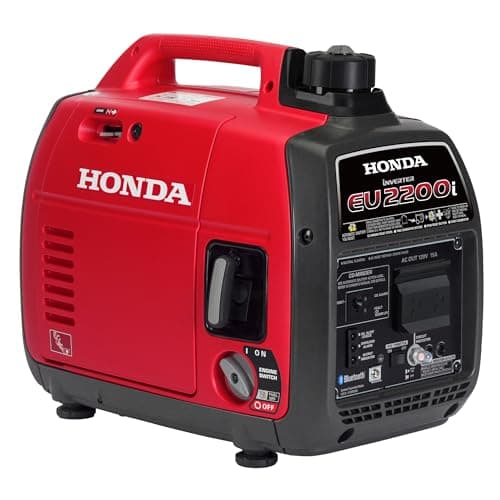
Honda EU2200i

2,200W at a published 48–57 dB(A) and 47.4 lb — the quietest machine on this site.

Campgrounds with generator rules, and light sleepers
2
No photo

Best inverter for a house

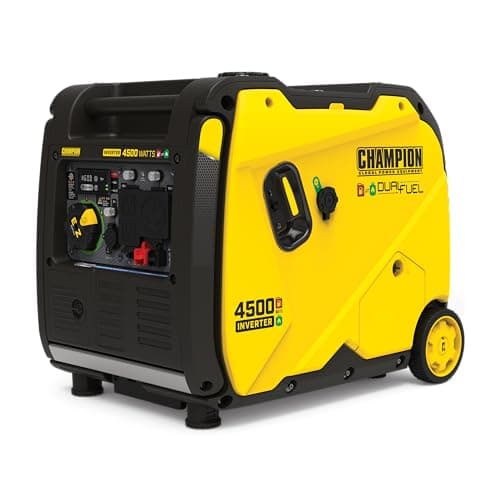
Champion 200988 4500W dual fuel inverter

4,500 starting watts of dual-fuel inverter power — the only pick here that does both.

Home backup where noise still matters
3
No photo

Most watts per dollar in an inverter

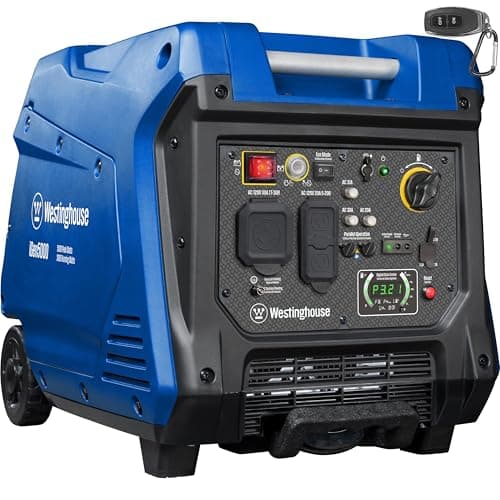
Westinghouse iGen4500

3,700 running watts of pure sine power, with a telescoping handle and wheels.

Sensitive electronics with a bigger load

Prices come from the retailer at page-build time and change constantly. Where no live price is available the button reads “Check price” rather than showing a number we cannot stand behind.

What an inverter generator actually does differently

A conventional generator holds its engine at a fixed 3,600 rpm because that is what produces 60 Hz at the alternator. It runs at 3,600 rpm powering a whole house, and it runs at 3,600 rpm powering a single lamp.

An inverter generator does something else entirely. It generates AC, rectifies it to DC, and then electronically synthesizes a clean 60 Hz sine wave from that DC. Because the frequency no longer depends on engine speed, the engine is free to throttle to the load.

Two consequences follow, and they are the whole product:

  • It is much quieter at partial load, which is nearly all the time.
  • It burns much less fuel at partial load, for exactly the same reason.

A third follows from the electronics: the output waveform is a genuine sine wave rather than a rough approximation, which matters for computers and anything with a sensitive switching power supply.

What it does not buy you

Capacity. An inverter generator costs roughly twice per watt, and the watts themselves are no better than a conventional machine's. If your requirement is 7,500 running watts, an inverter is an expensive way to get there and the money is better spent on a conventional machine with a bigger engine.

This is the mistake to avoid. Inverter technology is a solution to noise and to waveform quality, not to output. Buy it because you have a noise problem, not because it sounds like the better technology.

The noise arithmetic

Decibels are logarithmic, so the difference is larger than it reads. Each 10 dB is roughly a doubling of perceived loudness.

SourceApproximate levelIn practice
Honda EU2200i48–57 dB(A)Quieter than conversation at the low end
Normal conversation~60 dBReference point
Conventional open-frame generator~68–72 dBRoughly twice as loud as conversation
Gasoline lawnmower~90 dBHearing protection territory

The Honda figure is the manufacturer's published range, measured at a stated distance and load. The other rows are conventional reference levels for scale — we have not measured any of these, and a manufacturer's dB figure is measured under its own test conditions rather than in your yard.

The practical version: a conventional generator running overnight is audible inside a neighbor's house with the windows shut. An enclosed inverter at partial load usually is not. After a regional outage when everyone on the street is running one, that difference determines whether anybody sleeps.

The fuel advantage nobody mentions

The noise benefit gets all the attention and the fuel benefit is worth as much over a long outage. Because the engine throttles to the load, an inverter at light load consumes dramatically less than a conventional machine doing the same work.

What it costs to actually run

The sticker price of a dual-fuel generator is a fraction of what it costs you. The sticker price of a battery is nearly all of it. Here is the arithmetic, with the inputs stated so you can redo it with your own fuel price.

UnitPublished consumptionCost per hourCost per 24 h
Conventional 5,300W, light load~0.55 gal/hr (engine still at 3,600 rpm)$2.24$53.74
Inverter 4,500W, light load~0.25 gal/hr (engine throttled back)$1.02$24.43
Honda EU2200i, Eco Throttle0.95 gal over 8.1 h = 0.117 gal/hr$0.48$11.44
Gasoline at $4.071/gal (EIA weekly retail, U.S. average, week ending 31 August 2026). The Honda row is computed directly from its published 0.95-gallon tank and 8.1-hour run time. The other two rows are working estimates for machines of that size at light load, because manufacturers rarely publish consumption at a stated fraction of rated output — check your own manual, which does.

Over three days, the difference between a conventional machine and an inverter at light load is roughly ninety dollars and, more importantly, about twenty gallons of fuel you do not have to find, carry and store.

When to buy conventional instead

Be honest about the constraint. Buy conventional when you need more than about 5,000 running watts, when the machine will run at or near full load anyway (where the inverter's throttling advantage disappears), or when you have distance between you and your neighbors and simply want the most capacity per dollar.

The full comparison works through the decision properly, and the outage roundup includes both kinds sized against a real critical load.
The picks in full

01Quietest, and the one that holds its value

Honda EU2200i

2,200W at a published 48–57 dB(A) and 47.4 lb — the quietest machine on this site.

48–57 dB(A) is the number that justifies the price. Every 10 dB is roughly a doubling of perceived loudness, so against a conventional open-frame machine near 70 dB this is not a marginal difference — it is the difference between conversation and shouting.

2,200W maximum and 1,800W rated is genuinely limiting for home backup: it will run a fridge, or a furnace fan, but the pair starting together exceeds it. Where it excels is camping, an RV without air conditioning, and any situation with a generator noise rule.

8.1 hours on 0.95 gallons is remarkable economy, and Eco Throttle is why — the engine speed tracks the load. Honda's resale market is the other unstated feature: these hold value in a way no other generator does.

Skip it ifyou need to run a house. 1,800W rated will not start a fridge and a furnace fan together, and it is the most expensive watt here.

Published specifications for the Honda EU2200i
SpecificationPublished figure
Output2,200 W max / 1,800 W rated
TypeInverter (pure sine wave)
Noise48–57 dB(A)
Weight47.4 lb
Tank0.95 gal
Run timeup to 8.1 h on a full tank
FeaturesEco Throttle, CO-Minder, Bluetooth app monitoring

Source: Honda Power Equipment — EU2200i specifications. These are the manufacturer's published figures, not ours — we have not tested this unit.

02Best inverter for a house

Champion 200988 4500W dual fuel inverter

4,500 starting watts of dual-fuel inverter power — the only pick here that does both.

This is the inverter that is actually sized for a house. 3,500 running watts covers a fridge, a furnace fan and lighting, and the dual-fuel capability means it still runs when gas station pumps have no power.

Inverter plus dual fuel in one machine is an uncommon combination and the reason to choose this over the Honda for home use — you keep the noise and fuel-economy benefits without giving up propane availability.

Electric start and an RV-ready TT-30R outlet. Champion's three-year warranty with free lifetime technical support is unusually generous for the category.

Skip it ifyou need to be genuinely quiet at close range. An open-frame inverter is quieter than a conventional machine, not as quiet as an enclosed one.

Published specifications for the Champion 200988 4500W dual fuel inverter
SpecificationPublished figure
Output4,500 starting W / 3,500 running W (gasoline)
TypeInverter, RV ready
FuelGasoline or propane (dual fuel)
StartingElectric start
RV outlet120 V TT-30R, 30 A
Warranty3-year limited with free lifetime technical support

Source: Champion Power Equipment — 4500-watt dual fuel inverter specifications. These are the manufacturer's published figures, not ours — we have not tested this unit.

03Most watts per dollar in an inverter

Westinghouse iGen4500

3,700 running watts of pure sine power, with a telescoping handle and wheels.

3,700 running watts and 4,500 peak is the most inverter capacity per dollar here, and the handling design is genuinely considered: a telescoping handle and wheels mean one person repositions it without lifting anything.

Remote electric start with auto choke, an RV-ready TT-30R outlet, and parallel capability with a second unit if you later need more.

Pure sine wave output is the reason to buy an inverter for a home office specifically — a conventional generator's rougher waveform is fine for a heater and less ideal for a computer power supply.

Skip it ifyou want propane capability. This is the gasoline model — the DF variant adds it.

Published specifications for the Westinghouse iGen4500
SpecificationPublished figure
Output (gasoline)3,700 running W / 4,500 peak W
TypeInverter (pure sine wave)
StartingRemote electric start with auto choke
RV outlet120 V TT-30R, 30 A
ParallelCapable with a second unit

Source: Westinghouse — iGen4500 product specifications. These are the manufacturer's published figures, not ours — we have not tested this unit.

How these were chosen

We did not test these. Nobody at Watt & Warden has plugged one in. What we did instead: read the manufacturer's published specifications, compile them into a table where the figures line up, and compute the numbers manufacturers leave out — runtime against a real appliance load, and what an hour of running actually costs.

Anything that could not be sourced was left out rather than estimated, and every pick names the buyer who should skip it. The full method is here, including where it is weaker than a publisher with a test bench.

Questions people actually ask

Are inverter generators worth the extra money?

If noise matters or you are powering sensitive electronics, yes. If you need maximum watts per dollar and have space between you and your neighbors, no -- inverter technology solves noise and waveform quality, not capacity, and it costs roughly twice per watt.

How quiet is an inverter generator really?

Honda publishes 48-57 dB(A) for the EU2200i at a stated distance and load, against roughly 68-72 dB for a comparable conventional open-frame machine. Because decibels are logarithmic, that is close to half the perceived loudness -- the difference between audible inside a neighbor's closed house and not.

Can an inverter generator run a house?

A sufficiently large one can. A 3,500-4,500 running watt inverter covers a fridge, a furnace fan, a sump pump and lights. Beyond that, inverter models get expensive quickly and a conventional machine is the better buy.

Do I need pure sine wave power?

For computers, medical equipment and anything with an active-PFC power supply, yes. For heaters, lights and motors it makes no practical difference. Every inverter generator produces pure sine; conventional machines produce a rougher approximation.

Sources

Every figure on this page comes from a published source. We have not tested this equipment, so the specifications are the manufacturer's and the statistics are the dataset's — the arithmetic on top of them is ours, and it is shown in full so you can check it. How we work this out.