Skip to content
Watt Warden

Sizing

What Size Generator Do I Need for My House?

Four steps and about fifteen minutes. The whole method fits on one screen, and the two mistakes that inflate the answer are both easy to avoid.

By Sawyer V.Updated Published How we work this out
A notebook with calculations and a pen on a desk.

Watt & Warden earns a commission on qualifying purchases made through links on this page, at no extra cost to you. It never changes a ranking, and our picks include products we tell you to skip. Full disclosure.

The four steps

Step 1 — write the list, and keep it short

Not everything in the house. The things that genuinely must keep running. For most households that is four or five items:

  • Refrigerator, or refrigerator and freezer
  • Furnace fan, if you heat with gas or oil in a cold climate
  • Sump pump, if you have a basement
  • Well pump, if you are not on municipal water
  • Lighting and a router

Everything else — the television, the dishwasher, the oven — is a preference, not a requirement, and it belongs in a second list you power only when the first list is off.

Step 2 — find each item's running and starting watts

Two sources, in order of authority. First, the nameplate on your own appliance — a sticker inside the door, on the back, or on the motor, giving volts and amps. Watts = volts × amps, and that figure beats any chart.

Second, when there is no accessible nameplate, the published wattage chart, which carries Champion Power Equipment's and Honda's figures for everything in a normal house.

Step 3 — add the running watts

Straight addition of everything on list one. This is the number that decides whether the machine can carry your house continuously.

Step 4 — add the largest single surge

This is the step people get wrong. Take the item with the largest starting-watts figure, subtract its running watts from your total, and add its starting watts instead.

Peak = total running watts − (biggest item's running watts) + (biggest item's starting watts)

You do not add every appliance's surge. Motors almost never start at the same instant, and summing all the surges produces a number two or three times larger than the house needs — which is exactly how people end up with a machine they cannot lift and cannot fuel.

Three worked examples

A: apartment or small house, no basement

  • Refrigerator — 400W running, 1,200W starting
  • Six LED bulbs — 90W
  • Router and modem — 20W
  • Laptop and monitor — 100W

Running total 610W. Largest surge is the fridge at 1,200W. Peak = 610 − 400 + 1,200 = 1,410W.

This household should not buy a generator. A 1,152Wh battery with an 1,800W inverter covers it silently, indoors, with no fuel — see the power station picks.

B: family house with a basement and gas heat

  • Refrigerator — 400W running, 1,200W starting
  • Furnace fan, ½ HP — 800W running, 1,600W starting
  • Sump pump, ⅓ HP — 800W running, 1,600W starting
  • Lighting and electronics — 150W

Running total 2,150W. Largest surge 1,600W (furnace fan or sump pump). Peak = 2,150 − 800 + 1,600 = 2,950W.

A 3,500W generator covers this. A 5,300W machine gives comfortable headroom for a microwave on top — see generators under $1,000.

C: rural house on a well, with summer cooling

  • Refrigerator — 400W running, 1,200W starting
  • Well pump, 1 HP — 2,000W running, 4,000W starting
  • Window AC, 10,000 BTU — 1,200W running, 2,400W starting
  • Furnace fan, ½ HP — 800W running, 1,600W starting
  • Lighting and electronics — 150W

Running total 4,550W. Largest surge 4,000W (well pump). Peak = 4,550 − 2,000 + 4,000 = 6,550W.

This needs 7,500W or more — see the larger machines. The well pump is doing most of the damage, which is worth knowing: sequencing the pump away from everything else meaningfully reduces the requirement.

The two mistakes that inflate the answer

Adding every starting surge. This is the big one and it typically doubles the answer. Example C summing all four surges gives 9,200W instead of 6,550W — a machine two sizes larger, considerably heavier, and burning more fuel every hour to do identical work.

Sizing for everything at once. In a real outage you do not run the well pump, the air conditioner, the furnace and the microwave simultaneously. Deciding in advance what shares the machine — load shedding — is free capacity. Example C run as “well pump or air conditioning, never both” drops from 6,550W to about 4,150W, which is a different and much cheaper machine.

Then check the duration

The wattage number tells you how big. It does not tell you what kind — and that is decided by how long your power is off, not by watts.

A 2,000W requirement for four hours is a battery. The same 2,000W requirement for three days is a generator. Same number, completely different purchase. The duration page settles that half, and it is the half almost every other sizing guide skips.

What about the 240V question?

Most household circuits are 120V. A few large loads are 240V: an electric range, an electric water heater, a well pump, central air conditioning, an electric dryer.

If anything on your list is 240V, the generator must supply 240V — look for an L14-30R or 14-50R outlet and a 120/240V selector switch. And the appliance must be fed through a transfer switch or an interlock kit, because 240V loads are hard-wired and no extension cord reaches them.

Note also that a machine's rated watts may be split across its two 120V legs, so a 5,000W generator does not necessarily deliver 5,000W to one 120V circuit. The watt meters on a transfer switch exist precisely so you can balance the load rather than guess.

Quick picks

#ProductBest forPrice
1
No photo

Covers most houses' computed number

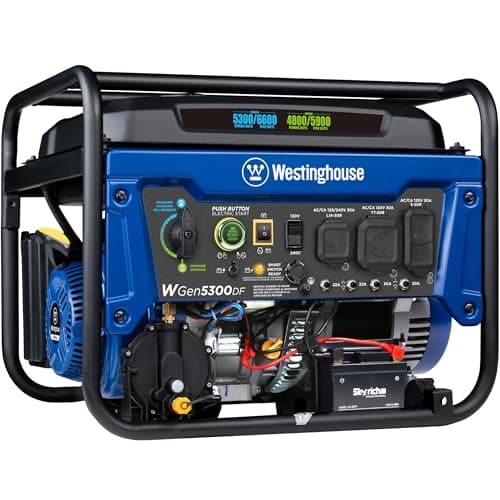
Westinghouse WGen5300DF

5,300 running watts, dual fuel, transfer-switch ready — where most of these calculations land.

A peak requirement between 3,000W and 5,300W
2
No photo

When a well pump is on the list

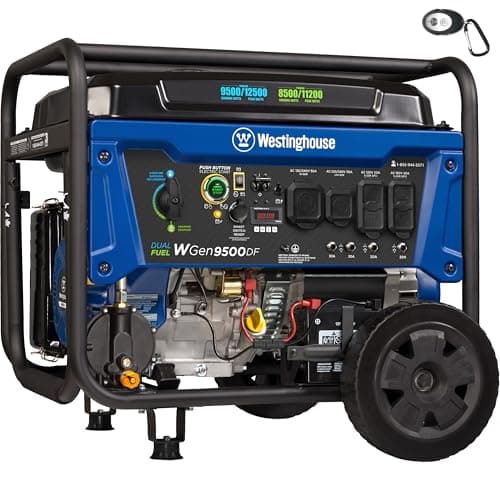
Westinghouse WGen9500DF

9,500 running watts and a 50A outlet — where a one-horsepower well pump pushes you.

A peak requirement between 5,500W and 9,500W
3
No photo

When the answer is not a generator

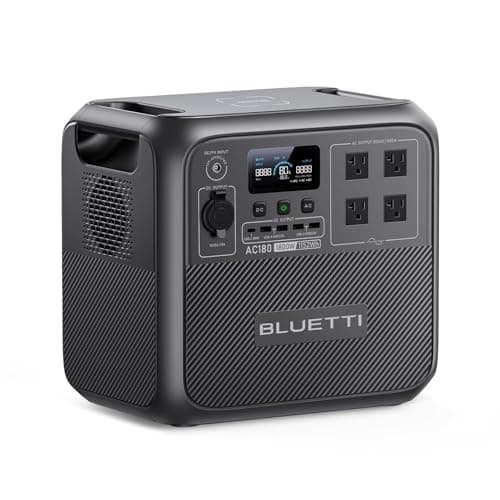
BLUETTI AC180

1,152Wh and 1,800W — silent, indoor-safe, and enough if your list is small.

A peak under 1,800W and a short outage

Prices come from the retailer at page-build time and change constantly. Where no live price is available the button reads “Check price” rather than showing a number we cannot stand behind.

The picks in full

01Covers most houses' computed number

Westinghouse WGen5300DF

5,300 running watts, dual fuel, transfer-switch ready — where most of these calculations land.

Most households doing this calculation honestly — fridge, furnace fan, sump pump, lights, without central air conditioning — land between 3,000W and 4,500W peak. This covers that with genuine margin rather than marketing margin.

Skip it ifyour number came out over 5,300W. Buying below your computed peak is the one mistake that leaves you with a machine that trips.

Published specifications for the Westinghouse WGen5300DF
SpecificationPublished figure
Output (gasoline)5,300 running W / 6,600 peak W
Output (propane)4,800 running W / 5,900 peak W
Engine274cc 4-stroke OHV
Tank4.7 gal (18 L)
Run timeup to 14.5 h on a full tank
Transfer-switch outlet120/240 V L14-30R, 30 A
RV outlet120 V TT-30R, 30 A
StartingPush-button electric with remote key fob

Source: Westinghouse — WGen5300DF product specifications. These are the manufacturer's published figures, not ours — we have not tested this unit.

02When a well pump is on the list

Westinghouse WGen9500DF

9,500 running watts and a 50A outlet — where a one-horsepower well pump pushes you.

A one-horsepower well pump at 2,000W running and up to 4,000W starting is what most commonly pushes a house past the 5,300W machine. If your calculation includes one, this is the tier.

Skip it ifyour computed peak is under 5,000W. A larger engine burns more fuel to do the same work.

Published specifications for the Westinghouse WGen9500DF
SpecificationPublished figure
Output (gasoline)9,500 running W / 12,500 peak W
FuelGasoline or propane (dual fuel)
Engine457cc 4-stroke OHV, cast iron sleeve
Tank6.6 gal (25 L)
Run timeup to 12 h on a full tank
Transfer-switch outlet120/240 V L14-30R, 30 A
RV outlet120/240 V 14-50R, 50 A
StartingPush-button electric with remote key fob
Warranty3-year limited

Source: Westinghouse — WGen9500DF product specifications. These are the manufacturer's published figures, not ours — we have not tested this unit.

03When the answer is not a generator

BLUETTI AC180

1,152Wh and 1,800W — silent, indoor-safe, and enough if your list is small.

If your computed peak comes in under 1,800W and your outages are short, the sizing exercise has told you not to buy a generator at all. That is a legitimate outcome and it is often the right one.

Skip it ifyour outage runs past about eight hours. Capacity, not output, becomes the constraint.

Published specifications for the BLUETTI AC180
SpecificationPublished figure
Usable capacity1,152 Wh (32 V, 36 Ah)
Cell chemistryLiFePO4 (LFP)
AC output1,800 W continuous / 2,700 W surge, 4 outlets
Cycle life3,500+ cycles to 80% capacity
Weight35.3 lb
Fast charge0–80% in 45 min
Max solar input500 W
Warranty5 years on registration

Source: BLUETTI — AC180 product specifications. These are the manufacturer's published figures, not ours — we have not tested this unit.

How these were chosen

We did not test these. Nobody at Watt & Warden has plugged one in. What we did instead: read the manufacturer's published specifications, compile them into a table where the figures line up, and compute the numbers manufacturers leave out — runtime against a real appliance load, and what an hour of running actually costs.

Anything that could not be sourced was left out rather than estimated, and every pick names the buyer who should skip it. The full method is here, including where it is weaker than a publisher with a test bench.

Questions people actually ask

What size generator do I need to run a house?

Add the running watts of everything that must stay on, then add only the largest single starting surge. For a typical house with a fridge, a furnace fan, a sump pump and lights, that comes to about 3,000W peak -- so a 3,500 to 5,300 running watt machine covers it. Add a well pump and it rises to 6,000-7,000W.

How many watts do I need for a whole house generator?

Whole-house coverage including central air conditioning generally starts around 10,000 running watts and rises from there, because a three-ton central AC compressor alone needs 5,000-6,000W just to start. At that point a standby installation is usually the more sensible route than a very large portable.

Should I add starting watts for every appliance?

No, and this is the single most common sizing error. Add all the running watts, then only the largest individual starting surge. Summing every surge typically doubles the answer and sends people home with a machine two sizes too large.

Is it bad to buy a generator that is too big?

It costs you three ways: more money, more weight, and more fuel per hour to do identical work, because a large engine at light load is running inefficiently. Size to your computed number with sensible margin, not to the worst case you can imagine.

Sources

Every figure on this page comes from a published source. We have not tested this equipment, so the specifications are the manufacturer's and the statistics are the dataset's — the arithmetic on top of them is ours, and it is shown in full so you can check it. How we work this out.