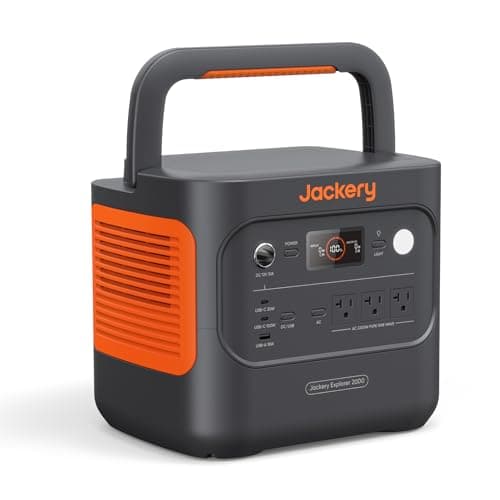
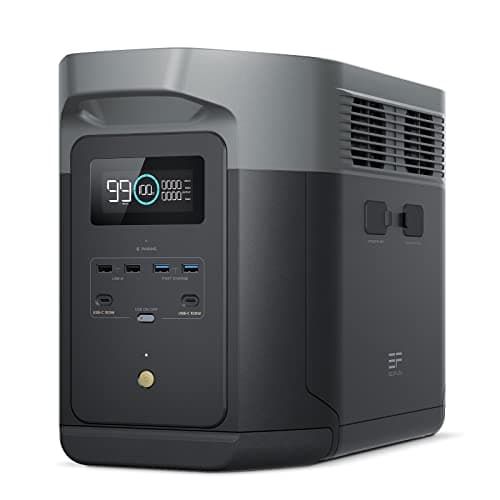
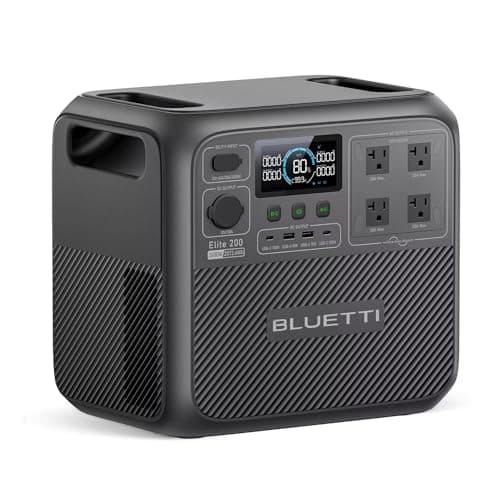
What two kilowatt-hours actually covers
This is the tier where a battery stops being a device charger and starts being backup power for a house. Some honest arithmetic:
| Load | Draw | How long 2,000Wh lasts |
|---|
| Refrigerator alone | ~150 W average | Well over a day |
|---|
| Fridge and freezer | ~250 W average | About 7 hours continuous, longer in blocks |
|---|
| Router, modem, phones, lights | ~50 W | Days |
|---|
| Gas furnace blower (½ HP) | 300–800 W | 2 to 6 hours |
|---|
| Electric space heater | 750–1,500 W | Under 90 minutes at full |
|---|
| Central air conditioning | 2,000 W+ | Not viable |
|---|
Furnace fan and space heater figures are Champion Power Equipment's published ranges. The 150W average fridge draw is this site's stated planning assumption, listed on the methodology page along with the 85% inverter efficiency we apply. Runtimes are calculated from those inputs, not measured.
The pattern is clear: 2kWh is generous for refrigeration and communications, adequate for a furnace blower overnight, and simply the wrong tool for anything that makes heat or cold with electricity directly.
Match the purchase to the outage
Capacity is not a preference. It falls out of two numbers: how long your power is usually off, and what you refuse to lose while it is.
The jump people get wrong is the last one. Capacity alone does not solve a multi-day outage at any battery size that exists in this format — what solves it is a recharge path, whether that is panels or an engine.
Surge capability, not capacity, decides what starts
Capacity tells you how long. Continuous and surge output tell you what will run at all, and it is the second that fails people.
A motor draws several times its running wattage for a fraction of a second at startup. Champion publishes 500–1,000 starting watts for a freezer and 800–1,600 for a half-horsepower furnace fan. If two of those call at once, a 1,800W inverter can trip where a 2,400W or 2,600W one does not.
Which is the practical reason to move up a tier: not more hours, but more things that will actually start.
LiFePO4 is the only sensible chemistry here
At this size and price, cycle life and calendar life dominate. LiFePO4 cells are rated in thousands of cycles rather than hundreds, tolerate heat far better, and are the reason ten-year design lives are now quoted at all.
A backup battery spends most of its life sitting charged. That makes calendar degradation the thing to buy against, and it is why every pick on this page uses the same chemistry. The chemistry comparison covers the trade in full.
What to check before you buy at this tier
- Continuous output in watts, and the surge figure separately. This decides what starts.
- Maximum solar input, in watts and volts. It caps how fast you can refill and therefore whether multi-day coverage is possible.
- AC recharge time. The difference between 43 minutes and six hours is the difference between using a brief restoration and missing it.
- Expansion. Cheaper to add a pack later than to buy twice.
- Weight. These are 50 lb and up. Decide now where it lives and whether it needs to move.
- UPS pass-through, if you want it. Some units switch fast enough to keep a desktop alive; most do not claim to.
Where this tier stops
Two kilowatt-hours is a night, not a week. For a multi-day outage you need either solar input to refill it daily or a generator running outdoors in blocks while the battery carries the house indoors.
That hybrid is the arrangement we would actually recommend for most households with long outages — it is quieter, uses a quarter of the fuel, and the generator never has to run at night. Generator versus power station makes the case properly.