Skip to content
Watt Warden

Home Standby

The Best Home Battery Backup Systems (2026)

A battery becomes a system at the point it can talk to your electrical panel. Everything below that line is a very large extension cord with a screen on it.

By Sawyer V.Updated Published How we work this out
A modern suburban home at dusk with exterior lights on.

Watt & Warden earns a commission on qualifying purchases made through links on this page, at no extra cost to you. It never changes a ranking, and our picks include products we tell you to skip. Full disclosure.

Quick picks

#ProductBest forPrice
1
No photo

Best overall

Anker SOLIX F3800

3,840Wh of LiFePO4 with genuine 120/240V split-phase output and 6,000W continuous.

Feeding a panel rather than a power strip
2
No photo

Best recharge behavior

EcoFlow DELTA Pro 3

4,096Wh at 120/240V with 0-80% in about an hour and 2,600W of solar input.

Somewhere the power returns in short windows
3
No photo

Best entry point

EcoFlow DELTA 2 Max

2,048Wh and 2,400W — enough for the fridge, the freezer and the network for a long outage.

Critical circuits only, on 120V
4
No photo

Best value at 2,000Wh

Jackery Explorer 2000 v2

2,042Wh with a 2,200W inverter and LiFePO4 cells.

The same critical-load list, for less
5
No photo

The part people forget to budget

Reliance Controls 31410CRK Pro/Tran

A 10-circuit manual transfer switch — the thing that makes a 240V battery useful.

Getting battery power to hardwired circuits

Prices come from the retailer at page-build time and change constantly. Where no live price is available the button reads “Check price” rather than showing a number we cannot stand behind.

What makes it a system rather than a battery

The marketing uses "home battery backup system" for everything from a 500Wh box upwards. One specification actually divides the category.

120V only. The unit has household outlets. Whatever you want backed up must have a plug and must be within reach of a cord. That covers a refrigerator, a freezer, the network and lighting, and it covers nothing that is hardwired.

120V/240V split-phase. The unit can supply both legs of a residential service, which means it can feed a transfer switch and therefore reach the well pump, the water heater, the furnace and the sump pump.

Everything else — capacity, app, chemistry, brand — sits downstream of that one distinction, and the price step across it is large.

TierReachesElectrical work
2,000Wh, 120VFridge, freezer, network, lighting, devicesNone — extension cords
3,800-4,100Wh, 240V split-phaseAll of the above plus well pump, furnace, sump pumpTransfer switch and an inlet, installed
Expanded, 8-27kWhMulti-day critical loadsThe same, plus space and weight planning
Installed home batteryWhole panel, automatic changeoverA quoted installation project

How long these actually last

Using 85% inverter efficiency, the figure this site uses throughout and documents on the methodology page.

LoadAverage drawFrom 3,840 Wh
Fridge, freezer, network, lighting300 WAbout 10.9 hours
The same, plus a furnace fan cycling450 W averageAbout 7.3 hours
Critical loads only, aggressively shed150 WAbout 21.8 hours
Well pump duty on a normal householdIntermittent, high surgeAdds little energy, needs the surge headroom

Rows are capacity x 0.85 / load. The well pump row is deliberately not a number: pumps draw heavily and briefly, so they cost surge capability rather than watt-hours.

The pattern worth noticing is that a day is achievable and a weekend is not, unless there is solar behind the battery or the outage has restoration windows in it.

Battery or standby generator?

This is the real decision and the answer depends on how long your outages run rather than on which technology you prefer.

A battery wins when outages are hours, when the house is in a place where a running engine is a problem, when there is solar to refill it, and when silence and zero maintenance are worth paying for.

A standby generator wins when outages run for days, because a fuel line has no capacity limit and a battery does. It also starts itself while you are away, which no plug-in battery does.

The direct comparison works through the whole trade, and the whole-house generator page covers what to ask before taking quotes on the other side of it.

What the installation actually involves

For a 240V unit feeding critical circuits, three things, in this order.

1. A transfer switch. Sized to the battery's output, wired to the circuits you chose. This is what makes backfeeding mechanically impossible.

2. An inlet. A weatherproof connection point so the battery is not tethered through a window. The inlet box explainer covers the ratings that matter.

3. A permit and an inspection in most jurisdictions. This is not optional and it is not the place to save money.

Budget for that work as part of the purchase rather than as a surprise afterwards. The installation cost page sets out the ranges.

The short version

  • 240V split-phase or it is not a system. That one line divides the category.
  • Budget the switch with the battery. A 240V unit with no way into the panel is a 120V unit.
  • Plan for a day, not a weekend. Unless solar is part of the plan.
  • Expandable beats big if you are unsure, because capacity is the specification people misjudge.

The picks in full

01Best overall

Anker SOLIX F3800

3,840Wh of LiFePO4 with genuine 120/240V split-phase output and 6,000W continuous.

Split-phase 240V is the specification that turns a battery into a backup system. It is what lets a unit feed a transfer switch and therefore reach the well pump, the water heater and the furnace — circuits no cord will ever reach.

6,000W continuous with 9,000W of surge covers a well pump start, which is the load that defeats almost everything else portable.

Expansion to 26.9kWh across six additional batteries is the part that makes this a system rather than a purchase: capacity becomes something you add to rather than something you got wrong.

The honest catch: connecting it to a panel is an electrician's job, permit included, and that cost is real. Used as a plug-in battery it is enormous overkill.

Skip it ifnothing you need to back up runs at 240V. You are paying for a capability you will not use.
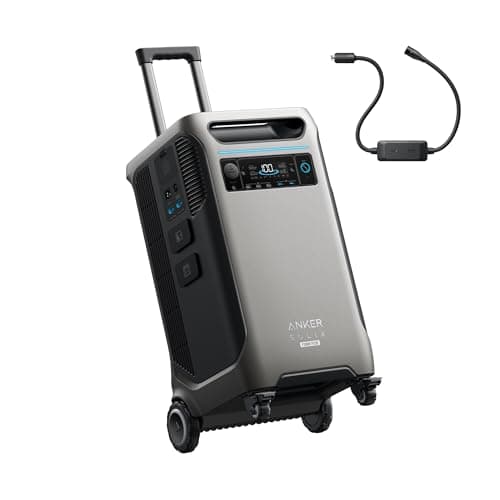
Published specifications for the Anker SOLIX F3800
SpecificationPublished figure
Capacity3,840 Wh
Cell chemistryLiFePO4
AC output6,000 W continuous, 9,000 W surge
Voltage120V / 240V split-phase
Cycle life3,000+ cycles to 80% capacity
Recharge1,800 W AC, up to 2,400 W solar
ExpansionUp to six expansion batteries, 26.9 kWh total
Warranty5 years

Source: Anker SOLIX — F3800 product specifications. These are the manufacturer's published figures, not ours — we have not tested this unit.

02Best recharge behavior

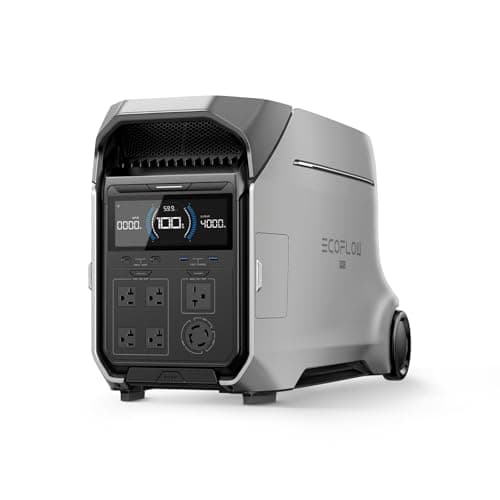
EcoFlow DELTA Pro 3

4,096Wh at 120/240V with 0-80% in about an hour and 2,600W of solar input.

Capacity is slightly higher than the pick above and the meaningful difference is how fast it comes back. 0-80% in about an hour means a brief restoration mid-outage genuinely refills the battery.

2,600W of solar input is the other half of that. A battery this size with a real array behind it stops being a fixed store of energy and starts being a daily budget — the solar sizing page covers what an array of that size actually returns.

The honest catch: it publishes 4,000+ cycles to 80% against a 5-year warranty, where the Anker carries the same 5 years over fewer rated cycles. Read both numbers, not one.

Skip it ifyou have no solar and stable restoration. Then recharge speed is worth less.

Published specifications for the EcoFlow DELTA Pro 3
SpecificationPublished figure
Capacity4,096 Wh
Cell chemistryLiFePO4 (LFP)
AC output4,000 W, 120V / 240V
Cycle life4,000+ cycles to 80% capacity
Wall recharge0-80% in about 1 hour
Max solar input2,600 W
Expansion4 kWh to 48 kWh

Source: EcoFlow — DELTA Pro 3 product listing. These are the manufacturer's published figures, not ours — we have not tested this unit.

03Best entry point

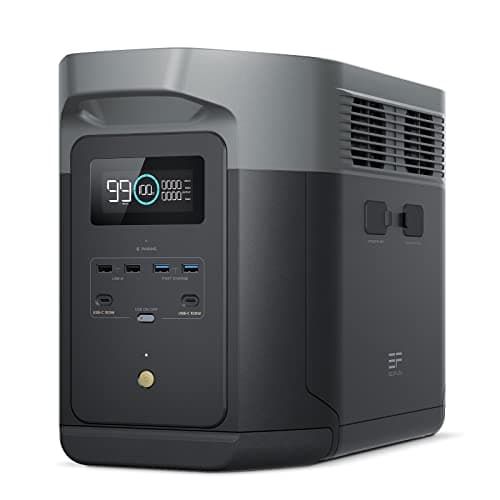
EcoFlow DELTA 2 Max

2,048Wh and 2,400W — enough for the fridge, the freezer and the network for a long outage.

Most households that say "home battery backup" mean the refrigerator, the freezer, the internet and some lighting. That list is about 300W averaged, and 2,048Wh carries it for the better part of a day without any electrical work at all.

Buying at this level and finding out what you actually miss during a real outage is a defensible strategy, and a much cheaper mistake than the reverse.

The honest catch: it is 120V only. No amount of capacity here reaches a hardwired 240V circuit.

Skip it ifthe well pump or the furnace is on your list. Those are 240V problems.

Published specifications for the EcoFlow DELTA 2 Max
SpecificationPublished figure
Capacity2,048 Wh, expandable to 6,144 Wh
Output2,400 W continuous
ChemistryLiFePO4, 3,000+ cycles to 80%
AC recharge0–80% in 43 minutes
Solar inputup to 1,000 W
Outlets15 total
Noiseas low as 30 dB

Source: EcoFlow — DELTA 2 Max published specifications. These are the manufacturer's published figures, not ours — we have not tested this unit.

04Best value at 2,000Wh

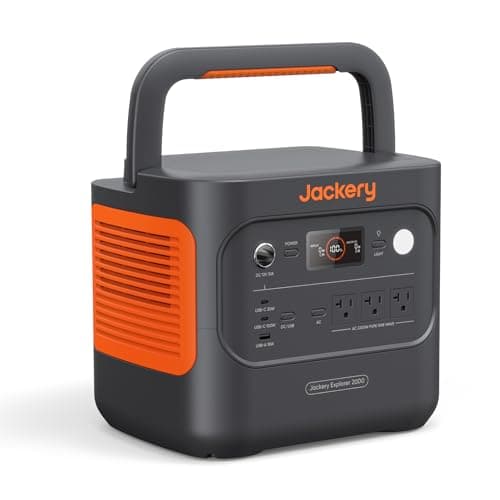
Jackery Explorer 2000 v2

2,042Wh with a 2,200W inverter and LiFePO4 cells.

The honest observation about the 2,000Wh band is that the units in it are close to interchangeable for this job. Capacity, inverter watts and chemistry are all within a few percent.

What differs is recharge speed, app quality and whether the platform expands. If none of those matter to you, buy on price.

The honest catch: a fixed 2,000Wh unit is a ceiling. When the next outage is longer than this one, your only move is to buy a second machine.

Skip it ifyou want to expand later. Buy into a system if that is the plan.

Published specifications for the Jackery Explorer 2000 v2
SpecificationPublished figure
Usable capacity2,042 Wh
Cell chemistryLiFePO4 (LFP)
AC output2,200 W continuous
UPS switchover20 ms
Weight39.5 lb
Charge time0–80% in 66 min; full in 102 min (emergency mode)
Charging noiseunder 30 dB in silent charging mode

Source: Jackery — Explorer 2000 v2 product specifications. These are the manufacturer's published figures, not ours — we have not tested this unit.

05The part people forget to budget

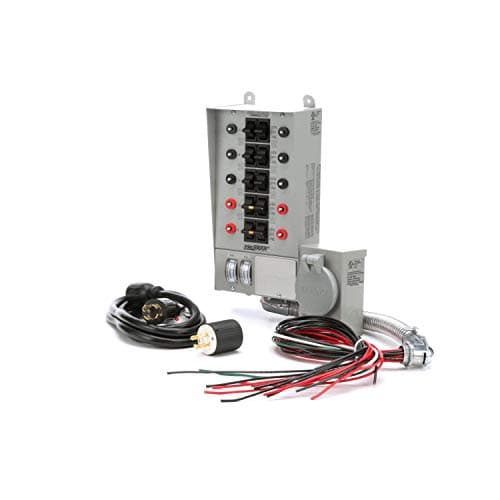
Reliance Controls 31410CRK Pro/Tran

A 10-circuit manual transfer switch — the thing that makes a 240V battery useful.

A 240V battery with no way into the panel powers exactly as much as a 120V one. The switch is not an accessory here, it is half the system.

Break-before-make switching also means the battery can never backfeed the utility line, which is the same safety requirement that applies to a generator. The switch versus interlock comparison covers the two legal ways to do this.

The honest catch: a 30A switch caps what you can draw. Size the switch to the battery, not to what is on the shelf.

Skip it ifyour battery is 120V only. It has nothing to connect to.

Published specifications for the Reliance Controls 31410CRK Pro/Tran
SpecificationPublished figure
Circuits10 — six 15 A and four 20 A single-pole breakers
Rating30 A, up to 7,500 W
MeteringTwo watt meters for balancing the load
SwitchingBreak-before-make double-throw, Line / Off / Gen
BackfeedMechanically prevented — the grid cannot be energized
InstallationLicensed electrician; a permit is usually required

Source: Reliance Controls — Pro/Tran 31410CRK product page. These are the manufacturer's published figures, not ours — we have not tested this unit.

How these were chosen

We did not test these. Nobody at Watt & Warden has plugged one in. What we did instead: read the manufacturer's published specifications, compile them into a table where the figures line up, and compute the numbers manufacturers leave out — runtime against a real appliance load, and what an hour of running actually costs.

Anything that could not be sourced was left out rather than estimated, and every pick names the buyer who should skip it. The full method is here, including where it is weaker than a publisher with a test bench.

Questions people actually ask

What is the best home battery backup system?

For most houses, a 3,800 to 4,100Wh unit with true 120/240V split-phase output, paired with a manual transfer switch. That combination reaches hardwired circuits -- the well pump, furnace and sump pump -- which is what separates a backup system from a large portable battery. Below that, a 2,000Wh 120V unit covers a fridge, freezer and network with no electrical work at all.

Can a home battery run my whole house?

Not for long, and usually not everything at once. A 3,840Wh battery carries a 300W critical-load list for roughly eleven hours. Running the whole panel including air conditioning or electric heat empties any portable battery in well under an hour, which is why backup is built around chosen circuits rather than the whole house.

Do I need an electrician for a battery backup system?

For a 120V unit used with extension cords, no. For anything feeding hardwired circuits, yes -- that needs a transfer switch and an inlet installed, and a permit and inspection in most jurisdictions. That work is what makes backfeeding the utility line mechanically impossible, and it is not a place to economize.

Is a battery better than a standby generator?

It depends on outage length. A battery is silent, needs no fuel or maintenance, and refills from solar -- excellent for outages measured in hours. A standby generator has no capacity limit as long as fuel arrives and starts itself while you are away, which wins once outages run for days.

How long do these batteries last before they need replacing?

The LiFePO4 units here publish 3,000 to 4,000 cycles to 80% capacity, which at any realistic household usage rate is well over a decade. In practice the electronics and the warranty period matter more than the cells -- these carry five years.

Sources

Every figure on this page comes from a published source. We have not tested this equipment, so the specifications are the manufacturer's and the statistics are the dataset's — the arithmetic on top of them is ours, and it is shown in full so you can check it. How we work this out.