Two words, and then everything else makes sense
Almost all the confusion in this category comes from two units that look similar and mean completely different things.
Watts (W) is how much. How much power something uses at any instant, or how much a machine can supply at any instant. A light bulb is 10 watts. A refrigerator is a few hundred. An electric kettle is about 1,500.
Think of it as the width of a pipe. A machine rated at 1,000 watts can supply a 1,000-watt load and will refuse a 1,200-watt one, no matter how much energy it is storing.
Watt-hours (Wh) is how long. How much energy is stored. A 1,000Wh battery supplies 1,000 watts for one hour, or 100 watts for ten hours, or 10 watts for a hundred.
Think of it as the size of the tank. Only batteries have watt-hours; generators do not, because their tank is however much fuel you can supply.
The trap: a large tank with a narrow pipe is useless for big appliances. A 1,000Wh battery with a 300-watt inverter will never run a refrigerator, however much energy it holds — because the fridge needs more than 300 watts to start. Check the watts first, then the watt-hours.
One more idea: starting watts
Anything with a motor — a fridge, a freezer, a furnace fan, a pump — needs a brief burst of extra power to get moving. It lasts a fraction of a second and it is typically two to three times the running draw.
Champion Power Equipment's published chart puts a domestic refrigerator at 150–400 watts running and 800–1,200 watts starting. The starting figure is the one that decides whether a machine can run it at all.
Things without motors — lights, laptops, televisions, phone chargers — have no starting surge, which is why small batteries handle them comfortably.
The three kinds of machine
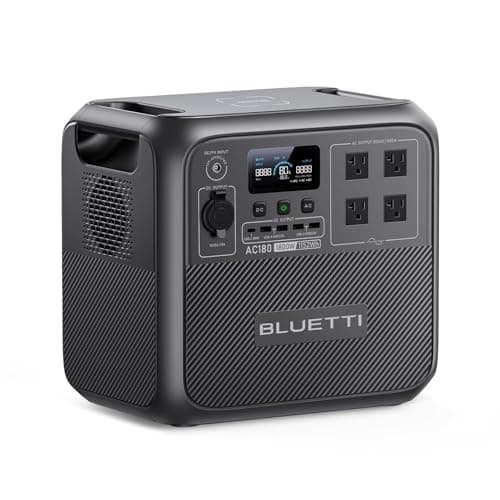
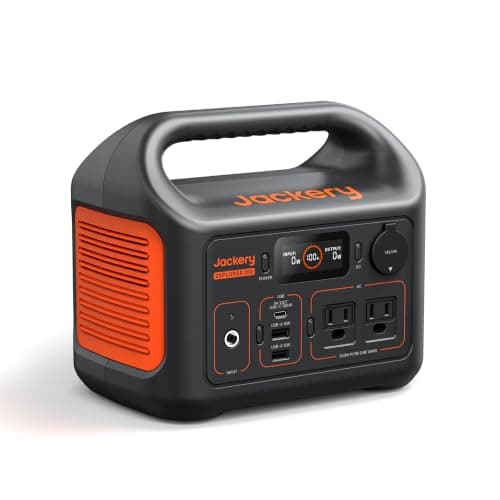
A power station (a big battery)
A battery in a box with outlets on the front. Charge it from the wall, unplug it, and it powers things.
Good: silent, completely safe indoors, no fuel, no maintenance, and it starts every time. Bad: it holds a fixed amount of energy and then it is empty. Expensive per watt-hour.
Buy one if your outages are hours rather than days.
A generator (an engine)
A gasoline or propane engine turning a generator. It runs for as long as you keep feeding it fuel.
Good: effectively unlimited runtime, far more power for the money, big enough to run a whole house. Bad: loud, must run outdoors, needs fuel you have to store, needs oil changes, and it produces carbon monoxide that kills people every year.
Buy one if your outages last a day or more.
A UPS (a small emergency battery)
A small battery that sits between the wall and your equipment and takes over instantly when the power fails. It lasts minutes, not hours.
Good: cheap, automatic, and it keeps a computer or a router from dropping. Bad: minutes of runtime.
Buy one if the internet or a computer is what you actually care about — and for many households that is the honest answer.
How to decide, in three steps
Step 1 — how long is your power off?
This decides the kind of machine, and it is the step nearly everybody skips. The EIA reports an average of eleven hours a year per U.S. customer for 2024, but the spread is enormous: South Carolina averaged nearly 53 hours that year and Arizona under two.
Search your utility's name plus “reliability report” or ask a long-standing neighbor. How to find and read that data.
Step 2 — what must keep running?
Write down four or five things, not twenty. For most households: refrigerator, router, some lights, and — if you have them — a furnace fan and a sump pump.
Find each one's running and starting watts on the wattage chart. Add the running watts. Then add only the biggest single starting figure — not all of them, because motors do not all start at once.
Step 3 — match the two
- Short outages, small list: a 300Wh power station.
- Overnight outages, fridge included: a 1,000–1,200Wh station with an 1,800W inverter.
- Day-long outages: a 2,000Wh station with solar, or a small generator.
- Multi-day outages: a generator, dual fuel.
The five mistakes beginners make
- Buying watt-hours and ignoring watts. The most common and the most frustrating. A big battery with a small inverter will not run the appliance you bought it for.
- Sizing for everything at once. In a real outage you run the fridge and the furnace, then the microwave with the furnace off. Planning that sequence halves the machine you need.
- Buying a generator for a two-hour outage. Fuel storage, maintenance and noise bought for an event that a $200 battery would cover in silence.
- Buying a battery for a three-day outage. It will be empty on the first morning and there is nothing to refill it from.
- Forgetting the connection. Extension cords reach a fridge. They do not reach a furnace, a well pump or a sump pump, which are wired into the panel and need a transfer switch.
Two safety rules, and they are not negotiable
Never run a generator indoors, in a garage, in a shed, on a porch or under a window. Carbon monoxide is colorless and odorless, CPSC records nearly 100 deaths a year from generator CO poisoning, and the early symptoms are indistinguishable from being tired and cold. Twenty feet from the house, exhaust pointed away, and a working CO alarm on every level. Read this before you buy one.
Never plug a generator into a wall outlet to power the house. It sends power back up the utility line at lethal voltage and can kill the person restoring your street. It is illegal essentially everywhere. The safe methods.
What we would tell a friend
Start small. Buy a 300Wh battery, keep it charged, and use it — camping, in the yard, wherever there is no outlet. It will cover the short outages that make up most of what actually happens, and you will learn what you genuinely need from the first real outage rather than from reading about them.
Then buy the second thing on evidence. If your first real outage lasted eight hours and the food was the problem, you know exactly what to buy next. That is a far better basis than a guess made in a shop.