Skip to content
Watt Warden

Power Stations

The Best Portable Power Stations for a Power Outage (2026)

Five batteries, sorted by the outage they actually cover. Every runtime figure here is computed from published capacity against a real appliance load — and every pick names the buyer who should not buy it.

By Sawyer V.Updated Published How we work this out
A single lamp lighting a dark living room during a power outage.

Watt & Warden earns a commission on qualifying purchases made through links on this page, at no extra cost to you. It never changes a ranking, and our picks include products we tell you to skip. Full disclosure.

Quick picks

#ProductBest forPrice
1
No photo

Best overall for outages

BLUETTI AC180

The most capacity-per-dollar in the 1kWh class, with the longest published cycle rating here.

A fridge plus essentials, overnight
2
No photo

Lightest 1kWh unit

Jackery Explorer 1000 v2

1,070Wh at 24 lb, which is 11 lb less than the comparable BLUETTI for 82Wh less capacity.

Anyone who has to carry it
3
No photo

Best if you might need more later

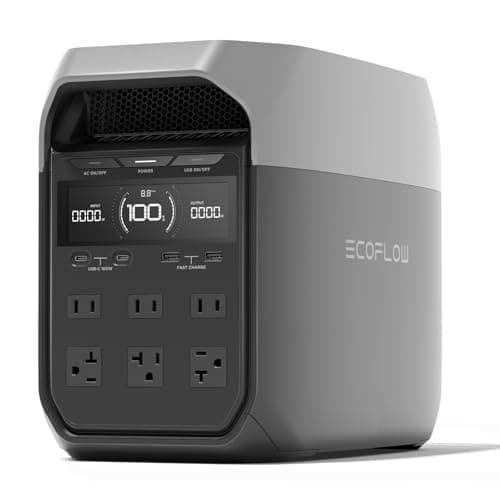
EcoFlow DELTA 2

1,024Wh that expands to 3kWh with add-on batteries — the only unit here that grows.

Households whose outages are getting longer
4
No photo

Fastest refill

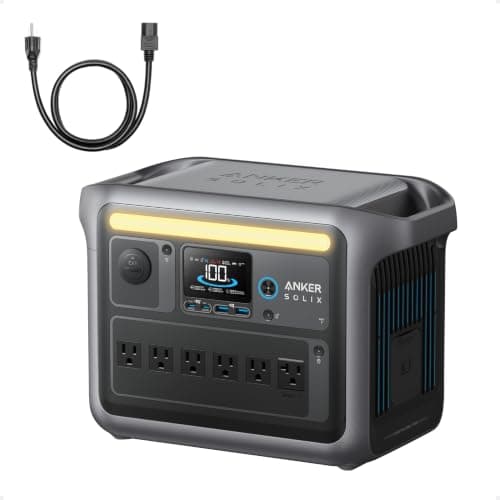
Anker SOLIX C1000

Full in 58 minutes from empty, which changes what the same capacity is worth.

Short, repeated outages
5
No photo

Cheapest one that is still useful

Jackery Explorer 300 Plus

288Wh and 300W: honest about being a communications-and-lights unit rather than an appliance one.

Phones, router, lights — not the fridge

Prices come from the retailer at page-build time and change constantly. Where no live price is available the button reads “Check price” rather than showing a number we cannot stand behind.

Who this page is for

You have had an outage, or you can see one coming, and you want a battery that keeps the important things running without putting an engine outside your house. This page ranks five of them by the length of outage each one actually covers.

The ranking is not a score. We have not tested these — nobody here has plugged one in — so a numerical rating would be an opinion dressed as a measurement. What we have done instead is compile the published specifications so they compare honestly, and compute the two numbers manufacturers leave out: how long each unit runs a real refrigerator, and what its stored energy costs per kilowatt-hour across its rated life.

Start with your outage, not the products

The EIA's Electric Power Annual for 2024 records an average of eleven hours without power per U.S. customer — the most in a decade. But the shape of that number matters more than its size. About two hours came from ordinary faults; nearly nine came from major events, and Hurricanes Beryl, Helene and Milton alone accounted for 80% of all national outage hours that year.

Which means the average household experiences several short interruptions and, occasionally, one long one — and those need different machines. A household in South Carolina, which averaged nearly 53 hours in 2024, is solving a different problem from one in Arizona, which averaged under two.

Match the purchase to the outage

Capacity is not a preference. It falls out of two numbers: how long your power is usually off, and what you refuse to lose while it is.

Your outage lastsWhat has to keep runningRealistic product class
2–6 hoursRouter, phones, a few lamps, the fridge cycling300–600Wh station
See the under-$500 picks
Overnight, 8–14 hoursAbove, plus the fridge staying properly cold and a furnace fan1,000–1,200Wh station with an 1,800W inverter
See the home-backup picks
1–2 daysAbove, plus a sump pump cycling and repeated device charging2,000Wh+ station, or a small generator
See generators under $1,000
3+ daysEverything above, plus a way to refill whatever you boughtDual-fuel generator, or a battery plus solar
See the hurricane-season picks
Duration figures are the U.S. Energy Information Administration's, from the Electric Power Annual for 2024. Your utility publishes your own local reliability data and it is worth more than any national average — how to find and read it.

How long each one runs a refrigerator

This is the calculation everybody wants and almost nobody publishes, because it requires committing to an assumption. Here is ours, stated so you can change it.

Champion's published wattage reference puts a domestic refrigerator at 150–400W running. But a fridge does not run continuously — the compressor cycles, typically somewhere around a third of the time in normal conditions. We use an average draw of 150W, which is a reasonable figure for a modern unit whose door stays shut, and we take 15% off for inverter conversion losses.

So: usable hours = capacity × 0.85 ÷ 150. On that basis the BLUETTI AC180's 1,152Wh gives about 6.5 hours, the Jackery 1000 v2's 1,070Wh about 6.1, the Anker C1000's 1,056Wh about 6.0, and the EcoFlow DELTA 2's 1,024Wh about 5.8. The Jackery 300 Plus does not appear because its inverter cannot start the fridge at all.

Two honest caveats. An older, larger or frequently-opened refrigerator draws considerably more than 150W average, and every figure above falls proportionally. And inverter efficiency varies with load and with the unit — 85% is conservative for a good inverter and generous for a cheap one. Substitute your own numbers; the full working is here.

What the stored energy costs

A battery's sticker price is nearly its whole cost — there is no fuel — but that cost is spread over a rated number of cycles, and the ratings differ enough to matter. Cost per usable kilowatt-hour is capacity multiplied by cycle count, divided by purchase price. We cannot publish the dollar figure here because we do not publish prices we cannot verify live, but the energy side of the ratio is fixed and published:

What it costs to actually run

The sticker price of a dual-fuel generator is a fraction of what it costs you. The sticker price of a battery is nearly all of it. Here is the arithmetic, with the inputs stated so you can redo it with your own fuel price.

UnitPublished consumptionCost per hourCost per 24 h
BLUETTI AC1801,152Wh × 3,500 cycles4,032 kWh lifetimeHighest here
Jackery Explorer 1000 v21,070Wh × 4,000 cycles (to 70%)4,280 kWh lifetimeDifferent endpoint
EcoFlow DELTA 21,024Wh × 3,000 cycles3,072 kWh lifetimeExpandable
Anker SOLIX C10001,056Wh × 3,000 cycles3,168 kWh lifetimeFastest refill
Lifetime energy = published capacity × published cycle rating. Note the endpoints differ: BLUETTI, EcoFlow and Anker quote cycles to 80% of original capacity, Jackery quotes 4,000 cycles to 70%. A 70% endpoint is the more permissive test, so the Jackery figure is not directly comparable to the others despite looking like the largest. Divide by the live purchase price for cost per kWh — we do not publish a price we cannot verify.

What none of these will do

No unit on this page runs central air conditioning, an electric range, or an electric water heater. Champion's reference puts a two-ton central air conditioner at 2,000–2,500W running and 3,500–4,500W starting, and an electric water heater at 3,000–4,500W. Those are generator or standby numbers, not battery numbers, and the whole-home scenario page deals with them properly.

None of them will get you through three days either, unless you can refill them. That is not a criticism — it is the defining property of stored energy, and it is why the generator comparison is worth reading before you commit, and why adding a panel changes the calculation entirely for long outages.

The budget ladder

If everything here is more than you want to spend, the honest next step is down rather than out: the under-$500 picks cover the short-outage case genuinely well, and a small unit you own beats a large one you did not buy. If you are looking at these and thinking they are too small, go up to the home-backup tier or across to generators under $1,000, which buy far more watt-hours per dollar at the cost of noise, fuel and having to stand outside in the rain.
The picks in full

01Best overall for outages

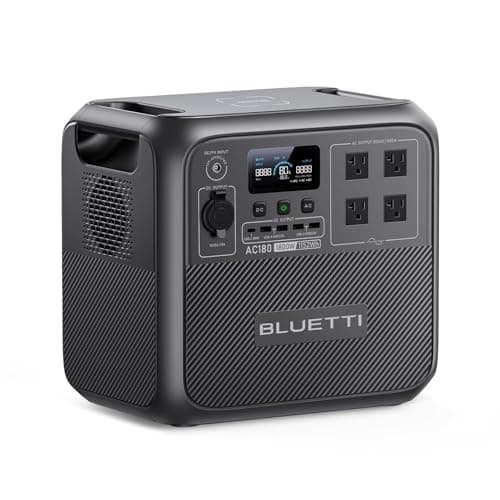
BLUETTI AC180

The most capacity-per-dollar in the 1kWh class, with the longest published cycle rating here.

1,152Wh is the largest capacity in this group, and it is paired with an 1,800W inverter across four AC outlets — enough to run a refrigerator, a furnace fan and a handful of lamps at once rather than in sequence. That combination is what most people actually need on the second evening of an outage.

The specification that separates it is cycle life: 3,500+ cycles to 80% capacity, against 3,000 for both the EcoFlow and the Anker. Spread over the life of the unit that difference is real money, and it is the basis of the cost per usable kilowatt-hour in the table below. The 0–80% charge in 45 minutes matters for a different reason: outages often come with warning, and a unit you can substantially fill during a storm watch is worth more than one you cannot.

The trade is weight. 35.3 lb is a two-hands, one-trip object. If it lives in a basement and comes upstairs twice a year that is irrelevant; if you want to move it around the house during the outage it is a genuine annoyance.

Skip it ifyou have to carry it upstairs regularly — at 35.3 lb it is the heaviest of the 1kWh units, roughly 11 lb more than the Jackery.

Published specifications for the BLUETTI AC180
SpecificationPublished figure
Usable capacity1,152 Wh (32 V, 36 Ah)
Cell chemistryLiFePO4 (LFP)
AC output1,800 W continuous / 2,700 W surge, 4 outlets
Cycle life3,500+ cycles to 80% capacity
Weight35.3 lb
Fast charge0–80% in 45 min
Max solar input500 W
Warranty5 years on registration

Source: BLUETTI — AC180 product specifications. These are the manufacturer's published figures, not ours — we have not tested this unit.

02Lightest 1kWh unit

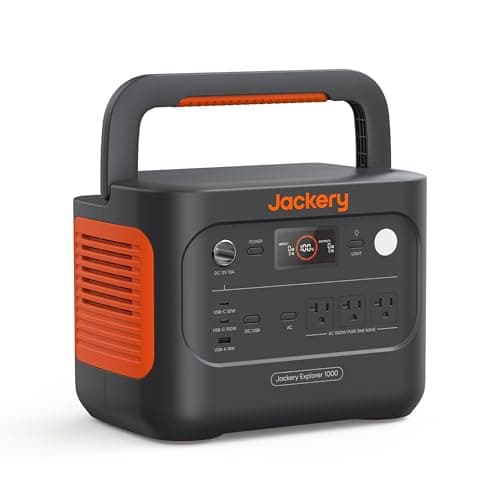
Jackery Explorer 1000 v2

1,070Wh at 24 lb, which is 11 lb less than the comparable BLUETTI for 82Wh less capacity.

The weight figure is the argument. 24 lb is the difference between a unit that gets carried to wherever the problem is and one that stays where you put it. For a household where the person most likely to be home during an outage is not the person who can lift 35 lb, that is not a minor specification.

It gives up two things for that. The inverter is 1,500W against the 1,800W of the BLUETTI, EcoFlow and Anker — still enough to start a refrigerator comfortably, given Champion's published 800–1,200W starting range, but with less headroom if a second motor kicks in. And the cycle rating is quoted differently: 4,000 cycles to 70% capacity rather than 3,500 to 80%. Those are not the same claim, and the 70% endpoint is the more permissive of the two.

Charging is the standout: roughly 1.7 hours from the wall, or about an hour in emergency mode. Combined with 400W of solar input, this is a unit that refills quickly when there is anywhere to refill it from.

Skip it ifyou need to run two motor loads at once — the 1,500W inverter is the smallest here, and a fridge plus a sump pump starting together will exceed it.

Published specifications for the Jackery Explorer 1000 v2
SpecificationPublished figure
Usable capacity1,070 Wh
Cell chemistryLiFePO4 (LFP)
AC output1,500 W continuous / 3,000 W surge
Weight24 lb
Cycle life4,000 cycles to 70% capacity
Max solar input400 W
Wall recharge~1.7 h, or ~1 h in emergency mode
Warranty3 years, extendable to 5 on registration

Source: Jackery — Explorer 1000 v2 product specifications. These are the manufacturer's published figures, not ours — we have not tested this unit.

03Best if you might need more later

EcoFlow DELTA 2

1,024Wh that expands to 3kWh with add-on batteries — the only unit here that grows.

Expandability is the whole reason to choose this one. The base unit is a 1,024Wh station in the same class as everything else here, but it accepts additional battery packs up to a total of 3kWh. That is a genuinely different proposition: it lets you buy for this year's outages and extend if next year's are worse, rather than replacing the unit.

X-Boost is the other distinguishing feature and it needs explaining honestly. It allows the station to supply up to 2,200W to resistive loads — heaters, kettles, incandescent lamps — by reducing the voltage slightly. It does not raise the inverter's real 1,800W capability, and it is not a solution for motor loads. Useful, but not the extra 400W of headroom it can read as.

500W of solar input and a five-year warranty round it out. The 3,000-cycle rating is mid-pack.

Skip it ifyou are certain 1kWh is enough. You are paying for an expansion port you will never use, and the BLUETTI gives you more capacity today for it.

Published specifications for the EcoFlow DELTA 2
SpecificationPublished figure
Usable capacity1,024 Wh (expandable to 3 kWh)
Cell chemistryLiFePO4 (LFP)
AC output1,800 W continuous / 2,700 W surge
X-Boost output2,200 W for resistive loads
Weight27 lb
Cycle life3,000+ cycles
Max solar input500 W
Warranty5 years

Source: EcoFlow — DELTA 2 product specifications. These are the manufacturer's published figures, not ours — we have not tested this unit.

04Fastest refill

Anker SOLIX C1000

Full in 58 minutes from empty, which changes what the same capacity is worth.

1,056Wh puts this in the middle of the group on capacity, and the 2,400W SurgePad headroom over an 1,800W continuous rating gives it the most generous motor-starting margin here. Where it genuinely leads is refill: 80% in 43 minutes and full in 58.

That specification is worth more than it first appears, but only in one pattern. If your utility takes you out for two hours several times a winter, a unit that recovers fully between events is effectively always ready. If you get one three-day outage a year, recharge speed is irrelevant — there is no power to recharge from — and you should buy capacity instead.

Solar input is the highest in this group at 600W, with a claimed full solar recharge in about 1.8 hours under good conditions. That partially answers the objection above, if you also buy panels.

Skip it ifyour outages are long rather than frequent. Recharge speed is worth nothing if there is no power to recharge from.

Published specifications for the Anker SOLIX C1000
SpecificationPublished figure
Usable capacity1,056 Wh
Cell chemistryLiFePO4 (LFP)
AC output1,800 W continuous / 2,400 W SurgePad
Cycle life3,000 cycles
Wall recharge80% in 43 min, full in 58 min
Max solar input600 W (full solar recharge ~1.8 h)
Ports11 total, including 6 AC on panel-equipped bundles

Source: Anker — SOLIX C1000 product specifications. These are the manufacturer's published figures, not ours — we have not tested this unit.

05Cheapest one that is still useful

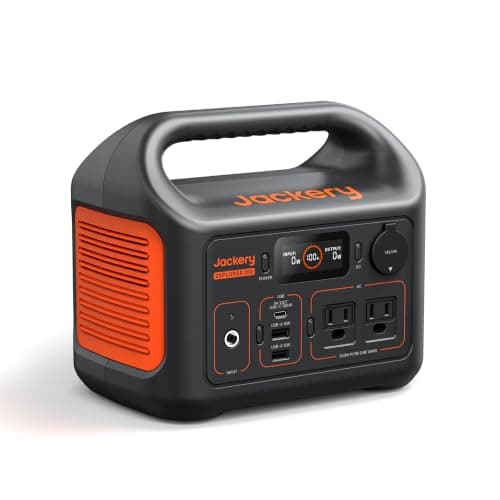
Jackery Explorer 300 Plus

288Wh and 300W: honest about being a communications-and-lights unit rather than an appliance one.

This is included because the alternative to a small station is often nothing at all, and nothing is worse. 288Wh runs a router and a modem — call it 20W together — for the better part of a working day, recharges several phones, and powers LED lighting for far longer than you will need it.

What it will not do is run a refrigerator, and the reason is the inverter rather than the battery. Champion's published starting range for a domestic fridge is 800–1,200W. A 300W inverter refuses that instantly and will keep refusing it. Any listing that implies otherwise is describing a different product.

At 8.3 lb it is genuinely portable, and it is the unit most likely to get used outside an emergency — which is a real argument for it, because equipment that gets used is equipment that works when you need it.

Skip it ifthe refrigerator is why you are here. The 300W inverter cannot start it, and no amount of capacity changes that.

Published specifications for the Jackery Explorer 300 Plus
SpecificationPublished figure
Usable capacity288 Wh
Cell chemistryLiFePO4 (LFP)
AC output300 W continuous
Weight8.3 lb (3.75 kg)
Solar compatibilitySolarSaga 40/60/80/100 W panels
ControlWi-Fi and Bluetooth app monitoring

Source: Jackery — Explorer 300 Plus product specifications. These are the manufacturer's published figures, not ours — we have not tested this unit.

How these were chosen

We did not test these. Nobody at Watt & Warden has plugged one in. What we did instead: read the manufacturer's published specifications, compile them into a table where the figures line up, and compute the numbers manufacturers leave out — runtime against a real appliance load, and what an hour of running actually costs.

Anything that could not be sourced was left out rather than estimated, and every pick names the buyer who should skip it. The full method is here, including where it is weaker than a publisher with a test bench.

Questions people actually ask

What size power station do I need for a power outage?

Work it from your outage length. Under six hours: 300-600Wh covers communications and lights. Overnight: 1,000-1,200Wh with an 1,800W inverter covers a fridge and a furnace fan. Beyond a day, you need 2,000Wh-plus or a recharge path, because a battery holds a fixed amount of energy and then it is empty.

Will a power station run my refrigerator?

It needs to clear two bars, not one. The inverter must handle the starting surge -- Champion's published range for a domestic fridge is 800-1,200W -- and the battery must hold enough watt-hours for the runtime you want. A 300W inverter fails the first test regardless of battery size. A 1,000Wh station with an 1,800W inverter passes both and gives roughly 6 hours at a 150W average draw.

Can I use a power station indoors during an outage?

Yes. Nothing burns, so there is no carbon monoxide and no exhaust. This is the fundamental difference from a generator, which must run outdoors at least twenty feet from the house with its exhaust pointed away from every opening.

How long do these batteries last before they wear out?

Read the cycle rating and its endpoint together. BLUETTI publishes 3,500+ cycles to 80% capacity for the AC180; Jackery publishes 4,000 cycles to 70% for the Explorer 1000 v2. Those are different tests -- a 70% endpoint is easier to reach. Either way, at one full cycle a week that is decades of service.

Should I buy solar panels with it?

Only if your outages run longer than a day. For a four-hour outage the battery never empties and the panel contributes nothing. For a three-day outage the panel is what stops the battery becoming a heavy plastic box on the second morning.

Sources

Every figure on this page comes from a published source. We have not tested this equipment, so the specifications are the manufacturer's and the statistics are the dataset's — the arithmetic on top of them is ours, and it is shown in full so you can check it. How we work this out.