Skip to content
Watt Warden

Sizing

What Size Power Station Do I Need?

A generator is sized in watts. A battery has to be sized twice - once in watts for what it can start, and once in watt-hours for how long it lasts. Most disappointment comes from checking only the second.

By Sawyer V.Updated Published How we work this out
A notebook with handwritten calculations and a pen.

Watt & Warden earns a commission on qualifying purchases made through links on this page, at no extra cost to you. It never changes a ranking, and our picks include products we tell you to skip. Full disclosure.

Two numbers, and people only check one

Watts — continuous and surge — decide what will run at all. If a load's starting draw exceeds the inverter's rating, it does not run for a short time; it does not run.

Watt-hours decide how long it runs once it is running.

A 1,500Wh battery with a 1,000W inverter will not start a freezer. A 1,000Wh battery with an 1,800W inverter will start it and run it most of the day. The larger number on the box is the wrong one to shop on.

Step 1 — list what has to keep running

Not what you would like. What you would be genuinely unhappy to lose. Most households write a much longer list than they need, and then buy for it.

LoadRunning wattsStarting wattsHours a day
Refrigerator~150 average500-1,00024 (cycling)
Freezer100-500500-1,00024 (cycling)
Router and modem~2024
LED lighting30-605-6
Laptop45-656-8
CPAP, humidifier off30-608
Furnace fan (½ HP)300-800800-1,6006-8 (cycling)
Sump pumpVariesHighDepends entirely on rain

All figures except the fridge average are Champion Power Equipment's published ranges. The 150W fridge average and the 85% inverter efficiency used below are this site's stated planning assumptions, listed on the methodology page. The full chart has the rest.

Step 2 — the watts number

Take the largest single starting wattage on your list, then add the running watts of everything that will already be on when it starts.

Worked example. A fridge, lights, a router and a laptop:

  • Fridge running average: 150W
  • Lights: 50W
  • Router and modem: 20W
  • Laptop: 60W
  • Running total: 280W
  • Fridge starting surge: 1,000W at the top of the published range
  • Peak demand: 280 − 150 + 1,000 = 1,130W

So an 1,800W inverter covers it with real margin. A 1,000W one does not.

The trap is two motors. If a chest freezer is on the list, both compressors can call within a second of each other, and the peak becomes roughly 280 − 150 − 300 + 1,000 + 1,000, which is nearly 2,000W. That is the entire reason the 2kWh tier exists, and why surge deserves its own page.

Step 3 — the watt-hours number

Multiply each load's running watts by the hours it actually runs, remembering that compressors cycle rather than run continuously — a fridge is on roughly a third of the time, which is where the 150W average comes from.

Same household, over 24 hours:

  • Fridge: 150W average × 24h = 3,600Wh
  • Lights: 50W × 6h = 300Wh
  • Router: 20W × 24h = 480Wh
  • Laptop: 60W × 8h = 480Wh
  • Total: 4,860Wh
  • Divide by 85% inverter efficiency: about 5,700Wh of battery

Which is more than any portable battery on this site. That number is not a mistake — it is the honest arithmetic, and it is why the next step matters more than the first two.

Step 4 — decide how long, then load-shed

The 5,700Wh figure assumes 24 hours of everything. Almost nobody needs that, and the fix is not a bigger battery.

  • Run the fridge in blocks. A closed fridge holds temperature for hours. Powering it four hours in twelve keeps food safe and cuts its share from 3,600Wh to roughly 1,200Wh.
  • Drop the laptop to essential use.
  • Light one room rather than the house.

Do that and the same household's day comes down to roughly 1,800-2,200Wh — squarely inside the 2kWh tier, and inside 1kWh for a single overnight.

Match the purchase to the outage

Capacity is not a preference. It falls out of two numbers: how long your power is usually off, and what you refuse to lose while it is.

Your outage lastsWhat has to keep runningRealistic product class
Under 4 hoursRouter, phones, a lamp300-500Wh is genuinely enough
Power stations under $500
4 to 24 hoursFridge, lights, devices1kWh with an 1,800W inverter
Best under $1,000
1 to 2 daysFridge, freezer, comms, furnace blower2kWh with 2,400W or more
Best 2000Wh power stations
3 days or moreAll of the above, sustained2kWh plus solar or a generator
Generator vs power station
The jump people get wrong is the last one. No portable battery covers a multi-day outage on capacity alone — what covers it is a recharge path, whether that is panels or an engine.

Step 5 — check the recharge path

Two limits in your station's manual, both capable of making a correctly-sized battery useless:

  • Maximum solar input. A unit that accepts 200W accepts 200W regardless of how much panel you own, which caps your daily allowance. The solar arithmetic works back from daily watt-hours.
  • AC recharge time. Real outages flicker. A battery that refills in an hour uses those windows; one that takes six hours misses them.

Four households, sized

HouseholdPeak watts neededDaily Wh (with load shedding)Buy
Apartment, comms only~200 W~500 Wh300-500Wh
House, fridge and essentials~1,130 W~1,500 Wh1kWh, 1,800W inverter
House, fridge and freezer~2,000 W~2,200 Wh2kWh, 2,400W+ inverter
Rural, plus a well pumpWell above 2,000 W~3,000 WhA generator, with a battery indoors

Calculated from the published figures above with this site's stated assumptions. Your appliances differ — an old fridge in a hot garage is well above the planning average, a new one below it.

Buy one size up, once

The most common regret in this category is under-buying, and the reason is that people size to the calculation exactly and then discover the calculation was optimistic — an appliance draws more than its label, or the outage lasts longer than expected, or a second thing turns out to matter.

Margin is cheap at purchase and impossible afterwards, and expansion only adds hours, never watts. If you are between two tiers, take the larger one.

Quick picks

#ProductBest forPrice
1
No photo

Tier 1 — communications

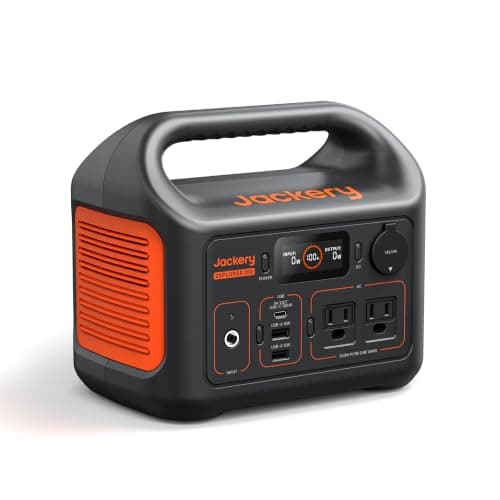
Jackery Explorer 300 Plus

A compact LiFePO4 station that covers the smallest useful load set.

Phones, router, a lamp, a CPAP
2
No photo

Tier 2 — the fridge tier

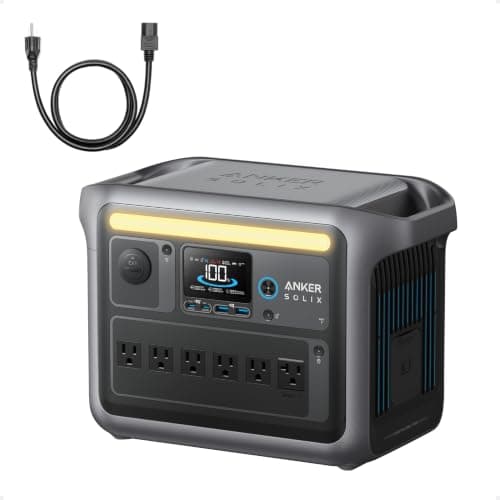
Anker SOLIX C1000

1,056Wh of LiFePO4 with 1,800W output — enough surge for a compressor.

A refrigerator plus the essentials
3
No photo

Tier 3 — two compressors

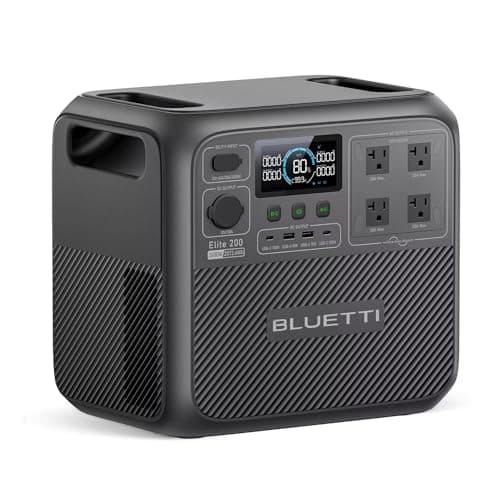
BLUETTI Elite 200 V2

2,073Wh of LiFePO4 with 2,600W output and a ten-year design life.

Fridge, freezer, and a furnace blower
4
No photo

Tier 4 — multi-day

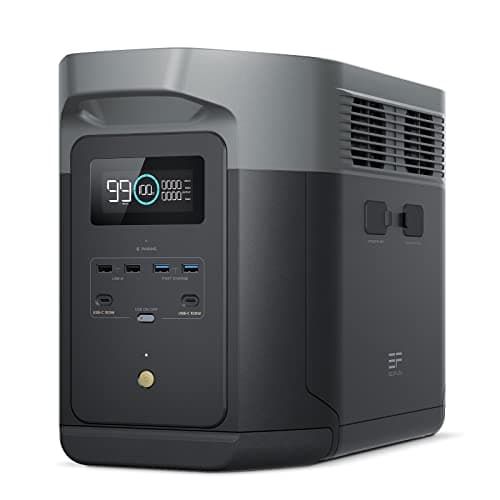
EcoFlow DELTA 2 Max

2,048Wh and 2,400W, expandable to 6,144Wh, 0-80% in 43 minutes.

Outages measured in days

Prices come from the retailer at page-build time and change constantly. Where no live price is available the button reads “Check price” rather than showing a number we cannot stand behind.

The picks in full

01Tier 1 — communications

Jackery Explorer 300 Plus

A compact LiFePO4 station that covers the smallest useful load set.

The right size for a household whose honest answer is "keep the phones and the internet alive". That load is 20 to 50W, and a few hundred watt-hours covers a day of it.

The limit is surge, not capacity. Nothing with a compressor starts here, and no amount of extra watt-hours changes that.

Skip it ifanything on your list has a motor in it. Then you need the next tier.

Published specifications for the Jackery Explorer 300 Plus
SpecificationPublished figure
Usable capacity288 Wh
Cell chemistryLiFePO4 (LFP)
AC output300 W continuous
Weight8.3 lb (3.75 kg)
Solar compatibilitySolarSaga 40/60/80/100 W panels
ControlWi-Fi and Bluetooth app monitoring

Source: Jackery — Explorer 300 Plus product specifications. These are the manufacturer's published figures, not ours — we have not tested this unit.

02Tier 2 — the fridge tier

Anker SOLIX C1000

1,056Wh of LiFePO4 with 1,800W output — enough surge for a compressor.

1,800W clears the 500-1,000W starting surge Champion publishes for a refrigerator or freezer with margin, which is what makes this the first tier that does something a power bank cannot.

At this site's 150W fridge planning average and 85% inverter efficiency, a kilowatt-hour is most of a day of refrigeration.

Skip it ifyou need a fridge and a chest freezer running together.

Published specifications for the Anker SOLIX C1000
SpecificationPublished figure
Usable capacity1,056 Wh
Cell chemistryLiFePO4 (LFP)
AC output1,800 W continuous / 2,400 W SurgePad
Cycle life3,000 cycles
Wall recharge80% in 43 min, full in 58 min
Max solar input600 W (full solar recharge ~1.8 h)
Ports11 total, including 6 AC on panel-equipped bundles

Source: Anker — SOLIX C1000 product specifications. These are the manufacturer's published figures, not ours — we have not tested this unit.

03Tier 3 — two compressors

BLUETTI Elite 200 V2

2,073Wh of LiFePO4 with 2,600W output and a ten-year design life.

The step up is bought for watts, not watt-hours. A fridge and a chest freezer can call for their starting surges within a second of each other, and 2,600W is what absorbs that.

It also covers the 800-1,600W starting draw Champion publishes for a half-horsepower furnace fan, which is the winter case.

Skip it ifone appliance is your whole requirement. You would be buying surge you never use.

Published specifications for the BLUETTI Elite 200 V2
SpecificationPublished figure
Usable capacity2,073.6 Wh
Cell chemistryAutomotive-grade LiFePO4 (LFP)
AC output2,600 W continuous / 3,900 W power lifting
Cycle life6,000+ cycles
Fast charge0–80% in 50 min via dual AC/DC input

Source: BLUETTI — Elite 200 V2 product specifications. These are the manufacturer's published figures, not ours — we have not tested this unit.

04Tier 4 — multi-day

EcoFlow DELTA 2 Max

2,048Wh and 2,400W, expandable to 6,144Wh, 0-80% in 43 minutes.

Past two days, capacity alone stops being the answer and a recharge path becomes the point. Expansion to 6,144Wh plus 1,000W of solar input is what makes an indefinite outage survivable without an engine.

Skip it ifyour outages are short. Expansion is money sitting idle if you never need it.

Published specifications for the EcoFlow DELTA 2 Max
SpecificationPublished figure
Capacity2,048 Wh, expandable to 6,144 Wh
Output2,400 W continuous
ChemistryLiFePO4, 3,000+ cycles to 80%
AC recharge0–80% in 43 minutes
Solar inputup to 1,000 W
Outlets15 total
Noiseas low as 30 dB

Source: EcoFlow — DELTA 2 Max published specifications. These are the manufacturer's published figures, not ours — we have not tested this unit.

How these were chosen

We did not test these. Nobody at Watt & Warden has plugged one in. What we did instead: read the manufacturer's published specifications, compile them into a table where the figures line up, and compute the numbers manufacturers leave out — runtime against a real appliance load, and what an hour of running actually costs.

Anything that could not be sourced was left out rather than estimated, and every pick names the buyer who should skip it. The full method is here, including where it is weaker than a publisher with a test bench.

Questions people actually ask

How do I calculate what size power station I need?

Two calculations. For watts, take the largest single starting wattage on your list and add the running watts of everything already on. For watt-hours, multiply each load's running watts by hours used, then divide by 85% for inverter losses. The watts number decides what starts; the watt-hours number decides how long.

What size power station do I need for a refrigerator?

At least an 1,800W inverter, because Champion publishes 500-1,000 starting watts for a fridge and you need margin above that. For capacity, a kilowatt-hour covers most of a day at this site's 150W planning average -- or considerably longer if you run it in blocks rather than continuously.

Is 2000Wh enough for a whole house?

Not for a whole house, but for the parts that matter it usually is. A fridge, a freezer, communications and a furnace blower with sensible load shedding comes to roughly 2,200Wh a day. Heating, air conditioning, electric cooking and electric water heating are out of reach at any portable battery size.

Should I size up or buy exactly what I calculated?

Size up. The common regret is under-buying, because calculations are optimistic -- appliances draw more than their labels, outages run longer than expected, and a second load turns out to matter. Margin is cheap at purchase and impossible afterwards, since expansion adds hours but never watts.

How do I make a power station last longer during an outage?

Load shedding, and mostly on the fridge. A closed refrigerator holds temperature for hours, so powering it four hours in twelve keeps food safe and cuts its daily share by roughly two thirds. Light one room rather than the house, and drop non-essential use. That typically halves a household's daily watt-hours.

Sources

Every figure on this page comes from a published source. We have not tested this equipment, so the specifications are the manufacturer's and the statistics are the dataset's — the arithmetic on top of them is ours, and it is shown in full so you can check it. How we work this out.