What “home backup” actually requires
Most power station roundups treat home backup as a bigger version of camping. It is not — it is a different technical requirement, and the difference is motors.
Camping loads are resistive and small: lights, a laptop, a fan, phone charging. Home backup loads include a refrigerator compressor, a furnace blower and possibly a sump pump, all of which draw two to three times their running wattage for a fraction of a second at startup. Champion's published reference puts a refrigerator at 150–400W running against 800–1,200W starting, and a half-horsepower sump pump at 800–1,050W running against 1,300–2,150W starting.
That is why an 1,800W inverter is the practical floor for this category and why a 300W or 600W unit — however many watt-hours it holds — is not a home backup device. It is also why the sump pump question changes which tier you should buy from, and it is the first thing to settle.
Build your list before you look at products
A critical-load list is four or five items, not twenty. For most houses:
- Refrigerator — 150–400W running, 800–1,200W starting
- Furnace fan (½ HP) — 300–800W running, 800–1,600W starting. Gas heat still needs the blower and the controls.
- Sump pump (⅓ HP) — 500–800W running, 1,000–1,600W starting, if you have a basement
- Router and modem — around 20W together
- LED lighting — 8–15W a bulb
All figures are Champion Power Equipment's published chart. Add the running watts, then add only the single largest starting surge — motors rarely start at the same instant, and sizing for simultaneous startup buys you a machine two or three times larger than you need.
A house with a fridge, a furnace and lights lands around 700W running and needs an inverter clearing roughly 1,900W of peak. A house that adds a sump pump needs materially more headroom, which is what moves it from the 1kWh tier to the 2kWh one. The full sizing method is here.
Match the purchase to the outage
Capacity is not a preference. It falls out of two numbers: how long your power is usually off, and what you refuse to lose while it is.
| Your outage lasts | What has to keep running | Realistic product class |
|---|
| Overnight (8–14 h) | Fridge cycling, furnace fan, router, lighting | 1,100–1,200Wh, 1,800W inverter
See the outage-focused picks |
|---|
| A full day | Above, plus device charging and a sump pump cycling | 2,000Wh+, 2,200W+ inverter
See the storm scenario |
|---|
| 2–3 days | Above, sustained — with no grid to recharge from | 2,000Wh+ battery plus solar, or a generator
See solar generators |
|---|
The runtime arithmetic, shown
Runtime is capacity divided by average load, less conversion losses. Our working assumptions, stated so you can change them: a modern refrigerator averages roughly 150W over a full cycle, because the compressor runs perhaps a third of the time; a furnace fan adds around 100W averaged over a winter night's duty cycle; router, modem and a few LEDs add about 50W. Call it a 300W average critical load. Inverter efficiency: 85%.
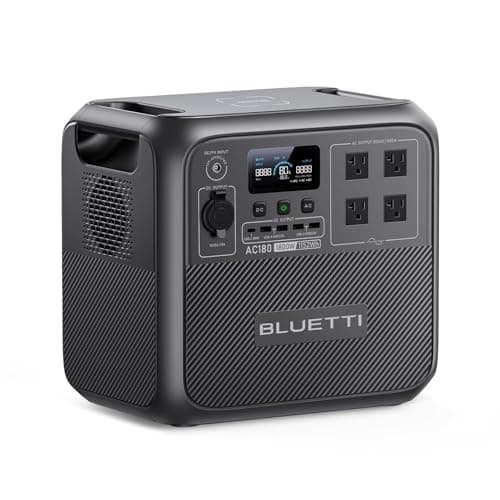
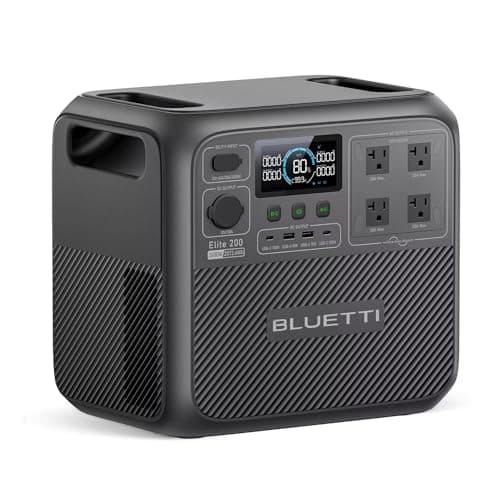
On that basis, the 1,152Wh BLUETTI AC180 gives about 3.3 hours at full critical load, and about 6.5 hours if you shed the furnace and run the fridge alone. The 2,073Wh Elite 200 V2 gives about 5.9 hours at full load and 11.7 on the fridge alone — which is the whole reason to buy the larger tier.
Load shedding is the cheapest capacity available. Running the fridge and the furnace alternately rather than together roughly doubles what any of these units delivers, and costs nothing but attention.
What it costs to actually run
The sticker price of a dual-fuel generator is a fraction of what it costs you. The sticker price of a battery is nearly all of it. Here is the arithmetic, with the inputs stated so you can redo it with your own fuel price.
| Unit | Published consumption | Cost per hour | Cost per 24 h |
|---|
| BLUETTI Elite 200 V2 | 2,073.6Wh × 6,000 cycles | 12,442 kWh lifetime | Longest life here |
|---|
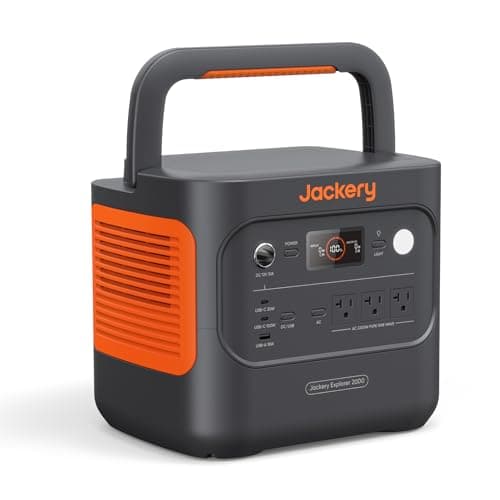
| Jackery Explorer 2000 v2 | 2,042Wh, cycle rating not published in this form | Not published | 20ms UPS |
|---|
| BLUETTI AC180 | 1,152Wh × 3,500 cycles | 4,032 kWh lifetime | Best value per Wh |
|---|
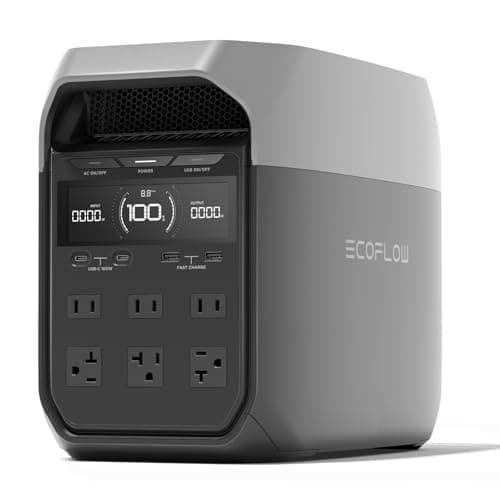
| EcoFlow DELTA 3 | 1,024Wh × 3,000 cycles | 3,072 kWh lifetime | Expandable to 3kWh |
|---|
Lifetime energy = published capacity × published cycle rating. Jackery does not publish a cycle figure for the Explorer 2000 v2 in a comparable form, so the cell says so rather than carrying an estimate. Divide by the live purchase price for cost per usable kilowatt-hour.
What a battery still cannot do for a house
None of these runs central air conditioning — Champion puts a two-ton unit at 3,500–4,500W starting — an electric range, or an electric water heater at 3,000–4,500W. If those are on your must-run list, you are looking at a large generator or a standby installation, and a battery is a complement rather than the answer.
And none of them lasts three days on its own. That is not a fault; it is what stored energy means. For multi-day coverage you need either fuel or a recharge path, which is what the generator comparison exists to settle.
Up and down the ladder
Too much machine? The under-$500 tier is honest about being a communications-and-lights purchase and does that job well. Not enough? Whole-house coverage is the next real step up, and it involves an electrician.