Skip to content
Watt Warden

Scenarios

Whole-Home Backup Power

The moment central air conditioning or an electric range joins the list, this stops being a purchase with a delivery date and becomes a project with a permit.

By Sawyer V.Updated Published How we work this out
A large family house at dusk with its lights on.

Watt & Warden earns a commission on qualifying purchases made through links on this page, at no extra cost to you. It never changes a ranking, and our picks include products we tell you to skip. Full disclosure.

What “whole home” actually means

Most people who say whole-home mean “everything I actually use”, and those are different requirements with very different prices.

The line is drawn by a small number of large loads. On Champion's published figures:

  • Central air conditioning, 3 ton — 3,000–3,500W running, 5,000–6,000W starting
  • Electric water heater — 3,000–4,500W
  • Well pump, 1 HP — 1,000–2,000W running, 2,000–4,000W starting

Add an electric range or an electric dryer and the totals rise further. Any one of these eliminates every portable battery on this site and most mid-sized generators.

So the first question is not which machine. It is: which of those do you genuinely need running during an outage? For a great many households the honest answer is none of them — you can put on a sweater, shower at a friend's, and cook on a gas range — and that answer saves a great deal of money.

The load math

A genuine whole-house list, at the upper end of the published ranges:

LoadRunning WStarting W
Central AC, 3 ton3,5006,000
Well pump, 1 HP2,0004,000
Refrigerator4001,200
Freezer5001,000
Furnace fan, ½ HP8001,600
Sump pump, ⅓ HP8001,600
Microwave1,200
Lighting and electronics300

Champion Power Equipment's published wattage chart, upper end of each range. Sizing against the upper end is deliberate: a system that only works with the efficient appliance is not a backup system.

Running total: 9,500W. The largest single surge is the central air conditioner at 6,000W, so peak = 9,500 − 3,500 + 6,000 = 12,000W.

That is the number that pushes a household from a portable to either a 13,000W machine or a standby installation, and it is almost entirely driven by one appliance. Drop the central air conditioning and the same house needs 6,000W running with a 8,000W peak — a completely different and much cheaper machine. The sizing method in full.

Match the purchase to the outage

Capacity is not a preference. It falls out of two numbers: how long your power is usually off, and what you refuse to lose while it is.

Your outage lastsWhat has to keep runningRealistic product class
Critical load only, any durationFridge, furnace, sump pump, lights5,300W generator plus a transfer switch
See generators under $1,000
Everything except air conditioningAbove, plus a well pump and cooking9,500W dual-fuel generator
See the larger machines
Genuinely everything, manuallyAbove, plus central air conditioning13,000W portable with a 50A transfer switch
Whole-house options
Everything, automatically, nobody homeThe whole service, starting itselfStandby generator on natural gas
Generac vs Kohler

The three routes

1. Selected circuits with a portable

A 5,000–9,500W dual-fuel generator plus a transfer switch or interlock kit, backing a chosen list. Delivers most of what an outage actually costs you, for a fraction of a standby installation.

What you give up: air conditioning, automatic start, and the requirement that somebody is home to run it.

2. Whole panel with a large portable

A 13,000W machine with a 50A transfer switch or an interlock kit, covering the whole panel including central air conditioning.

What you give up: automatic start, and you take on a serious fuel logistics problem — a machine this size consumes fuel in proportion to its output.

3. Standby installation

A permanently installed generator on natural gas or propane with an automatic transfer switch. It starts itself, transfers the house in under about thirty seconds, and on a gas main never runs out.

What you give up: a five-figure installed cost, a permit, a gas line and annual maintenance — and the machine does nothing between outages. What the installation involves.

What the fuel actually costs at this scale

What it costs to actually run

The sticker price of a dual-fuel generator is a fraction of what it costs you. The sticker price of a battery is nearly all of it. Here is the arithmetic, with the inputs stated so you can redo it with your own fuel price.

UnitPublished consumptionCost per hourCost per 24 h
13,000W portable, heavy load, gasoline~1.2 gal/hr$4.89$117.24
9,500W portable, half load, gasoline~0.55 gal/hr$2.24$53.74
Generac 24kW standby, half load, natural gas203 ft³/hr (about 2 CCF/hr)Your gas rate × 2 CCFYour gas rate × 48 CCF
Generac 24kW standby, half load, propane2.53 gal/hr$6.76$162.31
Gasoline at $4.071/gal and propane at $2.674/gal (EIA weekly retail and residential series). Generac's natural gas and LP consumption figures are its published values for the 24kW Guardian. We do not convert the natural gas row into dollars because residential gas rates vary far too widely by region and season for an average to mean anything — multiply by the rate on your own bill. Portable consumption figures are working estimates at the stated load; your manual publishes its own.

The natural gas row is why a standby unit on a gas main is a different proposition: there is no volume to store, no trips, no rationing, and no cans in the garage. That, rather than automatic start, is often the real argument for standby.

The question that saves the most money

Ask it honestly: does the air conditioning have to run?

It is the load that doubles the requirement, and there are alternatives that a portable can handle. Champion puts a 10,000 BTU window unit at 900–1,200W running and 1,800–2,400W starting — a fraction of a central system, and enough to make one or two rooms genuinely comfortable.

Cooling the bedroom rather than the house is a legitimate outage strategy, and it moves a household from the 13,000W tier to the 5,300W one. If anyone in the house is medically vulnerable to heat that calculation changes, and it should — but for most people this is the single biggest lever available.

Before you commit

  1. Write the honest must-run list. Not the wish list. What actually has to work.
  2. Compute the peak using the wattage chart: running total, minus the biggest item's running watts, plus its starting watts.
  3. Look up your outage history. If your utility averages two hours a year, whole-home standby is an enormous purchase for an event you do not have.
  4. Get two itemized quotes if standby is on the table, and compare line items rather than totals. The gas line is where the difference hides.
  5. Price the portable alternative alongside them — a 9,500W dual-fuel machine plus a professionally fitted transfer switch — so you know what the automatic-start premium actually costs.

Quick picks

#ProductBest forPrice
1
No photo

Whole-panel capability without an installation

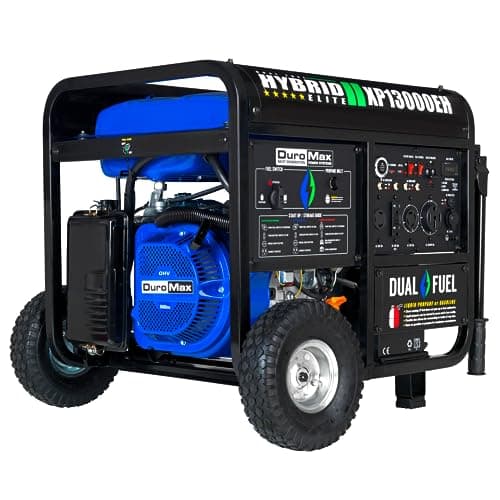
DuroMax XP13000EH

13,000 running watts and a 50A transfer-switch outlet — the largest portable here.

Central air conditioning, no gas main
2
No photo

The realistic middle path

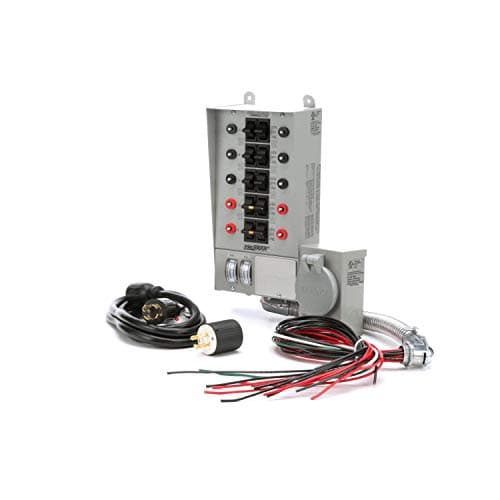
Reliance Controls 31410CRK Pro/Tran

Ten circuits, 30A, 7,500W, with watt meters and mechanical backfeed prevention.

A selected critical-load list rather than everything
3
No photo

The middle tier that suits most houses

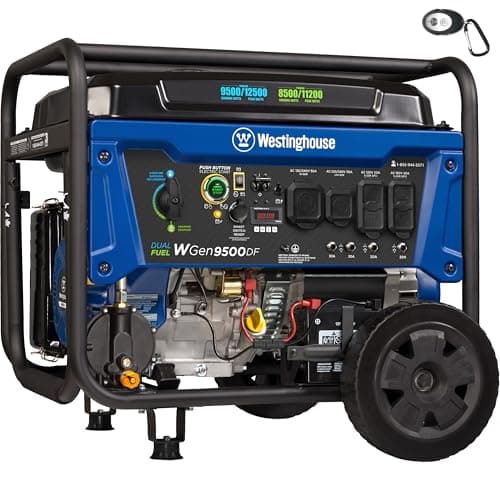
Westinghouse WGen9500DF

9,500 running watts, dual fuel, with both a 30A and a 50A outlet.

Everything except central air conditioning
4
No photo

The overnight complement

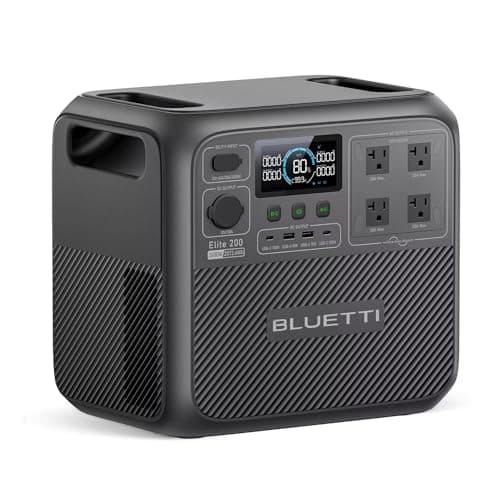
BLUETTI Elite 200 V2

2,073Wh and 2,600W — enough for a fridge, a freezer and a sump pump overnight.

Running the essentials silently while the generator is off

Prices come from the retailer at page-build time and change constantly. Where no live price is available the button reads “Check price” rather than showing a number we cannot stand behind.

The picks in full

01Whole-panel capability without an installation

DuroMax XP13000EH

13,000 running watts and a 50A transfer-switch outlet — the largest portable here.

13,000 running watts genuinely covers a whole panel including a three-ton central air conditioner, whose starting surge Champion puts at 5,000–6,000W.

The 50A transfer-switch outlet and all-metal frame mark it as near-standby equipment. The fuel implication is proportionate: a 500cc engine under real load consumes considerably more than the 0.75 gal/hr planning figure used for mid-sized machines.

Skip it ifnobody will reliably be home to start it. That is what standby buys and this does not.

Published specifications for the DuroMax XP13000EH
SpecificationPublished figure
Output13,000 running W / 16,000 peak W
FuelGasoline or propane (dual fuel)
Engine500cc OHV DuroMax
Transfer-switch outlet50 A
FrameAll-metal, no plastic panels
SafetyLow-oil shutoff; 5 ft propane hose with ACME connector

Source: DuroMax — XP13000EH product specifications. These are the manufacturer's published figures, not ours — we have not tested this unit.

02The realistic middle path

Reliance Controls 31410CRK Pro/Tran

Ten circuits, 30A, 7,500W, with watt meters and mechanical backfeed prevention.

Most households that think they need whole-home backup actually need a well-chosen ten circuits. Fridge, furnace, sump pump, a couple of lighting circuits and some outlets covers the great majority of what an outage costs.

The watt meters let you use the generator's full output across both legs rather than tripping one side while the other idles.

Skip it ifyou genuinely need the whole panel. Ten circuits is ten circuits, fixed at installation.

Published specifications for the Reliance Controls 31410CRK Pro/Tran
SpecificationPublished figure
Circuits10 — six 15 A and four 20 A single-pole breakers
Rating30 A, up to 7,500 W
MeteringTwo watt meters for balancing the load
SwitchingBreak-before-make double-throw, Line / Off / Gen
BackfeedMechanically prevented — the grid cannot be energized
InstallationLicensed electrician; a permit is usually required

Source: Reliance Controls — Pro/Tran 31410CRK product page. These are the manufacturer's published figures, not ours — we have not tested this unit.

03The middle tier that suits most houses

Westinghouse WGen9500DF

9,500 running watts, dual fuel, with both a 30A and a 50A outlet.

9,500 running watts covers a well pump, a furnace, a fridge, a freezer, lighting and cooking simultaneously — everything a house actually needs except the compressor on a central air conditioner.

Dual fuel matters at this size especially: a machine this large drinks fuel, and propane availability during a regional outage is what keeps it running past day two.

Skip it ifcentral air conditioning must run. That is what pushes a house into 13,000W or standby territory.

Published specifications for the Westinghouse WGen9500DF
SpecificationPublished figure
Output (gasoline)9,500 running W / 12,500 peak W
FuelGasoline or propane (dual fuel)
Engine457cc 4-stroke OHV, cast iron sleeve
Tank6.6 gal (25 L)
Run timeup to 12 h on a full tank
Transfer-switch outlet120/240 V L14-30R, 30 A
RV outlet120/240 V 14-50R, 50 A
StartingPush-button electric with remote key fob
Warranty3-year limited

Source: Westinghouse — WGen9500DF product specifications. These are the manufacturer's published figures, not ours — we have not tested this unit.

04The overnight complement

BLUETTI Elite 200 V2

2,073Wh and 2,600W — enough for a fridge, a freezer and a sump pump overnight.

Whole-home backup done well is not a generator running for five days. It is a generator running in blocks with a battery covering the quiet hours.

2,600W of inverter handles two motors starting together, which is what a fridge plus a sump pump can demand.

Skip it ifyou intend to run the generator continuously. Then you are buying a second machine to do nothing.

Published specifications for the BLUETTI Elite 200 V2
SpecificationPublished figure
Usable capacity2,073.6 Wh
Cell chemistryAutomotive-grade LiFePO4 (LFP)
AC output2,600 W continuous / 3,900 W power lifting
Cycle life6,000+ cycles
Fast charge0–80% in 50 min via dual AC/DC input

Source: BLUETTI — Elite 200 V2 product specifications. These are the manufacturer's published figures, not ours — we have not tested this unit.

How these were chosen

We did not test these. Nobody at Watt & Warden has plugged one in. What we did instead: read the manufacturer's published specifications, compile them into a table where the figures line up, and compute the numbers manufacturers leave out — runtime against a real appliance load, and what an hour of running actually costs.

Anything that could not be sourced was left out rather than estimated, and every pick names the buyer who should skip it. The full method is here, including where it is weaker than a publisher with a test bench.

Questions people actually ask

What size generator do I need for a whole house?

With central air conditioning, about 12,000W peak for a typical house at the upper end of published figures -- so 13,000 running watts or a standby installation. Without it, the same house needs roughly 8,000W peak, which a 9,500W machine covers comfortably.

Can a portable generator power a whole house?

A large one can. 13,000 running watts with a 50A transfer switch covers a whole panel including a three-ton central air conditioner. What it cannot do is start itself, which matters if nobody is reliably home when the power fails.

Do I need whole-home backup or just critical circuits?

For most households, critical circuits. A well-chosen ten circuits -- fridge, furnace, sump pump, lighting, some outlets -- covers the great majority of what an outage actually costs, at a fraction of the price of whole-panel coverage.

How much does whole-home backup cost?

It varies too much for an honest single figure, especially for standby installations where the gas line alone depends on the distance from the meter. Get at least two itemized local quotes, and price a large portable plus a transfer switch alongside them so you know what automatic start actually costs.

Can I skip the air conditioning to save money?

It is the single biggest lever available. Central air conditioning roughly doubles the requirement; a 10,000 BTU window unit at 900-1,200W running is a fraction of that and makes one or two rooms genuinely comfortable. That change moves a household from the 13,000W tier to the 5,300W one.

Sources

Every figure on this page comes from a published source. We have not tested this equipment, so the specifications are the manufacturer's and the statistics are the dataset's — the arithmetic on top of them is ours, and it is shown in full so you can check it. How we work this out.