Skip to content
Watt Warden

Solar

How Many Solar Panels Do I Need to Charge a Power Station?

Two numbers decide it: what a panel actually harvests in a day, and what your station will accept. Both are published, and neither is the number on the panel.

By Sawyer V.Updated Published How we work this out
Solar panels and a battery unit set up outdoors in sunlight.

Watt & Warden earns a commission on qualifying purchases made through links on this page, at no extra cost to you. It never changes a ranking, and our picks include products we tell you to skip. Full disclosure.

The two numbers

1. Daily harvest, not panel rating. A panel's wattage is measured under standard test conditions — 1,000W per square meter at 25°C cell temperature — which is a laboratory, not a backyard. In real deployment expect meaningfully less: heat reduces output, the angle is rarely optimal, and the charge controller takes a share.

Our working figure, given as a band because the honest answer is a band: a 100W panel delivers roughly 400–500Wh across a good summer day, well placed. That is about 50–80% of what a naive rating-times-daylight calculation would suggest.

2. The station's solar input ceiling. Every station publishes a maximum solar input in watts. Exceed it and the extra panel does nothing. This is the hard cap on any array, and it is the first thing to check.

The arithmetic

Panels needed = battery capacity ÷ harvest per panel per day, then check the total against the station's input ceiling.

A 1,000Wh station at 450Wh of harvest per 100W panel needs 1,000 ÷ 450 = 2.2 panels to refill fully in a day. Round up: three 100W panels, or 300W of array. Two panels roughly refill it in a day and a half, which for most outages is enough.

Sizing table

Battery capacityDaily top-up (slows the decline)Full refill in a dayCheck the input ceiling is at least
300 Wh100 W100 W100 W
500 Wh100 W100–200 W200 W
1,000 Wh100–200 W200–300 W300 W
1,500 Wh200 W300–400 W400 W
2,000 Wh200–300 W400–600 W600 W
3,000 Wh400 W600–800 W800 W

Computed at 400–500Wh of harvest per 100W of panel per good summer day. Winter, cloud and poor placement reduce all of these substantially — how much, and why. These are estimates from a stated assumption, not measurements; we have not tested any panel.

Top-up or refill? Decide which you are buying

A top-up array adds meaningfully to the battery each day without refilling it. It turns a one-day battery into a two- or three-day one, which for most outages is the whole requirement, and it is the cheaper and lighter option.

A refill array replaces a full day's consumption, making the system indefinitely sustainable in summer. It is roughly double the panel, and it is what you want for a genuine multi-day regional outage where nothing can be bought.

Most households are buying the first and pricing the second. Be clear which one your outage history justifies — how to find that out.

The four things that reduce your real number

  • Angle. A flat panel loses a great deal against one tilted toward the sun, especially in winter when the sun is low. Most folding panels have adjustable legs — use them, and reposition once or twice through the day.
  • Shade. Worse than it looks. Cells wired in series mean one shaded section can drag down the whole panel, so partial shade costs more than the shaded fraction.
  • Heat. Panels lose output as cell temperature rises above 25°C, which is exactly what happens on the sunny days you are counting on. Leaving an air gap underneath helps.
  • Dirt and snow. A dusting of snow takes output effectively to zero. Dust and pollen cost a few percent.

Bigger panels or more panels?

For the same total wattage, fewer larger panels are lighter in total, faster to set out, and involve fewer connections. More smaller panels are easier to carry individually, easier to position around obstructions, and cheaper to add incrementally.

For a fixed home setup, fewer larger panels. For something you carry to a campsite, several 100W panels. The camping scenario weighs that differently from a home one.

Check compatibility before you buy across brands

Three things have to line up, and a bundle exists partly to answer them for you:

  1. Voltage inside the station's charge controller window. Too low and it will not charge; too high and it can damage the controller.
  2. Current not exceeding the input maximum.
  3. Connector matching, or adapting — usually MC4 or a proprietary plug.

Manufacturers publish an accepted input range for exactly this reason. Whether to buy a bundle or the parts separately.

Quick picks

#ProductBest forPrice
1
No photo

The unit of account

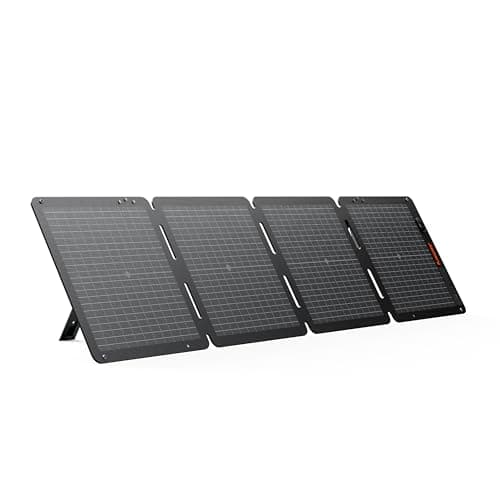
Jackery SolarSaga 100W

100W bifacial at 4.52 lb, IP68 — roughly 400–500Wh of harvest across a good summer day.

Building an array a panel at a time
2
No photo

Highest input ceiling here

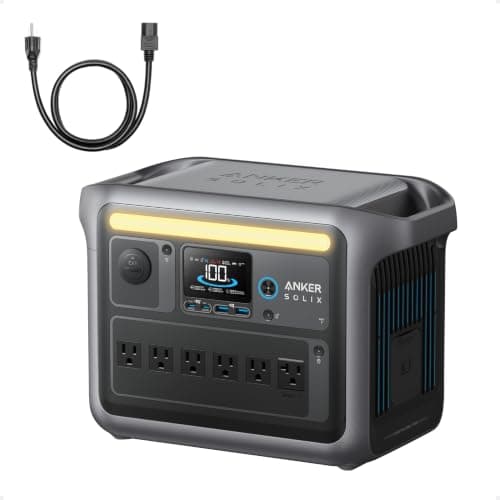
Anker SOLIX C1000

600W of solar input on 1,056Wh — the headroom to actually use a large array.

An array of 400W or more

Prices come from the retailer at page-build time and change constantly. Where no live price is available the button reads “Check price” rather than showing a number we cannot stand behind.

The picks in full

01The unit of account

Jackery SolarSaga 100W

100W bifacial at 4.52 lb, IP68 — roughly 400–500Wh of harvest across a good summer day.

100W panels are the easiest way to build an array incrementally, and at 4.52 lb each they stay genuinely portable in twos and threes.

Bifacial construction adds a little from reflected light off snow or a light surface, and IP68 means it stays out in the weather that is reducing its output.

Skip it ifyou need to refill a 2kWh battery daily. That is a 400–600W array, and buying six 100W panels is heavier and more expensive than fewer larger ones.

Published specifications for the Jackery SolarSaga 100W
SpecificationPublished figure
Rated output100 W
Cell typeMonocrystalline, bifacial
Conversion efficiencyup to 25%
Ingress ratingIP68
Weight4.52 lb
CompatibilityJackery Explorer stations

Source: Jackery — SolarSaga 100W product specifications. These are the manufacturer's published figures, not ours — we have not tested this unit.

02Highest input ceiling here

Anker SOLIX C1000

600W of solar input on 1,056Wh — the headroom to actually use a large array.

The input ceiling is the number that caps everything else: a station that accepts 200W cannot use a 400W array, however many panels you set out.

600W is the highest here, with Anker publishing a full solar recharge in about 1.8 hours in good conditions.

Skip it ifyou will only ever run one 100W panel. You are paying for input capacity you will not fill.

Published specifications for the Anker SOLIX C1000
SpecificationPublished figure
Usable capacity1,056 Wh
Cell chemistryLiFePO4 (LFP)
AC output1,800 W continuous / 2,400 W SurgePad
Cycle life3,000 cycles
Wall recharge80% in 43 min, full in 58 min
Max solar input600 W (full solar recharge ~1.8 h)
Ports11 total, including 6 AC on panel-equipped bundles

Source: Anker — SOLIX C1000 product specifications. These are the manufacturer's published figures, not ours — we have not tested this unit.

How these were chosen

We did not test these. Nobody at Watt & Warden has plugged one in. What we did instead: read the manufacturer's published specifications, compile them into a table where the figures line up, and compute the numbers manufacturers leave out — runtime against a real appliance load, and what an hour of running actually costs.

Anything that could not be sourced was left out rather than estimated, and every pick names the buyer who should skip it. The full method is here, including where it is weaker than a publisher with a test bench.

Questions people actually ask

How many solar panels do I need to charge a 1000Wh power station?

Two to three 100W panels for a full refill in a good summer day, working from roughly 400-500Wh of harvest per 100W panel. One panel is a top-up that slows the decline rather than reversing it. Check the station accepts at least 300W of solar input first.

How long does 100W of solar take to charge a power station?

Longer than the rating suggests. A 100W panel realistically delivers 400-500Wh across a good summer day, so a 1,000Wh station takes about two days on one panel. Cloud, winter and a flat panel angle reduce that substantially.

Can I use more panels than my power station's input rating?

There is no benefit -- the charge controller caps input at its published maximum, so the extra panel does nothing. Check the station's maximum solar input in watts before sizing an array, because it is the hard ceiling on the whole system.

Does tilting a solar panel make a difference?

A large one, and it is free. A panel angled toward the sun collects considerably more than a flat one, especially in winter when the sun is low. Most folding panels have adjustable legs, and repositioning once or twice through the day adds more still.

Sources

Every figure on this page comes from a published source. We have not tested this equipment, so the specifications are the manufacturer's and the statistics are the dataset's — the arithmetic on top of them is ours, and it is shown in full so you can check it. How we work this out.