Why every priority inverts
Almost everything that makes a good home backup purchase makes a poor camping one, and the differences are worth naming explicitly.
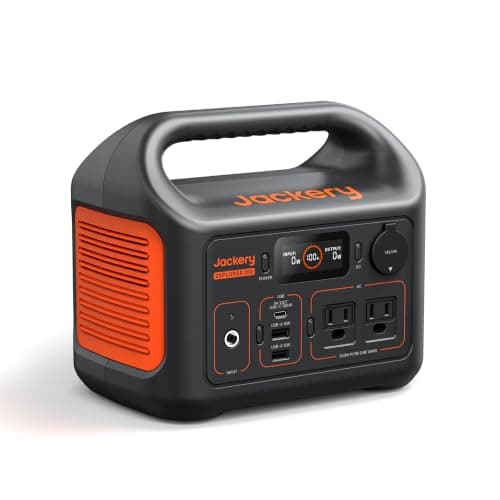
- Weight becomes the binding constraint. At home a machine is carried ten feet twice a year. Camping, you lift it in and out of a car, carry it to a campsite, and pack it around other kit.
- Silence becomes a requirement rather than a courtesy. Many campgrounds have generator hours, and some ban them outright. A battery is permitted everywhere; a generator often is not.
- Solar becomes central. At home, solar is worth it only for long outages. Camping, you are somewhere with no outlets by definition and usually in good summer sun.
- Capacity requirements drop sharply. No refrigerator that must not warm up, no sump pump, no furnace. Unless the RV air conditioner is on the list, the loads are small.
- Rugged matters. The equipment lives outdoors in dust, damp and heat rather than in a closet.
The load list
| Load | Typical draw | Per day |
|---|
| Phone charging, two phones | 10–20 W while charging | ~40 Wh |
|---|
| LED lighting, 4 lights | 32–60 W | ~200 Wh |
|---|
| Laptop | 45–65 W | ~300 Wh |
|---|
| 12V compressor fridge | 40–60 W while cycling | ~400 Wh |
|---|
| Fan overnight | 20–40 W | ~250 Wh |
|---|
| CPAP, no humidifier | 30–60 W | ~350 Wh |
|---|
| Portable induction cooktop | 1,200–1,800 W | ~300 Wh for 15 min |
|---|
| RV air conditioner (13,500 BTU) | 1,200–1,700 W running | Thousands of Wh |
|---|
CPAP figures from Champion Power Equipment's published chart. The remaining rows are working estimates from typical equipment power-supply ratings and duty cycles — we have not measured them, and your own kit's label is a better source. The RV air conditioner row is deliberately vague on daily total, because it depends entirely on ambient temperature and duty cycle.
The pattern is clear: everything except cooking and air conditioning is small. A 500Wh–1,000Wh battery covers a comfortable weekend for two people with lighting, phones, a laptop and a fridge.
The air conditioner decides everything
If your RV has a roof air conditioner and you intend to use it, that single load determines the whole purchase and everything else is a footnote.
A standard 13,500 BTU RV roof unit typically needs 3,000–3,500 starting watts and 1,200–1,700W running, which is why 3,500W inverter generators are the conventional RV size. No portable battery on this site delivers that starting surge, and even if one did, the running draw would empty a 2,000Wh battery in about an hour.
So: air conditioning means a generator, or shore power, or a soft-start device fitted to the air conditioner to reduce its inrush. Without air conditioning, a battery covers everything comfortably and silently.
Match the purchase to the outage
Capacity is not a preference. It falls out of two numbers: how long your power is usually off, and what you refuse to lose while it is.
| Your outage lasts | What has to keep running | Realistic product class |
|---|
| Overnight, tent | Phones, lights, a fan | 250–300Wh battery
See the under-$500 picks |
|---|
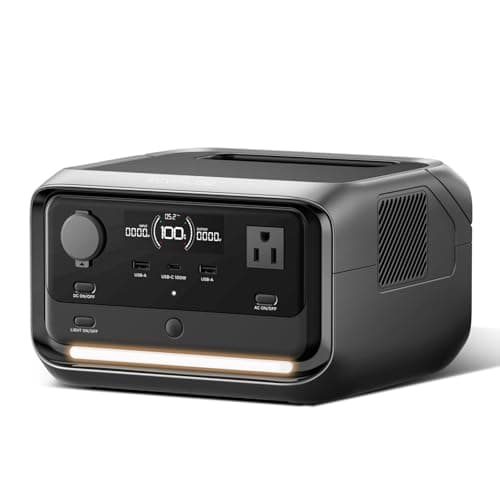
| A weekend, van | Above, plus a 12V fridge and a laptop | 500–1,000Wh battery, ideally with a panel
See power stations |
|---|
| A week, off-grid | Above, sustained, plus occasional cooking | 1,000Wh+ battery and 200W+ of panel
See solar generators |
|---|
| Any trip with roof air conditioning | 3,000–3,500W starting surge | 3,500W inverter generator, or shore power
See inverter generators |
|---|
Three budget tiers
Tier 1 — tent camping
A 250–300Wh battery, ideally under 10 lb. Covers phones, lights and a fan for a couple of nights. Add a 100W panel for anything longer. This is a genuinely small purchase and it transforms a weekend.
Tier 2 — van, overlanding, longer trips
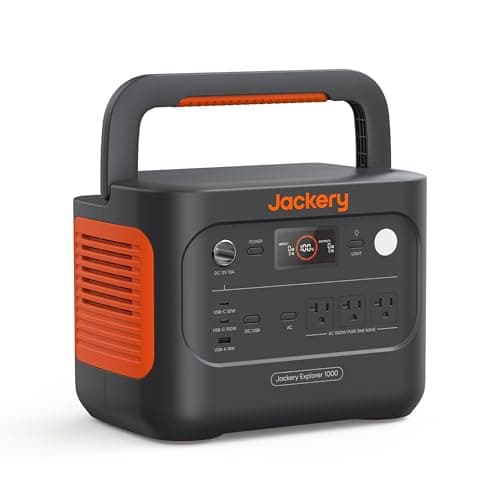
A 1,000Wh battery with a 1,500W+ inverter, plus 100–200W of panel. Runs a 12V fridge continuously, charges everything, powers a laptop working day, and handles a kettle or an induction cooktop in bursts. With panels this is indefinitely sustainable in summer.
Tier 3 — RV with air conditioning
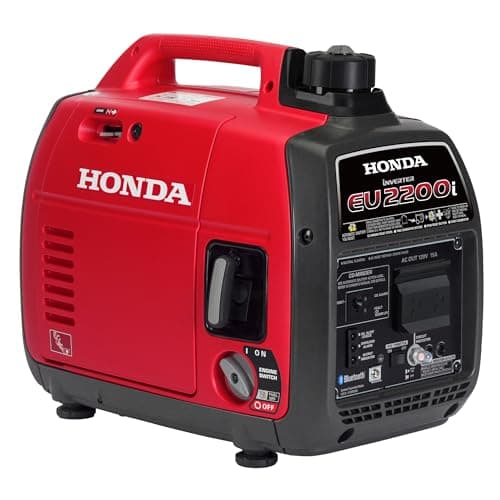
A 3,500W inverter generator, or a smaller one plus a battery for the quiet hours. The generator runs the air conditioner during permitted hours and the battery covers overnight silently — which is also the only way to have air conditioning at a site with generator restrictions.
The kit list
- The battery or generator, sized as above
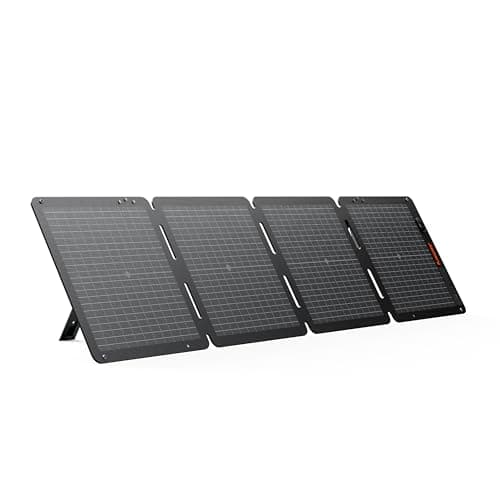
- Solar panel, 100W minimum, more for longer trips
- A 12V car charging cable — driving between sites recharges the battery for free
- An extension lead long enough to reach the pitch from wherever the battery lives
- A cover or dry bag — most stations are not weatherproof, whatever the panel is
- A CO alarm if a generator or any fuel-burning appliance is in use near a sleeping area, including an RV
- Fuel, if a generator: at 0.117 gal/hr for a small inverter, a week of evening use is a very small amount
Campground rules are the constraint nobody checks
Many campgrounds restrict generator use to set hours — commonly a morning and an evening window — and some prohibit them entirely. Some specify a maximum decibel figure, which is why Honda's published 48–57 dB(A) for the EU2200i is quoted so often in this context.
Batteries are permitted everywhere, silently, at any hour. If you camp at sites with restrictions, that is not a minor preference — it is the difference between equipment you can use and equipment you cannot.
Check the specific site's rules before buying. It is the cheapest research in this entire scenario.
The overlap with home backup
This is the argument that makes the whole purchase easier to justify. A 1,000–1,500Wh station with a panel is a strong camping purchase and a strong short-outage home purchase.
Buying with both in mind gets you more for the money, and — more importantly — a unit that goes camping four weekends a year is charged, familiar and working when a storm arrives. Emergency-only equipment is reliably flat at the moment of the emergency. The storm scenario is where the same machine earns its second keep.