Two tests, in order
A refrigerator is not one load, it is two, and a station has to pass both independently.
Test one: the starting surge. A compressor draws two to three times its running wattage for a fraction of a second at startup. Champion Power Equipment's published wattage reference puts a domestic refrigerator at 800–1,200W starting. If the inverter cannot deliver that instantaneously, the fridge does not start — not slowly, not partially. It clicks and fails, and it will keep failing. Battery capacity is completely irrelevant to this test.
Test two: the watt-hours. Only once the fridge starts does capacity matter, and here the useful number is not the running wattage but the average across a cycle. A compressor does not run continuously; it runs perhaps a third of the time in normal conditions. Champion puts running draw at 150–400W, and we use 150W as a working average for a modern unit whose door stays shut.
The arithmetic, in full
Usable hours = capacity × inverter efficiency ÷ average draw. We use 85% efficiency, which is conservative for a good inverter at moderate load and generous for a cheap one running near its limit.
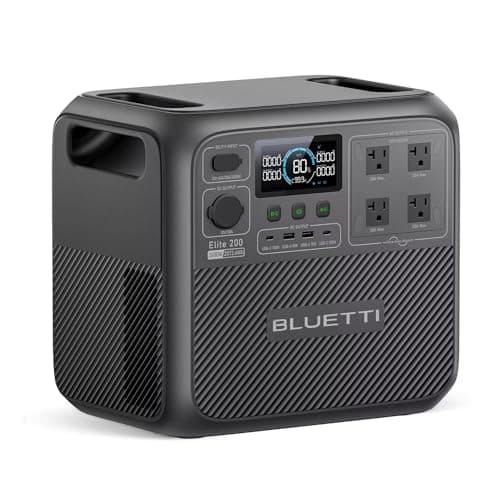
- BLUETTI Elite 200 V2 — 2,073.6 × 0.85 ÷ 150 = 11.7 h
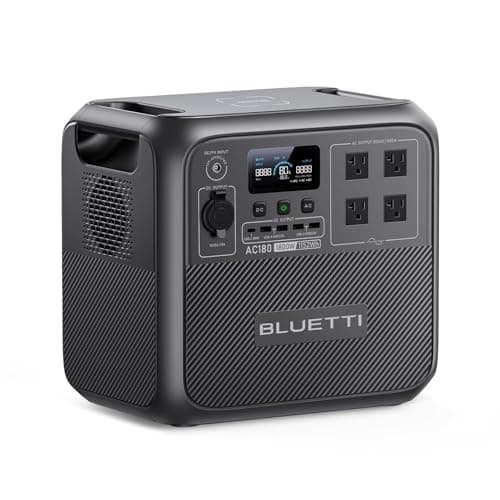
- BLUETTI AC180 — 1,152 × 0.85 ÷ 150 = 6.5 h
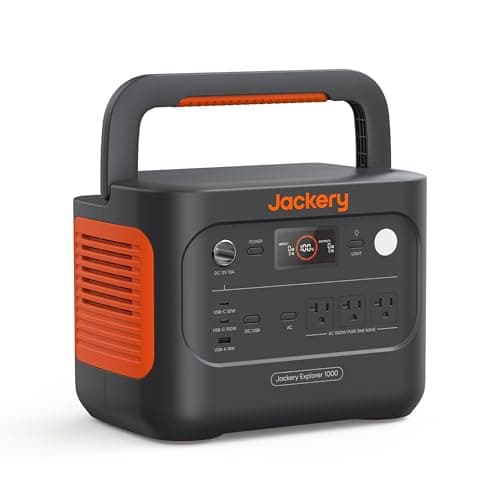
- Jackery Explorer 1000 v2 — 1,070 × 0.85 ÷ 150 = 6.1 h
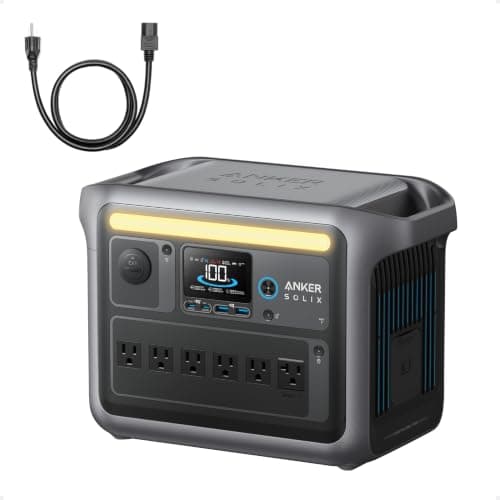
- Anker SOLIX C1000 — 1,056 × 0.85 ÷ 150 = 6.0 h
Change the assumption and every figure moves proportionally. At a 250W average — a large, older, or frequently-opened fridge — the AC180 gives 3.9 hours rather than 6.5. At 100W, for a small efficient unit in a cool house, it gives 9.8. Your fridge's actual consumption is on its EnergyGuide label in kWh per year; divide by 8,760 to get the average watts, and substitute that.
The thing that extends runtime for free
Keep the door shut. The USDA's guidance is that an unopened refrigerator holds safe temperature for about four hours on its own, a half-full freezer for about 24, and a full freezer for about 48. Every opening resets that.
Which produces a genuinely better strategy than running the fridge continuously: run it in blocks. Power it for an hour, switch it off for two, and let the thermal mass do the work. A well-sealed fridge holds temperature far longer than it takes to restore it, and this approach roughly doubles or triples what any station on this page delivers. It needs someone awake to manage it, which is its only real cost.
Match the purchase to the outage
Capacity is not a preference. It falls out of two numbers: how long your power is usually off, and what you refuse to lose while it is.
| Your outage lasts | What has to keep running | Realistic product class |
|---|
| Under 4 hours | Nothing. Keep the door shut and the fridge stays safe. | No purchase needed for the fridge
The outage sequence |
|---|
| 4–8 hours | Fridge cycling, run continuously or in blocks | 1,000–1,200Wh, 1,800W inverter
See the outage picks |
|---|
| Overnight to a full day | Fridge plus freezer, or fridge plus furnace fan | 2,000Wh+, 2,600W inverter
See the home-backup picks |
|---|
| Multiple days | Fridge and freezer, sustained, with no grid | Generator, or a large battery plus solar
See generators for outages |
|---|
What about a chest freezer?
Champion puts a freezer at 100–500W running and 500–1,000W starting — slightly less demanding than a refrigerator at startup, and often more efficient to run because a chest freezer opens from the top and does not spill its cold air.
The problem is not either appliance alone; it is both. Two compressors that happen to start within the same second combine their surges, and that combined figure can reach 2,200W. That is the specific case the 2,600W Elite 200 V2 exists to handle and the case where 1,800W units become a gamble. If you have both and both must run, buy the larger inverter.
If the answer is a generator instead
For anything beyond about twelve hours of refrigeration, a battery stops being the efficient answer. A small generator run for two hours twice a day keeps a fridge and a freezer cold indefinitely and costs a few dollars of fuel doing it — the fuel arithmetic is here.
The hybrid approach is better than either alone: a generator to refill the battery, and the battery to run the fridge silently overnight. The full comparison works through when each one wins.