Skip to content
Watt Warden

Power Stations

Anker SOLIX C1000 Review: The Fast One

A kilowatt-hour that refills in under an hour is a different product from a kilowatt-hour that takes three. This is the case for caring about recharge speed.

By Sawyer V.Updated Published How we work this out
Anker SOLIX C1000

Watt & Warden earns a commission on qualifying purchases made through links on this page, at no extra cost to you. It never changes a ranking, and our picks include products we tell you to skip. Full disclosure.

Quick picks

#ProductBest forPrice
1
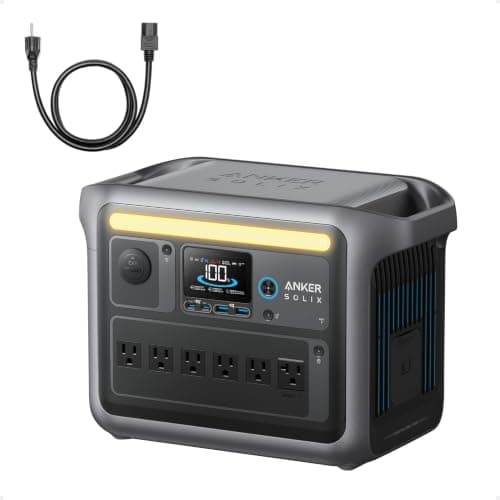
Anker SOLIX C1000

The unit under review

Anker SOLIX C1000

1,056Wh, 1,800W continuous with 2,400W SurgePad, 80% in 43 minutes and full in 58.

Storm outages that come and go
$499.99 · Check price on Amazon

#ad how this is funded · price as of October 20, 2026 · $599.99 17% off

2
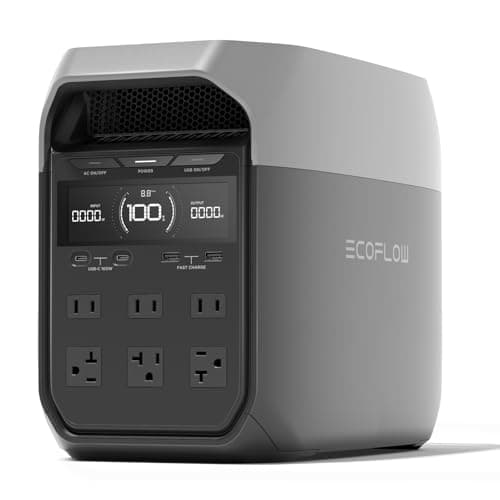
EcoFlow DELTA 3

The closest rival

EcoFlow DELTA 3

1,024Wh expandable to 5kWh, 1,800W continuous with 3,600W of surge and X-Boost to 2,200W.

Expanding later
$629.00 · Check price on Amazon

#ad how this is funded · price as of October 20, 2026 · $699.00 10% off

3
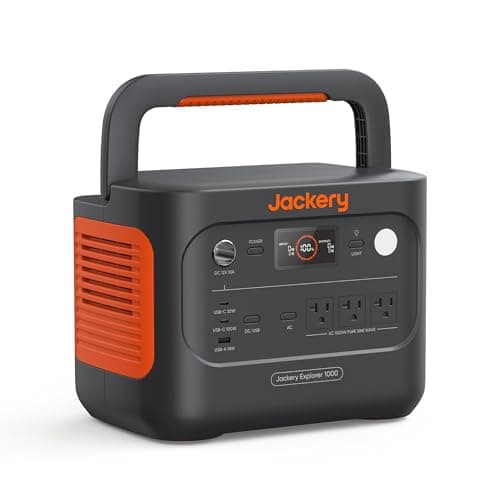
Jackery Explorer 1000 v2

The one to carry

Jackery Explorer 1000 v2

1,070Wh at 24 lb, with a 1,500W inverter and a 4,000-cycle rating.

Anything that leaves the house
$499.00 · Check price on Amazon

#ad how this is funded · price as of October 20, 2026 · $559.00 11% off

4
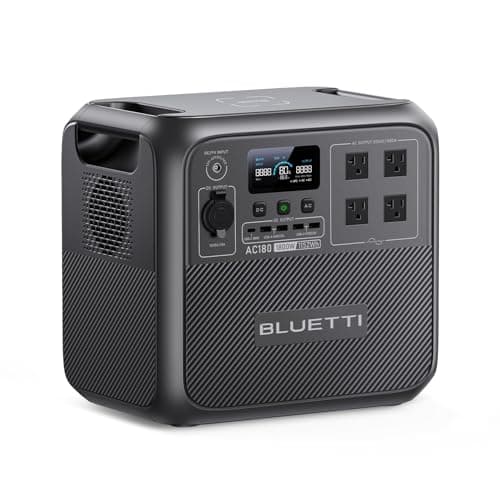
BLUETTI AC180

Most surge headroom

BLUETTI AC180

1,152Wh with 1,800W continuous and 2,700W of surge, rated 3,500+ cycles.

Compressors and pumps
$449.00 · Check price on Amazon

#ad how this is funded · price as of October 20, 2026 · $499.00 10% off

5
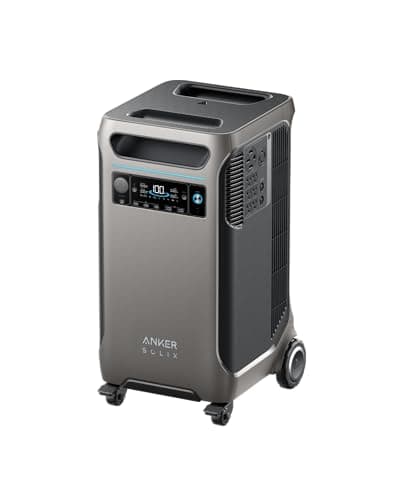
Anker SOLIX F3800

When 1kWh is not the answer

Anker SOLIX F3800

3,840Wh with 6,000W of 120/240V split-phase output and expansion to 26.9kWh.

Backing up a panel, not a worktop
$1,759.99 · Check price on Amazon

#ad how this is funded · price as of October 20, 2026

Prices come from the retailer at page-build time and change constantly. Where no live price is available the button reads “Check price” rather than showing a number we cannot stand behind.

How this review was done

We have not tested this unit. There is no bench on this site and our methodology page states that plainly. What follows is Anker's published specifications, the published figures of the units it competes with, and arithmetic shown in full.

Fifty-eight minutes is the product

The C1000 holds 1,056Wh of LiFePO4, delivers 1,800W continuous with 2,400W of SurgePad, and Anker publishes 80% in 43 minutes and a full charge in 58. Cells are rated at 3,000 cycles, solar input tops out at 600W, and a full solar recharge is published at about 1.8 hours.

Recharge speed sounds like a convenience specification until you think about how outages actually behave. A storm outage is rarely one clean block of darkness — the grid comes back at 2pm for forty minutes, drops again, returns at 7pm for an hour. The household that ends the day with a full battery is the one whose battery could use those windows.

In a forty-minute window, this unit takes on roughly 80% of a full charge. A 1.7-hour unit takes on rather less than half. That is the entire argument, and it only matters if your outages flicker.

The 1kWh class, compared

UnitCapacityContinuous / surgeRechargeCycle rating
Anker SOLIX C10001,056 Wh1,800 W / 2,400 W SurgePad80% in 43 min, full in 583,000 cycles
EcoFlow DELTA 31,024 Wh, to 3 kWh1,800 W / 2,700 WNot published here3,000+ cycles
BLUETTI AC1801,152 Wh1,800 W / 2,700 W0-80% in 45 min3,500+ cycles to 80%
Jackery Explorer 1000 v21,070 Wh1,500 W / 3,000 W~1.7 h full4,000 cycles to 70%

All figures are manufacturer specifications from the pages listed at the foot of this review. Cells that say "not published here" mean exactly that — we do not fill gaps with estimates.

Read down the capacity column and the class is a dead heat. Read across the other three and each unit has chosen a different thing to be best at: Anker chose speed, BLUETTI chose headroom and longevity, Jackery chose weight, EcoFlow chose expandability.

What 1,056Wh runs

Planning at 85% inverter efficiency gives about 898Wh usable.

LoadAverage drawRuntime
Refrigerator150 WAbout 6 hours
Gas furnace blower, cycling200 WAbout 4.5 hours
Router, modem and laptop75 WAbout 12 hours
CPAP, humidifier off40 WAbout 22 hours
Microwave, 1,000W class1,500 W while runningAbout 36 minutes of cooking

Runtime is 1,056Wh x 0.85 divided by the average draw. Nobody microwaves for 36 minutes — the row is there to show that cooking costs almost nothing in energy and everything in inverter capacity.

The microwave row is the practical difference between this unit and the 1,500W class. At 1,800W continuous the C1000 runs a standard 1,000W microwave, which draws about 1,500W at the wall. A 1,500W inverter does not.

Where the money goes

Every unit in this class costs roughly the same per watt-hour, so you are not buying energy. You are buying one of four specifications, and it is worth being honest about which one you actually need.

  • Speed (this unit). Worth it if your grid flickers or you recharge between trips.
  • Weight. Worth it if the battery leaves the house.
  • Surge headroom. Worth it if a compressor or pump is on the list.
  • Expandability. Worth it if you suspect 1kWh is not your final answer.

Who should buy it

  • Storm-outage households. The 43-minute figure is worth real money in an outage that comes and goes.
  • Anyone who wants a microwave on the list. 1,800W continuous is the threshold, and this clears it.
  • Solar users in a hurry. 600W of input and a published 1.8-hour solar recharge is the quickest daylight refill in the class.

Who should skip it

  • Anyone carrying it regularly — buy the 24 lb Jackery.
  • Anyone running it in a bedroom — fast charging means fan noise, and Jackery publishes a sub-30dB mode on its larger unit.
  • Anyone whose load list includes a well pump or 240V. That is not a 1kWh problem.

The short version

  • 1,056Wh, 1,800W, 2,400W SurgePad. A capable middle of the class.
  • 58 minutes to full is the specification you are paying for.
  • About six hours of refrigeration at 85% efficiency.
  • 3,000 cycles — respectable, and the shortest published rating in this table.
The picks in full

01 — The unit under review

Anker SOLIX C1000

1,056Wh, 1,800W continuous with 2,400W SurgePad, 80% in 43 minutes and full in 58.

Fifty-eight minutes to full is the specification that defines this unit. Its direct rivals publish 1.7 hours and 45 minutes to 80%, and in a flickering outage that gap decides whether you start the night full.

1,800W of continuous output clears the loads the 1,500W class cannot, and 2,400W of SurgePad covers the start of a motor.

The honest catch: Anker does not publish a weight on the specification page we cite, and fast charging is audible. For a bedroom, look at a quieter unit.

Skip it ifyou need it silent. Charging that fast means the fan runs.

Anker SOLIX C1000
$499.99 · Check price on Amazon

#ad how this is funded · price as of October 20, 2026 · $599.99 17% off

Published specifications for the Anker SOLIX C1000
SpecificationPublished figure
Usable capacity1,056 Wh
Cell chemistryLiFePO4 (LFP)
AC output1,800 W continuous / 2,400 W SurgePad
Cycle life3,000 cycles
Wall recharge80% in 43 min, full in 58 min
Max solar input600 W (full solar recharge ~1.8 h)
Ports11 total, including 6 AC on panel-equipped bundles

Source: Anker — SOLIX C1000 product specifications. These are the manufacturer's published figures, not ours — we have not tested this unit.

02 — The closest rival

EcoFlow DELTA 3

1,024Wh expandable to 5kWh, 1,800W continuous with 3,600W of surge and X-Boost to 2,200W.

The same inverter rating and near-identical capacity, with two things the Anker does not offer: expansion to 5kWh, and X-Boost, which runs resistive loads up to 2,200W by reducing voltage.

At 27.6 lb with a five-year warranty it is the more flexible purchase for a household that expects its needs to grow.

The honest catch: X-Boost is for heaters and kettles, not for anything with a motor or a compressor.

Skip it ifyou want the capacity you paid for today. Expansion is another purchase.

EcoFlow DELTA 3
$629.00 · Check price on Amazon

#ad how this is funded · price as of October 20, 2026 · $699.00 10% off

Published specifications for the EcoFlow DELTA 3
SpecificationPublished figure
Usable capacity1,024 Wh, expandable to 5 kWh
Cell chemistryLiFePO4 (LFP)
AC output1,800 W continuous / 3,600 W surge
X-Boost output2,200 W for resistive loads
Cycle life4,000 cycles to 80%+
AC rechargeFull in 56 minutes at 1,500 W input
Max solar input500 W
Weight27.6 lb (12.5 kg)
Outlets13 total
Warranty5 years

Source: EcoFlow — DELTA 3 product specifications. These are the manufacturer's published figures, not ours — we have not tested this unit.

03 — The one to carry

Jackery Explorer 1000 v2

1,070Wh at 24 lb, with a 1,500W inverter and a 4,000-cycle rating.

Effectively the same energy in the lightest package in the class. If the battery goes camping, in a truck or up a flight of stairs, weight beats recharge speed every time.

The 4,000-cycle rating to 70% is also longer than the C1000's published 3,000 cycles.

The honest catch: 300W less inverter and a slower refill, which is the trade you are making for the pounds.

Skip it ifcooking is on the list. 1,500W will not hold a microwave.

Jackery Explorer 1000 v2
$499.00 · Check price on Amazon

#ad how this is funded · price as of October 20, 2026 · $559.00 11% off

Published specifications for the Jackery Explorer 1000 v2
SpecificationPublished figure
Usable capacity1,070 Wh
Cell chemistryLiFePO4 (LFP)
AC output1,500 W continuous / 3,000 W surge
Weight24 lb
Cycle life4,000 cycles to 70% capacity
Max solar input400 W
Wall recharge~1.7 h, or ~1 h in emergency mode
Warranty3 years, extendable to 5 on registration

Source: Jackery — Explorer 1000 v2 product specifications. These are the manufacturer's published figures, not ours — we have not tested this unit.

04 — Most surge headroom

BLUETTI AC180

1,152Wh with 1,800W continuous and 2,700W of surge, rated 3,500+ cycles.

The largest capacity and the largest surge figure in the 1kWh class, with a five-year registered warranty behind it.

Surge is what a refrigerator, a sump pump or a small compressor asks for in the instant it starts, and 2,700W is real margin.

The honest catch: 45 minutes to 80% is quick, but BLUETTI does not publish a time to full on the page we cite.

Skip it ifyou have to lift it. 35.3 lb is the heaviest here.

BLUETTI AC180
$449.00 · Check price on Amazon

#ad how this is funded · price as of October 20, 2026 · $499.00 10% off

Published specifications for the BLUETTI AC180
SpecificationPublished figure
Usable capacity1,152 Wh (32 V, 36 Ah)
Cell chemistryLiFePO4 (LFP)
AC output1,800 W continuous / 2,700 W surge, 4 outlets
Cycle life3,500+ cycles to 80% capacity
Weight35.3 lb
Fast charge0–80% in 45 min
Max solar input500 W
Warranty5 years on registration

Source: BLUETTI — AC180 product specifications. These are the manufacturer's published figures, not ours — we have not tested this unit.

05 — When 1kWh is not the answer

Anker SOLIX F3800

3,840Wh with 6,000W of 120/240V split-phase output and expansion to 26.9kWh.

If the load list has a well pump, a 240V appliance or a whole-house ambition, no 1kWh unit is the answer and no number of them adds up to one.

This is the Anker unit that does that job — reviewed in full here.

The honest catch: it costs several times what the C1000 does, and most households genuinely do not need it.

Skip it ifyou want to move it. It is a wheeled appliance, not a portable.

Anker SOLIX F3800
$1,759.99 · Check price on Amazon

#ad how this is funded · price as of October 20, 2026

Published specifications for the Anker SOLIX F3800
SpecificationPublished figure
Capacity3,840 Wh
Cell chemistryLiFePO4
AC output6,000 W continuous, 9,000 W surge
Voltage120V / 240V split-phase
Cycle life3,000+ cycles to 80% capacity
Recharge1,800 W AC, up to 2,400 W solar
ExpansionUp to six expansion batteries, 26.9 kWh total
Warranty5 years
Current Amazon listingRenewed. Anker's new first-party F3800 listing is currently unavailable and the model has been succeeded by the F3800 Plus; the unit itself is unchanged

Source: Anker SOLIX — F3800 product specifications. These are the manufacturer's published figures, not ours — we have not tested this unit.

How these were chosen

We did not test these. Nobody at Watt & Warden has plugged one in. What we did instead: read the manufacturer's published specifications, compile them into a table where the figures line up, and compute the numbers manufacturers leave out — runtime against a real appliance load, and what an hour of running actually costs.

Anything that could not be sourced was left out rather than estimated, and every pick names the buyer who should skip it. The full method is here, including where it is weaker than a publisher with a test bench.

Questions people actually ask

Did you test the Anker SOLIX C1000?

No. This site runs no test bench and states that on every page. The review is built from Anker's published specifications, the published specifications of rival units, and arithmetic shown on the page.

How long does the Anker SOLIX C1000 take to charge?

Anker publishes 80% in 43 minutes and a full charge in 58 minutes from a wall outlet, and about 1.8 hours from its 600W maximum solar input. That is the fastest published wall recharge in the 1,000Wh class we cover.

Will the C1000 run a microwave?

A standard 1,000W microwave draws roughly 1,400 to 1,600W at the wall, which is inside the 1,800W continuous rating, and SurgePad covers the start. A 1,200W microwave approaching 1,900W of input is not a safe assumption -- check the input rating on the appliance nameplate.

What is SurgePad?

Anker's name for short-term output above the continuous rating -- 2,400W against the 1,800W continuous figure. It exists to cover the inrush current when a motor or compressor starts. It is not a sustained output level, so size your continuous loads against 1,800W.

C1000 or Jackery Explorer 1000 v2?

Capacity is a tie at 1,056Wh against 1,070Wh. The Anker gives you 300W more inverter and a far faster refill; the Jackery gives you 24 lb and a longer 4,000-cycle rating. If the battery stays home, buy the Anker. If it travels, buy the Jackery.

Sources

Every figure on this page comes from a published source. We have not tested this equipment, so the specifications are the manufacturer's and the statistics are the dataset's — the arithmetic on top of them is ours, and it is shown in full so you can check it. How we work this out.