Skip to content
Watt Warden

Power Stations

The Best Power Stations Under $500 (2026)

At this budget you are buying a communications-and-lights unit, and that is a genuinely useful thing to own. What you are not buying is a refrigerator. Here is where the line falls and why.

By Sawyer V.Updated Published How we work this out
A small battery pack charging a phone on a desk.

Watt & Warden earns a commission on qualifying purchases made through links on this page, at no extra cost to you. It never changes a ranking, and our picks include products we tell you to skip. Full disclosure.

Quick picks

#ProductBest forPrice
1
No photo

Best of the small units

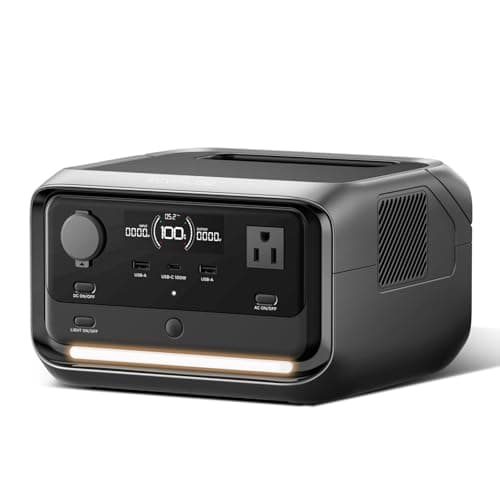
EcoFlow RIVER 3 Plus

286Wh with a 600W inverter and sub-10ms UPS switchover — it doubles as a proper UPS.

A desk, a router and a short outage
2
No photo

Lightest useful unit

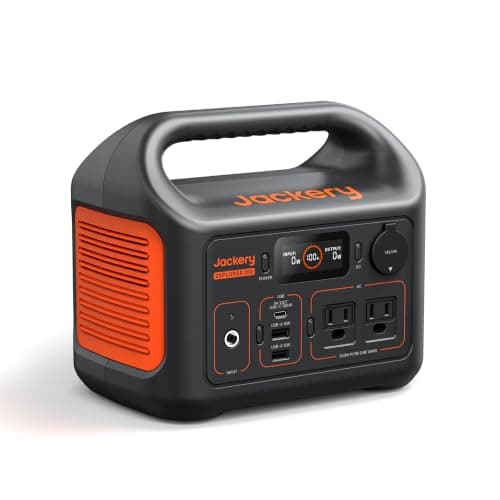
Jackery Explorer 300 Plus

288Wh in 8.3 lb, with app monitoring and a wide range of compatible panels.

Carrying it anywhere, including away from home
3
No photo

Cheapest way to keep the internet on

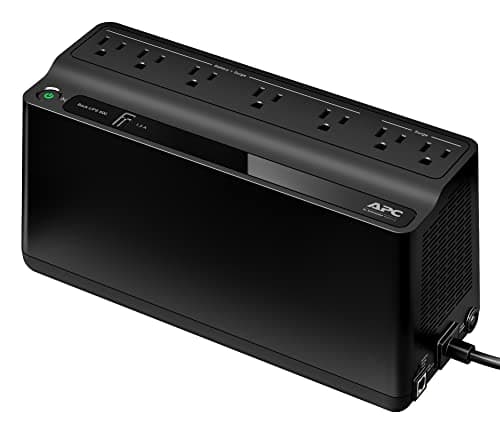
APC Back-UPS BE600M1

600VA of battery backup that does one job properly, for a fraction of a power station.

Just the modem and router

Prices come from the retailer at page-build time and change constantly. Where no live price is available the button reads “Check price” rather than showing a number we cannot stand behind.

What this budget actually buys

Under $500 buys somewhere between 250Wh and 500Wh, with an inverter between 300W and 600W. Both of those numbers matter and the second one matters more, because it is what sets a hard boundary on what the unit can be asked to do.

A 600W inverter runs anything that does not contain a motor or a heating element. That is a longer list than it sounds: routers, modems, laptops, monitors, LED lighting, phone and tablet charging, a CPAP machine, a television, a small fan. For a four-hour outage that covers essentially everything a household needs except cold food.

What it does not run is the refrigerator, and this is where sub-$500 listings become misleading. Champion's published reference puts a domestic fridge at 800–1,200W to start. A 300W or 600W inverter refuses that, immediately and permanently, and there is no configuration or setting that changes it. Any listing implying a 300Wh station will keep your food cold is describing a product that does not exist at this price.

Match the purchase to the outage

Capacity is not a preference. It falls out of two numbers: how long your power is usually off, and what you refuse to lose while it is.

Your outage lastsWhat has to keep runningRealistic product class
1–4 hoursRouter, phones, a couple of lamps250–300Wh — anything on this page
You are already here
4–8 hoursAbove, plus a laptop working day and a television500Wh+, or a 300Wh unit with a solar panel
See solar generators
Overnight, including the fridgeAbove, plus a refrigerator that must not warm up1,100Wh+ with an 1,800W inverter — a different tier
See the home-backup picks

Why a small unit is often the right buy anyway

The advice everywhere else in this category is to buy bigger. That advice is wrong for a large number of households, and the EIA's data is why.

The Electric Power Annual for 2024 records about two hours of non-major-event interruption per U.S. customer across the whole year, and four states — Arizona, South Dakota, North Dakota and Massachusetts — averaged under two hours in total including major events. If that is your situation, a 1,000Wh station is a machine bought for an outage you do not get, and the money would do more good elsewhere.

A small unit also gets used. It goes camping, it charges things on a picnic table, it runs a laptop in the yard. A 40 lb station in a basement gets forgotten, and a forgotten battery is a flat battery.

Where the food question lands

If your worry is genuinely the freezer, the honest answer at this budget is not a battery — it is the door. The USDA's guidance is that a full freezer holds safe temperature for roughly 48 hours unopened and a half-full one about 24, while a refrigerator manages about four. Keeping the door shut buys you more hours than any sub-$500 station could, and it costs nothing.

Combine that with a small battery for the router and the phones, and a typical short outage is fully covered for well under the price of a single 1kWh unit. The full outage sequence is here.

The upgrade path, if you need one

If you read the above and concluded your outages are longer than this tier covers, go up rather than sideways. The outage picks start at the 1kWh, 1,800W point where the fridge becomes possible. Generators under $1,000 buy several times the energy for the same money, at the cost of noise, fuel and having to stand outside.

What is not worth doing is buying two small units. Two 300Wh stations cost more than one 600Wh station, weigh more together, and still cannot start a fridge — inverters do not add up across separate boxes.
The picks in full

01Best of the small units

EcoFlow RIVER 3 Plus

286Wh with a 600W inverter and sub-10ms UPS switchover — it doubles as a proper UPS.

The UPS behavior is what makes this different from a battery with a outlet on it. Sub-10ms switchover means a desktop, a modem or a network switch plugged into it never registers that the grid failed. For anyone working from home, that alone is worth the difference over a dumber unit.

600W continuous covers essentially every non-motor load in a house: laptops, monitors, routers, lamps, a phone charger, a small fan. X-Boost lifts that to a claimed 1,200W for resistive loads only — useful for a kettle, not for a fridge, and worth understanding as the narrow thing it is.

286Wh expandable to 858Wh is real, but do the arithmetic before you rely on it: buying the base unit plus an expansion usually costs more than buying a 1kWh station outright. The expansion is a change-of-circumstance option, not a plan.

Skip it ifyou want it for camping runtime rather than outage cover. 286Wh empties fast, and the expansion battery costs more than a larger unit would have.

Published specifications for the EcoFlow RIVER 3 Plus
SpecificationPublished figure
Usable capacity286 Wh (expandable to 858 Wh)
Cell chemistryLiFePO4 (LFP)
AC output600 W continuous / 1,200 W with X-Boost
UPS switchoverunder 10 ms
Operating noiseunder 30 dB
AC recharge1 hour

Source: EcoFlow — RIVER 3 Plus product specifications. These are the manufacturer's published figures, not ours — we have not tested this unit.

02Lightest useful unit

Jackery Explorer 300 Plus

288Wh in 8.3 lb, with app monitoring and a wide range of compatible panels.

8.3 lb is the specification. This is a unit that goes in a car, on a camping trip and into a closet without any of those being a decision, which means it gets used — and equipment that gets used routinely is equipment that is charged when the storm arrives.

The 300W inverter is genuinely limiting and worth being clear about: it runs a laptop, a router, lights, a CPAP machine (Champion's chart puts one at 30–60W without heat, 60–120W with a heated humidifier), and a phone charger. It does not run a fridge, a microwave at 600–1,200W, or a space heater at 750–1,500W.

Solar compatibility across Jackery's 40W to 100W SolarSaga range makes it the easiest unit here to turn into something self-sustaining for a multi-day event, which partially offsets the small battery.

Skip it ifyou need to run anything with a motor. The 300W inverter is half the RIVER 3 Plus's and it is the binding constraint.

Published specifications for the Jackery Explorer 300 Plus
SpecificationPublished figure
Usable capacity288 Wh
Cell chemistryLiFePO4 (LFP)
AC output300 W continuous
Weight8.3 lb (3.75 kg)
Solar compatibilitySolarSaga 40/60/80/100 W panels
ControlWi-Fi and Bluetooth app monitoring

Source: Jackery — Explorer 300 Plus product specifications. These are the manufacturer's published figures, not ours — we have not tested this unit.

03Cheapest way to keep the internet on

APC Back-UPS BE600M1

600VA of battery backup that does one job properly, for a fraction of a power station.

This is not a power station and it is here deliberately. If the only thing you actually need through a short outage is the internet — and for a great many households it is, because the phones have their own batteries — a small UPS does that job for a fraction of the price.

A modem and a router together draw somewhere near 20W. APC publishes about 23 minutes of runtime at a 100W load, which at 20W extends considerably further. Five battery-backed outlets and two surge-only outlets is the right shape for a small network shelf.

The honest limits: 330W of output means no appliances, and the internal battery is a consumable with a 3–5 year life that you will eventually replace. The full router-and-modem comparison is here.

Skip it ifyou want it to power anything else. 330W and roughly 23 minutes at 100W is a bridge, not a backup system.

Published specifications for the APC Back-UPS BE600M1
SpecificationPublished figure
Capacity600 VA / 330 W
Outlets7 total — 5 battery-backed, 2 surge-only
Run timeabout 23 min at a 100 W load
Transfer time6–10 ms typical
Battery life3–5 years depending on use
ExtrasUSB charging port

Source: APC — Back-UPS BE600M1 product specifications. These are the manufacturer's published figures, not ours — we have not tested this unit.

How these were chosen

We did not test these. Nobody at Watt & Warden has plugged one in. What we did instead: read the manufacturer's published specifications, compile them into a table where the figures line up, and compute the numbers manufacturers leave out — runtime against a real appliance load, and what an hour of running actually costs.

Anything that could not be sourced was left out rather than estimated, and every pick names the buyer who should skip it. The full method is here, including where it is weaker than a publisher with a test bench.

Questions people actually ask

Will a $500 power station run a refrigerator?

No, and the limit is the inverter rather than the battery. A fridge needs 800-1,200W for an instant to start its compressor, per Champion's published chart, and units in this price band top out at 300-600W continuous. The refusal is immediate and there is no workaround.

What can a 300Wh power station actually run?

A router and modem for the better part of a day, several phone charges, LED lighting for far longer than you will need it, a laptop for a full working day, and a CPAP machine overnight without the heated humidifier. It will not run anything with a compressor or a heating element.

Is a UPS better than a small power station?

For keeping a modem and router alive through a short outage, a small UPS is cheaper and switches over instantly. A power station is more versatile -- it is portable, it charges from solar, and it powers things away from a wall outlet. If you only need the internet, buy the UPS.

Should I buy two small units instead of one big one?

No. Two 300Wh units cost more than one 600Wh unit, weigh more in total, and their inverters do not combine -- you still cannot start a fridge on either of them. Capacity adds across units; output does not.

Sources

Every figure on this page comes from a published source. We have not tested this equipment, so the specifications are the manufacturer's and the statistics are the dataset's — the arithmetic on top of them is ours, and it is shown in full so you can check it. How we work this out.