Skip to content
Watt Warden

Generators

The Best Generators for Hurricane Season (2026)

In 2024, hurricanes Beryl, Helene and Milton caused 80% of all U.S. outage hours. That is the outage this page is sized for — measured in days, with no working gas station.

By Sawyer V.Updated Published How we work this out
Hurricane storm clouds approaching a coastline.

Watt & Warden earns a commission on qualifying purchases made through links on this page, at no extra cost to you. It never changes a ranking, and our picks include products we tell you to skip. Full disclosure.

Quick picks

#ProductBest forPrice
1
No photo

Best overall for a multi-day outage

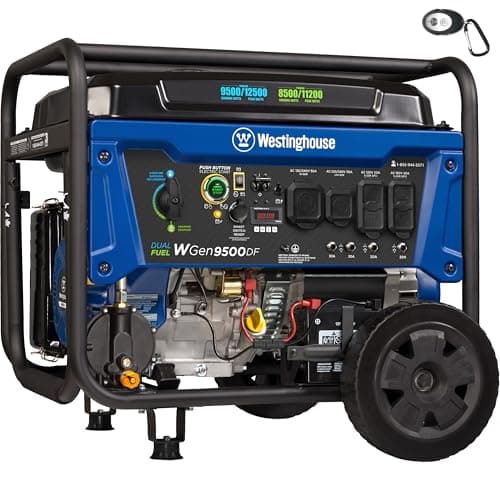
Westinghouse WGen9500DF

9,500 running watts, dual fuel, with both a 30A transfer-switch outlet and a 50A RV outlet.

Whole critical load, including a well pump
2
No photo

Most capacity without a standby install

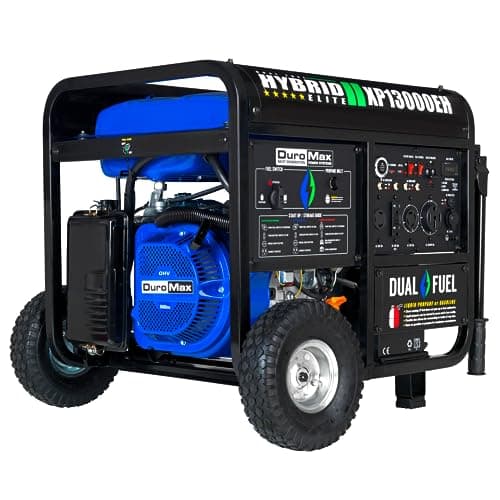
DuroMax XP13000EH

13,000 running watts and a 50A transfer-switch outlet — effectively whole-panel coverage.

Houses with central air conditioning
3
No photo

Best fuel economy for the coverage

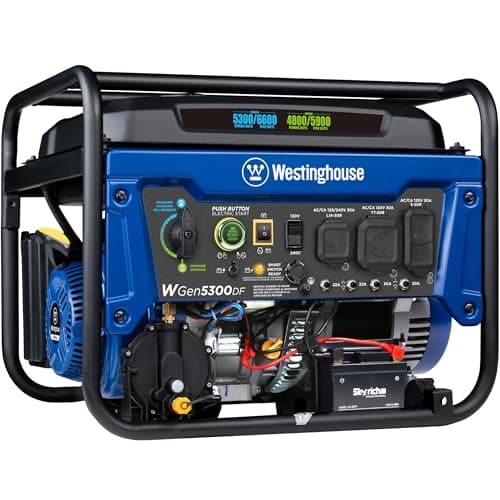
Westinghouse WGen5300DF

5,300 running watts and 14.5 hours on a 4.7-gallon tank, which is the longest run per gallon here.

Fridge, furnace, sump pump, lights — the actual list
4
No photo

Best if noise matters

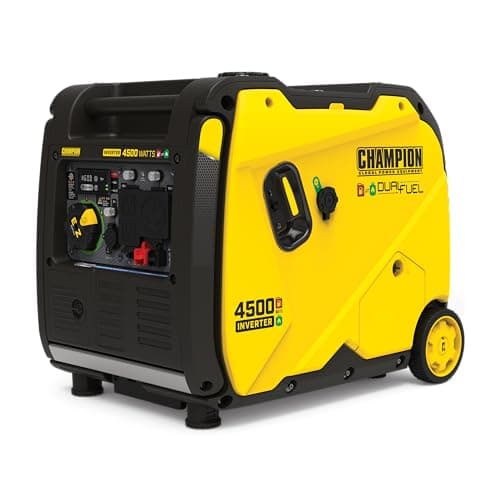
Champion 200988 4500W dual fuel inverter

4,500 starting watts of dual-fuel inverter power — quiet enough not to be the reason nobody sleeps.

Dense neighborhoods and overnight running
5
No photo

The part everyone forgets to buy

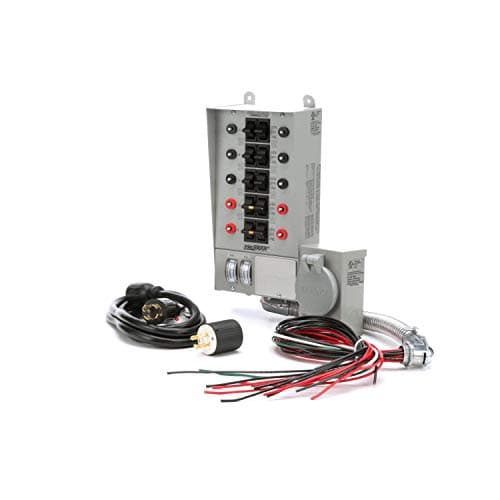
Reliance Controls 31410CRK Pro/Tran

A 10-circuit manual transfer switch — the legal, non-lethal way to connect any of the above to a house.

Anyone running hard-wired circuits

Prices come from the retailer at page-build time and change constantly. Where no live price is available the button reads “Check price” rather than showing a number we cannot stand behind.

Why hurricane outages are a different purchase

The EIA's Electric Power Annual for 2024 makes the case better than any argument could. U.S. customers averaged eleven hours without power that year — the most in a decade — and hurricanes Beryl, Helene and Milton alone accounted for 80% of those hours. Customers in South Carolina averaged nearly 53 hours. Customers in Arizona averaged under two.

A machine sized for the national average is sized for the wrong event. If you live where hurricanes make landfall, your outage is not eleven hours spread thinly across a year; it is one multi-day event, in heat, with the roads blocked and the gas stations dark. Everything below follows from that.

The three requirements hurricane season adds

1. Fuel you can actually obtain. This is the one people underestimate. When a region loses power, gas station pumps stop working — they are electric. The fuel available to you is what you stored before the storm, plus propane, which is sold from unpowered pallets and exchange cages. Dual fuel is not a convenience feature here; it is the difference between a generator that runs on day four and an ornament.

2. Enough capacity for heat. Hurricanes are a warm-weather event, and after the water recedes the problem is temperature. Champion's reference puts a 10,000 BTU window air conditioner at 900–1,200W running and 1,800–2,400W starting — a manageable load. Central air at 3,500–6,000W starting is not, and it is the specification that decides whether you need 5,000 watts or 13,000.

3. Electric start. Pull-starting a 457cc engine is a real physical task in good conditions. In wind, in rain, on the second day, by whoever happens to be home, it is a bad plan. Every pick here has electric start and most have a remote fob.

Match the purchase to the outage

Capacity is not a preference. It falls out of two numbers: how long your power is usually off, and what you refuse to lose while it is.

Your outage lastsWhat has to keep runningRealistic product class
Under 12 hoursFridge, phones, lightsA power station — quieter, indoor-safe, no fuel
See power stations
1–2 daysFridge, furnace or window AC, sump pump, lights4,500–5,500 running watts, dual fuel
See generators under $1,000
3–7 daysAbove, sustained, plus a well pump7,500–9,500 running watts, dual fuel, transfer switch
How to connect it
3–7 days with central airThe whole panel including a central AC compressor13,000 running watts, or a standby installation
See whole-house options
Outage duration figures from the U.S. Energy Information Administration's Electric Power Annual for 2024. Appliance figures from Champion Power Equipment's published wattage chart.

Three days of fuel, costed

This is the number that changes plans, and almost nobody publishes it. A mid-sized generator consumes roughly 0.75 gallons an hour at half load. At the EIA's reported U.S. average of $4.071 a gallon for regular gasoline in the week ending 31 August 2026:

What it costs to actually run

The sticker price of a dual-fuel generator is a fraction of what it costs you. The sticker price of a battery is nearly all of it. Here is the arithmetic, with the inputs stated so you can redo it with your own fuel price.

UnitPublished consumptionCost per hourCost per 24 h
Continuous running0.75 gal/hr × 24 h = 18 gal/day$3.05$73.28
12 hours a day (daytime only)0.75 gal/hr × 12 h = 9 gal/day$3.05$36.64
4 hours a day (fridge cycling only)0.75 gal/hr × 4 h = 3 gal/day$3.05$12.21
Propane, continuousroughly 1.0 gal/hr × 24 h = 24 gal/day$2.67$64.18
Gasoline at $4.071/gal (EIA weekly retail, week ending 31 August 2026). Propane at $2.674/gal (EIA weekly residential, week ending 30 March 2026 — the series publishes through the heating season only, and a 20 lb exchange cylinder costs substantially more per gallon than bulk residential delivery). Consumption of 0.75 gal/hr is a working figure for a mid-sized unit at half load; propane burns roughly a third more volume for the same energy. Your machine's manual publishes its own figure — use that.

The cost is the smaller problem. Eighteen gallons a day is four full five-gallon cans, and most households store two. Three days of continuous running is over fifty gallons, which is not a quantity you can safely or legally keep in a garage.

Which is why the practical answer is not continuous running. Run the generator in blocks — four to six hours a day, timed around the fridge and the well pump — and use a battery to carry the quiet hours. That combination is cheaper, quieter, and needs a third of the fuel.

Buy the connection before the storm

The most common failure in this whole category is owning a generator and having no legal way to connect it to the things that matter. Extension cords reach a fridge and a lamp. They do not reach a furnace, a well pump or a sump pump, because those are hard-wired.

That needs a transfer switch or an interlock kit, fitted by an electrician, with a permit in most places. Electricians are booked solid the week a hurricane is forecast and unavailable the week after. This is an off-season purchase and it is the one that most changes whether the generator is useful.

And never backfeed. Plugging a generator into a wall outlet with a double-male cord energizes your house circuits and sends power back up the utility line at lethal voltage. It kills lineworkers. It is illegal essentially everywhere. The safe methods are here.

The safety rule that is not negotiable

Carbon monoxide from portable generators kills people after every major storm, and the pattern is always the same: the machine was in a garage, on a porch, in a basement or under a window. Twenty feet from the house, exhaust pointed away from every door, window and vent, and a working CO alarm on every level. Read the full guide before the storm, not during it.
The picks in full

01Best overall for a multi-day outage

Westinghouse WGen9500DF

9,500 running watts, dual fuel, with both a 30A transfer-switch outlet and a 50A RV outlet.

9,500 running watts is enough for a genuine critical-load group with room for a well pump — Champion's chart puts a one-horsepower well pump at 1,000–2,000W running and 2,000–4,000W starting, and this absorbs that without noticing.

Dual fuel is the specification that matters in a hurricane specifically. When a region loses power, gas stations lose the power to run their pumps, and the fuel you can actually get is the propane already in your grill tank or on a hardware store pallet. Propane also stores indefinitely, which gasoline does not.

The 457cc engine runs up to 12 hours on its 6.6-gallon tank, and both outlets matter: the L14-30R feeds a transfer switch for hard-wired circuits, and the 14-50R covers an RV if you evacuate in one. Electric start with a remote key fob means not pull-starting a 457cc engine in wind.

Skip it ifyou have no way to store fuel. At roughly 0.75 gal/hr this needs about 18 gallons for three days, which is four full five-gallon cans.

Published specifications for the Westinghouse WGen9500DF
SpecificationPublished figure
Output (gasoline)9,500 running W / 12,500 peak W
FuelGasoline or propane (dual fuel)
Engine457cc 4-stroke OHV, cast iron sleeve
Tank6.6 gal (25 L)
Run timeup to 12 h on a full tank
Transfer-switch outlet120/240 V L14-30R, 30 A
RV outlet120/240 V 14-50R, 50 A
StartingPush-button electric with remote key fob
Warranty3-year limited

Source: Westinghouse — WGen9500DF product specifications. These are the manufacturer's published figures, not ours — we have not tested this unit.

02Most capacity without a standby install

DuroMax XP13000EH

13,000 running watts and a 50A transfer-switch outlet — effectively whole-panel coverage.

Central air conditioning is what pushes a household out of every other machine on this page. Champion's reference puts a three-ton central unit at 3,000–3,500W running and 5,000–6,000W starting — a surge that eliminates most portables outright. 13,000 running watts from a 500cc engine handles it alongside the rest of the house.

The 50A transfer-switch outlet is the tell that this is designed as near-standby equipment rather than as a camping generator. The all-metal frame with no plastic panels is the other.

Be honest about the fuel implication before buying it. A machine this size at a heavier load consumes considerably more than the 0.75 gal/hr figure we use for a mid-sized unit at half load, and in a multi-day outage that becomes a logistics problem rather than a cost one.

Skip it ifyou will not be running air conditioning. This burns fuel in proportion to its size and it is the largest here.

Published specifications for the DuroMax XP13000EH
SpecificationPublished figure
Output13,000 running W / 16,000 peak W
FuelGasoline or propane (dual fuel)
Engine500cc OHV DuroMax
Transfer-switch outlet50 A
FrameAll-metal, no plastic panels
SafetyLow-oil shutoff; 5 ft propane hose with ACME connector

Source: DuroMax — XP13000EH product specifications. These are the manufacturer's published figures, not ours — we have not tested this unit.

03Best fuel economy for the coverage

Westinghouse WGen5300DF

5,300 running watts and 14.5 hours on a 4.7-gallon tank, which is the longest run per gallon here.

This is the size most households actually need and it is consistently over-bought past. A refrigerator, a furnace fan, a sump pump and lighting comes to roughly 1,500W running with a peak near 3,200W on Champion's published figures. 5,300 running watts covers that with substantial margin.

The fuel figure is the argument: up to 14.5 hours on 4.7 gallons, against the WGen9500DF's 12 hours on 6.6. Over three days, the smaller machine burns materially less fuel to do the job you actually asked of it, and fuel availability — not fuel cost — is what constrains you in a hurricane.

Dual fuel, transfer-switch ready via L14-30R, RV-ready via TT-30R, and remote electric start. It gives up 500 watts on propane (4,800 running against 5,300), which is the normal 10–15% penalty.

Skip it ifyou have central air conditioning. 5,300W will not start a three-ton compressor.

Published specifications for the Westinghouse WGen5300DF
SpecificationPublished figure
Output (gasoline)5,300 running W / 6,600 peak W
Output (propane)4,800 running W / 5,900 peak W
Engine274cc 4-stroke OHV
Tank4.7 gal (18 L)
Run timeup to 14.5 h on a full tank
Transfer-switch outlet120/240 V L14-30R, 30 A
RV outlet120 V TT-30R, 30 A
StartingPush-button electric with remote key fob

Source: Westinghouse — WGen5300DF product specifications. These are the manufacturer's published figures, not ours — we have not tested this unit.

04Best if noise matters

Champion 200988 4500W dual fuel inverter

4,500 starting watts of dual-fuel inverter power — quiet enough not to be the reason nobody sleeps.

After a hurricane, everyone on the street runs a generator, and the cumulative noise is genuinely miserable for days. An inverter generator throttles its engine to the load instead of holding 3,600 rpm regardless, which is why it is dramatically quieter at the partial loads a house actually draws.

Dual fuel on an inverter is an uncommon and useful combination: you get the propane availability advantage and the noise advantage in one machine. Electric start and an RV-ready TT-30R outlet round it out.

The trade is capacity. 3,500 running watts on gasoline covers a fridge, a furnace fan and lights but leaves little margin, and it will not start a large well pump. Champion's three-year warranty with lifetime technical support is unusually good for the category.

Skip it ifyou need to run a well pump or air conditioning. 3,500 running watts is the real number and it is the constraint.

Published specifications for the Champion 200988 4500W dual fuel inverter
SpecificationPublished figure
Output4,500 starting W / 3,500 running W (gasoline)
TypeInverter, RV ready
FuelGasoline or propane (dual fuel)
StartingElectric start
RV outlet120 V TT-30R, 30 A
Warranty3-year limited with free lifetime technical support

Source: Champion Power Equipment — 4500-watt dual fuel inverter specifications. These are the manufacturer's published figures, not ours — we have not tested this unit.

05The part everyone forgets to buy

Reliance Controls 31410CRK Pro/Tran

A 10-circuit manual transfer switch — the legal, non-lethal way to connect any of the above to a house.

A generator cannot power a furnace, a well pump or a sump pump through an extension cord, because those are hard-wired. The switch is what connects them, and it is routinely discovered the week the storm is forecast rather than months before.

Ten circuits — six 15A and four 20A — rated to 30A and 7,500W total, with two watt meters so you can balance the load rather than guess. The break-before-make double-throw switching mechanically prevents backfeed, which is the point: it makes it impossible to send power up the utility line and kill the lineworker restoring your street.

Budget for the electrician as well as the switch. In most jurisdictions this is permitted work tying into your service panel, and the labor typically costs more than the hardware. The transfer switch versus interlock decision is here.

Skip it ifyou only intend to run extension cords to a fridge and a lamp. That is legitimate and needs no switch.

Published specifications for the Reliance Controls 31410CRK Pro/Tran
SpecificationPublished figure
Circuits10 — six 15 A and four 20 A single-pole breakers
Rating30 A, up to 7,500 W
MeteringTwo watt meters for balancing the load
SwitchingBreak-before-make double-throw, Line / Off / Gen
BackfeedMechanically prevented — the grid cannot be energized
InstallationLicensed electrician; a permit is usually required

Source: Reliance Controls — Pro/Tran 31410CRK product page. These are the manufacturer's published figures, not ours — we have not tested this unit.

How these were chosen

We did not test these. Nobody at Watt & Warden has plugged one in. What we did instead: read the manufacturer's published specifications, compile them into a table where the figures line up, and compute the numbers manufacturers leave out — runtime against a real appliance load, and what an hour of running actually costs.

Anything that could not be sourced was left out rather than estimated, and every pick names the buyer who should skip it. The full method is here, including where it is weaker than a publisher with a test bench.

Questions people actually ask

What size generator do I need for hurricane season?

5,000-7,500 running watts covers a refrigerator, a furnace or window air conditioner, a sump pump and lighting for most homes. Add a well pump and you want 7,500-9,500. Central air conditioning pushes you to 13,000 or to a standby installation, because a three-ton compressor alone needs 5,000-6,000W to start.

Should I get a dual fuel generator for hurricanes?

Yes, and it is the most important specification for this use. Gas station pumps are electric, so a regional outage means no gasoline for days. Propane is sold from unpowered exchange cages, stores indefinitely, and does not gum a carburetor. You give up 10-15% of rated output on propane, which is a good trade for fuel you can actually get.

How much fuel do I need for a 3-day outage?

Running continuously at 0.75 gallons an hour, about 54 gallons -- which is more than you can safely store. Running in blocks of four to six hours a day, 9 to 14 gallons, which is two or three cans. Block running is the realistic plan and it is what to budget for.

Can I run a generator during a hurricane?

Not during the storm itself -- it must run outdoors and it cannot run safely in high wind and driving rain, and going outside to start it is dangerous. Generators are for after the storm passes. Plan on the outage starting before the machine can be used.

Sources