What this review is and is not
This site runs no test bench, so nothing below is a measurement. Every figure here comes from Anker's own published specification pages for the C2000 Gen 2, the BP2000 Gen 2 expansion battery and the S2000, all cited at the foot of the page. Where we do arithmetic on those figures we say so and show the sum, so you can check it.
That matters more than usual on this unit, because two of its headline numbers do not mean what the marketing implies.
The specification, in one place
| C2000 Gen 2 | S2000 |
|---|
| Capacity | 2,048 Wh | 2,010 Wh |
|---|
| AC output | 2,400 W max / 4,000 W peak | 1,500 W rated / 3,000 W peak |
|---|
| Cycle life | 4,000 cycles | 6,000 to 80%, 10,000 to 60% |
|---|
| Max solar input | 800 W | 400 W |
|---|
| AC input | 1,800 W max | 1,150 W, or 1,600 W in UltraFast mode |
|---|
| Expansion | One BP2000 Gen 2, to 4,096 Wh | None |
|---|
| RV socket | TT-30R, 1x | Not published |
|---|
| UPS switchover | 10 ms, UL 1178 certified | 10 ms or less |
|---|
| Weight | 41.7 lb (18.9 kg) | 35.7 lb (16.2 kg) |
|---|
| Warranty | Not stated in Anker's spec table | 5-year |
|---|
Both columns are Anker's published figures, from the two product pages linked under Sources. Where a row says a figure is not published, that is what we found — it is not an omission on our part.
The 58-minute number, read properly
Anker publishes 80% in 45 minutes and full in 58 minutes, and the specification page attributes both to AC plus solar. The unit accepts 1,800W from the wall and up to 800W from panels, which is where a 2,600W total input comes from.
Take the solar away and the arithmetic changes. 2,048Wh divided by 1,800W is 1.14 hours — 68 minutes at a theoretical 100% efficiency, before any conversion losses, so a wall-only refill is comfortably over an hour rather than under. That is still fast. It is not 58 minutes.
This is worth knowing because the scenario that makes refill speed valuable is the one where solar is least available: a winter storm, grid up for two hours in the middle of the day, heavy overcast. If you are buying for recharge speed, buy knowing the number you will actually see. The charging-time page covers what sets the floor on every unit in the category.
The TT-30 socket is the real differentiator
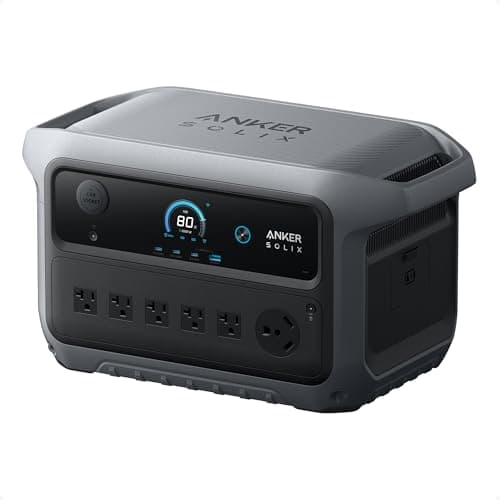
A TT-30R is the 120V, 30-amp receptacle on a travel-trailer cord — the one you plug into at a campground pedestal. Finding one on a portable battery is unusual, and it is the single feature that makes this unit different from every rival in the 2kWh class.
What it buys you is a direct connection: a trailer's own 30A cord goes straight into the station without a dogbone adapter, and the trailer's distribution panel handles the rest exactly as it would at a campground.
What it does not buy you is 30 amps. A TT-30 pedestal supplies 120V at 30A, which is 3,600W nominal. This station's inverter stops at 2,400W, and Anker rates the TT-30R output at 2,400W to match. The socket is a connector convenience and an output-ceiling convenience, not a replacement for shore power. Anyone sizing a trailer hookup should read 30-amp versus 50-amp RV service before assuming a battery substitutes for a pedestal.
The practical consequence is that a trailer plugged into this will run its lights, water pump, fridge on electric and the converter happily, and will trip the station the moment the air conditioner starts. The air conditioning page explains why that threshold sits where it does.
Expansion: what doubling actually involves
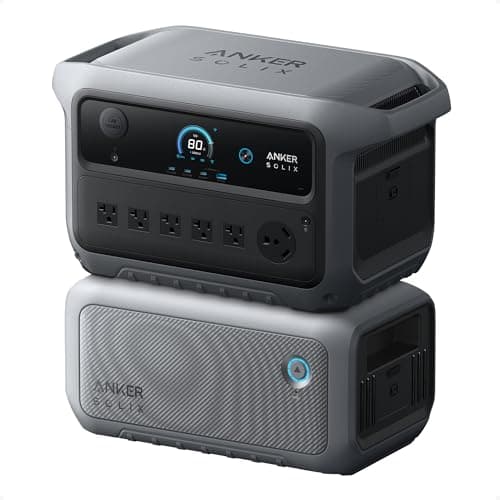
One BP2000 Gen 2 takes the system from 2,048Wh to 4,096Wh. Anker is specific that the expansion battery is for the C2000 Gen 2 family — C2000 Gen 2, C2000X Gen 2 and C2000 Gen 2 Plus — and explicitly not compatible with the F2000.
Three things are worth understanding before you treat expansion as a reason to buy:
- The battery has no outlets. It is dead weight without the station attached. Two independent units would give you redundancy; this gives you capacity.
- It is priced like a purchase, not an accessory. Amazon no longer lists the Gen 2 expansion battery separately, so the buy buttons above compare the bare station against the 4,096Wh bundle. Check that gap before you assume expansion is the cheap path, and buy direct from Anker if you already own the station.
- Anker publishes a five-year full-device warranty on the expansion battery and no warranty term at all in the station's own spec table, which is an odd asymmetry worth confirming on the listing.
Whether capacity or redundancy is the better buy depends on what fails in your outages — expansion battery versus a second power station works through both cases.
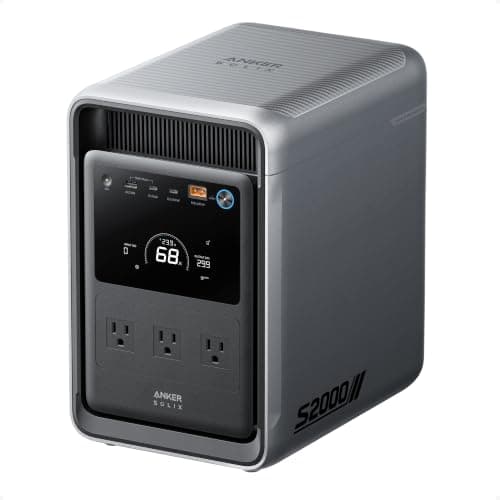
4,000 cycles, and why the S2000 wins on paper
Anker rates the C2000 Gen 2 at 4,000 cycles. That is a good LFP figure and far beyond what a storm-season household will ever use: twenty full cycles a year is 200 years of rated life, so cycle count is not the binding constraint for most buyers here.
It becomes the binding constraint for the people who cycle a battery daily — off-grid cabins, vanlife, anyone using storage as routine infrastructure rather than insurance. For them the in-house alternative is better: the S2000 is rated 6,000 cycles to 80% and 10,000 to 60% on 314Ah cells, and that is a meaningfully longer service life for less money.
What the S2000 gives up is ceiling and speed — 1,500W rated instead of 2,400W, 400W of solar instead of 800W, and no expansion. If your loads are a refrigerator, a freezer, lighting and a network, that ceiling is plenty. LiFePO4 versus lithium-ion covers why these cycle numbers are so much larger than the ones the category used to publish.
What two kilowatt-hours covers in an outage
Apply this site's standing convention — 85% inverter efficiency — and 2,048Wh of cells delivers about 1,740Wh to an appliance.
Against a refrigerator, the answer depends entirely on duty cycle. At the 150W continuous average this site uses, 3,600Wh a day, 1,740Wh is a little under 12 hours. With the door kept shut and the compressor cycling as it normally does — around 1,200Wh a day — the same battery runs roughly 35 hours.
Anker claims 30 hours for a dual-door fridge on the station alone and 64 hours with the expansion battery. Those figures sit at the optimistic end of our own arithmetic rather than outside it, which is a better showing than most runtime claims in this category manage. The refrigerator page shows how to get your own number off the energy label instead of using anyone's average.
For the loads that actually define a 2kWh purchase — a gas furnace blower, a sump pump, a well pump, a home office — outage duration and capacity is the page that turns your outage history into a capacity number.
The 10 ms UPS claim, and what it is for
Anker publishes a 10 ms switchover with UL 1178 certification. That is fast enough that a desktop computer, a modem, a sump pump control board or a CPAP will not notice the grid going away.
Two limits are worth being clear about. First, UPS mode means the station sits between the wall and the load permanently, so the battery lives at a high state of charge — fine for LFP, but it does mean the unit is in use rather than in storage. Second, this is a device-level UPS and not a house-level one: everything you want protected has to be plugged into the station.
If the switchover is the reason you are buying, the UPS-function roundup compares the units that publish a figure, and power station versus UPS covers when a conventional UPS is the better buy.
The cold-weather limit nobody reads
Anker's spec table gives two temperature windows: charging from 32°F to 104°F (0°C to 40°C), and a wider -4°F to 104°F window for the unit otherwise.
The charging limit is the one that bites. A battery stored in an unheated garage or an uninsulated truck bed through a January storm will refuse to take a charge until it warms up, which is exactly when you need it to. This is a property of LFP chemistry rather than a fault in this unit, and every honest manufacturer publishes a similar floor — the cold-weather roundup covers how to plan around it.
Who should buy it
- Households whose heaviest load is over 1,500W. A microwave, a 1,500W heater with margin, a coffee maker, a shop tool — the 2,400W ceiling is the reason to choose this over the S2000.
- Trailer owners who want a direct 30A cord connection and understand it delivers 2,400W, not 3,600W.
- Anyone who may want more capacity later. The single-battery route to 4kWh is genuinely useful and most rivals at this size do not offer one.
- Buyers who refill from the wall between outages and value getting back to full inside about an hour rather than three.
Who should not
- Anyone cycling a battery daily. The S2000's 6,000-cycle rating and lower price are the better infrastructure buy.
- Households whose outages end by morning. The C1000 at the kilowatt-hour tier covers that for considerably less.
- Anyone who needs 240V. This is a 120V unit. Split-phase output starts at the F3800 class — the F3800 review covers what that capability costs.
- Anyone expecting it to replace a generator for a multi-day event. Two kilowatt-hours is a night, not a week. Generator versus power station is the honest comparison.
The short version
The C2000 Gen 2 is a well-specified 2kWh battery whose distinguishing features are a 2,400W ceiling, a TT-30 socket and a real expansion path — and whose headline recharge figure requires sun to achieve. The unit it genuinely competes with is Anker's own S2000, which holds almost the same energy on longer-lived cells for less money and gives up the inverter headroom to do it. Decide which of those two things your outages need, and the choice makes itself.