How this review was done
We have not tested an F3800, and we do not claim to have. Watt & Warden runs no test bench — the methodology page explains why and what we do instead.
This review is built from Anker's published specifications for the F3800, F3800 Plus and F3000, checked against the live listings, and from the same runtime arithmetic used across the site. Where a figure comes from Anker, it says so. Where it is our calculation, the working is shown. What it cannot tell you is how the unit behaves after three years in a hot garage, and nobody reviewing a product this new honestly can.
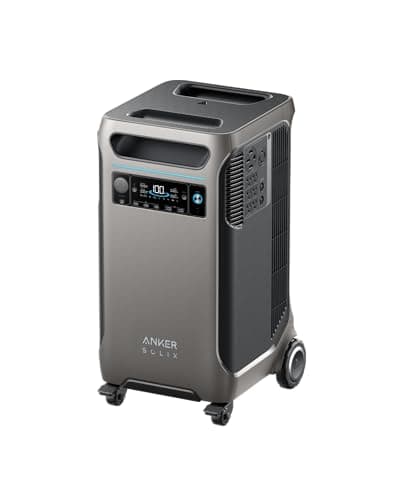
The one feature that justifies the price
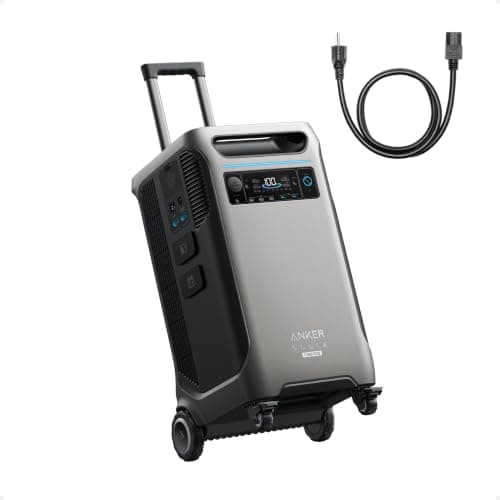
Strip the F3800 down to what makes it different and it is one thing: split-phase 120/240V output.
A residential electrical service has two 120V legs. Most things in the house use one of them; a few large appliances use both, at 240V. Those 240V loads — the well pump, the electric water heater, the dryer, some furnaces and many air conditioners — are hardwired and cannot be reached by any cord.
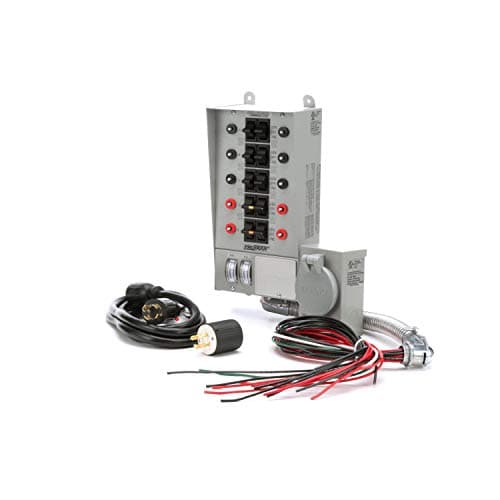
Almost every portable battery produces 120V only. The F3800 produces both legs, which means it can feed a transfer switch and power 240V circuits directly. That is the capability you are paying for. If you do not need it, the F3800 is an expensive way to buy capacity you could have for less.
The home battery backup systems page covers why split-phase is the dividing line between a big battery and a genuine backup system.
The published numbers
| F3800 | F3800 Plus | F3000 |
|---|
| Capacity | 3,840 Wh | 3,840 Wh | 3,072 Wh |
|---|
| Cycle rating | 3,000+ | 3,000+ | 4,000 |
|---|
| Continuous output | 6,000 W | 6,000 W | 3,600 W |
|---|
| 240V from one unit | Yes — 14-50 and L14-30 | Yes — L14-30 | No — needs two units and a hub |
|---|
| Max solar input | 2,400 W | 3,200 W | 2,400 W |
|---|
| AC charging | 1,800 W | 1,800 W; 6,000 W via generator | 1,800 W; 3,600 W via TT-30 |
|---|
| Switchover | Under 20 ms | 20 ms; 30-50 ms on generator | 20 ms |
|---|
| Weight | 132.3 lb | 136.7 lb | 91.5 lb |
|---|
All figures are Anker's published specifications from its F3800, F3800 Plus and F3000 product pages, linked below. Surge for the F3800 is published at 9,000W; Anker's F3800 Plus page did not state a surge figure, so none is given here.
What 3,840 watt-hours actually runs
Using 85% inverter efficiency, the figure this site uses throughout.
| Load | Average draw | Hours from 3,840 Wh |
|---|
| Fridge, freezer, network, lighting | 300 W | About 10.9 hours |
|---|
| Critical loads, aggressively shed | 150 W | About 21.8 hours |
|---|
| The above plus a furnace blower cycling | 450 W | About 7.3 hours |
|---|
| Well pump, normal household use | Intermittent | Costs little energy; needs the surge headroom |
|---|
| Central air conditioning running | 3,500 W average | About 55 minutes |
|---|
Hours are 3,840 Wh x 0.85 / load, per the methodology page. The well pump row is deliberately not a number — see the well pump page for why pumps cost surge rather than watt-hours.
The pattern: a full day of critical loads, not a weekend, and nowhere near whole-house air conditioning. That boundary does not move with capacity in this product class.
F3800 or F3800 Plus?
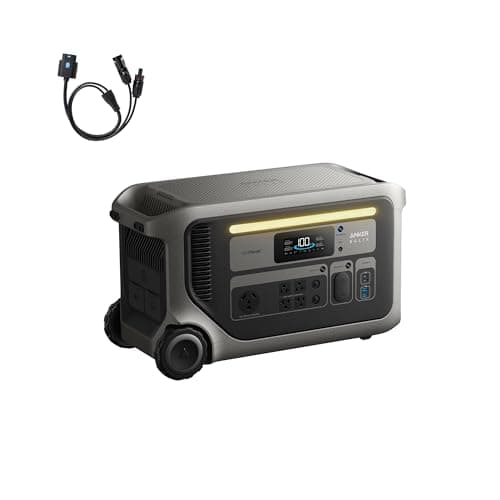
This is the most searched version of the decision, and the answer is narrower than the price gap suggests. The battery, the capacity and the headline output are the same. The Plus changes how it charges.
Buy the Plus if you are building a large solar array and want every watt of it, or you plan to pair the battery with a generator and want to refill it at 6,000W rather than 1,800W. Either way the Plus turns long charging sessions into short ones.
Buy the F3800 if you have a modest array or none, and no generator to pair. Then the Plus upgrades charging paths you will not use, and the original is the better value.
Pairing a battery with a small generator is often the best arrangement of all — the solar versus gas comparison covers why the two work better together than either alone.
F3800 or F3000?
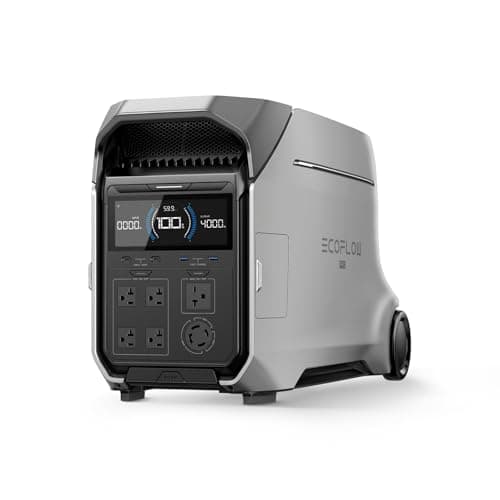
The question that saves the most money. The F3000 costs considerably less, weighs 41 lb less and is rated for more cycles. It loses on exactly one thing that matters: on its own, it is 120V only.
So the test is simple. Go and look at what you want to back up. If every item has a plug — fridge, freezer, network, lighting, a space heater on a cord — the F3000 does the job and the F3800 is overkill. If anything on the list is a hardwired 240V circuit, the F3800 is the one that reaches it with a single unit.
The 3000Wh roundup covers the wider field in this capacity band.
Who should buy it
- A house on a well. An outage removes water, the pump is 240V and hardwired, and the F3800's 9,000W surge covers the start that defeats most portable batteries.
- A household that wants silence and no fuel. It does the circuit-level job a generator does, with no exhaust, no noise and no fuel logistics — for outages measured in hours.
- Someone building toward whole-home backup in stages. Expansion to 26.88kWh means buying the base unit now and adding capacity after a real outage shows what you need.
Who should skip it
- Anyone whose loads all have plugs. The F3000 or a 2,000Wh unit does the same job for much less.
- Anyone with multi-day outages and no solar. A battery is a fixed store; a generator with fuel beside it is not — the battery versus generator page works that through.
- Anyone who needs to carry it. At 132.3 lb it is not portable in any useful sense.
- Anyone not willing to fit a transfer switch. Without one, the 240V capability — most of the price — does nothing.
The short version
- The F3800 is worth it if you need 240V from one unit. That is the whole case.
- Everything with a plug? Look at the F3000 first.
- The Plus is for big arrays or generator charging. Otherwise buy the original.
- Budget the transfer switch. The 240V is useless without it.