Skip to content
Watt Warden

Generators

Generator vs Power Station: Which Should You Buy?

The whole comparison reduces to one property: a battery holds a fixed amount of energy, and a generator with fuel beside it does not. Everything else follows from how long your power is off.

By Sawyer V.Updated Published How we work this out
A generator and a battery box standing side by side in a garage.

Watt & Warden earns a commission on qualifying purchases made through links on this page, at no extra cost to you. It never changes a ranking, and our picks include products we tell you to skip. Full disclosure.

Quick picks

#ProductBest forPrice
1
No photo

The generator case

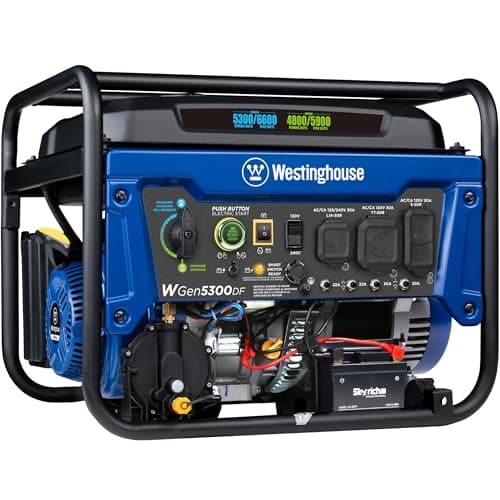
Westinghouse WGen5300DF

5,300 running watts and 14.5 hours a tank — unlimited runtime for the price of fuel.

Outages measured in days
2
No photo

The battery case

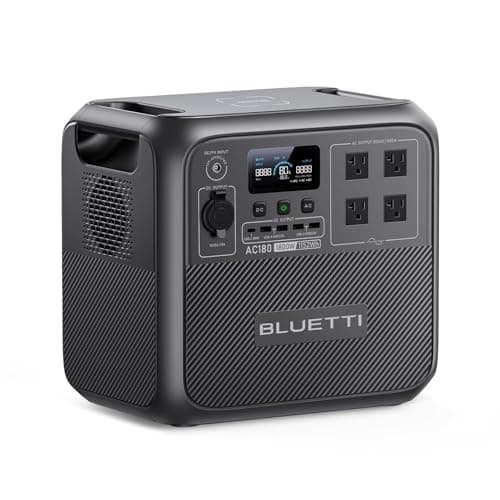
BLUETTI AC180

1,152Wh, 1,800W, silent, indoor-safe, and it starts every time.

Outages measured in hours
3
No photo

The thing that changes the answer

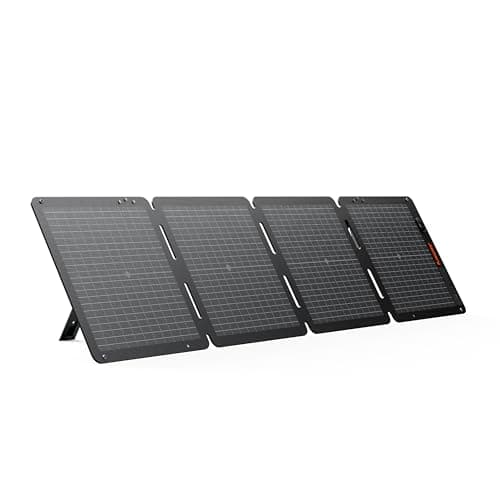
Jackery SolarSaga 100W

A folding 100W panel — the recharge path that removes the battery's only real disadvantage.

Making a battery viable for multi-day outages

Prices come from the retailer at page-build time and change constantly. Where no live price is available the button reads “Check price” rather than showing a number we cannot stand behind.

The one difference that decides it

A power station holds a fixed quantity of energy. When it is gone, it is gone until you find somewhere to recharge. A generator converts fuel into electricity for as long as you keep supplying fuel.

Every other difference between them is a consequence or a side effect. So the question is not “which is better” — it is how long is your power actually off, and that is answerable.

The EIA's Electric Power Annual for 2024 puts the average U.S. customer at eleven hours of interruption across the year: about two from ordinary faults and nearly nine from major events, with hurricanes Beryl, Helene and Milton accounting for 80% of the national total. Which means most households experience several short outages and, if they are unlucky or in the wrong state, one long one. Find your own number before deciding.

Side by side

PropertyPower stationGenerator
RuntimeFixed — hoursUnlimited with fuel
Indoor useYes, safelyNever — carbon monoxide kills
Noise~30 dB under load~68–72 dB conventional, ~50–60 dB inverter
MaintenanceTop up every 3–6 monthsOil changes, fuel rotation, seasonal starts
Reliability of startingAlwaysDepends on fuel age and maintenance
Typical output300–2,600 W2,200–13,000 W
Cost per delivered kWhHigh up front, near zero to runLow up front, ongoing fuel cost
Runs central air conditioningNoYes, above about 9,500 W
Works during the storm itselfYesNo — cannot be started safely in high wind

Output and noise figures are drawn from the published specifications of the units covered on this site, linked below. We have not measured any of them.

The energy cost, computed

A generator's energy is cheap and continuous. A battery's is expensive and finite, but it is bought once. Here is the running side of both, which is the part you can actually compute:

What it costs to actually run

The sticker price of a dual-fuel generator is a fraction of what it costs you. The sticker price of a battery is nearly all of it. Here is the arithmetic, with the inputs stated so you can redo it with your own fuel price.

UnitPublished consumptionCost per hourCost per 24 h
Generator, mid-size at half load0.75 gal/hr gasoline$3.05$73.28
Generator, block running 6 h/day0.75 gal/hr × 6 h$3.05$18.32
Battery, recharged from the grid1.152 kWh per full cycle$0.21 per full recharge
Battery, recharged from solarPanel harvest$0.00
Gasoline at $4.071/gal (EIA weekly retail, week ending 31 August 2026). Battery recharge computed at the EIA's U.S. average residential electricity price of 18.34 cents per kWh for June 2026, against the AC180's 1,152Wh capacity. Note the battery figure is the recharge cost only — it excludes the purchase price, which is where nearly all of a battery's real cost sits.

Twenty-one cents to refill a 1kWh battery against three dollars an hour to run a generator looks decisive until you remember the battery holds about one hour of a generator's output. The generator is dramatically cheaper per delivered kilowatt-hour up front; the battery is dramatically cheaper to run. Which matters depends entirely on how many kilowatt-hours you need, which is the outage-length question again.

The safety difference is not symmetrical

This is the part that should carry the most weight and usually carries the least. A power station has no failure mode that kills you. A generator does, and it does so routinely: carbon monoxide poisoning from portable generators kills people in the United States after every major storm, and the circumstances are always the same — the machine was in a garage, a basement, on a porch, or under a window.

A generator is entirely safe when operated correctly: outdoors, at least twenty feet from the house, exhaust pointed away from every opening, with working carbon monoxide alarms inside. But “operated correctly” has to hold at 2am on the second night, in the rain, possibly by someone who did not read the manual. That is a real difference in risk profile, and it deserves its own page.

The answer most households should reach

Both, in that order. A battery first, because it covers the common case — the short outage, several times a year — silently, indoors, with no maintenance and no risk. Then a generator if your history includes multi-day events.

Used together they are better than either alone. Run the generator for two hours in the afternoon to refill the battery and top the freezer, shut it down, and run the house silently off the battery all night. You burn a quarter of the fuel, your neighbors sleep, and you get generator endurance with battery quiet. The charging combination is covered here.

If it has to be one: under eight hours, a battery. Over a day, a generator. And if you genuinely do not know, find your utility's reliability data before you spend anything.

The picks in full

01The generator case

Westinghouse WGen5300DF

5,300 running watts and 14.5 hours a tank — unlimited runtime for the price of fuel.

The argument is endurance. 5,300 running watts sustained for as long as you can supply fuel is a completely different proposition from a battery, and on the third day of an ice storm it is the only proposition that works.

Dual fuel matters here specifically: propane is available when gas station pumps have no power, and stores for years without degrading.

Skip it ifyour outages are short. You are buying maintenance, fuel storage and noise for an event that a battery would cover silently.

Published specifications for the Westinghouse WGen5300DF
SpecificationPublished figure
Output (gasoline)5,300 running W / 6,600 peak W
Output (propane)4,800 running W / 5,900 peak W
Engine274cc 4-stroke OHV
Tank4.7 gal (18 L)
Run timeup to 14.5 h on a full tank
Transfer-switch outlet120/240 V L14-30R, 30 A
RV outlet120 V TT-30R, 30 A
StartingPush-button electric with remote key fob

Source: Westinghouse — WGen5300DF product specifications. These are the manufacturer's published figures, not ours — we have not tested this unit.

02The battery case

BLUETTI AC180

1,152Wh, 1,800W, silent, indoor-safe, and it starts every time.

The argument is everything except endurance. No carbon monoxide, so it runs in a hallway. Around 30 dB, so nobody wakes up. No carburetor to gum up over a year in a shed, no fuel to go stale, no pull cord.

1,800W clears a refrigerator's published 800–1,200W starting surge, and 1,152Wh runs one for about six and a half hours at a 150W average. For the majority of outages, that is the entire requirement.

Skip it ifyou routinely lose power for more than a day. It will be empty by the second morning and there is no refilling it.

Published specifications for the BLUETTI AC180
SpecificationPublished figure
Usable capacity1,152 Wh (32 V, 36 Ah)
Cell chemistryLiFePO4 (LFP)
AC output1,800 W continuous / 2,700 W surge, 4 outlets
Cycle life3,500+ cycles to 80% capacity
Weight35.3 lb
Fast charge0–80% in 45 min
Max solar input500 W
Warranty5 years on registration

Source: BLUETTI — AC180 product specifications. These are the manufacturer's published figures, not ours — we have not tested this unit.

03The thing that changes the answer

Jackery SolarSaga 100W

A folding 100W panel — the recharge path that removes the battery's only real disadvantage.

A battery's single weakness is that it runs out. A panel partially fixes that — roughly 400–500Wh of harvest across a good summer day from a 100W panel, which is about half of a 1,000Wh station.

It does not make a battery equivalent to a generator, and we would not claim it does. It makes a battery viable for a longer outage than it otherwise would be, at a cost well below a second machine.

Skip it ifyour outages are short. The battery never empties, so the panel does nothing you needed.

Published specifications for the Jackery SolarSaga 100W
SpecificationPublished figure
Rated output100 W
Cell typeMonocrystalline, bifacial
Conversion efficiencyup to 25%
Ingress ratingIP68
Weight4.52 lb
CompatibilityJackery Explorer stations

Source: Jackery — SolarSaga 100W product specifications. These are the manufacturer's published figures, not ours — we have not tested this unit.

How these were chosen

We did not test these. Nobody at Watt & Warden has plugged one in. What we did instead: read the manufacturer's published specifications, compile them into a table where the figures line up, and compute the numbers manufacturers leave out — runtime against a real appliance load, and what an hour of running actually costs.

Anything that could not be sourced was left out rather than estimated, and every pick names the buyer who should skip it. The full method is here, including where it is weaker than a publisher with a test bench.

Questions people actually ask

Is a power station better than a generator?

For outages under about eight hours, usually yes -- it is silent, safe indoors, needs no fuel and always starts. Beyond a day it stops being viable, because a battery holds a fixed amount of energy and a generator with fuel does not.

Can a power station replace a generator?

For short outages and for anything under about 2,600W, yes. It cannot replace one for multi-day outages or for large loads like central air conditioning, an electric range or an electric water heater at 3,000-4,500W.

Which is cheaper, a generator or a power station?

A generator, by a wide margin per watt of capacity. A battery's cost is nearly all up front and its running cost is close to nothing -- about 21 cents to refill a 1kWh unit at the EIA's June 2026 average residential rate. Which is cheaper overall depends on how many kilowatt-hours you actually need.

Should I buy both?

For most households with a history of multi-day outages, yes, and used together they beat either alone. Run the generator for a couple of hours to refill the battery and cool the freezer, then run the house silently off the battery overnight -- a quarter of the fuel and none of the noise.

Sources