Skip to content
Watt Warden

Sizing

30 Amp vs 50 Amp RV Service

The names suggest these are close. They are not: one gives you 3,600 watts and the other gives you 12,000, because 50 amp service carries two legs instead of one.

By Sawyer V.Updated Published How we work this out
RVs parked at a forested campsite.

Watt & Warden earns a commission on qualifying purchases made through links on this page, at no extra cost to you. It never changes a ranking, and our picks include products we tell you to skip. Full disclosure.

The arithmetic that explains everything

The names are misleading because they describe amps on a single leg, and the two services do not have the same number of legs.

30 amp service is a single 120V leg at 30 amps. 120 x 30 = 3,600 watts.

50 amp service is two 120V legs, each at 50 amps. 120 x 50 x 2 = 12,000 watts.

So 50 amp is not 67% more than 30 amp. It is roughly 3.3 times the available power, which is why coaches with two air conditioners are all 50 amp and coaches with one are mostly 30.

30 amp50 amp
Available power3,600 W12,000 W
LegsOne 120V legTwo 120V legs
ConnectorTT-30, three prongsNEMA 14-50, four prongs
Typical coachTravel trailer, small Class C, one roof unitFifth wheel, Class A, two or three roof units
Generator to match3,500-3,700 running watts7,500-12,000 running watts

The connectors are not variants of each other

A TT-30 plug has three prongs: one hot, one neutral, one ground. A NEMA 14-50 has four: two hots, one neutral, one ground.

That difference is physical and electrical, and it is why adapters go only one way usefully. A 50 amp coach on a 30 amp pedestal, through a dogbone adapter, gets 3,600 watts — both legs of the coach are fed from the single available leg. Nothing is broken; you simply have a quarter of the power and have to manage loads accordingly.

Going the other way — a 30 amp coach on a 50 amp pedestal — is straightforward, and the coach still only draws its own 30 amps. That adapter is the useful one to carry.

The one genuine trap: a TT-30 looks superficially like a household dryer or RV-style outlet to people who have not met one before. It is 120V, not 240V, and plugging a coach into the wrong thing is an expensive mistake.

What 30 amps actually runs

3,600 watts sounds generous until an air conditioner joins the list.

LoadRunning wattsShare of 3,600 W
13,500 BTU roof air conditioner1,200-1,700 WUp to about half
Microwave1,400-1,600 W at the wallAnother 40%
Water heater on electric1,400 WAnother 40%
Converter charging the house battery200-600 WModest but continuous
Refrigerator on electric150-400 WSmall
Lighting and devicesUnder 200 WNegligible

RV appliance figures are typical published ranges; microwave draw is input rather than cooking power, which the microwave page explains.

Add the top three rows and you are past 3,600 watts. That is the daily reality of a 30 amp coach: the air conditioner and the microwave are an either-or, and the water heater goes on propane.

Managing 30 amps well

  • Put the water heater and fridge on propane. Both appliances usually offer it, and both are large electric loads for no benefit.
  • Treat the microwave as a pause. Air conditioner off, microwave on, microwave off, air conditioner back.
  • Fit a soft starter if the compressor start is what trips you rather than the running total.
  • Watch the pedestal voltage. Older parks sag badly on hot afternoons, and low voltage damages compressors — a monitor with fault diagnostics is worth carrying.

Matching a generator to the service

The principle is the same one that governs house backup: the connection caps the machine, so size them together.

For 30 amp, a 3,500-3,700W inverter generator with a TT-30R is the natural match. Going bigger buys nothing the cord can pass.

For 50 amp, you need a machine with a 14-50R to use both legs. A 7,500W machine covers most real 50 amp coaches; only a very demanding one approaches the full 12,000W.

The RV generator roundup covers the machines, and the RV power station page covers the battery side, which is the better answer for everything except air conditioning.

The short version

  • 30 amp is 3,600W. 50 amp is 12,000W. Two legs, not one.
  • TT-30 has three prongs; 14-50 has four. Different connectors, not variants.
  • A 50 amp coach on a 30 amp pedestal works — at a quarter of the power.
  • Match the generator outlet to the service, then size the watts to that.

Quick picks

#ProductBest forPrice
1
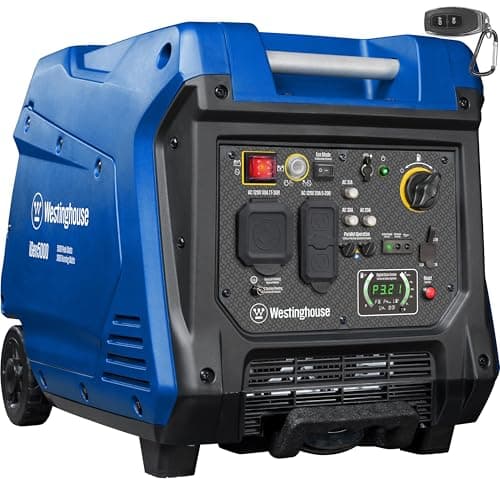
Westinghouse iGen4500

Best for a 30 amp coach

Westinghouse iGen4500

3,700 running watts with a TT-30R RV outlet and remote electric start.

A 13,500 BTU roof unit with margin
$849.00 · Check price on Amazon

#ad how this is funded · price as of October 21, 2026

2
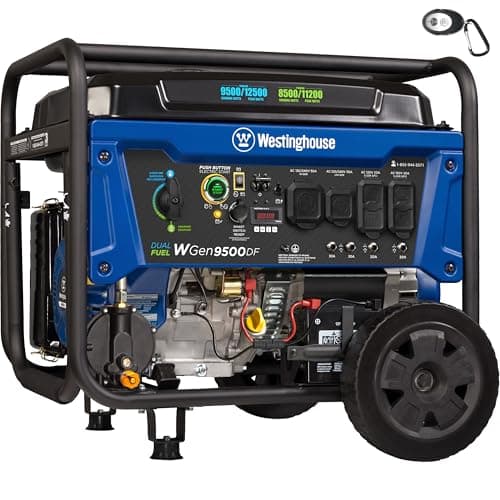
Westinghouse WGen9500DF

Best for a 50 amp coach

Westinghouse WGen9500DF

9,500 running watts with a 14-50R outlet — the connector 50 amp service uses.

Two air conditioners and a residential fridge
$999.00 · Check price on Amazon

#ad how this is funded · price as of October 21, 2026

3
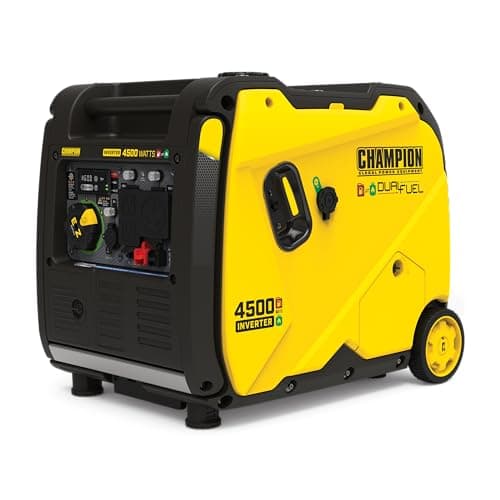
Champion 4500W dual fuel inverter generator

Best quiet option for 30 amp

Champion 4500W dual fuel inverter generator

4,500 peak and 3,500 running watts of inverter-clean dual fuel output.

A smaller coach, or a campground with noise rules
$988.62 · Check price on Amazon

#ad how this is funded · price as of October 21, 2026

4
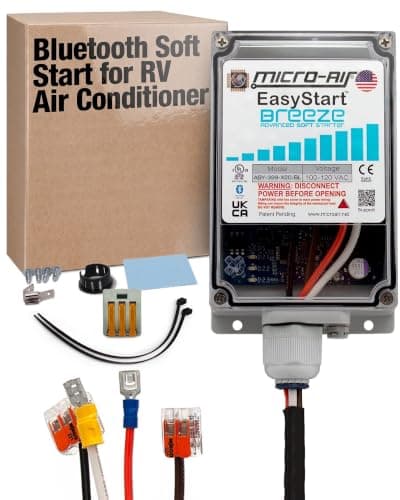
Micro-Air EasyStart Breeze soft starter

The cheap way to make 30 amp work

Micro-Air EasyStart Breeze soft starter

A soft starter that cuts the compressor's starting current dramatically.

Starting a roof unit on a smaller supply
$355.00 · Check price on Amazon

#ad how this is funded · price as of October 21, 2026

Prices come from the retailer at page-build time and change constantly. Where no live price is available the button reads “Check price” rather than showing a number we cannot stand behind.

The picks in full

01 — Best for a 30 amp coach

Westinghouse iGen4500

3,700 running watts with a TT-30R RV outlet and remote electric start.

3,700 running watts is very close to the 3,600W ceiling of 30 amp service, which makes this machine the natural match — you are not leaving capacity unused and you are not buying watts the cord cannot pass.

The TT-30R outlet means your shore cord plugs straight in with no adapter, which is one fewer warm connection assembled in the dark.

The honest catch: at 30 amps you sequence loads. The air conditioner and the microwave do not run together, whatever the generator is.

Skip it ifyour coach is 50 amp with two air conditioners. This is half that service.

Westinghouse iGen4500
$849.00 · Check price on Amazon

#ad how this is funded · price as of October 21, 2026

Published specifications for the Westinghouse iGen4500
SpecificationPublished figure
Output (gasoline)3,700 running W / 4,500 peak W
TypeInverter (pure sine wave)
StartingRemote electric start with auto choke
RV outlet120 V TT-30R, 30 A
ParallelCapable with a second unit

Source: Westinghouse — iGen4500 product specifications. These are the manufacturer's published figures, not ours — we have not tested this unit.

02 — Best for a 50 amp coach

Westinghouse WGen9500DF

9,500 running watts with a 14-50R outlet — the connector 50 amp service uses.

The 14-50R outlet is the specification that matters. A 50 amp coach cord ends in a NEMA 14-50P, and a generator without that receptacle cannot supply both legs at all.

9,500 running watts is not the full 12,000W a 50 amp pedestal delivers, but it covers two roof units plus the rest of the coach, which is what people actually run.

The honest catch: it is a large, loud open-frame machine, and many campgrounds restrict exactly that.

Skip it ifyour coach is 30 amp. You would be feeding it through an adapter for no gain.

Westinghouse WGen9500DF
$999.00 · Check price on Amazon

#ad how this is funded · price as of October 21, 2026

Published specifications for the Westinghouse WGen9500DF
SpecificationPublished figure
Output (gasoline)9,500 running W / 12,500 peak W
FuelGasoline or propane (dual fuel)
Engine457cc 4-stroke OHV, cast iron sleeve
Tank6.6 gal (25 L)
Run timeup to 12 h on a full tank
Transfer-switch outlet120/240 V L14-30R, 30 A
RV outlet120/240 V 14-50R, 50 A
StartingPush-button electric with remote key fob
Warranty3-year limited

Source: Westinghouse — WGen9500DF product specifications. These are the manufacturer's published figures, not ours — we have not tested this unit.

03 — Best quiet option for 30 amp

Champion 4500W dual fuel inverter generator

4,500 peak and 3,500 running watts of inverter-clean dual fuel output.

Inverter output throttles to the load, so an evening of lights and a fridge is genuinely quiet rather than merely tolerable — which is what gets a machine tolerated in a campground.

Dual fuel means the propane you already carry for the stove and the water heater.

The honest catch: 3,500 running watts is just under the 30 amp ceiling, so you are slightly capacity-limited rather than cord-limited.

Skip it ifyou run a 15,000 BTU roof unit. That is marginal at 3,500 watts.

Champion 4500W dual fuel inverter generator
$988.62 · Check price on Amazon

#ad how this is funded · price as of October 21, 2026

Published specifications for the Champion 4500W dual fuel inverter generator
SpecificationPublished figure
Output4,500 starting W / 3,500 running W (gasoline)
TypeInverter, RV ready
FuelGasoline or propane (dual fuel)
StartingElectric start
RV outlet120 V TT-30R, 30 A
Warranty3-year limited with free lifetime technical support

Source: Champion Power Equipment — 4500-watt dual fuel inverter specifications. These are the manufacturer's published figures, not ours — we have not tested this unit.

04 — The cheap way to make 30 amp work

Micro-Air EasyStart Breeze soft starter

A soft starter that cuts the compressor's starting current dramatically.

The constraint on a 30 amp coach is almost always the air conditioner's starting surge rather than its running draw, and a soft starter collapses that surge.

It also helps on marginal shore power at older parks, where the pedestal voltage sags when everyone's compressor starts at once.

The honest catch: it is an installation on the roof unit, and it does nothing for running watts — only for the surge.

Skip it ifyour generator already starts the air conditioner comfortably.

Micro-Air EasyStart Breeze soft starter
$355.00 · Check price on Amazon

#ad how this is funded · price as of October 21, 2026

Published specifications for the Micro-Air EasyStart Breeze soft starter
SpecificationPublished figure
In-rush reductionUp to 75%, per Micro-Air
Made forRV and marine air conditioner compressors
Fitted toThe air conditioner, not the generator
InstallWired into the air conditioner — professional fitting for most owners

Source: Micro-Air — EasyStart Breeze soft starter. These are the manufacturer's published figures, not ours — we have not tested this unit.

How these were chosen

We did not test these. Nobody at Watt & Warden has plugged one in. What we did instead: read the manufacturer's published specifications, compile them into a table where the figures line up, and compute the numbers manufacturers leave out — runtime against a real appliance load, and what an hour of running actually costs.

Anything that could not be sourced was left out rather than estimated, and every pick names the buyer who should skip it. The full method is here, including where it is weaker than a publisher with a test bench.

Questions people actually ask

What is the difference between 30 amp and 50 amp RV service?

Far more than the names suggest. 30 amp is a single 120V leg at 30 amps, which is 3,600 watts. 50 amp is two 120V legs at 50 amps each, which is 12,000 watts -- roughly 3.3 times the power, not 67% more. That is why coaches with two air conditioners are all 50 amp.

Can I plug a 50 amp RV into a 30 amp outlet?

Yes, with a dogbone adapter, and nothing is damaged -- but you get 3,600 watts rather than 12,000, because both legs of the coach are fed from the single available leg. You have to manage loads accordingly: one air conditioner, and not while the microwave is running.

What size generator do I need for a 30 amp RV?

A 3,500 to 3,700 running watt inverter generator with a TT-30R outlet. That is very close to the 3,600W ceiling of 30 amp service, so you are neither leaving capacity unused nor buying watts the cord cannot pass. Going bigger gains nothing through a 30 amp connection.

What size generator do I need for a 50 amp RV?

One with a NEMA 14-50R outlet, because a generator without it cannot supply both legs at all. A 7,500 running watt machine covers most real 50 amp coaches including two roof units; only a very demanding coach approaches the full 12,000W a 50 amp pedestal can deliver.

Why does my 30 amp RV keep tripping the breaker?

Almost always too many large loads at once. A 13,500 BTU air conditioner takes up to half the available 3,600 watts and a microwave takes another 40%, so the two together exceed the service. Put the water heater and fridge on propane, treat the microwave as a pause in cooling, and fit a soft starter if the compressor start is what trips you.

Sources

Every figure on this page comes from a published source. We have not tested this equipment, so the specifications are the manufacturer's and the statistics are the dataset's — the arithmetic on top of them is ours, and it is shown in full so you can check it. How we work this out.