Why this page has no buy button for a standby generator
Whole-house standby generators are sold through dealer and installer channels, and the installation is not optional: a gas line, a concrete pad, a permit, and a licensed electrician tying into your service panel.
We are not going to manufacture a buy button for something that cannot be bought that way, and we are not going to quote you an installed price we cannot source. What this page does instead is explain what the specifications mean, so that when three installers quote you, you can tell what you are comparing.
What the units actually publish
The two names you will be quoted are Generac and Kohler. Here is what each publishes for a comparable unit — and what neither publishes in a form we could retrieve.
| Specification | Generac 24kW Guardian (7209) | Kohler 26RCAL |
|---|
| Rated output, LP | 24,000 W | 26 kW |
|---|
| Rated output, natural gas | 21,000 W | Not published in a retrievable form |
|---|
| Engine | G-Force 1000 | Commercial-grade, tested to 2,000 hours continuous operation |
|---|
| Fuel use, 50% load (natural gas) | 203 ft³/hr | Not published in a retrievable form |
|---|
| Fuel use, 100% load (natural gas) | 306 ft³/hr | Not published in a retrievable form |
|---|
| Fuel use, 50% load (LP) | 92 ft³/hr, or 2.53 gal/hr | Not published in a retrievable form |
|---|
| Fuel use, 100% load (LP) | 142 ft³/hr, or 3.9 gal/hr | Not published in a retrievable form |
|---|
| Dimensions | 48 × 25 × 29 in | Not published in a retrievable form |
|---|
| Weight | 455 lb | Not published in a retrievable form |
|---|
| Warranty | 5-year limited | 5-year / 2,000-hour limited, including parts, labor and travel |
|---|
| Sound level | Not published on the product page | Not published in a retrievable form |
|---|
Generac figures from its published 24kW Guardian 7209 product specifications. Kohler figures from its published 26RCAL product information and press material; Kohler's technical documentation moved during a corporate reorganization and several specification pages were not retrievable at the time of writing, so those cells say so rather than carrying a guess. Ask the installer for the current spec sheet — they have it.
The fuel figure is the one nobody explains
Generac's published natural gas consumption for the 24kW Guardian is 203 cubic feet an hour at half load and 306 at full. That is a genuinely useful number and it is worth converting.
Natural gas is billed by the therm or the CCF (hundred cubic feet). At 203 ft³/hr, a half-loaded 24kW Guardian consumes roughly 2 CCF an hour — about 48 CCF a day. Multiply by your own gas rate, which is on your bill, and you have your running cost. We are not quoting a national gas price here because residential rates vary far too widely by region and season for an average to mean anything useful.
On propane the figures convert directly: 2.53 gal/hr at half load and 3.9 at full. At the EIA's reported residential propane price of $2.674 a gallon for the week ending 30 March 2026, half load is about $6.76 an hour or $162 a day — and a 500-gallon tank runs a half-loaded unit for about eight days.
That difference is the strongest argument for natural gas if you have a main: the gas does not run out and nobody has to arrange a delivery in a disaster.
What the installation actually involves
- A site survey. Where the pad goes, how far it is from the gas meter and the electrical panel, and what the clearances to windows and property lines are.
- A gas line. Frequently the largest variable in the quote. A unit near the meter is a straightforward job; one on the far side of the house may need a larger-diameter run and a meter upgrade.
- A concrete pad or composite base. The unit is 455 lb on the Generac figures and needs a level, stable foundation.
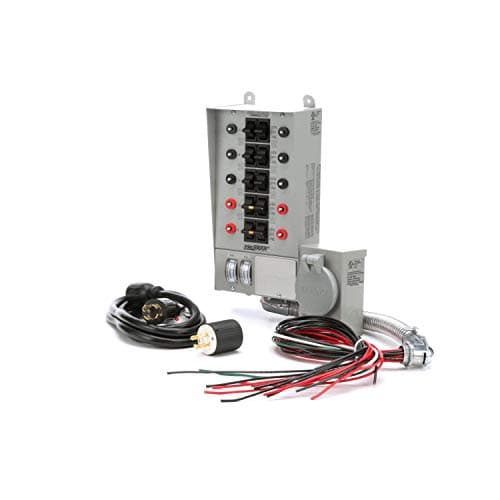
- An automatic transfer switch. Whole-service or selected-circuit. This is a significant part of the cost and the choice matters.
- Electrical work. Tying into the service panel, licensed and inspected.
- Permits and inspection. Cost and duration vary enormously by jurisdiction.
We deliberately do not publish an installed price. It depends on your gas run, your panel, your ground, your local labor rates and your permit costs, and a national average would be a number pretending to be advice. Get at least two itemized local quotes and compare the line items rather than the totals — that is where the differences hide.
Sizing: whole-service or selected circuits
The real decision is not which brand. It is whether the generator backs the whole electrical service or a selected group of circuits.
Whole-service means everything works and nobody has to think. It requires a larger unit, because the generator must handle the biggest motor in the house starting under generator power — usually the central air conditioner, whose surge Champion puts at 3,500–4,500W for a two-ton unit and 5,000–6,000W for a three-ton.
Selected circuits backs a defined list: the furnace, the fridge, some lighting, the well pump. It is a smaller unit, a cheaper switch and a lower install cost, and the trade is that you have to decide in advance what matters.
Arrive at the site visit with your own list. It is the single best way to avoid being sold two sizes more machine than the house needs. The sizing method is here.
The comparison that is usually more honest
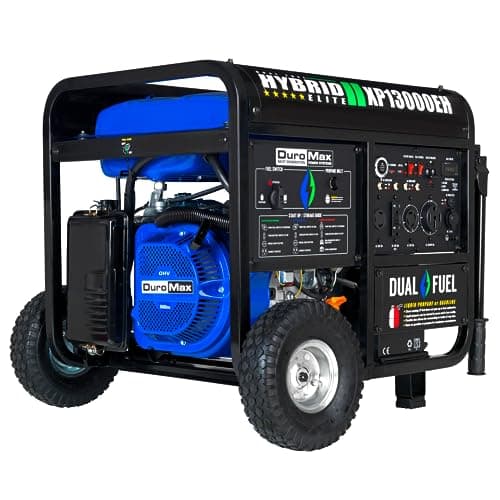
A large dual-fuel portable plus a professionally fitted transfer switch gets you a substantial fraction of standby capability for far less. What you give up is real and specific:
- Automatic start. A portable needs someone to go out, start it and throw the switch. If nobody is home, nothing happens.
- Unlimited fuel. Natural gas does not run out. A portable runs on what you can store and carry.
- Weather-proof unattended running. A standby unit is built to run through a storm in a fixed enclosure.
- Air conditioning. Most portables will not start a central compressor; the 13,000W class will.
What you gain: the machine is useful for camping and a jobsite, it moves with you, it needs no permit, and it does not require a gas line you may not have. A home battery is the third option, and it answers a different question again.