Skip to content
Watt Warden

Home Standby

Home Backup Systems With the Highest Continuous Output

Surge decides whether the compressor starts. Continuous output decides whether the dryer, the range and the air conditioning can be on at the same time — and that is a much lower ceiling than people expect.

By Sawyer V.Updated Published How we work this out
A person loading detergent into a stacked washer and dryer in a modern laundry room.

Watt & Warden earns a commission on qualifying purchases made through links on this page, at no extra cost to you. It never changes a ranking, and our picks include products we tell you to skip. Full disclosure.

Quick picks

#ProductBest forPrice
1
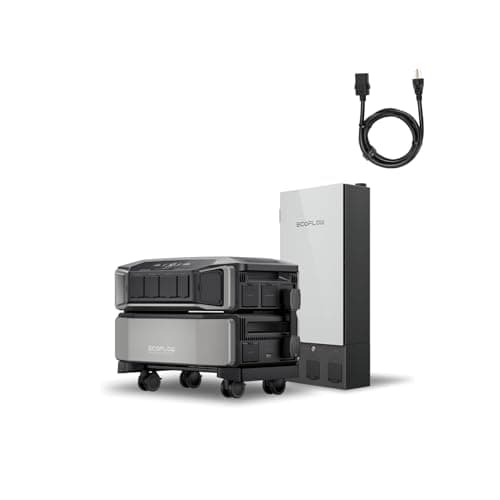
EcoFlow DELTA Pro Ultra with Smart Home Panel 2

Highest continuous output you can buy as one kit

EcoFlow DELTA Pro Ultra with Smart Home Panel 2

7,200W continuous at native 120/240V from one inverter, wired to 12 circuits — and a documented path to 21.6kW across three.

A house that wants several large loads running at once
$5,499.00 · Check price on Amazon

#ad how this is funded · price as of October 20, 2026

2
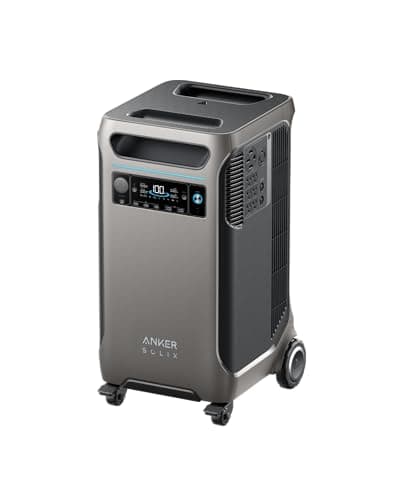
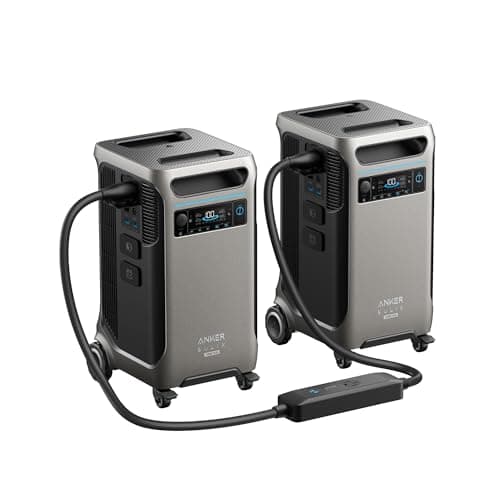
Anker SOLIX F3800 Plus with Double Power Hub

Highest paired-unit output without a sub-panel

Anker SOLIX F3800 Plus with Double Power Hub

Anker publishes 12kW from two linked F3800s at native 120/240V — more sustained output than any single unit here.

A rural house with several 240V loads it cannot shed
$5,398.99 · Check price on Amazon

#ad how this is funded · price as of October 20, 2026 · $9,897.00 45% off

3
Anker SOLIX F3800

Best continuous output per dollar

Anker SOLIX F3800

6,000W continuous at 120V and 240V together, through a NEMA 14-50 and an L14-30 each rated to the full 6,000W.

One serious 240V load plus the rest of a critical-load panel
$1,759.99 · Check price on Amazon

#ad how this is funded · price as of October 20, 2026

4
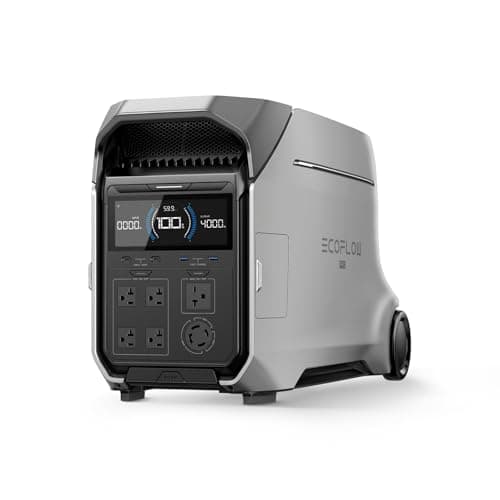
EcoFlow DELTA Pro 3

The 4,000W tier, honestly labeled

EcoFlow DELTA Pro 3

4,000W continuous with 240V available as a selected mode, and 8,000W of surge behind it.

A critical-load list with one 240V circuit at a time
$2,799.00 · Check price on Amazon

#ad how this is funded · price as of October 20, 2026 · $3,699.00 24% off

5
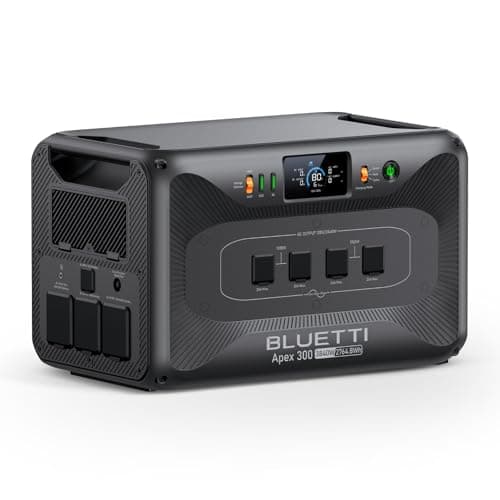
BLUETTI Apex 300

Most sustained output under $2,000

BLUETTI Apex 300

3,840W continuous pure sine with 120V and 240V simultaneously, which BLUETTI frames as roughly two 1,920W legs.

An RV on a 50A cord, or one 240V circuit in a small house
$1,498.98 · Check price on Amazon

#ad how this is funded · price as of October 20, 2026 · $1,699.00 12% off

6
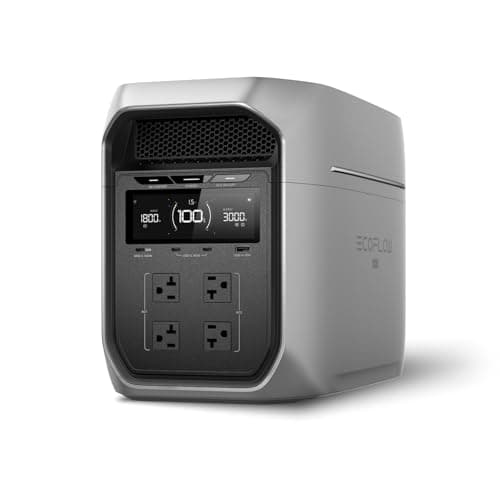
EcoFlow DELTA 3 Max Plus

Where the 120V tier tops out

EcoFlow DELTA 3 Max Plus

3,000W continuous with 6,000W of surge and a 10ms switchover — the practical ceiling for a plug-in 120V unit.

A critical-load list with nothing on 240V
$1,199.00 · Check price on Amazon

#ad how this is funded · price as of October 20, 2026 · $1,899.00 37% off

Prices come from the retailer at page-build time and change constantly. Where no live price is available the button reads “Check price” rather than showing a number we cannot stand behind.

The verdict, in one paragraph

Among systems you can buy outright, the EcoFlow DELTA Pro Ultra leads at 7,200W continuous per inverter, and it is the only product here with a documented path to 21.6kW across three. Two linked Anker SOLIX F3800s publish 12kW, which is the highest sustained figure available without a wired sub-panel. A single F3800 is 6,000W, the DELTA Pro 3 is 4,000W, the BLUETTI Apex 300 is 3,840W, and the 120V tier tops out around 3,000W. The highest residential figure published by anyone is Tesla's Powerwall 3 at 11.5 kW, but that is installed, hardwired equipment rather than something you buy and plug in. The number to understand before any of this: a 200A service is 48kW, so even 21.6kW is under half a house, and "whole home" always means load management.

Published continuous output, ranked

SystemContinuous outputVoltageMulti-unit ceiling
Tesla Powerwall 3 (installed)11.5 kW120V/240VUp to 4 Powerwalls per system
Anker SOLIX F3800, two units12 kW120V/240V nativeUp to 2 units, 53.8 kWh
EcoFlow DELTA Pro Ultra7,200 W per inverter120V/240V native21.6 kW across 3 inverters
Anker SOLIX F38006,000 W120V/240V native, both at full rating12 kW paired
Anker SOLIX F3800 Plus6,000 W max; 120V outlets capped at 2,400 WL14-30 split-phase port at 6,000 WNot published separately
EcoFlow DELTA Pro 34,000 W120V, or 240V as a selected modeNot published as a continuous figure
BLUETTI Apex 3003,840 W120V and 240V simultaneously11.52 kW scaled
Anker SOLIX F30003,600 W120V only7,200 W with two units and a hub
Jackery HomePower 30003,600 W120V onlyNot published
EcoFlow DELTA 3 Ultra Plus3,600 W120V onlyNot published
EcoFlow DELTA 3 Max Plus3,000 W120V onlyNot published
BLUETTI Elite 4002,600 W120V onlyNot published

Every figure is the manufacturer's own published continuous rating, from the pages cited under Sources. Tesla's Powerwall 3 is listed first because it publishes the highest residential figure, but it is installed equipment that is not sold through a retail buy button, so it is not a pick. Current prices sit inside the buy buttons above, each with the date it was last refreshed.

Continuous is not surge, and the gap is the whole decision

These two specifications answer different questions and the wrong one gets quoted constantly:

  • Surge is extra wattage for about a second, at full voltage. It decides whether a motor starts. A compressor draws three to five times its running current for an instant and then settles.
  • Continuous is what the inverter sustains indefinitely. It decides what you can run at the same time, for hours.

A unit can be excellent at one and ordinary at the other. The DELTA Pro 3 publishes 8,000W of surge against 4,000W continuous — a 2x ratio that starts almost anything but sustains a modest load. The F3800 publishes 9,000W surge against 6,000W continuous — a 1.5x ratio that starts less aggressively but runs far more.

If your problem is "the air conditioner will not start," you want the surge ranking, and a soft starter is often the cheaper fix. If your problem is "everything trips when the dryer is on," you are on the right page.

Two more figures that are not continuous output

  1. X-Boost. EcoFlow's published description is intelligent voltage control that marginally reduces voltage so a higher-rated appliance runs on a lower-rated inverter, and EcoFlow states it is for resistive appliances — kettles, hair dryers, ovens — and that it is unavailable while the unit is charging. X-Boost to 6,000W does not mean 6,000W continuous.
  2. Power lifting. BLUETTI's equivalent term, and it sits where a surge rating would. The Apex 300 publishes 7,680W lifting against 3,840W continuous.

When a listing shows three wattages, the smallest one is almost always the real sustained figure, and it is the one this page ranks.

The arithmetic that caps "whole house"

This is the part that reframes the question. A standard residential service is 200 amps at 240 volts, which is 48,000 watts of theoretical capacity. A 100A service is 24,000W.

Against that, the best system on this page sustains 7,200W from one inverter and 21.6kW from three. The highest published residential battery figure anywhere — Tesla's 11.5 kW — is under a quarter of a 200A service.

Houses rarely draw their full service, so this is not as bad as it sounds. But it means the honest version of whole-house backup is a managed subset of circuits, not the whole panel. Both major smart panels publish 12 circuits, which is exactly the design admitting it. Typical large loads, using the published figures this site works from:

LoadRunning wattsWhat it does to a 6,000W budget
Electric water heater3,000-4,500 WTakes half to three quarters of it
Central air, 3 ton3,000-3,500 WTakes over half, before the start
Central air, 2 ton2,000-2,500 WA third
Heat pump auxiliary strip heat9,600-19,200 W at 240VExceeds it outright — shed this, always
Space heater750-1,500 WUp to a quarter, for one room
Furnace blower300-800 WNegligible, and the best value on the list
RefrigeratorAbout 150 W averageNegligible

Water heater, central air, space heater and furnace blower figures are Champion's published wattage chart. Strip-heat figures are Goodman's published kit capacities at 240V. The refrigerator figure is this site's standing working average.

Stacking batteries does not raise continuous output

This is the single most expensive misunderstanding in the category. Adding expansion batteries multiplies kilowatt-hours; the inverter wattage does not move. Five extra batteries on a DELTA Pro Ultra takes it to a published 30kWh of storage and leaves it at 7,200W of output.

Output only rises when you add inverters, which is why every high figure in the table above is a multi-unit configuration: 21.6kW is three EcoFlow inverters, 12kW is two Anker units. How much home battery capacity you can stack covers the capacity side, and it is a genuinely separate purchase decision from this one.

How to work out the number you actually need

  1. List what must run simultaneously, not everything you own. The sum of running watts for that list is your continuous requirement.
  2. Add the largest single starting surge on that list to the running total, and check it against the unit's surge figure rather than its continuous one.
  3. Decide what you will shed. Water heater, range, dryer and strip heat are the four that break every budget, and switching them off costs nothing.
  4. Check the voltage. A 240V load needs a split-phase source, and continuous output is irrelevant if the voltage is wrong.
  5. Then check runtime separately. High output drains a battery fast — sizing a home battery does that arithmetic.

Where a generator still wins

Being straight about it: if the requirement is genuinely high sustained output for days, an engine is still the answer. A 9,500W dual-fuel portable sustains more than any single battery on this page and refuels in minutes, and a standby unit goes well beyond that.

What a battery buys instead is silence, no maintenance schedule, instant transfer and indoor operation. The strongest arrangement for a house with large loads is usually both — running a battery and a generator together covers which systems accept generator charging and at what wattage, and generator versus home battery runs the economics.

Who should buy on continuous output

  • Several large loads at once, installed system: DELTA Pro Ultra with the Smart Home Panel 2, scaling to three inverters if the house justifies it.
  • Maximum sustained output without a sub-panel: two Anker SOLIX F3800s at a published 12kW.
  • One serious 240V load plus a critical-load panel: a single F3800 at 6,000W. This is the sensible answer for most houses asking this question.
  • A critical-load list with one 240V circuit: DELTA Pro 3 at 4,000W.
  • Best sustained output on a budget: BLUETTI Apex 300 at 3,840W with simultaneous split-phase.
  • Nothing on 240V: stop at 3,000W and spend the difference on kilowatt-hours instead.

The short version

Continuous output is the specification that decides what runs together, and it tops out far lower than people expect: 7,200W from the best single unit you can buy, 12kW from two linked Ankers, 21.6kW from three EcoFlow inverters, against a 200A service worth 48kW. Ignore X-Boost and power lifting, because neither is a sustained rating. Remember that extra batteries add hours and not watts. And decide what you are willing to shed before you shop, because the water heater, the range, the dryer and heat-pump strip heat will break any budget on this page.

The picks in full

01 — Highest continuous output you can buy as one kit

EcoFlow DELTA Pro Ultra with Smart Home Panel 2

7,200W continuous at native 120/240V from one inverter, wired to 12 circuits — and a documented path to 21.6kW across three.

EcoFlow publishes 7,200W continuous at 120/240V per DELTA Pro Ultra inverter, which is the highest sustained figure on this site for anything you can buy as a single listed package. The Smart Home Panel 2 is what turns that into usable output: 12 circuits and a 20ms switchover, rather than 7,200W available only at the front panel.

The number that matters for "large home loads" is the one above it. EcoFlow publishes 21.6kW across three inverters, which is the only configuration here that gets within sight of a real service.

The honest catch: 6,144Wh per inverter is roughly 5,220Wh delivered at this site's 85% convention. Running 7,200W flat out empties that in under an hour. High continuous output and long runtime are two separate purchases — usable capacity is the other half.

Skip it ifyour keep-list is a refrigerator and a furnace blower. You are buying kilowatts you will never draw.

EcoFlow DELTA Pro Ultra with Smart Home Panel 2
$5,499.00 · Check price on Amazon

#ad how this is funded · price as of October 20, 2026

Published specifications for the EcoFlow DELTA Pro Ultra with Smart Home Panel 2
SpecificationPublished figure
Battery6,144 Wh per inverter unit
AC output7,200 W continuous, 120V/240V; 10.8 kW surge
PanelSmart Home Panel 2, 12 circuits, 20 ms switchover
Expansion30 kWh on one inverter; 90 kWh and 21.6 kW across three
Cycle life3,500 cycles to 80% capacity
Warranty5 years

Source: EcoFlow — DELTA Pro Ultra product specifications. These are the manufacturer's published figures, not ours — we have not tested this unit.

02 — Highest paired-unit output without a sub-panel

Anker SOLIX F3800 Plus with Double Power Hub

Anker publishes 12kW from two linked F3800s at native 120/240V — more sustained output than any single unit here.

Two F3800s and the Double Power Hub reach a published 12kW at 120/240V. That is enough to run a well pump, a furnace, a refrigerator and a freezer simultaneously with real headroom left — which is the practical definition of "large home loads" for most houses that ask this question.

Because the units generate split-phase themselves, there is no autotransformer and no voltage hub in the path, so the full 12kW is available to 240V circuits rather than only to 120V outlets.

The honest catch: a hub links the units; it does not switch circuits. For automatic circuit-level transfer you still add Anker's Home Power Panel, which publishes 12 backed-up circuits and a sub-20ms switchover.

Skip it ifone 240V load at a time is genuinely enough. A single F3800 at 6,000W costs far less.

Anker SOLIX F3800 Plus with Double Power Hub
$5,398.99 · Check price on Amazon

#ad how this is funded · price as of October 20, 2026 · $9,897.00 45% off

Published specifications for the Anker SOLIX F3800 Plus with Double Power Hub
SpecificationPublished figure
Capacity7,680 Wh as listed
Paired-unit output12,000 W AC, per the listing
Paired-unit ceiling53.8 kWh with expansion batteries, per Anker's F3800 specifications
Voltage120V and 240V dual voltage
Solar input3,200 W
GeneratorGenerator-ready, per the listing
Cell chemistryLiFePO4, 3,000+ cycles
Warranty5 years

Source: Anker SOLIX — F3800 Plus with Double Power Hub retail listing. These are the manufacturer's published figures, not ours — we have not tested this unit.

03 — Best continuous output per dollar

Anker SOLIX F3800

6,000W continuous at 120V and 240V together, through a NEMA 14-50 and an L14-30 each rated to the full 6,000W.

Six kilowatts sustained is the threshold where a battery stops being a critical-load device and starts being a small service. Anker publishes it at both voltages simultaneously, with the 14-50 and the L14-30 each rated to the full figure rather than to a share of it.

For the common case — a well pump, a furnace blower, refrigeration, lighting and a network — 6,000W is comfortable rather than tight, and that matters more than a headline surge number you touch for one second a day.

The honest catch: 6,000W is the ceiling for everything at once, not per leg. A 4,500W electric water heater leaves 1,500W for the entire rest of the house.

Skip it ifyou need to run a 4,500W water heater alongside anything else. 6,000W disappears quickly.

Anker SOLIX F3800
$1,759.99 · Check price on Amazon

#ad how this is funded · price as of October 20, 2026

Published specifications for the Anker SOLIX F3800
SpecificationPublished figure
Capacity3,840 Wh
Cell chemistryLiFePO4
AC output6,000 W continuous, 9,000 W surge
Voltage120V / 240V split-phase
Cycle life3,000+ cycles to 80% capacity
Recharge1,800 W AC, up to 2,400 W solar
ExpansionUp to six expansion batteries, 26.9 kWh total
Warranty5 years
Current Amazon listingRenewed. Anker's new first-party F3800 listing is currently unavailable and the model has been succeeded by the F3800 Plus; the unit itself is unchanged

Source: Anker SOLIX — F3800 product specifications. These are the manufacturer's published figures, not ours — we have not tested this unit.

04 — The 4,000W tier, honestly labeled

EcoFlow DELTA Pro 3

4,000W continuous with 240V available as a selected mode, and 8,000W of surge behind it.

Four kilowatts sustained covers a furnace, a refrigerator, a freezer, lighting and a network with room to spare. It does not cover a dryer or a range on top of that, and no honest reading of the specification suggests otherwise.

The 2x surge ratio is genuinely useful here — 8,000W of headroom against 4,000W continuous means motor starts rarely become the binding constraint, which is the opposite of the pattern on most units in this class.

The honest catch: X-Boost takes appliances to 6,000W, and that is not a continuous rating. EcoFlow describes X-Boost as voltage reduction for resistive appliances. Read the 4,000W figure as the real sustained ceiling.

Skip it ifyou want 120V and 240V simultaneously. EcoFlow documents this as a mode, not a parallel output.

EcoFlow DELTA Pro 3
$2,799.00 · Check price on Amazon

#ad how this is funded · price as of October 20, 2026 · $3,699.00 24% off

Published specifications for the EcoFlow DELTA Pro 3
SpecificationPublished figure
Capacity4,096 Wh
Cell chemistryLiFePO4 (LFP)
AC output4,000 W, 120V / 240V
Cycle life4,000+ cycles to 80% capacity
Wall recharge0-80% in about 1 hour
Max solar input2,600 W
Expansion4 kWh to 48 kWh

Source: EcoFlow — DELTA Pro 3 product listing. These are the manufacturer's published figures, not ours — we have not tested this unit.

05 — Most sustained output under $2,000

BLUETTI Apex 300

3,840W continuous pure sine with 120V and 240V simultaneously, which BLUETTI frames as roughly two 1,920W legs.

Nearly four kilowatts sustained from a single box under two thousand dollars is the best continuous-output value on this page, and it comes with simultaneous split-phase rather than a mode switch.

BLUETTI is unusually straightforward about how to read the number, framing the 3,840W as about two 1,920W legs at 120V. That is the honest way to read every split-phase rating here, and almost nobody else states it.

The honest catch: BLUETTI also publishes scaling to 11.52kW across multiple units, which is a system figure. One box is 3,840W.

Skip it ifthe 240V load is a central air compressor. Two 1,920W legs is a modest ceiling for that.

BLUETTI Apex 300
$1,498.98 · Check price on Amazon

#ad how this is funded · price as of October 20, 2026 · $1,699.00 12% off

Published specifications for the BLUETTI Apex 300
SpecificationPublished figure
Capacity2,764.8 Wh
Cell chemistryLiFePO4 (LFP)
AC output3,840 W continuous pure sine / 7,680 W lifting
Voltage120V and 240V simultaneous output
Max solar input2,400 W (2 x 1,200 W, 12-60 V, 20 A each)
ExpansionB300K at 2,764.8 Wh each, or B500K at 5,120 Wh each
Cycle life6,000 cycles to 80% capacity
Weight83.78 lb (38 kg)
Warranty5 years

Source: BLUETTI — Apex 300 RV power system guide (published specifications). These are the manufacturer's published figures, not ours — we have not tested this unit.

06 — Where the 120V tier tops out

EcoFlow DELTA 3 Max Plus

3,000W continuous with 6,000W of surge and a 10ms switchover — the practical ceiling for a plug-in 120V unit.

Three kilowatts is the point where a 120V unit covers a microwave, a 1,500W heater with margin, a refrigerator and lighting simultaneously. For a household with no 240V loads on the keep-list, that is the whole requirement.

It is also the tier where output stops being the constraint and runtime starts being one, which is a better problem to have.

The honest catch: this is a 120V machine. A well pump, a dryer, a range or central air are not reachable at any wattage — the split-phase shortlist is where that requirement gets solved.

Skip it ifanything in your plan is 240V. No amount of 120V output reaches a 240V circuit.

EcoFlow DELTA 3 Max Plus
$1,199.00 · Check price on Amazon

#ad how this is funded · price as of October 20, 2026 · $1,899.00 37% off

Published specifications for the EcoFlow DELTA 3 Max Plus
SpecificationPublished figure
Capacity2,048 Wh, scalable 2-10 kWh
AC output3,000 W rated / 6,000 W surge
X-BoostAppliances up to 3,800 W
AC charge0-80% in 43 minutes with generator charging
UPS10 ms auto-switch
Noise25 dB published
Warranty3 years, plus 2 on EcoFlow app registration

Source: EcoFlow — DELTA 3 Max series product page. These are the manufacturer's published figures, not ours — we have not tested this unit.

How these were chosen

We did not test these. Nobody at Watt & Warden has plugged one in. What we did instead: read the manufacturer's published specifications, compile them into a table where the figures line up, and compute the numbers manufacturers leave out — runtime against a real appliance load, and what an hour of running actually costs.

Anything that could not be sourced was left out rather than estimated, and every pick names the buyer who should skip it. The full method is here, including where it is weaker than a publisher with a test bench.

Questions people actually ask

Which home backup system has the highest continuous output?

Of systems you can buy outright, the EcoFlow DELTA Pro Ultra at 7,200W continuous per inverter, with a published 21.6kW across three inverters. Two linked Anker SOLIX F3800s publish 12kW, the highest sustained figure available without a wired sub-panel. Tesla publishes 11.5 kW for the Powerwall 3, but that is installed equipment rather than a retail purchase.

What is the difference between continuous and surge output?

Surge is extra wattage for about a second at full voltage, and it decides whether a motor starts. Continuous is what the inverter sustains indefinitely, and it decides what you can run at the same time for hours. The EcoFlow DELTA Pro 3 publishes 8,000W surge against 4,000W continuous; the Anker SOLIX F3800 publishes 9,000W against 6,000W.

Can a home battery run my whole house?

Not a whole 200A service, which is 48,000 watts. The highest single-unit figure here is 7,200W and the highest multi-unit figure is 21.6kW. Whole-house backup in practice means a managed subset of circuits, which is why both major smart panels publish 12 circuits rather than a full panel.

Does adding batteries increase continuous output?

No. Extra batteries add kilowatt-hours, not kilowatts - the inverter rating does not change. Five expansion batteries take a DELTA Pro Ultra to a published 30kWh of storage while it still sustains 7,200W. Output only rises when you add inverters, which is why 21.6kW is three EcoFlow inverters and 12kW is two Anker units.

Is X-Boost a continuous output rating?

No. EcoFlow describes X-Boost as intelligent voltage control that marginally reduces voltage so a higher-rated appliance runs on a lower-rated inverter, states it is for resistive appliances such as kettles and ovens, and notes it is unavailable while the station is charging. BLUETTI's power lifting is the equivalent term. When a listing shows three wattages, the smallest is usually the real sustained figure.

How much continuous output do I need for a large home?

Add the running watts of everything that must be on simultaneously, not everything you own. A furnace blower at 300 to 800W and a refrigerator at about 150W are negligible; an electric water heater at 3,000 to 4,500W and 3-ton central air at 3,000 to 3,500W each consume most of a 6,000W budget. Heat pump auxiliary strip heat at 9,600 to 19,200W exceeds every system on this page and should always be shed.

Is a generator better for high continuous loads?

For sustained output over days, yes. A 9,500W dual-fuel portable sustains more than any single battery here and refuels in minutes. What a battery gives instead is silence, no service schedule, instant transfer and indoor operation, which is why the strongest setup for a house with large loads is usually a battery running the house and an engine refilling it.

Sources

Every figure on this page comes from a published source. We have not tested this equipment, so the specifications are the manufacturer's and the statistics are the dataset's — the arithmetic on top of them is ours, and it is shown in full so you can check it. How we work this out.