Skip to content
Watt Warden

Home Standby

Tesla Powerwall vs Generator: Which Backs Up a House?

This is not really a product comparison. It is a question about how long your power goes out for - because a battery has a fixed amount of energy and a generator has as much as you can feed it.

By Sawyer V.Updated Published How we work this out
An electrician installing a home energy storage battery unit.

Watt & Warden earns a commission on qualifying purchases made through links on this page, at no extra cost to you. It never changes a ranking, and our picks include products we tell you to skip. Full disclosure.

Quick picks

#ProductBest forPrice
1
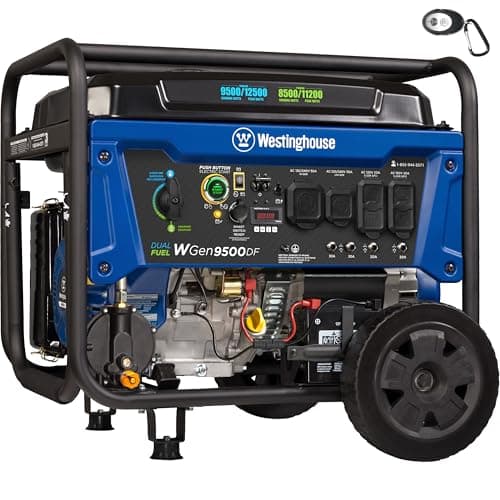
Westinghouse WGen9500DF

The generator case, affordably

Westinghouse WGen9500DF

9,500 running watts of dual fuel with both 240V outlets and remote start.

Long outages, at a fraction of an installed battery
$999.00 · Check price on Amazon

#ad how this is funded · price as of October 20, 2026

2
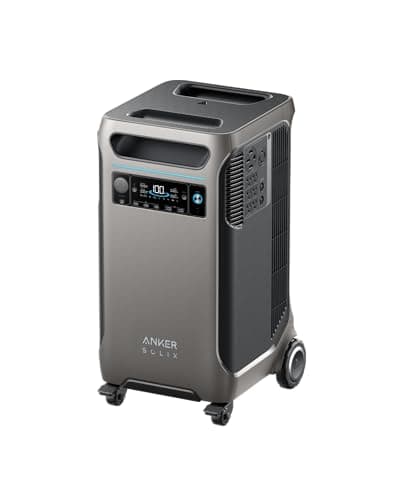
Anker SOLIX F3800

The battery case, without the install

Anker SOLIX F3800

3,840Wh of LiFePO4 with 6,000W continuous and true 120/240V split-phase.

Silent backup that you can also take with you
$1,759.99 · Check price on Amazon

#ad how this is funded · price as of October 20, 2026

3
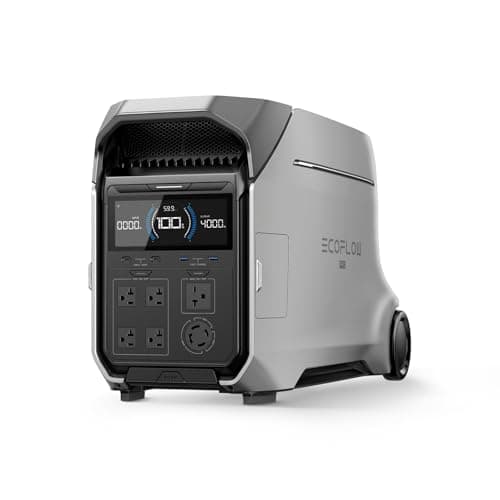
EcoFlow DELTA Pro 3

Best for pairing with solar

EcoFlow DELTA Pro 3

4,096Wh at 120/240V with 2,600W of solar input and a one-hour recharge.

A house with panels and short, frequent outages
$2,799.00 · Check price on Amazon

#ad how this is funded · price as of October 20, 2026 · $3,699.00 24% off

4
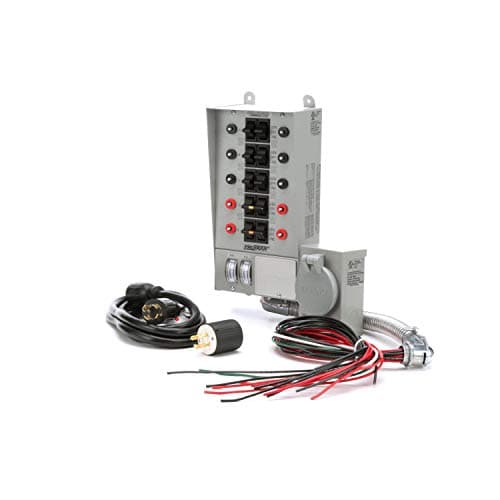
Reliance Controls 31410CRK Pro/Tran

What either option needs

Reliance Controls 31410CRK Pro/Tran

A 10-circuit manual transfer switch rated 30A / 7,500W with two watt meters.

Reaching hardwired circuits legally
$470.22 · Check price on Amazon

#ad how this is funded · price as of October 20, 2026

Prices come from the retailer at page-build time and change constantly. Where no live price is available the button reads “Check price” rather than showing a number we cannot stand behind.

The difference that decides it

Everything else in this comparison follows from one fact.

A battery stores a fixed amount of energy. When it is empty, it is empty, and the only things that refill it are the grid — which is out — or solar, which depends on weather and daylight.

A generator makes energy from fuel. Its capacity is however much fuel you can get, which during a short outage is unlimited and during a regional multi-day event is its own problem.

So the question is not which is better. It is how long your power goes out for, and the honest answer for most households is that they do not know — which is what the outage duration page exists to fix.

Side by side

Installed home batteryStandby generator
DurationFixed — hours, unless solar refills itUnlimited while fuel arrives
NoiseSilentLoud, and it runs all night
ChangeoverInstant — the lights do not flicker10-30 seconds while it starts
MaintenanceEssentially noneAnnual service, fuel management, exercise runs
FuelNoneNatural gas line, or propane deliveries
Everyday valueTime-of-use arbitrage, solar self-consumptionNone — it sits idle
LifespanWarranty typically 10 yearsDecades with servicing
Cold weatherReduced capacity, usually managed by heatingStarts harder; propane vaporizes less readily

Characteristics are general to the product classes. This site does not publish installed-system prices; those depend on your panel, your site and your installer, and any figure we quoted would be wrong for most readers.

The energy arithmetic, plainly

A single home battery unit typically stores somewhere in the low tens of kilowatt-hours. Run against a modest critical-load list, that is a useful number of hours; run against a whole house including air conditioning, it is not.

LoadAverage drawHours from 13.5 kWh
Critical loads only300 WAbout 45 hours
Critical loads plus a furnace blower600 W averageAbout 22 hours
Normal household use, no heating or cooling1,200 WAbout 11 hours
Household with central air running3,500 W averageUnder 4 hours

13.5 kWh is used as an illustrative single-unit capacity. Hours are capacity divided by average draw; real systems reserve some capacity and lose a little to conversion.

Note the shape. Managed carefully, a home battery covers a two-day outage comfortably. Used as though the grid were still there, it covers an evening. That difference is behavioral rather than technical, and it is where most disappointment comes from.

Solar changes the answer completely

This is the single biggest factor and it is often left out of the comparison.

A battery without solar is a fixed store — you get one tankful. A battery with a decent array refills every sunny day, which turns a two-day capability into an indefinite one, silently, with no fuel.

That is the configuration where a battery genuinely beats a generator, and it is why most installed home batteries are sold alongside panels rather than on their own.

The caveat is seasonal. Winter production in most of the United States is a fraction of summer, and winter is when the long outages happen — the solar sizing page covers what an array actually returns.

The two things only a battery does

1. It pays for itself between outages. Time-of-use arbitrage — charging when power is cheap and discharging when it is expensive — and storing your own solar production instead of exporting it. A generator earns nothing for the 8,750 hours a year it is idle.

2. The changeover is invisible. A battery switches in milliseconds, so clocks do not reset and computers do not reboot. A standby generator takes ten to thirty seconds to start and transfer, which is a brief outage every time.

The two things only a generator does

1. It runs for a week. The scenario that actually justifies whole-house backup — a regional ice storm or a hurricane aftermath — is exactly the one a fixed store of energy handles worst.

2. It carries large loads continuously. Central air conditioning, electric heat, a well pump and an electric range are loads a generator sized for them will run indefinitely and a battery will run briefly.

The configuration that is often best

Both, and it is less extravagant than it sounds because the two are sized against different problems.

A modest battery handles the common case — the several short outages a year — silently and automatically, with no fuel and no noise. A portable generator handles the rare multi-day event, gets pulled out twice a decade, and costs a fraction of upsizing the battery to cover a week.

The technology comparison covers the underlying trade in more detail, and the home battery systems page covers the units that sit between a power station and an installed system.

The short version

  • Hours-long outages: battery. Silent, instant, no maintenance.
  • Days-long outages: generator. Fuel has no capacity limit.
  • Solar changes the answer more than any other single factor.
  • A battery earns money between outages. A generator does not.

The picks in full

01 — The generator case, affordably

Westinghouse WGen9500DF

9,500 running watts of dual fuel with both 240V outlets and remote start.

The strongest argument against an installed home battery is that a portable generator plus a transfer switch delivers most of the practical benefit for a small fraction of the cost.

9,500 running watts is more usable output than a single home battery typically delivers continuously, and with fuel beside it there is no capacity limit at all.

The honest catch: it is loud, it must be started by a person, it needs fuel fetched during exactly the week fuel is hard to get, and it needs maintaining.

Skip it ifnobody will be home to start it. A portable is not automatic.

Westinghouse WGen9500DF
$999.00 · Check price on Amazon

#ad how this is funded · price as of October 20, 2026

Published specifications for the Westinghouse WGen9500DF
SpecificationPublished figure
Output (gasoline)9,500 running W / 12,500 peak W
FuelGasoline or propane (dual fuel)
Engine457cc 4-stroke OHV, cast iron sleeve
Tank6.6 gal (25 L)
Run timeup to 12 h on a full tank
Transfer-switch outlet120/240 V L14-30R, 30 A
RV outlet120/240 V 14-50R, 50 A
StartingPush-button electric with remote key fob
Warranty3-year limited

Source: Westinghouse — WGen9500DF product specifications. These are the manufacturer's published figures, not ours — we have not tested this unit.

02 — The battery case, without the install

Anker SOLIX F3800

3,840Wh of LiFePO4 with 6,000W continuous and true 120/240V split-phase.

This is the middle ground the comparison usually ignores: split-phase output that reaches hardwired circuits, without a permanent installation or a utility interconnection agreement.

3,840Wh is roughly a quarter of a typical installed home battery, and it expands to 26.9kWh — which brings it into the same territory for considerably less.

The honest catch: it does not switch over automatically for the whole house, and it does not participate in utility programs the way an installed battery can.

Skip it ifyou want automatic changeover with nobody home. That is an installed system.

Anker SOLIX F3800
$1,759.99 · Check price on Amazon

#ad how this is funded · price as of October 20, 2026

Published specifications for the Anker SOLIX F3800
SpecificationPublished figure
Capacity3,840 Wh
Cell chemistryLiFePO4
AC output6,000 W continuous, 9,000 W surge
Voltage120V / 240V split-phase
Cycle life3,000+ cycles to 80% capacity
Recharge1,800 W AC, up to 2,400 W solar
ExpansionUp to six expansion batteries, 26.9 kWh total
Warranty5 years
Current Amazon listingRenewed. Anker's new first-party F3800 listing is currently unavailable and the model has been succeeded by the F3800 Plus; the unit itself is unchanged

Source: Anker SOLIX — F3800 product specifications. These are the manufacturer's published figures, not ours — we have not tested this unit.

03 — Best for pairing with solar

EcoFlow DELTA Pro 3

4,096Wh at 120/240V with 2,600W of solar input and a one-hour recharge.

The case where a battery genuinely beats a generator is a house with solar and outages measured in hours. Then the battery refills for free every day and the generator sits burning money.

2,600W of solar input is enough to make that real rather than theoretical.

The honest catch: it needs an array to match, and in a multi-day winter outage solar production is exactly when it is lowest.

Skip it ifyou have no solar and long outages. Then a generator is the honest answer.

EcoFlow DELTA Pro 3
$2,799.00 · Check price on Amazon

#ad how this is funded · price as of October 20, 2026 · $3,699.00 24% off

Published specifications for the EcoFlow DELTA Pro 3
SpecificationPublished figure
Capacity4,096 Wh
Cell chemistryLiFePO4 (LFP)
AC output4,000 W, 120V / 240V
Cycle life4,000+ cycles to 80% capacity
Wall recharge0-80% in about 1 hour
Max solar input2,600 W
Expansion4 kWh to 48 kWh

Source: EcoFlow — DELTA Pro 3 product listing. These are the manufacturer's published figures, not ours — we have not tested this unit.

04 — What either option needs

Reliance Controls 31410CRK Pro/Tran

A 10-circuit manual transfer switch rated 30A / 7,500W with two watt meters.

A generator or a portable battery both stop at the same place: the hardwired circuits. The switch is what gets either of them to the furnace, the well pump and the sump pump.

An installed home battery includes this function as an automatic transfer switch and a gateway, which is a meaningful part of what the installation cost buys.

The honest catch: a 30A switch caps the feed at 7,500W regardless of what is on the other end.

Skip it ifyou are having an installed system with an automatic transfer switch.

Reliance Controls 31410CRK Pro/Tran
$470.22 · Check price on Amazon

#ad how this is funded · price as of October 20, 2026

Published specifications for the Reliance Controls 31410CRK Pro/Tran
SpecificationPublished figure
Circuits10 — six 15 A and four 20 A single-pole breakers
Rating30 A, up to 7,500 W
MeteringTwo watt meters for balancing the load
SwitchingBreak-before-make double-throw, Line / Off / Gen
BackfeedMechanically prevented — the grid cannot be energized
InstallationLicensed electrician; a permit is usually required

Source: Reliance Controls — Pro/Tran 31410CRK product page. These are the manufacturer's published figures, not ours — we have not tested this unit.

How these were chosen

We did not test these. Nobody at Watt & Warden has plugged one in. What we did instead: read the manufacturer's published specifications, compile them into a table where the figures line up, and compute the numbers manufacturers leave out — runtime against a real appliance load, and what an hour of running actually costs.

Anything that could not be sourced was left out rather than estimated, and every pick names the buyer who should skip it. The full method is here, including where it is weaker than a publisher with a test bench.

Questions people actually ask

Is a Powerwall better than a generator?

It depends entirely on how long your outages last. A home battery stores a fixed amount of energy and is silent, instant and maintenance-free -- excellent for outages measured in hours. A generator makes energy from fuel and has no capacity limit, which wins once outages run for days. Solar changes the answer more than any other factor.

How long will a home battery run a house?

Against a 300W critical-load list, an illustrative 13.5 kWh unit runs about 45 hours. Against normal household use with no heating or cooling, about 11 hours. With central air conditioning running, under four. The difference is behavioral -- managed carefully a home battery covers a two-day outage, used as though the grid were still there it covers an evening.

Can a home battery run central air conditioning?

Briefly. A household with central air averages around 3,500W, which empties an illustrative 13.5 kWh battery in under four hours. Most installed systems handle this by backing up chosen circuits rather than the whole panel, which is the same load-shedding logic that applies to a generator.

Do I need solar with a home battery?

Not strictly, but it changes the product. Without solar a battery is a fixed store -- you get one tankful and then it is empty. With a decent array it refills every sunny day, which turns a two-day capability into an indefinite one. The caveat is that winter production is a fraction of summer, and winter is when long outages happen.

Is it worth having both a battery and a generator?

Often, and it is less extravagant than it sounds because they are sized against different problems. A modest battery covers the several short outages a year silently and automatically. A portable generator covers the rare multi-day event, gets used twice a decade, and costs far less than upsizing the battery to cover a week.

Sources

Every figure on this page comes from a published source. We have not tested this equipment, so the specifications are the manufacturer's and the statistics are the dataset's — the arithmetic on top of them is ours, and it is shown in full so you can check it. How we work this out.