Skip to content
Watt Warden

Solar

How Much Solar Do I Need for a Power Outage?

A battery is a bucket with a fixed size. Solar turns it into a daily allowance. The question is not how big the bucket is — it is whether the allowance covers what you spend each day.

By Sawyer V.Updated Published How we work this out
A solar array in a field under a broad sky.

Watt & Warden earns a commission on qualifying purchases made through links on this page, at no extra cost to you. It never changes a ranking, and our picks include products we tell you to skip. Full disclosure.

The framing that makes this simple

A battery is a bucket. It has a fixed size, you empty it, and then it is empty.

Solar is an allowance. Every day it puts a certain amount back, and if the allowance is bigger than your daily spend, the outage can last indefinitely.

So the question is never "how much solar do I need" in the abstract. It is two questions: how much energy do I use per day, and how many peak sun hours does my location get. Everything else is arithmetic.

Step 1 — your daily energy

Not your peak watts. Watt-hours across 24 hours, which is a much smaller and much more useful number.

TierWhat it coversDaily energy
Communications onlyRouter, modem, phones, a few lights~300–500 Wh
Food and essentialsFridge, lights, devices, a laptop~1,200–1,800 Wh
Food plus a freezerAbove, plus a chest freezer~2,000–3,000 Wh
Essentials plus a pumpAbove, plus a well pump or sump pump~3,000–4,500 Wh

These are working estimates assembled from the appliance figures Champion and Honda publish, combined with typical duty cycles. They are a starting point for planning, not measurements of your house — an old fridge in a hot garage will be well above the range, a new one below it. The full wattage chart has the underlying numbers.

Notice what is absent. Heating, air conditioning, electric water heating, electric cooking and clothes drying are all missing, because they are kilowatt-hours per hour rather than per day. No portable solar setup covers them, and pretending otherwise is how people end up disappointed by equipment that was never going to work.

Step 2 — your peak sun hours

A peak sun hour is one hour of sunlight at 1,000 W/m² — the intensity panels are rated at. A location with 5 peak sun hours does not get five hours of daylight; it gets a whole day whose total energy equals five hours at full intensity.

Using it is straightforward: a 200W panel in a location with 5 peak sun hours produces roughly 1,000Wh a day before losses.

LocationAnnual average peak sun hours per day
Arizona6.5
California5.6
Texas5.3
Florida5.3
Minnesota4.3
New York4.0
Washington3.8
National average≈ 5.0

State figures as published by Unbound Solar's peak sun hours map, which draws on NREL's PVWatts data from the National Solar Radiation Database. These are annual averages — a December figure is substantially lower than a June one at every latitude, and that seasonal swing matters more than the state-to-state difference. For your own location and month, NREL's PVWatts calculator is the free authoritative tool.

Step 3 — the arithmetic, and the derating

The formula is: panel watts = daily Wh ÷ peak sun hours ÷ 0.7.

The 0.7 is the part people leave out. Between the panel's rating and the energy that reaches your battery you lose output to cell temperature, imperfect angle, cable resistance, charge-controller conversion and dirt on the glass. Assuming you collect about 70% of the theoretical figure is a conservative planning assumption rather than a measured one.

Daily needAt 4 peak sun hoursAt 5 peak sun hoursAt 6 peak sun hours
500 Wh~180 W~145 W~120 W
1,500 Wh~535 W~430 W~360 W
2,500 Wh~890 W~715 W~595 W
4,000 Wh~1,430 W~1,145 W~955 W

Calculated as daily Wh ÷ peak sun hours ÷ 0.7 and rounded. The derating factor is a planning assumption, not a measurement; real conditions vary considerably day to day.

The middle row is the one most households land on, and it is worth sitting with. Sustaining a fridge, lights and devices indefinitely takes roughly 400–550W of panel — two decent folding panels, not one. A single 200W panel covers about half of it.

Step 4 — check the battery can take it

Two limits, both in your station's manual, and both capable of making the panels you bought useless:

  • Maximum solar input in watts. A station that accepts 200W will accept 200W no matter what you connect. This is the most common way money gets wasted here.
  • Battery capacity relative to the overnight load. Solar produces nothing after dark, and a fridge keeps cycling. The battery has to be big enough to carry from sunset to sunrise on its own.

A rough pairing that works: battery capacity at least equal to your daily energy, and panel wattage from the table above. That gives you a full day of margin if a day comes in badly.

Season is the thing that breaks plans

The state figures above are annual averages, and every one of them hides a large seasonal swing. Winter days are shorter, the sun is lower, and storm systems are thicker — which is exactly when outages happen in most of the country.

So a system sized on annual averages will underperform in the season you most need it. Two responses, both legitimate:

  • Oversize the panels. Excess capacity in June costs nothing and rescues December.
  • Pair solar with a generator. Solar covers indefinite summer outages silently; the generator covers the ice storm. That combination is more robust than either alone and it is what we would actually recommend for most of the country.

What cloud actually costs you goes into the numbers, and solar versus gas makes the case for the pairing.

The honest summary

  • For communications and lights — one 100W to 200W panel and a 500Wh to 1kWh battery. This works, everywhere, all year.
  • For a fridge and essentials — 400W to 500W of panel and a 1.5kWh to 2kWh battery. The common case, and two panels rather than one.
  • For a freezer and a pump as well — 800W or more of panel and 3kWh of battery, which is a large and expensive folding-panel array. Consider a generator for the recharge instead.
  • For heating, cooling or electric cooking — not solar. Not at portable scale, not with any number of folding panels.

And the practical shortcut: work out your daily watt-hours first. Almost everyone who is disappointed by a solar backup setup skipped that step and bought by headline capacity instead. Matching capacity to outage length is the companion to this page.

Quick picks

#ProductBest forPrice
1
No photo

Best battery to build around

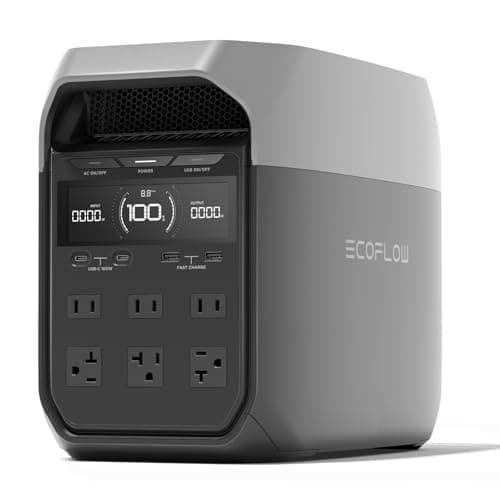
EcoFlow DELTA 2

1,024Wh and 1,800W with 500W of solar input and expansion to 3kWh.

A fridge and the essentials, extendable
2
No photo

The panel most people should buy

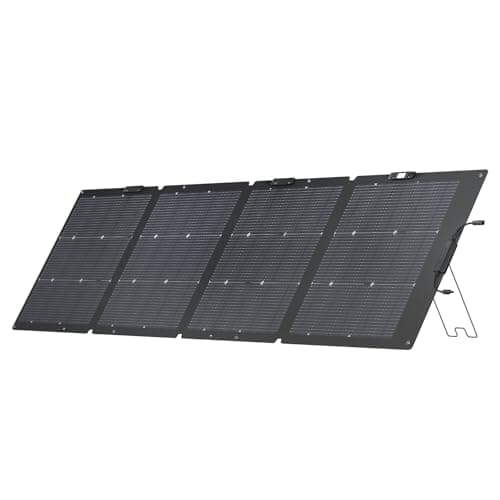
EcoFlow 220W Bifacial Solar Panel

220W front and 155W rear bifacial, IP68, 20.9 lb, with an adjustable stand.

Covering a modest daily load
3
No photo

The second panel

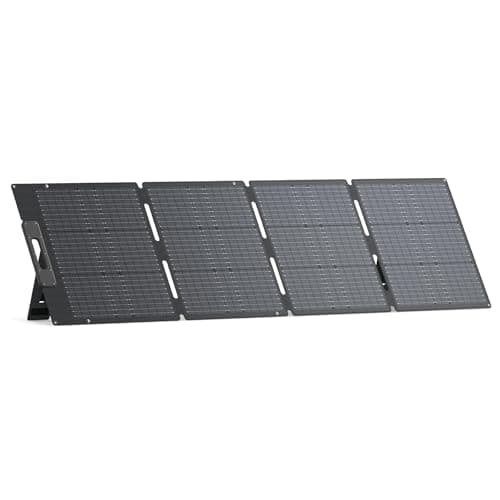
BLUETTI SP200 200W Solar Panel

200W on MC4, 14.3 lb, at up to 23.5% efficiency.

Margin for cloud and short winter days
4
No photo

For a bigger daily budget

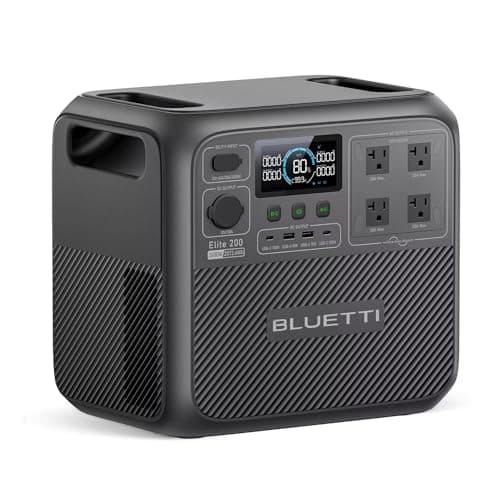
BLUETTI Elite 200 V2

2,073Wh of LiFePO4 with 2,600W output and a ten-year design life.

Fridge, freezer and a well pump

Prices come from the retailer at page-build time and change constantly. Where no live price is available the button reads “Check price” rather than showing a number we cannot stand behind.

The picks in full

01Best battery to build around

EcoFlow DELTA 2

1,024Wh and 1,800W with 500W of solar input and expansion to 3kWh.

500W of solar input is the specification that makes this a multi-day answer. A station that accepts only 200W caps your daily allowance no matter how much panel you own.

Expandable to 3kWh, so the bucket can grow later if it turns out your outages are longer than you assumed.

Skip it ifyou need to cover heating or air conditioning. Neither is a solar-and-battery problem at portable scale.

Published specifications for the EcoFlow DELTA 2
SpecificationPublished figure
Usable capacity1,024 Wh (expandable to 3 kWh)
Cell chemistryLiFePO4 (LFP)
AC output1,800 W continuous / 2,700 W surge
X-Boost output2,200 W for resistive loads
Weight27 lb
Cycle life3,000+ cycles
Max solar input500 W
Warranty5 years

Source: EcoFlow — DELTA 2 product specifications. These are the manufacturer's published figures, not ours — we have not tested this unit.

02The panel most people should buy

EcoFlow 220W Bifacial Solar Panel

220W front and 155W rear bifacial, IP68, 20.9 lb, with an adjustable stand.

At roughly 4 to 5 peak sun hours across most of the United States, a 220W panel in good conditions covers the daily energy of a fridge plus lighting and devices, which is the load most people actually need to sustain.

The adjustable stand is not a detail. Angle is one of the largest levers on real output, and a panel flat on the ground gives away a great deal of it.

Skip it ifyour station's solar input ceiling is under 220W. Then you are paying for output it cannot take.

Published specifications for the EcoFlow 220W Bifacial Solar Panel
SpecificationPublished figure
Rated output220 W front, 155 W rear (bifacial)
Cell typeN-type monocrystalline
Conversion efficiencyUp to 25%
Ingress ratingIP68
Weight20.9 lb (9.5 kg)
ConstructionOne-piece tempered glass
StandCarry case doubles as an adjustable kickstand

Source: EcoFlow — 220W Bifacial Solar Panel published specifications. These are the manufacturer's published figures, not ours — we have not tested this unit.

03The second panel

BLUETTI SP200 200W Solar Panel

200W on MC4, 14.3 lb, at up to 23.5% efficiency.

The honest sizing conclusion for most households is two panels rather than one, because a single panel is adequate on a good June day and inadequate on every other kind.

MC4 termination makes it straightforward to pair with a station from another brand. Series versus parallel decides how you combine them.

Skip it ifyou would exceed your station's input voltage limit by putting two panels in series.

Published specifications for the BLUETTI SP200 200W Solar Panel
SpecificationPublished figure
Rated output200 W
Cell typeMonocrystalline
Conversion efficiencyUp to 23.5%
Ingress ratingIP65
Weight14.3 lb
Folded size20.7 x 20.5 in
ConnectorMC4

Source: BLUETTI — SP200 published specifications. These are the manufacturer's published figures, not ours — we have not tested this unit.

04For a bigger daily budget

BLUETTI Elite 200 V2

2,073Wh of LiFePO4 with 2,600W output and a ten-year design life.

Where the daily load is larger, the battery has to be large enough to carry the overnight portion of it — solar produces nothing between sunset and sunrise, which is when a fridge still cycles.

LiFePO4 with a ten-year design life is the right chemistry for equipment that spends most of its life charged and idle.

Skip it ifyour daily load is small. Buy panel capacity before you buy battery capacity.

Published specifications for the BLUETTI Elite 200 V2
SpecificationPublished figure
Usable capacity2,073.6 Wh
Cell chemistryAutomotive-grade LiFePO4 (LFP)
AC output2,600 W continuous / 3,900 W power lifting
Cycle life6,000+ cycles
Fast charge0–80% in 50 min via dual AC/DC input

Source: BLUETTI — Elite 200 V2 product specifications. These are the manufacturer's published figures, not ours — we have not tested this unit.

How these were chosen

We did not test these. Nobody at Watt & Warden has plugged one in. What we did instead: read the manufacturer's published specifications, compile them into a table where the figures line up, and compute the numbers manufacturers leave out — runtime against a real appliance load, and what an hour of running actually costs.

Anything that could not be sourced was left out rather than estimated, and every pick names the buyer who should skip it. The full method is here, including where it is weaker than a publisher with a test bench.

Questions people actually ask

How much solar do I need to run a fridge during an outage?

Roughly 400-550W of panel to sustain a fridge plus lights and devices indefinitely -- about 1,500Wh a day divided by four to five peak sun hours, with a 30% allowance for real-world losses. That is two decent folding panels, not one, plus a battery of at least 1.5kWh to carry the overnight load.

What are peak sun hours?

One peak sun hour is an hour of sunlight at 1,000 W/m2, the intensity panels are rated at. A location with five peak sun hours gets a whole day whose total energy equals five hours at full intensity. Most of the United States averages around four to five annually, from about 3.8 in Washington to 6.5 in Arizona.

Can solar panels power my whole house during an outage?

Portable ones, no. Heating, air conditioning, electric water heating and electric cooking are kilowatt-hours per hour rather than per day, and no number of folding panels reaches them. Whole-house solar with battery storage is a roof-mounted, permitted, installer-fitted project and a different purchase entirely.

How do I calculate how many solar panels I need?

Panel watts equals daily watt-hours divided by your location's peak sun hours divided by 0.7. The 0.7 accounts for cell temperature, angle, cable loss, charge-controller conversion and dirt. Then check your power station's maximum solar input, because it will not accept more than its rating regardless.

Will solar work in a winter storm outage?

Less well, and that is the central planning problem -- winter days are short, the sun is low, and storm cloud is thick, which is exactly when outages happen. Either oversize the panels so December still works, or pair a modest solar setup with a generator and let each cover the season it suits.

Sources

Every figure on this page comes from a published source. We have not tested this equipment, so the specifications are the manufacturer's and the statistics are the dataset's — the arithmetic on top of them is ours, and it is shown in full so you can check it. How we work this out.