Skip to content
Watt Warden

Sizing

How Many Watts to Run a House?

"Run the house" means four different things to four people. Separating them is the difference between a $500 purchase and a $12,000 one.

By Sawyer V.Updated Published How we work this out
An open home electrical breaker panel.

Watt & Warden earns a commission on qualifying purchases made through links on this page, at no extra cost to you. It never changes a ranking, and our picks include products we tell you to skip. Full disclosure.

The question is really four questions

"How many watts to run a house" has no single answer because the phrase covers everything from keeping food cold to living as if nothing happened. Separate them and the numbers become obvious.

TierWhat runsRunning wattsPeak watts
1 — SurviveFridge, lights, router, phones~300~1,200
2 — Critical circuitsAbove, plus freezer, furnace blower, well or sump pump~1,500-2,500~4,000-5,000
3 — ComfortableAbove, plus a window AC or one range element~3,500-5,000~7,000-8,000
4 — As if nothing happenedAbove, plus central AC, electric water heating, dryer~10,000-15,000~15,000-20,000+

Built up from Champion Power Equipment's and Honda Power Equipment's published appliance figures plus this site's stated 150W fridge planning average. Peak columns apply the largest-single-surge method rather than adding every starting figure together. These are planning brackets, not a survey of houses — yours will differ, and the wattage chart has the underlying numbers.

Almost everyone who says "run the house" means tier 2. Almost everyone who prices tier 4 stops and reconsiders.

What makes tier 4 so expensive

Three loads, and they are all the same kind of thing: appliances that move or make heat with electricity directly.

  • Central air conditioning. Champion publishes 3,000-3,500 running and 5,000-6,000 starting for a 3 ton unit. That one appliance is larger than tiers 1 and 2 combined.
  • Electric water heating. 3,000-4,500W whenever it cycles, and it cycles on its own schedule.
  • Electric range, oven and dryer. Thousands of watts each, and a range with several elements on is a house-sized load by itself.

Which points to the most useful strategy in the whole category: if your heating, cooking and hot water run on gas, backup power gets dramatically cheaper. A gas furnace needs only its blower, a gas water heater often needs nothing at all, and a gas range can usually be lit by hand.

Why nobody powers the whole panel

A typical modern house has a 200 amp service, which at 240 volts is a theoretical 48,000 watts. No portable generator comes close, and no household ever draws it — service size is about the maximum a house could ever demand, not what it uses.

The point of a transfer switch is precisely that you choose a handful of circuits in advance and power those. Ten circuits is the common residential kit size, and ten well-chosen circuits covers tier 2 comfortably.

Choosing them is the useful exercise: the connection guide walks through which circuits earn a slot.

Watts is only half of it

A generator sized correctly in watts can still be the wrong purchase, because watts say nothing about how long you can keep them coming.

At 0.32 gal/hr, six hours a day of a 5,300W machine is about 1.9 gallons — so three days is under six gallons, which is two cans in the garage. The same three days run continuously is about 23 gallons, which is more than many jurisdictions permit in an attached garage.

Block running is what makes the fuel arithmetic work, and it costs nothing: six hours a day keeps a fridge and freezer safe indefinitely. The consumption arithmetic and the storage limits cover both sides.

Where a battery lands on this scale

Portable batteries cover tier 1 outright and reach into tier 2 with load shedding. They do not reach tier 3 or 4, and no amount of capacity changes that — a 1,500W space heater or a 3,500W air conditioner would empty any of them in an hour.

What a battery does uniquely well is run tier 1 indoors, silently, all night. Which is why the arrangement we would actually recommend for a long outage is a generator at tier 2 running in blocks during the day, and a battery covering the essentials overnight.

Generator versus power station makes the case, and sizing a battery works the other half.

How to get your own number in ten minutes

  1. Write down what has to keep running. Be honest — the list is usually shorter than the first draft.
  2. Look each item up in the wattage chart, or read the label on the appliance itself.
  3. Add the running watts.
  4. Find the largest single starting wattage and add the difference between it and that appliance's running figure. Why you do not add them all.
  5. Add 20% margin. Labels are optimistic and old appliances draw more than new ones.
  6. Buy the machine whose running watts exceed that figure — not the one whose peak watts do.

That last step is the one that catches people. A generator advertised as "9,500 watts" may be 9,500 peak and 7,500 running. The running number is what you own.

Quick picks

#ProductBest forPrice
1
No photo

Tier 2 — the critical circuits

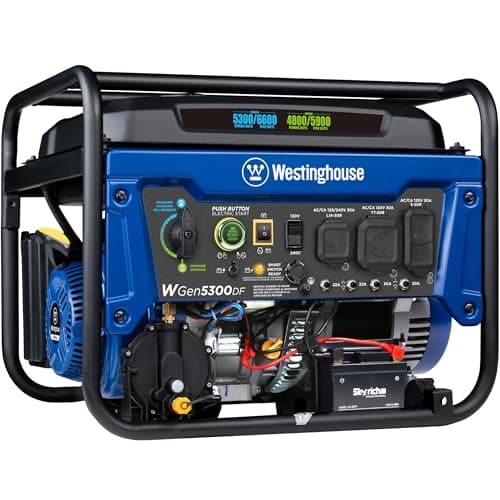
Westinghouse WGen5300DF

5,300 running watts on gasoline and up to 14.5 hours on 4.7 gallons.

Fridge, furnace, well pump, lights
2
No photo

Tier 3 — critical circuits plus comfort

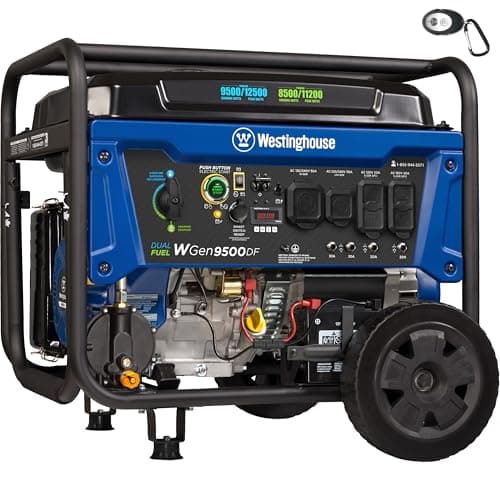
Westinghouse WGen9500DF

9,500 running watts with both a 30A transfer-switch outlet and a 50A RV outlet.

Adding a window air conditioner or an electric range element
3
No photo

Tier 4 — nearly everything

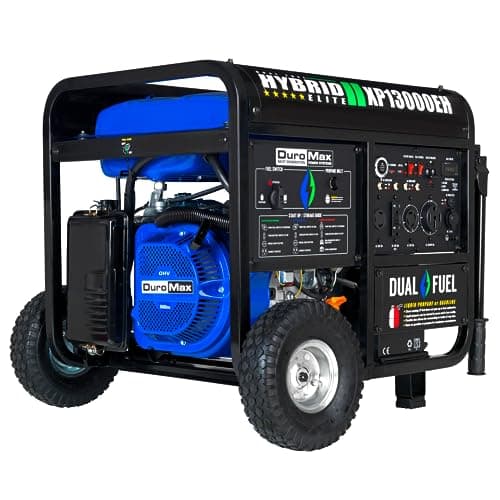
DuroMax XP13000EH

Dual fuel at the top of the portable range, with electric start.

A large house with central air and a well
4
No photo

How any of this reaches the house

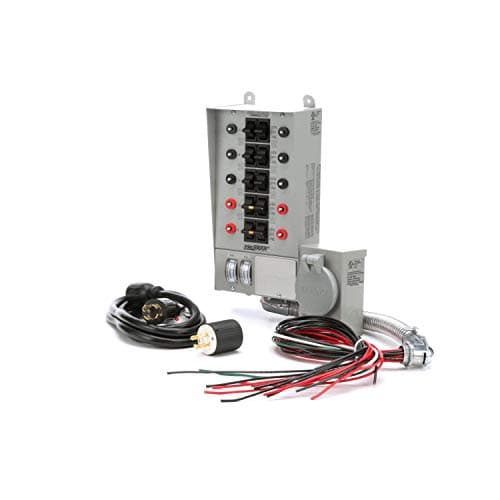
Reliance Controls 31410CRK Pro/Tran

A 10-circuit manual transfer switch rated 30A / 7,500W with two watt meters.

Feeding hardwired circuits

Prices come from the retailer at page-build time and change constantly. Where no live price is available the button reads “Check price” rather than showing a number we cannot stand behind.

The picks in full

01Tier 2 — the critical circuits

Westinghouse WGen5300DF

5,300 running watts on gasoline and up to 14.5 hours on 4.7 gallons.

This is the tier most households actually mean. 5,300 running watts covers a refrigerator, a furnace blower, a sump or well pump and lighting simultaneously, with room for a microwave used one at a time.

About 0.32 gallons an hour averaged across a tank makes three days of six-hour block running roughly six gallons — two five-gallon cans. That is a plan you can actually store for.

Skip it ifyou need central air conditioning or an electric water heater.

Published specifications for the Westinghouse WGen5300DF
SpecificationPublished figure
Output (gasoline)5,300 running W / 6,600 peak W
Output (propane)4,800 running W / 5,900 peak W
Engine274cc 4-stroke OHV
Tank4.7 gal (18 L)
Run timeup to 14.5 h on a full tank
Transfer-switch outlet120/240 V L14-30R, 30 A
RV outlet120 V TT-30R, 30 A
StartingPush-button electric with remote key fob

Source: Westinghouse — WGen5300DF product specifications. These are the manufacturer's published figures, not ours — we have not tested this unit.

02Tier 3 — critical circuits plus comfort

Westinghouse WGen9500DF

9,500 running watts with both a 30A transfer-switch outlet and a 50A RV outlet.

The step up is bought for a specific extra load, not for comfort in general. 6.6 gallons over up to 12 hours is about 0.55 gal/hr — the price of the headroom, compounding across a multi-day outage.

The L14-30R and 14-50R outlets are what make it a house machine rather than a large camping one.

Skip it ifyour critical load fits in 5,300W. This costs about 70% more per hour in fuel.

Published specifications for the Westinghouse WGen9500DF
SpecificationPublished figure
Output (gasoline)9,500 running W / 12,500 peak W
FuelGasoline or propane (dual fuel)
Engine457cc 4-stroke OHV, cast iron sleeve
Tank6.6 gal (25 L)
Run timeup to 12 h on a full tank
Transfer-switch outlet120/240 V L14-30R, 30 A
RV outlet120/240 V 14-50R, 50 A
StartingPush-button electric with remote key fob
Warranty3-year limited

Source: Westinghouse — WGen9500DF product specifications. These are the manufacturer's published figures, not ours — we have not tested this unit.

03Tier 4 — nearly everything

DuroMax XP13000EH

Dual fuel at the top of the portable range, with electric start.

At this output a portable starts to approach what a small permanently installed unit does — and everything scales with it: weight, noise, fuel consumption, and the size of transfer switch required.

Past this point, a standby generator is usually the better answer, because it starts itself and runs on the gas main.

Skip it ifyou have not sized your load. This is far more machine than most houses need.

Published specifications for the DuroMax XP13000EH
SpecificationPublished figure
Output13,000 running W / 16,000 peak W
FuelGasoline or propane (dual fuel)
Engine500cc OHV DuroMax
Transfer-switch outlet50 A
FrameAll-metal, no plastic panels
SafetyLow-oil shutoff; 5 ft propane hose with ACME connector

Source: DuroMax — XP13000EH product specifications. These are the manufacturer's published figures, not ours — we have not tested this unit.

04How any of this reaches the house

Reliance Controls 31410CRK Pro/Tran

A 10-circuit manual transfer switch rated 30A / 7,500W with two watt meters.

The furnace, the well pump and the sump pump have no plugs, which means a generator without a transfer switch cannot reach the loads that define "running a house" at all.

The two watt meters matter more than they look: they let you balance the load across both legs and see how close to the limit you actually are, rather than discovering it by tripping.

Skip it ifeverything you need has a plug. Extension cords are simpler and cheaper.

Published specifications for the Reliance Controls 31410CRK Pro/Tran
SpecificationPublished figure
Circuits10 — six 15 A and four 20 A single-pole breakers
Rating30 A, up to 7,500 W
MeteringTwo watt meters for balancing the load
SwitchingBreak-before-make double-throw, Line / Off / Gen
BackfeedMechanically prevented — the grid cannot be energized
InstallationLicensed electrician; a permit is usually required

Source: Reliance Controls — Pro/Tran 31410CRK product page. These are the manufacturer's published figures, not ours — we have not tested this unit.

How these were chosen

We did not test these. Nobody at Watt & Warden has plugged one in. What we did instead: read the manufacturer's published specifications, compile them into a table where the figures line up, and compute the numbers manufacturers leave out — runtime against a real appliance load, and what an hour of running actually costs.

Anything that could not be sourced was left out rather than estimated, and every pick names the buyer who should skip it. The full method is here, including where it is weaker than a publisher with a test bench.

Questions people actually ask

How many watts does it take to run a house?

It depends what you mean. Keeping a fridge, lights and internet alive is about 300 running watts. The critical circuits -- adding a freezer, furnace blower and a pump -- is roughly 1,500 to 2,500. Adding a window air conditioner takes it to 3,500-5,000, and matching normal life with central air and electric water heating is 10,000 to 15,000.

Can a portable generator run a whole house?

Not the whole panel -- a 200 amp service is a theoretical 48,000 watts, and no portable comes near it. But nothing draws that either. A transfer switch exists so you pick a handful of circuits in advance, and ten well-chosen circuits covers the critical tier comfortably on about 5,000 running watts.

What size generator do I need for a house with gas heat?

Much smaller than one with electric heat, because a gas furnace needs only its blower -- 300 to 800 running watts rather than thousands. If heating, cooking and hot water are all gas, the critical tier fits inside about 5,000 running watts, which is the cheapest house-sized bracket.

How much fuel does running a house use?

At Westinghouse's published 0.32 gal/hr for the WGen5300DF, six hours a day is about 1.9 gallons, so three days is under six gallons -- two cans. The same three days run continuously is about 23 gallons, which exceeds what many jurisdictions permit in an attached garage. Block running is what makes it work.

Should I buy on peak watts or running watts?

Running watts. A machine advertised as 9,500 watts may be 9,500 peak and 7,500 running, and peak is a fraction of a second. Size your load, add 20% margin for optimistic labels and older appliances, then buy the machine whose running figure exceeds that.

Sources

Every figure on this page comes from a published source. We have not tested this equipment, so the specifications are the manufacturer's and the statistics are the dataset's — the arithmetic on top of them is ours, and it is shown in full so you can check it. How we work this out.