How much fuel three days actually needs
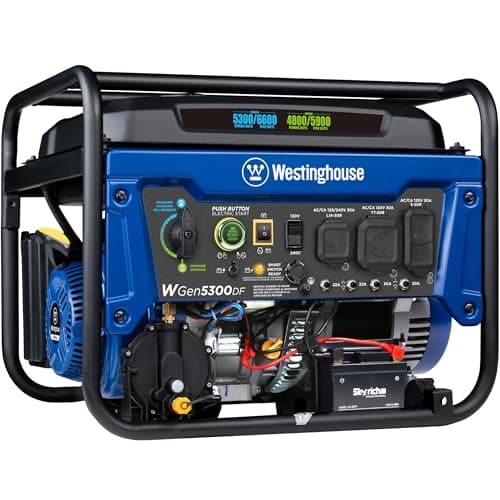
Start from consumption, not tank size. Westinghouse publishes 4.7 gallons over up to 14.5 hours for the WGen5300DF, which is about 0.32 gallons an hour averaged across a tank.
| Running pattern | Per day | Three days | Cans needed |
|---|
| 6 hours a day, in blocks | ~1.9 gal | ~5.8 gal | Two 5-gal cans |
|---|
| 12 hours a day | ~3.8 gal | ~11.5 gal | Three 5-gal cans |
|---|
| Continuous, 24 hours | ~7.7 gal | ~23 gal | Five 5-gal cans |
|---|
Computed from Westinghouse's published tank size and run time for the WGen5300DF. A heavier load raises consumption; a larger machine raises it considerably. This is arithmetic from published figures, not a measurement of your generator.
Which makes the case for block running on its own: six hours a day keeps a fridge and freezer safe and needs about a quarter of the fuel that continuous running does.
What it costs
What it costs to actually run
The sticker price of a dual-fuel generator is a fraction of what it costs you. The sticker price of a battery is nearly all of it. Here is the arithmetic, with the inputs stated so you can redo it with your own fuel price.
| Unit | Published consumption | Cost per hour | Cost per 24 h |
|---|
| WGen5300DF on gasoline, 6 hr/day | 0.32 gal/hr (computed from published figures) | $1.30 | $7.82 |
|---|
| WGen5300DF on gasoline, 24 hr/day | 0.32 gal/hr (computed from published figures) | $1.30 | $31.27 |
|---|
| Same machine on propane, 6 hr/day | 0.32 gal/hr equivalent, propane priced separately | $0.86 | $5.13 |
|---|
Gasoline at $4.071 a gallon, the U.S. Energy Information Administration's weekly retail average for the week ending 31 August 2026. Propane at $2.674 a gallon, the EIA's residential average for the week ending 30 March 2026, the most recent in a series that publishes through the winter heating season only. A 20 lb exchange cylinder costs considerably more per gallon than the bulk residential figure, which is why refilling beats exchanging.
How much you may legally store
This is where plans meet local rules, and the rules vary. Fire codes commonly limit the quantity of gasoline kept in an attached garage or dwelling, and containers have to be approved for the purpose.
Rather than quote a number that may be wrong where you live, the useful instruction is: check your local fire code or ask your fire department before planning to store more than a few cans. It is a short call and they answer it routinely.
What is universal:
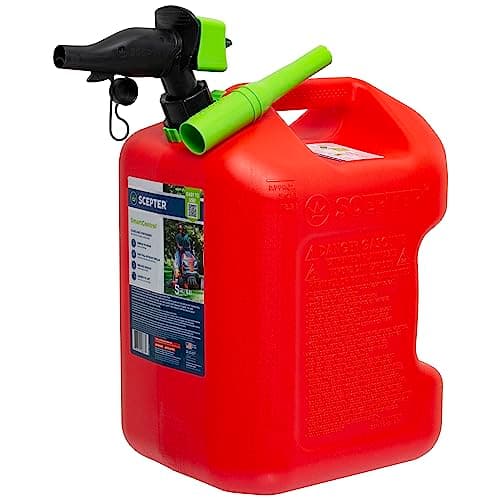
- Approved containers only. Not milk jugs, not water containers, not unrated plastic.
- Never in the living space. Not a basement, not a utility room, not a hallway.
- Away from ignition sources. Water heaters, furnaces and anything with a pilot light or a spark.
- Ventilated, shaded and cool. Vapor pressure rises with temperature.
- Never in a vehicle passenger compartment.
The full storage guidance covers rotation and container choice in more detail.
Rotation is the part people skip
Even treated fuel has a life. The workable routine is twice a year, at the same time you exercise the generator:
- Pour the stored cans into your vehicle's tank.
- Refill the cans with fresh gasoline.
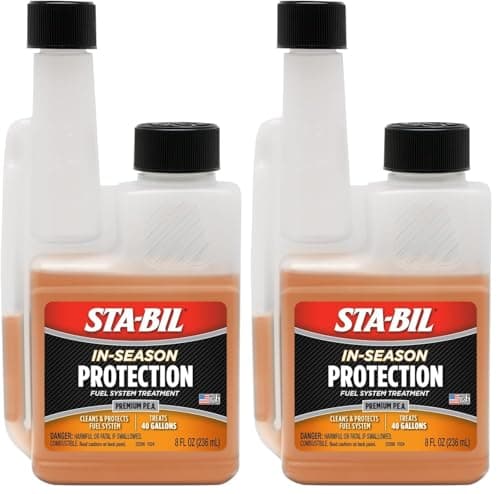
- Add stabilizer as you fill, before the fuel has aged.
- Label each can with the fill date in marker.
Nothing is wasted — the fuel goes into a car that was going to buy some anyway — and it takes twenty minutes. The seasonal routine folds it in with the oil check.
The propane alternative
Propane changes this entire page. It does not oxidize, does not absorb water, does not gum a carburetor and does not need rotation. Stored in proper cylinders it keeps indefinitely.
The trades are real: lower output on propane than gasoline on the same machine, cylinders are bulky, and vaporization slows in severe cold. But for a machine that sits eleven months a year, "the fuel does not go off" is a very large advantage.
The dual-fuel case weighs both sides.