The one that kills people
Start here, because it is the thing this page exists to prevent.
Never connect a generator to a wall outlet using a cord with male plugs on both ends. These are sometimes called suicide cords, and the name is accurate in more than one direction.
Doing it produces three separate ways to hurt someone:
- It energizes the utility line. Power flows backwards through your meter to the pole transformer, which steps it up to distribution voltage. A lineworker who has isolated your street and is working on a conductor they believe is dead can be electrocuted.
- The exposed prongs are live. Whichever end is not plugged in is a live male plug you are holding.
- It bypasses overload protection. Power enters the circuit downstream of the breaker, so the wiring is unprotected.
It is illegal essentially everywhere. Transfer switches and interlock kits exist specifically to make this configuration impossible, and that is their entire design purpose.
Method 1 — extension cords
Run outdoor-rated cords from the generator to the appliances you care about. No installation, no permit, no electrician.
What it covers: a refrigerator, a freezer, lamps, phone chargers, a television, a fan, a power station you are refilling.
What it cannot cover: anything hard-wired — a furnace, a well pump, a sump pump, a water heater. Those have no plug.
Doing it properly: use outdoor-rated cords heavy enough for the load and the distance (14-gauge for short runs, 12-gauge for longer or heavier ones). Do not daisy-chain them. Route them so doors and windows are not held open around them, because that defeats the carbon monoxide clearance you established by putting the generator twenty feet away.
This is how most people start and it is entirely legitimate. It covers the food, which is most of what an outage actually costs a household.
Method 2 — a manual transfer switch
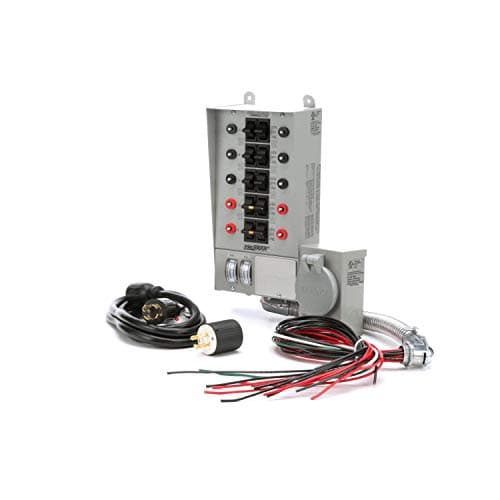
A box beside your panel, wired to a chosen group of circuits, with a three-position toggle per circuit: Line, Off, Generator. An exterior inlet box takes the generator cord.
What it covers: whichever circuits you wired to it, including hard-wired equipment. A ten-circuit switch typically covers a furnace, a fridge, a sump pump, a couple of lighting circuits and some outlets.
What it costs: the switch, the inlet box, the cord, and an electrician for half a day to a day. Permit fees vary. The labor generally exceeds the hardware.
Why it is the standard answer: it is foolproof — the switch cannot connect a circuit to both sources — it is obvious to operate, and the watt meters let you use the generator's full output without tripping it. Compared against the interlock option here.
Method 3 — an interlock kit
A plate fitted to your existing panel that makes it physically impossible to have the main breaker and a dedicated generator breaker on at the same time. Turn off the main, slide the plate, turn on the generator breaker, and the whole panel is fed from the generator.
What it covers: every circuit in the panel — subject to what the generator can actually supply.
What it costs: less hardware than a transfer switch, similar labor, plus the same inlet box and cord.
The catch: the kit must be listed for your specific panel make and model, and there is no metering, so managing load is entirely on you. Turn on more than the generator can supply and it trips.
Method 4 — an automatic transfer switch
Part of a standby installation rather than a portable one. It monitors the utility, starts the generator when the supply fails, waits for the engine to stabilize, and transfers the house across — usually in under thirty seconds, with nobody involved.
This is a different purchase entirely, and it comes with the generator rather than being added to one. What a standby installation involves.
Which method for which requirement
| What you need to power | Method | Electrician? |
|---|
| Fridge, lamps, phones, a TV | Extension cords | No |
|---|
| Add a furnace or a sump pump | Transfer switch or interlock | Yes |
|---|
| Add a well pump (240V) | Transfer switch or interlock, 240V capable | Yes |
|---|
| Most of the panel, on demand | Interlock kit with a large generator | Yes |
|---|
| Everything, automatically, nobody home | Standby generator with automatic transfer switch | Yes, plus a gas fitter |
|---|
Where to put the inlet box
This detail gets decided badly and then lives with you for years.
The generator must sit at least twenty feet from the house, with its exhaust pointed away from every door, window and vent — CPSC's guidance, and the reason nearly 100 people a year die of generator carbon monoxide poisoning is that it gets ignored.
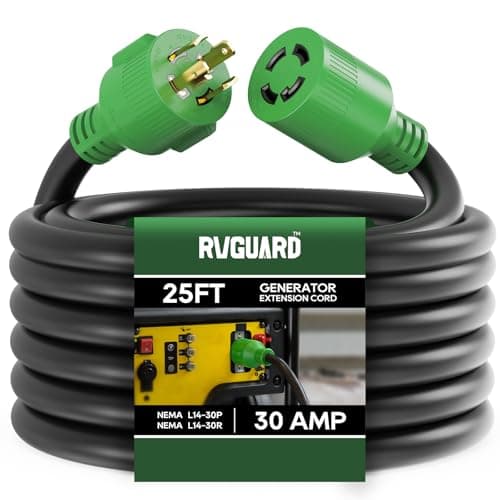
So place the inlet box on the wall nearest wherever the generator will actually stand, and buy a cord that comfortably spans the distance. A 25-foot cord to an inlet twenty feet from the pad works. A 15-foot cord does not, and what happens then is that somebody moves the generator closer, in the dark, in the rain, on the second night.
Think about it in the weather too. If the natural generator location is exposed, you want a proper open-sided cover there — never a tarp, never a garage.
Do it out of season
This is the practical advice that matters most and is easiest to ignore.
Electricians are booked solid the week a hurricane is forecast and unavailable for weeks afterwards. Permits take time. Inlet boxes and transfer switches sell out regionally ahead of a storm.
A generator with no legal way to reach the furnace is a generator that runs a fridge through a window. Get the connection installed in the spring, test it once, and then forget about it.