Skip to content
Watt Warden

Home Standby

What Size Standby Generator Do I Need?

The honest first question is not how many kilowatts. It is whether you want everything to work at once, or everything to work - because those are different sizes and different prices.

By Sawyer V.Updated Published How we work this out
A utility unit beside a suburban house exterior.

Watt & Warden earns a commission on qualifying purchases made through links on this page, at no extra cost to you. It never changes a ranking, and our picks include products we tell you to skip. Full disclosure.

Whole-house or managed-load: decide this first

Everything downstream depends on this, and it is where the money is.

Whole-house means the generator can carry everything the panel can throw at it simultaneously — central air, electric range, dryer and water heater all at once. It is the expensive answer, and it is expensive because it is sized for a coincidence that almost never happens.

Managed-load means the system sheds or staggers large loads so they do not run together. A load management module will hold the air conditioner off while the dryer runs, then let it start. Everything still works; it just does not all work in the same minute.

Managed-load commonly lets a household drop a tier or two, which is the single largest saving available in this purchase — and most people never find out it was an option because they price whole-house and stop.

Ballpark sizes, and what drives them

What you wantRoughlyThe load that decides it
Critical circuits only7-10 kWFurnace blower plus a well pump
Critical plus one air conditioner12-16 kWThe AC compressor's starting surge
Most of a gas-heated house18-22 kWCentral air plus a range element
Whole house, all electric24 kW and upElectric water heating, range and dryer together

These are planning brackets built from the appliance figures Champion and Honda publish, not a manufacturer sizing table. A load calculation done by your installer against your actual panel is the number that matters, and it is part of a proper quote.

Gas heat changes everything

The single biggest variable, and it is worth checking before doing any other arithmetic.

A gas furnace needs only its blower — Champion publishes 300-800 running watts for a half-horsepower fan. An electric furnace or a heat pump with resistance strips is a completely different and far larger load.

The same applies right across the house:

  • Gas water heater: often needs nothing at all. Electric: 3,000-4,500W whenever it cycles.
  • Gas range: usually lightable by hand. Electric: several thousand watts.
  • Gas dryer: just the drum motor. Electric: thousands of watts.

A gas-heated house with gas cooking and hot water can often be well covered by a mid-size unit where an all-electric house of the same size needs the largest residential model made.

Size against your fuel, not the headline

The mistake that costs people a tier. Standby units are rated differently on the two gases.

Generac rates the Guardian 24kW at 24 kW on propane and 21 kW on natural gas. If your calculation landed on 22 kW and you connect to the gas main, that unit does not cover it.

Always compare units on the rating for the fuel you will actually use. The fuel comparison goes into why the gap exists and which fuel to pick.

The air conditioner is usually the decider

In most houses, one appliance sets the size, and it is the central air conditioner.

Champion publishes 3,000-3,500 running and 5,000-6,000 starting watts for a 3 ton unit. That starting surge is what a generator has to absorb, and it is larger than the entire rest of a typical critical-circuit list.

Two ways round it, both worth raising with your installer:

  • A soft starter on the air conditioner. Micro-Air publishes 65-75% start current reduction, which can bring the surge inside a smaller generator's capability and save a tier.
  • Load management. Let the AC start only when the dryer and range are not running.

Why the starting figure is so much larger explains the mechanism.

Measure rather than estimate

Here is the approach we would actually recommend, and almost nobody takes it.

  1. Fit a manual transfer switch and use a portable for a season. This costs a fraction of a standby installation.
  2. Read the watt meters during a real outage. You find out what your house actually draws, with your appliances, in your weather.
  3. Note what you genuinely missed. Most households discover the list is shorter than they assumed — and occasionally discover one load they had not thought about at all.
  4. Then size the standby unit against a measurement rather than a spreadsheet.

The portable does not become redundant afterwards either — it becomes the backup to the backup, covering the annual service window and gas supply interruptions.

How to read a quote

  • Ask which fuel the quoted kW is for. If the answer is not immediate, ask again.
  • Ask whether it includes load management and what it would save.
  • Ask for the load calculation, not just the recommendation. A proper one lists your appliances.
  • Ask what the transfer switch covers — whole panel or a sub-panel of selected circuits.
  • Ask about gas pipe sizing or tank siting. This is where quotes diverge most, and where surprises appear.

The installation guide covers what the whole job involves, and the whole-house comparison covers the units themselves.

Bigger is not automatically safer

Oversizing has real costs beyond the purchase price. A generator running far below its rating burns more fuel per useful watt, runs cooler than it was designed to, and on some engines that leads to incomplete combustion and deposits over time.

The exercise cycle costs more too, every week, for years.

Some margin above your calculated load is sensible. Two tiers is money spent on a coincidence that will not happen, and it is exactly what load management exists to avoid buying.

Quick picks

#ProductBest forPrice
1
No photo

The cheap way to test your sizing

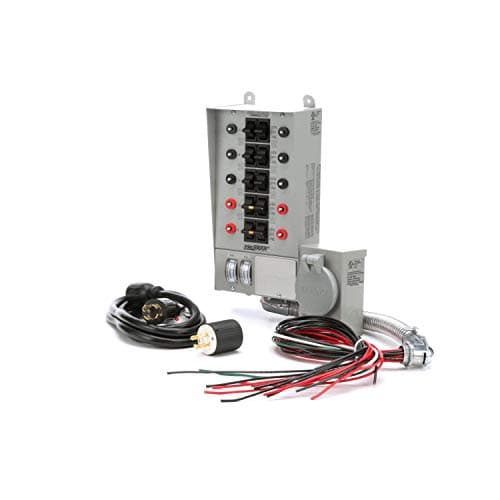
Reliance Controls 31410CRK Pro/Tran

A 10-circuit manual transfer switch rated 30A / 7,500W with two watt meters.

Finding out what you actually need before you commit
2
No photo

The portable equivalent of a mid-size standby

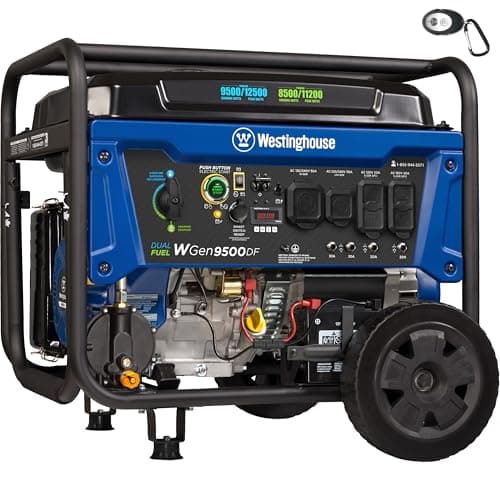
Westinghouse WGen9500DF

9,500 running watts with 240V outlets and push-button electric start.

Critical circuits plus comfort
3
No photo

Where portables stop

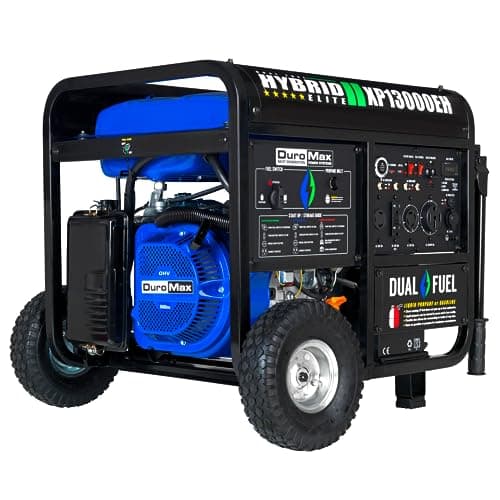
DuroMax XP13000EH

Dual fuel at the top of the portable range, with electric start.

Large loads without an installation
4
No photo

What lets you size down

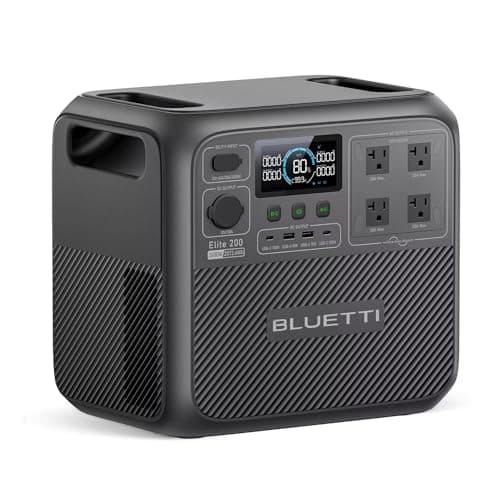
BLUETTI Elite 200 V2

2,073Wh of LiFePO4 with 2,600W output and a ten-year design life.

Covering the transfer gap and the quiet loads

Prices come from the retailer at page-build time and change constantly. Where no live price is available the button reads “Check price” rather than showing a number we cannot stand behind.

The picks in full

01The cheap way to test your sizing

Reliance Controls 31410CRK Pro/Tran

A 10-circuit manual transfer switch rated 30A / 7,500W with two watt meters.

The most useful thing on this page and the least obvious. A manual transfer switch with watt meters lets you run your critical circuits from a portable for a real outage and read the actual number instead of estimating it.

People routinely install standby units sized from a spreadsheet and discover afterwards that they bought a tier too large. A season of real measurement costs a fraction of that mistake.

Skip it ifyou are already committed to a standby unit with its own automatic switch.

Published specifications for the Reliance Controls 31410CRK Pro/Tran
SpecificationPublished figure
Circuits10 — six 15 A and four 20 A single-pole breakers
Rating30 A, up to 7,500 W
MeteringTwo watt meters for balancing the load
SwitchingBreak-before-make double-throw, Line / Off / Gen
BackfeedMechanically prevented — the grid cannot be energized
InstallationLicensed electrician; a permit is usually required

Source: Reliance Controls — Pro/Tran 31410CRK product page. These are the manufacturer's published figures, not ours — we have not tested this unit.

02The portable equivalent of a mid-size standby

Westinghouse WGen9500DF

9,500 running watts with 240V outlets and push-button electric start.

9,500 running watts covers what most households mean by "the essentials plus being comfortable" — and it is worth knowing that a portable reaches that, because it changes what the standby premium is actually buying.

What it is buying is automatic operation, a fuel supply you do not handle, and not going outside in a storm. Those are real, and they are the argument rather than raw output.

Skip it ifyou want automatic operation. That is the whole reason standby units exist.

Published specifications for the Westinghouse WGen9500DF
SpecificationPublished figure
Output (gasoline)9,500 running W / 12,500 peak W
FuelGasoline or propane (dual fuel)
Engine457cc 4-stroke OHV, cast iron sleeve
Tank6.6 gal (25 L)
Run timeup to 12 h on a full tank
Transfer-switch outlet120/240 V L14-30R, 30 A
RV outlet120/240 V 14-50R, 50 A
StartingPush-button electric with remote key fob
Warranty3-year limited

Source: Westinghouse — WGen9500DF product specifications. These are the manufacturer's published figures, not ours — we have not tested this unit.

03Where portables stop

DuroMax XP13000EH

Dual fuel at the top of the portable range, with electric start.

At the top of the portable range you approach what a small standby unit does, and the comparison stops being about watts. Weight, noise, fuel handling and starting it yourself all scale with output.

Past this point, an installed unit that starts itself is usually the better purchase — which is a useful way to know when you have crossed the line.

Skip it ifyou need central air and a well pump running together. That is standby territory.

Published specifications for the DuroMax XP13000EH
SpecificationPublished figure
Output13,000 running W / 16,000 peak W
FuelGasoline or propane (dual fuel)
Engine500cc OHV DuroMax
Transfer-switch outlet50 A
FrameAll-metal, no plastic panels
SafetyLow-oil shutoff; 5 ft propane hose with ACME connector

Source: DuroMax — XP13000EH product specifications. These are the manufacturer's published figures, not ours — we have not tested this unit.

04What lets you size down

BLUETTI Elite 200 V2

2,073Wh of LiFePO4 with 2,600W output and a ten-year design life.

A standby generator takes seconds to detect, start and transfer. Anything that must not blink needs a battery or a UPS regardless of how many kilowatts you install.

It also covers the week the unit is out for service and a gas supply interruption — two failures no amount of sizing addresses.

Skip it ifnothing in the house minds a brief interruption and you have no reason to hedge.

Published specifications for the BLUETTI Elite 200 V2
SpecificationPublished figure
Usable capacity2,073.6 Wh
Cell chemistryAutomotive-grade LiFePO4 (LFP)
AC output2,600 W continuous / 3,900 W power lifting
Cycle life6,000+ cycles
Fast charge0–80% in 50 min via dual AC/DC input

Source: BLUETTI — Elite 200 V2 product specifications. These are the manufacturer's published figures, not ours — we have not tested this unit.

How these were chosen

We did not test these. Nobody at Watt & Warden has plugged one in. What we did instead: read the manufacturer's published specifications, compile them into a table where the figures line up, and compute the numbers manufacturers leave out — runtime against a real appliance load, and what an hour of running actually costs.

Anything that could not be sourced was left out rather than estimated, and every pick names the buyer who should skip it. The full method is here, including where it is weaker than a publisher with a test bench.

Questions people actually ask

What size standby generator do I need for my house?

Roughly 7-10kW for critical circuits, 12-16kW to add one air conditioner, 18-22kW for most of a gas-heated house, and 24kW and up for a whole all-electric house. The load calculation your installer does against your actual panel is the number that matters -- these are planning brackets.

Does a whole-house generator have to run everything at once?

Only if you buy it that way. Load management sheds or staggers large loads so the air conditioner waits while the dryer runs -- everything still works, just not in the same minute. That commonly drops a household a tier or two, and it is the single largest saving in this purchase.

How does gas heat change the generator size I need?

Dramatically. A gas furnace needs only its blower at 300-800 running watts, where an electric furnace is thousands. Gas water heating often needs nothing, and a gas range can usually be lit by hand. A gas-heated house frequently needs a mid-size unit where an all-electric one of the same size needs the largest residential model.

Should I size a standby generator on the propane or natural gas rating?

On whichever fuel you will actually connect. Generac rates the Guardian 24kW at 24kW on propane and 21kW on natural gas -- so if your calculation landed on 22kW and you connect to the main, that unit does not cover it. Always compare on the rating for your fuel.

Is it bad to oversize a standby generator?

It has real costs. A generator running far below its rating burns more fuel per useful watt and runs cooler than designed, which on some engines causes deposits over time -- and the weekly exercise cycle costs more, every week, for years. Some margin is sensible; two tiers is buying a coincidence.

Sources

Every figure on this page comes from a published source. We have not tested this equipment, so the specifications are the manufacturer's and the statistics are the dataset's — the arithmetic on top of them is ours, and it is shown in full so you can check it. How we work this out.