Skip to content
Watt Warden

Sizing

What Size Generator for a 2,000 Square Foot House?

Floor area tells you almost nothing about electrical load. Two identical 2,000 square foot houses can need a 5,000 watt machine and a 20 kilowatt one - and the difference is what heats them.

By Sawyer V.Updated Published How we work this out
A modern two-story family home with a garage and landscaped yard.

Watt & Warden earns a commission on qualifying purchases made through links on this page, at no extra cost to you. It never changes a ranking, and our picks include products we tell you to skip. Full disclosure.

Why square footage is the wrong question

It is the question everybody asks, and it correlates only loosely with the answer. Electrical load is set by what is in the house, not by how much floor it sits on.

Consider two 2,000 square foot houses.

House AHouse B
HeatingGas furnace, electric blowerElectric heat pump with resistance backup
Water heatingGasElectric, 4,500 W element
CookingGas rangeElectric range
Water supplyMunicipal1 HP well pump
Sensible generator5,000-7,500 W portableA standby unit, and a quoted installation

Same floor area, completely different answers. Anyone quoting a watts-per-square-foot rule is guessing at which house you have.

The right question, in four steps

1. List what must run. Not what could run — what you would genuinely miss. For most households that is the refrigerator, the freezer, the furnace blower, a sump or well pump, some lighting and the internet.

2. Add the running watts. Use the appliance wattage chart or the plates on your own equipment.

3. Add the single largest starting surge, not all of them. Two motors almost never start in the same instant, and sizing for that coincidence buys a machine twice as big as you need.

4. Add 20% margin. Nameplates are optimistic and older appliances draw more than new ones.

A worked example

A 2,000 square foot house with gas heat, municipal water, and a normal appliance list.

LoadRunning wattsStarting watts
Refrigerator150 W average500-1,000 W
Chest freezer150 W average500-1,000 W
Furnace blowerUp to 1,600 WHigher on start — the largest surge here
Sump pumpAbout 1,050 WUp to 2,150 W
Lighting, LED throughout100-200 WNone
Router, modem, devicesAbout 100 WNone
Running totalAbout 3,250 WPlus about 2,150 W for the worst single start

Figures are the ranges used across this site; see the appliance wattage chart for sources. Refrigerator and freezer figures are cycling averages, not continuous draw.

So the requirement is roughly 3,250 running watts plus headroom for a 2,150W start, and then 20% margin on the running figure. That lands at about 4,000 running watts with real surge capability — comfortably inside a 5,000W machine and very comfortably inside 7,500W.

Note how far that is from the "you need 20 kilowatts for a 2,000 square foot house" answer people are often given. That number is for running the entire panel including central air and electric heat, which is a standby generator's job.

The four things that change the answer

  • Electric heat. Resistance heating is thousands of watts continuously and defeats every portable machine. The furnace page covers the difference between a gas furnace's blower and actual electric heat.
  • A well pump. Adds a large, unpredictable surge — the well pump page has the figures.
  • Central air conditioning. 3,000-5,000W of starting surge, and usually the reason people move up to standby.
  • An electric water heater or range. 4,500W and up, sustained. Possible on a big portable, alone.

When the answer stops being a portable

If two or more of the items above apply, the arithmetic stops pointing at a portable generator. Running central air, electric heat and a well pump together is a standby installation sized by a dealer, not a machine you wheel out.

The standby sizing page covers that exercise, which is genuinely different — it works from the service panel rather than from a load list.

The short version

  • Ignore square footage. It does not predict load.
  • A typical gas-heated 2,000 sq ft house needs about 4,000 running watts for a real critical-load list.
  • Add only the largest single surge, not all of them.
  • Electric heat, central air or a well pump are what move you up a class — or to standby.

Quick picks

#ProductBest forPrice
1
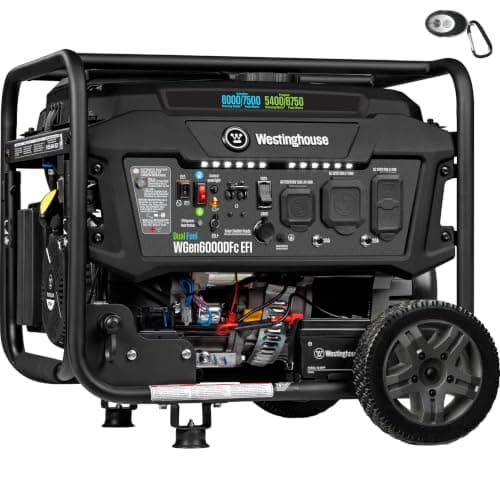
Westinghouse 7500 EFI dual fuel generator

The honest default

Westinghouse 7500 EFI dual fuel generator

7,500 peak watts of EFI dual-fuel power.

A typical 2,000 sq ft house with gas heat
$1,049.00 · Check price on Amazon

#ad how this is funded · price as of October 20, 2026

2
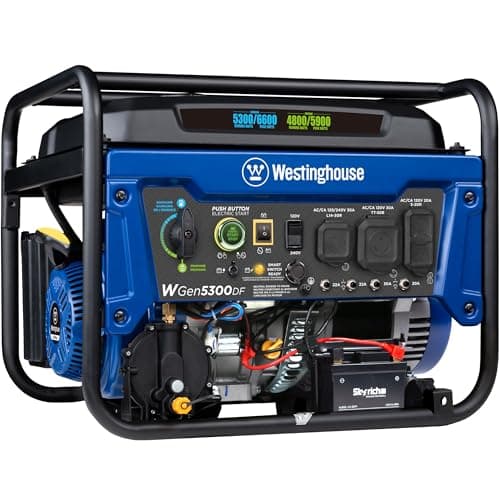
Westinghouse WGen5300DF

Enough for most people

Westinghouse WGen5300DF

5,300 running watts of dual fuel with the 240V outlet a switch needs.

A critical-load list rather than the whole panel
$649.00 · Check price on Amazon

#ad how this is funded · price as of October 20, 2026

3
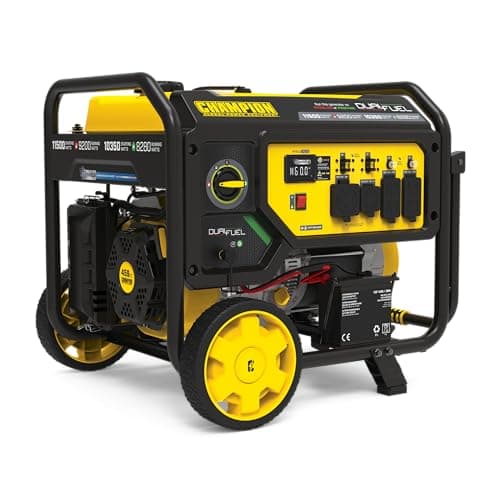
Champion 11,500W dual fuel generator

Best instrumentation at the same size

Champion 11,500W dual fuel generator

11,500 starting watts of dual fuel with electric start.

Knowing what the machine is actually carrying
$1,159.00 · Check price on Amazon

#ad how this is funded · price as of October 20, 2026

4
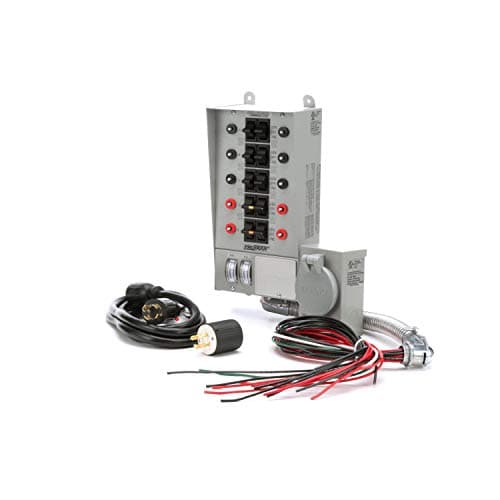
Reliance Controls 31410CRK Pro/Tran

The part that decides the answer

Reliance Controls 31410CRK Pro/Tran

A 10-circuit manual transfer switch rated 30A / 7,500W.

Reaching the furnace and the well pump
$470.22 · Check price on Amazon

#ad how this is funded · price as of October 20, 2026

Prices come from the retailer at page-build time and change constantly. Where no live price is available the button reads “Check price” rather than showing a number we cannot stand behind.

The picks in full

01 — The honest default

Westinghouse 7500 EFI dual fuel generator

7,500 peak watts of EFI dual-fuel power.

For the common case — gas or oil heat, gas water heating, a normal appliance list — 7,500 peak watts covers everything people mean by backing up the house, with several loads running at once.

It also matches the standard residential connection exactly, so you are not paying for watts the switch cannot pass.

The honest catch: it will not run central air conditioning alongside everything else, and it will not run an electric range or water heater except on its own.

Skip it ifyour heat or water is electric. Then this is not enough.

Westinghouse 7500 EFI dual fuel generator
$1,049.00 · Check price on Amazon

#ad how this is funded · price as of October 20, 2026

Published specifications for the Westinghouse 7500 EFI dual fuel generator
SpecificationPublished figure
Output7,500 peak W
FuelGasoline or propane (dual fuel)
Fuel systemElectronic fuel injection (EFI)
StartingRemote electric start
UseHome backup through a transfer switch

Source: Westinghouse — 7500 peak watt EFI dual fuel listing. These are the manufacturer's published figures, not ours — we have not tested this unit.

02 — Enough for most people

Westinghouse WGen5300DF

5,300 running watts of dual fuel with the 240V outlet a switch needs.

The list most households actually back up — refrigerator, freezer, furnace blower, sump pump, lighting, network — totals well under 5,000 running watts, and this covers it with margin.

Buying against the real list rather than the floor area is what saves people the most money in this category.

The honest catch: a 1 HP well pump start is marginal here. If you are on a well, size up.

Skip it ifthere is a well pump or central air on the list.

Westinghouse WGen5300DF
$649.00 · Check price on Amazon

#ad how this is funded · price as of October 20, 2026

Published specifications for the Westinghouse WGen5300DF
SpecificationPublished figure
Output (gasoline)5,300 running W / 6,600 peak W
Output (propane)4,800 running W / 5,900 peak W
Engine274cc 4-stroke OHV
Tank4.7 gal (18 L)
Run timeup to 14.5 h on a full tank
Transfer-switch outlet120/240 V L14-30R, 30 A
RV outlet120 V TT-30R, 30 A
StartingPush-button electric with remote key fob

Source: Westinghouse — WGen5300DF product specifications. These are the manufacturer's published figures, not ours — we have not tested this unit.

03 — Best instrumentation at the same size

Champion 11,500W dual fuel generator

11,500 starting watts of dual fuel with electric start.

Live volts, hertz and run-time hours are more useful than they sound when you are sequencing loads by hand. You can see the headroom rather than guessing at it.

The honest catch: propane run time drops to 5.5 hours against 8 on gasoline, which is a short night on cylinders.

Skip it ifyou want remote start. This is electric start at the panel.

Champion 11,500W dual fuel generator
$1,159.00 · Check price on Amazon

#ad how this is funded · price as of October 20, 2026

Published specifications for the Champion 11,500W dual fuel generator
SpecificationPublished figure
Output11,500 starting W
FuelGasoline or propane (dual fuel)
StartingElectric start
UseWhole-panel backup through a transfer switch

Source: Champion — 11,500-watt dual fuel listing. These are the manufacturer's published figures, not ours — we have not tested this unit.

04 — The part that decides the answer

Reliance Controls 31410CRK Pro/Tran

A 10-circuit manual transfer switch rated 30A / 7,500W.

Ten circuits is the residential standard and it is genuinely enough for a 2,000 square foot house: furnace, well pump, sump pump, refrigerator, freezer, and a few lighting and outlet circuits.

It also caps the feed at 7,500W, which is why buying a 9,500W machine for a 30A switch buys nothing.

The honest catch: this needs an electrician and a permit, and that cost belongs in the budget from the start.

Skip it ifeverything you want to power has a plug on it.

Reliance Controls 31410CRK Pro/Tran
$470.22 · Check price on Amazon

#ad how this is funded · price as of October 20, 2026

Published specifications for the Reliance Controls 31410CRK Pro/Tran
SpecificationPublished figure
Circuits10 — six 15 A and four 20 A single-pole breakers
Rating30 A, up to 7,500 W
MeteringTwo watt meters for balancing the load
SwitchingBreak-before-make double-throw, Line / Off / Gen
BackfeedMechanically prevented — the grid cannot be energized
InstallationLicensed electrician; a permit is usually required

Source: Reliance Controls — Pro/Tran 31410CRK product page. These are the manufacturer's published figures, not ours — we have not tested this unit.

How these were chosen

We did not test these. Nobody at Watt & Warden has plugged one in. What we did instead: read the manufacturer's published specifications, compile them into a table where the figures line up, and compute the numbers manufacturers leave out — runtime against a real appliance load, and what an hour of running actually costs.

Anything that could not be sourced was left out rather than estimated, and every pick names the buyer who should skip it. The full method is here, including where it is weaker than a publisher with a test bench.

Questions people actually ask

What size generator do I need for a 2,000 square foot house?

Floor area does not set the answer -- what heats and cools the house does. A gas-heated 2,000 sq ft house on municipal water needs about 4,000 running watts for a real critical-load list, which fits comfortably in a 5,000 to 7,500W portable. The same house with electric heat and a well pump needs a standby unit.

Is 7500 watts enough for a 2,000 sq ft house?

For the circuits people mean by house backup, comfortably. It is also exactly what a 30A transfer switch passes, which is the standard residential connection. What it will not do is run central air conditioning alongside everything else, or an electric range or water heater except on its own.

Do I add up all the starting watts?

No, and doing so is the commonest sizing mistake. Add all the running watts, then add only the single largest starting surge on the list. Two motors almost never start in the same instant, and sizing for that coincidence buys a machine roughly twice as big as the house needs.

Why do dealers quote 20kW for a house this size?

Because a standby quote assumes running the entire panel automatically, including central air conditioning and any electric heat, with nobody managing loads. A portable generator backs up chosen circuits with a person sequencing things, which is a far smaller requirement. Both answers are correct for different questions.

How much margin should I add?

About 20% on the running total. Nameplate figures are optimistic, older appliances draw more than new ones, and the list you actually plug in during an outage grows rather than shrinks. Margin is cheap at purchase and impossible afterwards.

Sources

Every figure on this page comes from a published source. We have not tested this equipment, so the specifications are the manufacturer's and the statistics are the dataset's — the arithmetic on top of them is ours, and it is shown in full so you can check it. How we work this out.