Skip to content
Watt Warden

Power Stations

The Best Goal Zero Power Stations (2026)

Goal Zero charges more than anyone else for a given watt-hour, and it publishes the specifications that explain why. Whether those specifications matter to you is the entire question.

By Sawyer V.Updated Published How we work this out
Goal Zero Yeti 1500

Watt & Warden earns a commission on qualifying purchases made through links on this page, at no extra cost to you. It never changes a ranking, and our picks include products we tell you to skip. Full disclosure.

Quick picks

#ProductBest forPrice
1
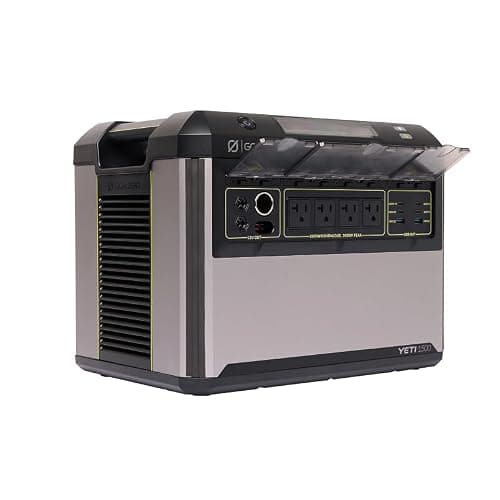
Goal Zero Yeti 1500

Best Goal Zero overall

Goal Zero Yeti 1500

1,505Wh and a 2,000W inverter in an IPX4 aluminum case, full from empty in 1.1 hours.

Home backup that also goes outside
$1,499.95 · Check price on Amazon

#ad how this is funded · price as of October 20, 2026

2
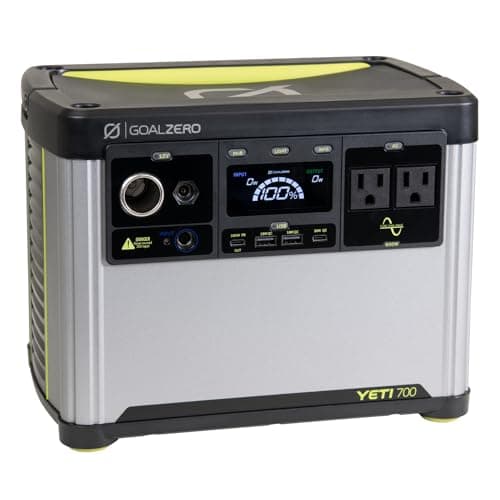
Goal Zero Yeti 700

Best for weekends outdoors

Goal Zero Yeti 700

677Wh at 20.3 lb with IPX4 protection, a 100W USB-C port and a 1.7-hour fast charge.

Camping, a van, or a boat
$699.95 · Check price on Amazon

#ad how this is funded · price as of October 20, 2026

3
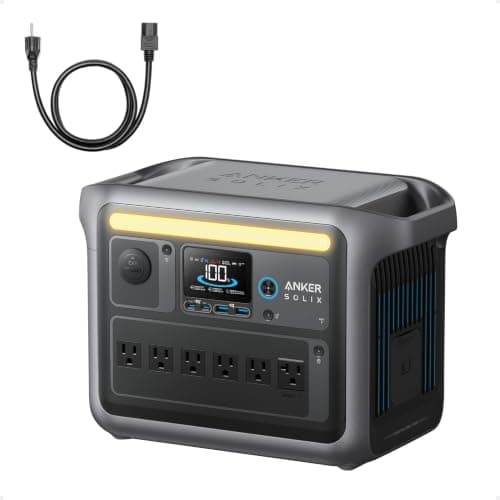
Anker SOLIX C1000

The cheaper answer to the same question

Anker SOLIX C1000

1,056Wh with 1,800W continuous and a 58-minute full recharge.

Anyone who wants watt-hours rather than armor
$499.99 · Check price on Amazon

#ad how this is funded · price as of October 20, 2026 · $599.99 17% off

4
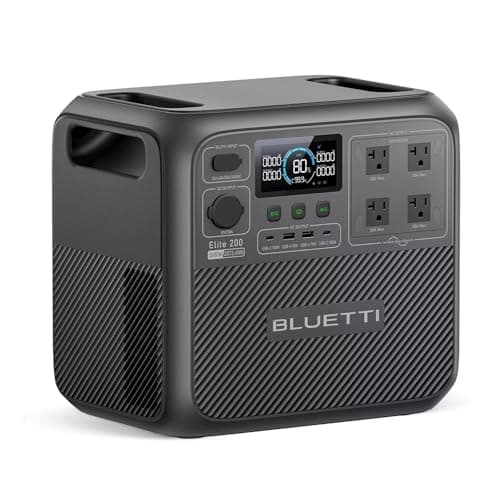
BLUETTI Elite 200 V2

More battery for Yeti 1500 money

BLUETTI Elite 200 V2

2,073.6Wh and 2,600W continuous with a 6,000+ cycle rating.

Indoor home backup
$1,399.00 · Check price on Amazon

#ad how this is funded · price as of October 20, 2026

Prices come from the retailer at page-build time and change constantly. Where no live price is available the button reads “Check price” rather than showing a number we cannot stand behind.

How these were chosen

We have tested none of this equipment, and our methodology page says so in detail. Everything below is Goal Zero's published specification for that model, the equivalent published figure for the units it competes with, or arithmetic we show.

Three criteria decided the picks, in this order:

  1. Is it currently purchasable? Two of the most-searched Goal Zero model numbers are not, which is covered in the next section.
  2. Does the inverter match the capacity? A big battery behind a small inverter runs fewer things, and Goal Zero's smaller models are conservative here.
  3. Does the premium buy something you can name? IPX4, aluminum, 4,000+ cycles, a five-year warranty and a 900W solar ceiling are all real. Brand reputation on its own is not.

First, the models people search for that you cannot buy

Goal Zero replaced its X-series with a 6th-generation Yeti line, and search results have not caught up. Three specific cases matter:

  • Yeti 300. Goal Zero still lists it in the 6th-generation line, but it is no longer available through Amazon, so it has no buy link on this site. It stays in the tables below for comparison because the specifications are real and people still search for them. If 297Wh is the size you want, the Yeti 700 is the smallest Goal Zero you can actually buy today.
  • Yeti 1500X. Still one of the most searched Goal Zero terms, and at the time of writing it is listed on Amazon as currently unavailable. The current equivalent is the Yeti 1500 in this roundup, which is a different machine with LiFePO4 cells rather than the X-series lithium NMC.
  • Yeti 400 and the older numbered units. Long discontinued. Any listing you find is old stock or third-party resale, and the warranty question alone makes that a poor purchase.

We do not feature products we cannot confirm as purchasable. If you arrived here looking for a 1500X, the Yeti 1500 is the model that replaced it and the specifications below are the current ones.

The current lineup, side by side

ModelCapacityAC outputWeightAC rechargeMax solar
Yeti 300 (not currently available)297 Wh350 W / 600 W surge13.7 lb50 min fast, 3 h default200 W
Yeti 700677 Wh600 W / 1,000 W surge20.3 lb1.7 h at 500 W200 W
Yeti 15001,505 Wh2,000 W / 3,600 W surge52.75 lb0.8 h to 80%, 1.1 h full900 W

Every figure is Goal Zero's own published specification from the product pages linked at the foot of this page. All three are LiFePO4, all three are rated IPX4, all three carry a five-year warranty and a 4,000+ cycle rating.

Read across the AC output column and the shape of the range becomes obvious. The jump from the 700 to the 1500 is not really about capacity — it is 600W to 2,000W of inverter, which is the difference between charging things and running a household.

What the premium actually buys

Goal Zero costs more per watt-hour than the brands this site covers most often. Four published specifications explain where that money goes, and it is worth being precise about which of them you will ever use.

What you pay forThe specificationWho actually needs it
Weather resistanceIPX4 across the rangeAnyone using it on a truck bed, a boat, a job site or an exposed campsite
Cell longevity4,000+ cycles to 80%Daily cyclers — vans, cabins, off-grid. Storm households will never reach it
Solar ceiling (1500 only)900 W across dual inputsAnyone charging from panels rather than from a wall socket
Warranty5 yearsEveryone, and it is genuinely longer than most

Specifications are Goal Zero's published figures. The right-hand column is our judgment, not theirs.

The honest summary: if the battery lives indoors and gets used three times a year, you are paying for protection you will never use. If it lives outdoors, gets rained on, and cycles weekly, the premium is defensible and the warranty makes it more so.

Goal Zero against the cheaper alternatives

This is the comparison the brand does not make, so here it is on published numbers.

UnitCapacityContinuous outputCyclesWeather rating
Goal Zero Yeti 15001,505 Wh2,000 W4,000IPX4
BLUETTI Elite 200 V22,073.6 Wh2,600 W6,000+None published
EcoFlow DELTA 2 Max2,048 Wh2,400 W3,000+None published
Goal Zero Yeti 700677 Wh600 W4,000+IPX4
Anker SOLIX C10001,056 Wh1,800 W3,000None published

Manufacturer figures from the pages cited below. "None published" means the maker states no ingress rating on the page we cite — not that the unit is fragile, only that nobody has promised anything.

On capacity and output per dollar, Goal Zero loses to every rival in that table. On protection, cycle rating and warranty, it wins. That is the trade in one sentence, and neither side of it is marketing.

What each one runs, and for how long

Planning at 85% inverter efficiency, which is the figure used across this site.

LoadYeti 300 (297 Wh, discontinued)Yeti 700 (677 Wh)Yeti 1500 (1,505 Wh)
CPAP, no humidifier (40 W)About 6 hoursAbout 14 hoursAbout 32 hours
Router, modem, laptop (75 W)About 3.4 hoursAbout 7.7 hoursAbout 17 hours
Refrigerator (150 W average)Not enough surge headroomMarginal — 1,000 W surgeAbout 8.5 hours
Two LED lamps and phones (25 W)About 10 hoursAbout 23 hoursOver two days

Runtime is capacity x 0.85 divided by average draw. A refrigerator compressor can demand 600 to 1,200W at the instant it starts, which is why the 700's 1,000W surge is marked marginal — starting watts vs running watts explains the distinction.

Which one, for which buyer

  • Storm backup for a house: the Yeti 1500, or a cheaper 2kWh rival if the unit never leaves the utility room. Compare against the 2000Wh roundup before deciding.
  • Camping, overlanding, a boat: the Yeti 700. The IPX4 rating and 20 lb carry weight are worth real money here in a way they are not indoors.
  • Phones, a CPAP and lights: the Yeti 700 is the smallest Goal Zero still on sale, or the smaller units in the 500Wh roundup if weather protection is irrelevant to you.
  • Maximum capacity per dollar: not Goal Zero. That is what Anker and Jackery compete on, and they win it.

The short version

  • Two models you can buy: Yeti 700 (677Wh) and Yeti 1500 (1,505Wh). Both LiFePO4, both IPX4, both five-year warranty. The Yeti 300 is no longer available through Amazon.
  • The 1500 is the one that backs up a house — 2,000W of inverter and a 900W solar ceiling no rival here matches.
  • The 700 is the one to take outdoors. Twenty pounds and a published water rating.
  • You pay a premium per watt-hour. It buys protection, cycle life and warranty — not capacity or output.
  • The Yeti 1500X is gone. If that is what you searched for, the Yeti 1500 replaced it.
The picks in full

01 — Best Goal Zero overall

Goal Zero Yeti 1500

1,505Wh and a 2,000W inverter in an IPX4 aluminum case, full from empty in 1.1 hours.

This is the model that justifies the brand. 2,000W continuous with a 3,600W surge runs a refrigerator, a microwave or a sump pump; four AC outlets mean a household is not juggling one socket; and Goal Zero publishes a full recharge in 1.1 hours, with 80% in 0.8.

The specification that separates it from every rival in this roundup is the 900W solar input across dual inputs. That is roughly double what most 1.5kWh-class units accept, and it is the difference between solar as a trickle and solar as a genuine refill.

An IPX4 rating and an aluminum body are the other half of the premium. Most competitors are plastic and publish no ingress rating at all, which matters if the unit lives on a truck bed or a boat rather than a shelf.

The honest catch: 52.75 lb. That is substantially heavier than 2kWh rivals that hold more energy, and it is the clearest sign that this case was built for abuse rather than for carrying.

Skip it ifyou want the most watt-hours for your money. This is not that purchase.

Goal Zero Yeti 1500
$1,499.95 · Check price on Amazon

#ad how this is funded · price as of October 20, 2026

Published specifications for the Goal Zero Yeti 1500
SpecificationPublished figure
Capacity1,505.28 Wh (51.2 V, 29.4 Ah)
Cell chemistryLiFePO4 (LFP)
AC output2,000 W continuous / 3,600 W surge, pure sine, 4 outlets
USB140 W and 60 W USB-C, plus 2x 30 W
12 V output405 W high-power port, 162 W auxiliary
Cycle life4,000 cycles to 80%
AC recharge0-80% in 0.8 h, full in 1.1 h
Max solar input900 W across dual inputs (about 2 h)
Weight52.75 lb
Dimensions15.7 x 11.4 x 12.02 in
Ingress ratingIPX4 water resistant
Warranty5 years

Source: Goal Zero — Yeti 1500 product specifications. These are the manufacturer's published figures, not ours — we have not tested this unit.

02 — Best for weekends outdoors

Goal Zero Yeti 700

677Wh at 20.3 lb with IPX4 protection, a 100W USB-C port and a 1.7-hour fast charge.

The weight-to-protection ratio is the argument. Twenty pounds is a one-hand carry, and the IPX4 rating means a shower at the campsite is an inconvenience rather than an emergency.

The port selection is unusually good for the size: 100W USB-C Power Delivery charges a laptop at full speed, and two more 30W USB-C ports cover phones and a tablet at once.

The honest catch: 600W continuous and a single AC outlet. For the money, rival units offer three times the inverter and more sockets — you are paying for the case and the warranty, not the electronics.

Skip it ifyou want to run a refrigerator. 600W continuous is not enough headroom for a compressor start.

Goal Zero Yeti 700
$699.95 · Check price on Amazon

#ad how this is funded · price as of October 20, 2026

Published specifications for the Goal Zero Yeti 700
SpecificationPublished figure
Capacity677.37 Wh
Cell chemistryLiFePO4 (LFP)
AC output600 W continuous / 1,000 W surge, pure sine, 1 outlet
USB1x 100 W USB-C PD, 2x 30 W USB-C QC, 2x USB-A (18 W combined)
Cycle life4,000+ cycles to 80% at 75F
AC recharge1.7 h at 500 W input; 3 h at 340 W
Max solar input200 W (about 3.8 h to full)
Weight20.3 lb (9.2 kg)
Ingress ratingIPX4 water resistant
Warranty5 years

Source: Goal Zero — Yeti 700 product specifications. These are the manufacturer's published figures, not ours — we have not tested this unit.

03 — The cheaper answer to the same question

Anker SOLIX C1000

1,056Wh with 1,800W continuous and a 58-minute full recharge.

Half again the capacity of the Yeti 700 and three times its inverter, at a price that undercuts the Goal Zero ladder at every rung.

For a battery that sits in a utility room waiting for storms, that arithmetic is very hard to argue with.

The honest catch: 3,000 published cycles against Goal Zero's 4,000+, no published water resistance, and a shorter warranty. You are trading durability for capacity.

Skip it ifthe unit will live outdoors. Anker publishes no ingress rating on the page we cite.

Anker SOLIX C1000
$499.99 · Check price on Amazon

#ad how this is funded · price as of October 20, 2026 · $599.99 17% off

Published specifications for the Anker SOLIX C1000
SpecificationPublished figure
Usable capacity1,056 Wh
Cell chemistryLiFePO4 (LFP)
AC output1,800 W continuous / 2,400 W SurgePad
Cycle life3,000 cycles
Wall recharge80% in 43 min, full in 58 min
Max solar input600 W (full solar recharge ~1.8 h)
Ports11 total, including 6 AC on panel-equipped bundles

Source: Anker — SOLIX C1000 product specifications. These are the manufacturer's published figures, not ours — we have not tested this unit.

04 — More battery for Yeti 1500 money

BLUETTI Elite 200 V2

2,073.6Wh and 2,600W continuous with a 6,000+ cycle rating.

Around 38% more energy than the Yeti 1500, 600W more continuous output, and the longest published cycle life of anything on this site.

If the battery lives indoors and never sees weather, this is the better machine on paper — reviewed in full here.

The honest catch: 50 minutes to 80% against the Yeti's 48 minutes to 80%, and a solar ceiling nowhere near Goal Zero's 900W. Give and take, but the durability gap is real.

Skip it ifthe unit goes outside. No published ingress rating, and it is not built for it.

BLUETTI Elite 200 V2
$1,399.00 · Check price on Amazon

#ad how this is funded · price as of October 20, 2026

Published specifications for the BLUETTI Elite 200 V2
SpecificationPublished figure
Usable capacity2,073.6 Wh
Cell chemistryAutomotive-grade LiFePO4 (LFP)
AC output2,600 W continuous / 3,900 W power lifting
Cycle life6,000+ cycles
Fast charge0–80% in 50 min via dual AC/DC input

Source: BLUETTI — Elite 200 V2 product specifications. These are the manufacturer's published figures, not ours — we have not tested this unit.

How these were chosen

We did not test these. Nobody at Watt & Warden has plugged one in. What we did instead: read the manufacturer's published specifications, compile them into a table where the figures line up, and compute the numbers manufacturers leave out — runtime against a real appliance load, and what an hour of running actually costs.

Anything that could not be sourced was left out rather than estimated, and every pick names the buyer who should skip it. The full method is here, including where it is weaker than a publisher with a test bench.

Questions people actually ask

What happened to the Goal Zero Yeti 300?

Goal Zero still lists it in the 6th-generation Yeti line, but it is no longer available through Amazon, so this site no longer carries a buy link for it. Its specifications stay in the tables above because they are real and people still search for them. The smallest Goal Zero you can actually buy today is the Yeti 700 at 677Wh and 600W, with the same IPX4 rating, 4,000+ cycle rating and five-year warranty.

Are Goal Zero power stations worth the money?

They are if the unit goes outside. Goal Zero publishes an IPX4 water resistance rating, 4,000+ cycles and a five-year warranty across the current Yeti range, and rivals at the same price publish more capacity but usually no ingress rating at all. For a battery that sits indoors waiting for storms, cheaper brands give you more watt-hours and more inverter for the money.

What happened to the Goal Zero Yeti 1500X?

It has been superseded by the 6th-generation Yeti line and is listed as currently unavailable on Amazon at the time of writing. The current equivalent is the Yeti 1500, which holds 1,505Wh of LiFePO4, delivers 2,000W continuous, and recharges fully in 1.1 hours.

Which Goal Zero model runs a refrigerator?

The Yeti 1500. Its 2,000W continuous output and 3,600W surge comfortably cover a household refrigerator, which draws 150W or so while running and 600 to 1,200W at startup, and 1,505Wh gives roughly 8.5 hours at 85% inverter efficiency. The Yeti 700's 1,000W surge is marginal for a compressor and the Yeti 300 cannot do it.

Can Goal Zero power stations be used in the rain?

They are rated IPX4, which Goal Zero publishes across the 6th-generation Yeti line. That means splash resistance from any direction -- rain at a campsite, spray on a boat -- not immersion. It is more protection than most rivals promise, because most publish no ingress rating at all.

How long do Goal Zero batteries last?

Goal Zero rates the current Yeti LiFePO4 cells at 4,000+ cycles to 80% of original capacity, which the company describes as over a decade of daily use. For a household that cycles a battery a few times a year during outages, the cells will outlast the electronics by a wide margin.

Sources

Every figure on this page comes from a published source. We have not tested this equipment, so the specifications are the manufacturer's and the statistics are the dataset's — the arithmetic on top of them is ours, and it is shown in full so you can check it. How we work this out.