Skip to content
Watt Warden

Power Stations

The Best BLUETTI Power Stations (2026)

BLUETTI publishes the longest cycle ratings in the category and the cheapest route to 240V from a single box. Both of those are real, and neither is the reason most people should buy one.

By Sawyer V.Updated Published How we work this out
BLUETTI Elite 200 V2

Watt & Warden earns a commission on qualifying purchases made through links on this page, at no extra cost to you. It never changes a ranking, and our picks include products we tell you to skip. Full disclosure.

Quick picks

#ProductBest forPrice
1
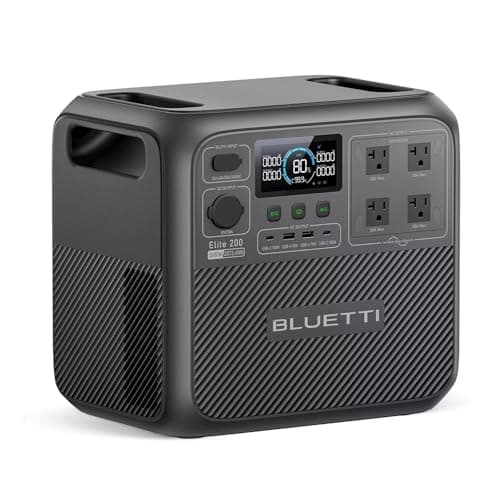
BLUETTI Elite 200 V2

Best BLUETTI overall

BLUETTI Elite 200 V2

2,073.6Wh of automotive-grade LFP rated 6,000+ cycles, behind a 2,600W inverter with 3,900W of power lifting.

A night of critical loads, for a decade of storm seasons
$1,399.00 · Check price on Amazon

#ad how this is funded · price as of October 21, 2026

2
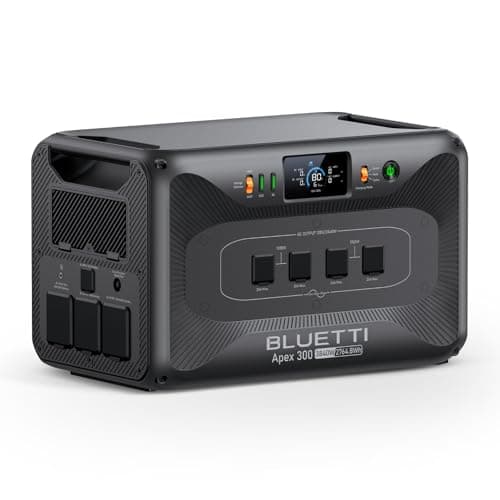
BLUETTI Apex 300

The one that does 240V

BLUETTI Apex 300

2,764.8Wh and 3,840W with 120V and 240V output simultaneously, 7,680W of lifting power, 6,000 cycles.

An RV on a 50A cord, or one 240V circuit in a small house
$1,498.98 · Check price on Amazon

#ad how this is funded · price as of October 21, 2026 · $1,699.00 12% off

3
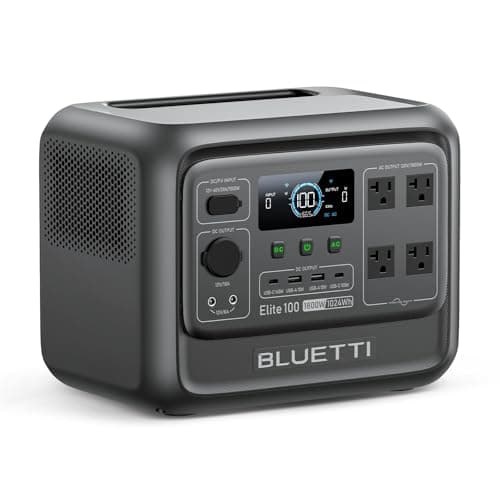
BLUETTI Elite 100 V2

Best light one

BLUETTI Elite 100 V2

1,024Wh and 1,800W at 25 lb, with 1,000W of solar input, a 10ms UPS and 4,000+ cycles.

Carrying it, and charging it from panels fast
$499.00 · Check price on Amazon

#ad how this is funded · price as of October 21, 2026 · $899.00 44% off

4
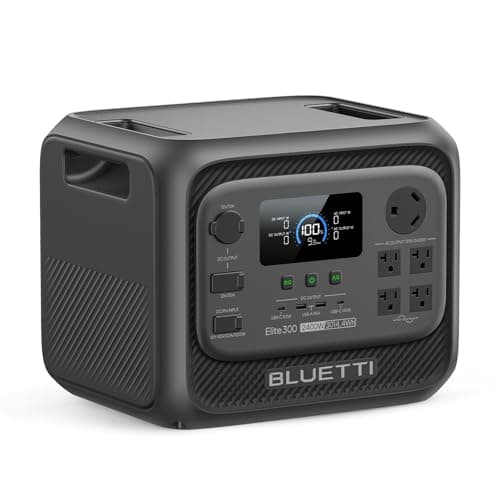
BLUETTI Elite 300

Best for a long keep-list

BLUETTI Elite 300

3,014.4Wh behind 2,400W with 4,800W of lifting power, a TT-30 socket and 6,000+ cycles, at 58 lb.

Three kilowatt-hours at a weight one person can still move
$1,199.00 · Check price on Amazon

#ad how this is funded · price as of October 21, 2026

5
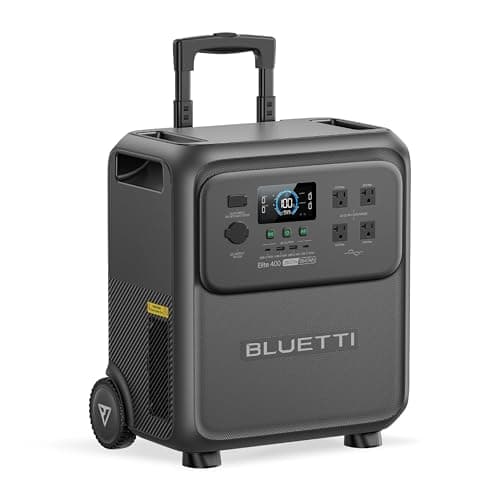
BLUETTI Elite 400

Most watt-hours in the range at 120V

BLUETTI Elite 400

3,840Wh with 2,600W continuous, 5,200W of surge and a 3W standby draw, on built-in wheels.

Two nights of critical loads, with wheels
$1,449.00 · Check price on Amazon

#ad how this is funded · price as of October 21, 2026 · $1,899.00 24% off

6
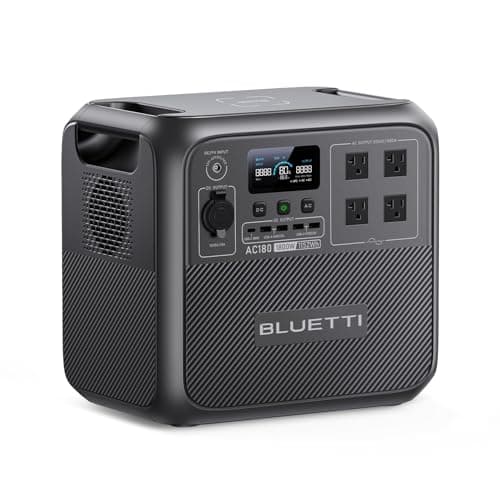
BLUETTI AC180

Best value

BLUETTI AC180

1,152Wh and 1,800W across four AC outlets with 2,700W of surge, 0-80% in 45 minutes, 3,500+ cycles.

A first power station, or a second one for the car
$449.00 · Check price on Amazon

#ad how this is funded · price as of October 21, 2026 · $499.00 10% off

Prices come from the retailer at page-build time and change constantly. Where no live price is available the button reads “Check price” rather than showing a number we cannot stand behind.

The verdict, in one paragraph

Buy the Elite 200 V2 for home backup: 2,073.6Wh and 2,600W with a 6,000+ cycle rating is the best balance in the range. Buy the Apex 300 if anything you own is 240V — it is the cheapest unit on this site that produces simultaneous 120V and 240V from a single box. Buy the Elite 100 V2 if weight and solar speed matter, the Elite 300 or Elite 400 if you need three to four kilowatt-hours and can accept a 2,400 to 2,600W ceiling, and the AC180 if price per watt-hour is the only criterion.

How these were chosen

This site runs no test bench, so nothing below is a measurement. Every figure comes from BLUETTI's own published specifications for each model, cited at the foot of the page, and where we do arithmetic on those figures we say so and show the sum.

The selection rule is that a unit has to be currently purchasable and currently in BLUETTI's lineup. BLUETTI retires models faster than most of the category — the AC200L, AC300 and AC500 generations are all still widely written about and several are now marked discontinued on BLUETTI's own store — so an older model only appears here if it is both available and still the better value for a specific buyer.

The current lineup, side by side

ModelCapacityAC outputSolar inCyclesWeight
Elite 100 V21,024 Wh1,800 W / 2,700 W lifting1,000 W4,000+25 lb
AC1801,152 Wh1,800 W / 2,700 W surge500 W3,500+35.3 lb
Elite 200 V22,073.6 Wh2,600 W / 3,900 W liftingNot published6,000+Not published
Apex 3002,764.8 Wh3,840 W / 7,680 W lifting, 120V and 240V2,400 W6,00083.78 lb
Elite 3003,014.4 Wh2,400 W / 4,800 W lifting1,200 W6,000+58 lb
Elite 4003,840 Wh2,600 W / 5,200 W surge1,000 W4,000+85.98 lb

BLUETTI's published figures, from the product pages cited under Sources. Where a row says a figure is not published, that is what we found on BLUETTI's own listing — it is not an omission on our part. Current prices sit inside the buy buttons above, each with the date it was last refreshed.

What BLUETTI does better than the rest of the category

  • Cycle ratings. 6,000+ cycles on the Elite 200 V2, the Elite 300 and the Apex 300 is the longest published figure on this site. EcoFlow and Anker publish 3,000 to 4,000 across most of their ranges.
  • Split-phase at a non-installed price. The Apex 300 produces simultaneous 120V and 240V from one box. Its nearest rival on that capability is more than twice the capacity and considerably more money.
  • Solar input per watt-hour. 1,000W into a 1,024Wh Elite 100 V2 is unusually generous; 2,400W into the Apex 300 is serious off-grid input.
  • Granular expansion. A B300K at 2,764.8Wh is the smallest meaningful capacity increment of any ecosystem on this site, which means buying a season at a time rather than in one decision.

And what it does worse

  • Published specification detail is thin. Several current BLUETTI listings do not publish weight, AC input wattage or UPS switchover in a place a buyer can find. That is why rows in the table above read "not published" — we will not fill a gap with a retailer's number.
  • Model churn. The AC180, AC200L, AC300 and AC500 families all still dominate search results, and BLUETTI's own store marks several as discontinued. Verify a model is current before buying on the strength of a two-year-old review.
  • Inverter ceilings lag capacity. The Elite 300 and Elite 400 put three to four kilowatt-hours behind 2,400 to 2,600W, where rivals at that capacity publish 3,000 to 3,600W.

The warranty, which has a condition worth reading

BLUETTI publishes 24 to 72 months for portable power stations and 48 to 60 months for home backup systems, with 12 months on solar panels and accessories such as cables and chargers.

The clause that matters for an Amazon purchase is BLUETTI's own: the warranty excludes products purchased from unauthorized resellers, and is restricted to the country of purchase. Buy from BLUETTI's own storefront or an authorized one, and keep the order confirmation — power station warranties compared sets this against what every other brand publishes.

What each one actually runs

Apply the site's standing 85% inverter convention and published capacity turns into delivered watt-hours:

  • Elite 100 V2, 1,024Wh delivers about 870Wh. At the 150W average this site uses for a refrigerator, roughly six hours flat out, or most of a day with the door kept shut.
  • Elite 200 V2, 2,073.6Wh delivers about 1,760Wh — a refrigerator and a freezer overnight with a furnace blower cycling.
  • Elite 300, 3,014.4Wh delivers about 2,560Wh, which is a full critical-load keep-list for a night with margin.
  • Elite 400, 3,840Wh delivers about 3,260Wh — two nights of a reduced list, or one of a full one.

What size power station you need turns your own appliances into that number, and the refrigerator page shows why duty cycle swings the answer so far.

Which one, for which buyer

  • Home backup, one night, nothing over 2,600W: Elite 200 V2.
  • A well pump, a 240V circuit or an RV on a 50A cord: Apex 300.
  • Camping, carrying it, charging from panels: Elite 100 V2.
  • A long keep-list and a willingness to wheel it: Elite 300, or Elite 400 for the extra night.
  • Cheapest kilowatt-hours that still work: AC180.
  • Daily cycling as storage rather than insurance: any of the 6,000-cycle models — Elite 200 V2, Elite 300 or Apex 300.

The short version

BLUETTI's argument is cycle life and the Apex 300's split-phase inverter, and both are genuinely class-leading. Its weakness is that inverter ceilings lag capacity across the Elite range and its published specifications are less complete than its rivals'. Buy the Elite 200 V2 unless you need 240V, in which case buy the Apex 300 and read the leg arithmetic first — and buy from an authorized seller, because BLUETTI's warranty explicitly excludes the rest.
The picks in full

01 — Best BLUETTI overall

BLUETTI Elite 200 V2

2,073.6Wh of automotive-grade LFP rated 6,000+ cycles, behind a 2,600W inverter with 3,900W of power lifting.

Two kilowatt-hours at 2,600W is the sweet spot for home backup, and BLUETTI's 6,000+ cycle rating on this unit is the longest published figure on this site. At twenty full cycles a year that is a service life nobody will reach.

The practical consequence is that this is the BLUETTI to buy if the battery will double as daily storage rather than sitting as insurance — cycle life is the specification that separates infrastructure from an emergency purchase.

The honest catch: 2,600W rules out a microwave and a space heater at once, and BLUETTI publishes 0-80% in 50 minutes only via dual AC and DC input together. From the wall alone, expect longer.

Skip it ifyour heaviest load is over 2,600W. The ceiling, not the capacity, is what stops this unit.

BLUETTI Elite 200 V2
$1,399.00 · Check price on Amazon

#ad how this is funded · price as of October 21, 2026

Published specifications for the BLUETTI Elite 200 V2
SpecificationPublished figure
Usable capacity2,073.6 Wh
Cell chemistryAutomotive-grade LiFePO4 (LFP)
AC output2,600 W continuous / 3,900 W power lifting
Cycle life6,000+ cycles
Fast charge0–80% in 50 min via dual AC/DC input

Source: BLUETTI — Elite 200 V2 product specifications. These are the manufacturer's published figures, not ours — we have not tested this unit.

02 — The one that does 240V

BLUETTI Apex 300

2,764.8Wh and 3,840W with 120V and 240V output simultaneously, 7,680W of lifting power, 6,000 cycles.

This is the genuinely unusual product in the range. BLUETTI publishes 3,840W of continuous pure sine with 120V and 240V simultaneous output and 7,680W of lifting power — making it the cheapest route on this site to split-phase from a single box, with no voltage hub and no autotransformer.

It also takes 2,400W of solar across two ports and expands with B300K modules at 2,764.8Wh each or B500K at 5,120Wh, to a published stack of around 100kWh.

The honest catch: BLUETTI frames the 3,840W as roughly two 1,920W legs, so a hard-starting 240V well pump is a real question rather than a formality — the split-phase page compares it against the F3800 properly.

Skip it ifnothing you own is 240V. The split-phase inverter is most of what you are paying for.

BLUETTI Apex 300
$1,498.98 · Check price on Amazon

#ad how this is funded · price as of October 21, 2026 · $1,699.00 12% off

Published specifications for the BLUETTI Apex 300
SpecificationPublished figure
Capacity2,764.8 Wh
Cell chemistryLiFePO4 (LFP)
AC output3,840 W continuous pure sine / 7,680 W lifting
Voltage120V and 240V simultaneous output
Max solar input2,400 W (2 x 1,200 W, 12-60 V, 20 A each)
ExpansionB300K at 2,764.8 Wh each, or B500K at 5,120 Wh each
Cycle life6,000 cycles to 80% capacity
Weight83.78 lb (38 kg)
Warranty5 years

Source: BLUETTI — Apex 300 RV power system guide (published specifications). These are the manufacturer's published figures, not ours — we have not tested this unit.

03 — Best light one

BLUETTI Elite 100 V2

1,024Wh and 1,800W at 25 lb, with 1,000W of solar input, a 10ms UPS and 4,000+ cycles.

Twenty-five pounds for a kilowatt-hour and 1,800W is a good ratio, and the specification that stands out is solar: 1,000W of input with built-in MPPT, full in a published 70 minutes. Most units at this capacity accept 400 to 500W.

It also publishes a 10ms UPS switchover and 30dB under light loads, which makes it usable on a desk rather than only in a garage.

The honest catch: 1,000W of solar input needs 1,000W of panels to exploit, which is more panel than most people own — how many panels you need has the derating.

Skip it ifthis is meant to cover a night. One kilowatt-hour is an evening of refrigeration.

BLUETTI Elite 100 V2
$499.00 · Check price on Amazon

#ad how this is funded · price as of October 21, 2026 · $899.00 44% off

Published specifications for the BLUETTI Elite 100 V2
SpecificationPublished figure
Capacity1,024 Wh
Cell chemistryLiFePO4 (LFP)
AC output1,800 W / 2,700 W lifting power, 11 ports
AC charge0-80% in 45 min via 1,200 W TurboBoost
Max solar input1,000 W with built-in MPPT; full charge in 70 min
Cycle life4,000+ cycles
UPS10 ms switchover
Noise30 dB under light loads
Weight25 lb

Source: BLUETTI — Elite 100 V2 product listing. These are the manufacturer's published figures, not ours — we have not tested this unit.

04 — Best for a long keep-list

BLUETTI Elite 300

3,014.4Wh behind 2,400W with 4,800W of lifting power, a TT-30 socket and 6,000+ cycles, at 58 lb.

Three kilowatt-hours is where a battery stops covering a night and starts covering a night and a day of a reduced keep-list. At the site's 85% convention this delivers about 2,560Wh to appliances.

The TT-30 socket is the quiet differentiator: a travel trailer's own 30A cord plugs straight in, with no dogbone adapter — 30-amp versus 50-amp service explains what that does and does not give you.

The honest catch: 2,400W is the same inverter as a 2kWh unit, so the extra kilowatt-hour buys duration and nothing else. If the problem is that something will not start, this is the wrong upgrade.

Skip it ifyou need more than 2,400W. Three kilowatt-hours behind a modest inverter is a specific trade.

BLUETTI Elite 300
$1,199.00 · Check price on Amazon

#ad how this is funded · price as of October 21, 2026

Published specifications for the BLUETTI Elite 300
SpecificationPublished figure
Capacity3,014.4 Wh
Cell chemistryAutomotive-grade LiFePO4, CNAS certified
AC output2,400 W / 4,800 W lifting power
Max solar input1,200 W (12-60 V, 22 A)
Cycle life6,000+ cycles
UPS10 ms or less
RV socketTT-30 supported
Weight26.3 kg (58 lb)

Source: BLUETTI — Elite 300 product listing. These are the manufacturer's published figures, not ours — we have not tested this unit.

05 — Most watt-hours in the range at 120V

BLUETTI Elite 400

3,840Wh with 2,600W continuous, 5,200W of surge and a 3W standby draw, on built-in wheels.

Nearly four kilowatt-hours is the most BLUETTI puts behind a 120V inverter, and the specification worth noticing is the 3W standby draw with AC and DC output off. A battery left ready for a storm that never arrives loses very little of itself.

BLUETTI publishes 0-80% in 70 minutes at 2,800W of AC plus solar and full in 1.8 hours, which is quick for this capacity.

The honest catch: 2,600W continuous against 3,840Wh is a low ratio. This is a duration purchase, and at this size the Apex 300's split-phase inverter is a stronger argument for not much more money.

Skip it ifyou have to carry it upstairs. 86 lb is a wheeled unit, not a portable one.

BLUETTI Elite 400
$1,449.00 · Check price on Amazon

#ad how this is funded · price as of October 21, 2026 · $1,899.00 24% off

Published specifications for the BLUETTI Elite 400
SpecificationPublished figure
Capacity3,840 Wh
Cell chemistryLiFePO4 (LFP)
AC output2,600 W continuous / 3,900 W power lifting / 5,200 W surge
Max solar input1,000 W (12-60 V, 20 A)
AC charge0-80% in 70 min at 2,800 W AC plus solar; full in 1.8 h
Cycle life4,000+ cycles, 10-year expected life
UPS15 ms
Standby draw3 W with AC and DC output off
Weight39 kg (85.98 lb), built-in wheels

Source: BLUETTI — Elite 400 product listing. These are the manufacturer's published figures, not ours — we have not tested this unit.

06 — Best value

BLUETTI AC180

1,152Wh and 1,800W across four AC outlets with 2,700W of surge, 0-80% in 45 minutes, 3,500+ cycles.

The AC180 is the older generation and the reason to consider it is price per watt-hour. 1,152Wh with an 1,800W inverter and 2,700W of surge covers a refrigerator, a freezer and lighting, and it refills to 80% in a published 45 minutes.

Four AC outlets at this capacity is more than several newer units offer, which matters when the thing is doing duty as an extension-cord hub during an outage.

The honest catch: 35.3 lb against the Elite 100 V2's 25, 500W of solar input against 1,000W, and 3,500 cycles against 4,000+. It is the value pick precisely because it is the previous generation.

Skip it ifyou want the newest cells. The Elite 100 V2 is lighter with twice the solar input.

BLUETTI AC180
$449.00 · Check price on Amazon

#ad how this is funded · price as of October 21, 2026 · $499.00 10% off

Published specifications for the BLUETTI AC180
SpecificationPublished figure
Usable capacity1,152 Wh (32 V, 36 Ah)
Cell chemistryLiFePO4 (LFP)
AC output1,800 W continuous / 2,700 W surge, 4 outlets
Cycle life3,500+ cycles to 80% capacity
Weight35.3 lb
Fast charge0–80% in 45 min
Max solar input500 W
Warranty5 years on registration

Source: BLUETTI — AC180 product specifications. These are the manufacturer's published figures, not ours — we have not tested this unit.

How these were chosen

We did not test these. Nobody at Watt & Warden has plugged one in. What we did instead: read the manufacturer's published specifications, compile them into a table where the figures line up, and compute the numbers manufacturers leave out — runtime against a real appliance load, and what an hour of running actually costs.

Anything that could not be sourced was left out rather than estimated, and every pick names the buyer who should skip it. The full method is here, including where it is weaker than a publisher with a test bench.

Questions people actually ask

Which BLUETTI power station is best?

The Elite 200 V2 for most buyers: 2,073.6Wh of automotive-grade LFP rated 6,000+ cycles behind a 2,600W inverter with 3,900W of power lifting. If anything you run is 240V, the Apex 300 instead - it publishes 3,840W with simultaneous 120V and 240V output, which nothing else at its price does.

Does any BLUETTI power station do 240V?

Yes. BLUETTI publishes simultaneous 120V and 240V output for the Apex 300, at 3,840W continuous with 7,680W of lifting power, from a single unit with no voltage hub. BLUETTI frames the 3,840W as roughly two 1,920W legs, so read it as a system ceiling rather than a per-leg figure.

What is BLUETTI's warranty on a power station?

BLUETTI publishes 24 to 72 months for portable power stations and 48 to 60 months for home backup systems, with 12 months on solar panels and accessories. Two conditions matter: the warranty is restricted to the country of purchase, and it excludes products bought from unauthorized resellers.

What does BLUETTI mean by power lifting?

It is BLUETTI's term for output above the continuous rating. The Elite 200 V2 publishes 3,900W of lifting against 2,600W continuous, and the Apex 300 publishes 7,680W against 3,840W. On the Elite 400 BLUETTI publishes lifting and surge separately, at 3,900W and 5,200W against 2,600W continuous.

Is BLUETTI better than EcoFlow or Jackery?

On cycle life, yes - 6,000+ cycles on several current models against 3,000 to 4,000 across most of EcoFlow's and Anker's ranges. On inverter ceiling per kilowatt-hour, no: the Elite 300 and 400 put three to four kilowatt-hours behind 2,400 to 2,600W where rivals publish 3,000 to 3,600W at that capacity.

How long will a BLUETTI Elite 200 V2 run a refrigerator?

At this site's 85% inverter convention, 2,073.6Wh delivers about 1,760Wh. At a 150W continuous average that is roughly twelve hours; with the door kept shut and the compressor cycling normally, nearer a day and a half. Your own fridge's energy label beats either number.

Should I buy the AC180 or the Elite 100 V2?

The Elite 100 V2 unless price is the deciding factor. It is ten pounds lighter at 25 lb, accepts 1,000W of solar against 500W, and is rated 4,000+ cycles against 3,500+. The AC180 holds slightly more energy at 1,152Wh and has four AC outlets, and it is the previous generation, which is why it costs less.

Sources