What 1,800 running watts covers
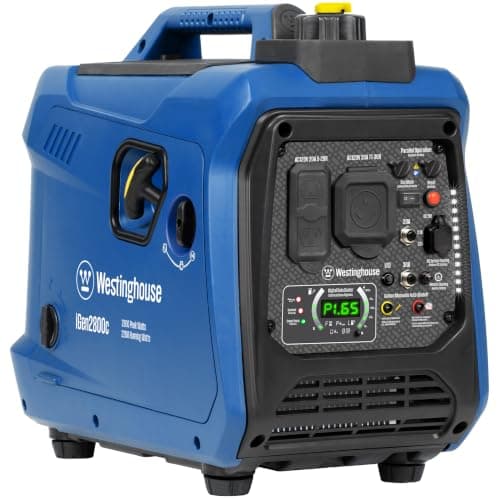
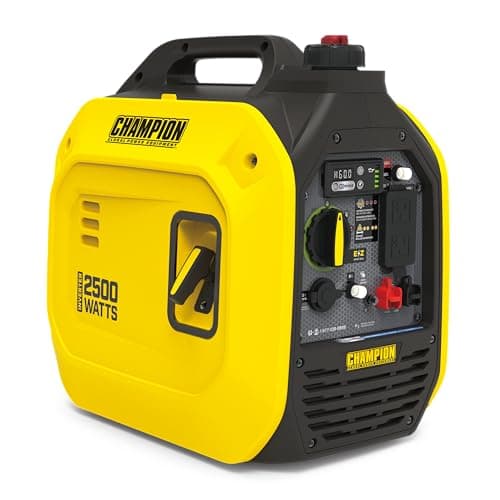
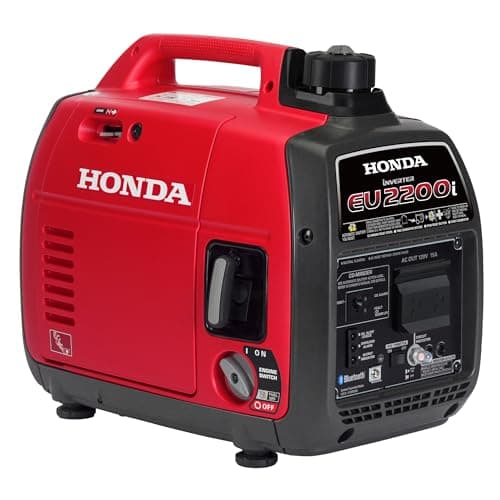
Note the number. Machines in this class are sold as 2,000 or 2,200 watt units and run at about 1,800 — the higher figure is the momentary peak that absorbs a motor start.
| Load | Running watts | Inside 1,800 W? |
|---|
| Refrigerator | 150 W average, 500-1,000 W to start | Yes, comfortably |
|---|
| Laptop, phones, lights, router | Under 200 W together | Yes |
|---|
| Coffee maker | 800-1,200 W | Yes, on its own |
|---|
| Microwave | 1,000-1,500 W | Yes, on its own |
|---|
| RV air conditioner, 13,500 BTU | 1,700 W running, up to 3,500 W starting | No — needs two units or a soft starter |
|---|
| Space heater | 1,500 W on high | Only if nothing else runs |
|---|
The honest summary: this size runs a refrigerator and a household's worth of small things all day, or one large appliance at a time. It does not do both.
Why every machine in this class is an inverter
Look for a conventional 2,000W generator and you will mostly find inverter units, for two reasons that both matter.
Noise. An inverter throttles the engine to the load rather than holding 3,600 rpm regardless. At the light loads this class actually sees, that is the difference between conversation and shouting.
Waveform. These machines run laptops, phones, CPAP machines and camera batteries — all switch-mode supplies. Inverter units publish total harmonic distortion under 3%; the architecture comparison covers what happens on a dirtier waveform.
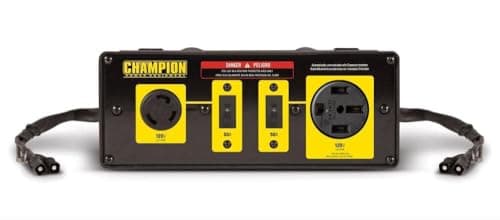
One 3,500W machine or two 1,800W units?
A genuine fork, and the answer depends on what you value.
| Two 1,800W units | One 3,500W unit |
|---|
| Noise | Quieter, especially at light load | Louder |
|---|
| Carrying | Two manageable lifts | One awkward one |
|---|
| Total weight | Higher | Lower |
|---|
| Cost | Higher, plus a kit | Lower |
|---|
| Redundancy | Half power if one fails | None |
|---|
| Light-load efficiency | Run one, leave the other off | One engine carrying a small load |
|---|
For camping and tailgating the two-unit route usually wins. For house backup it usually does not, because a single larger machine feeding a transfer switch is simpler and cheaper.
Where this size is genuinely the wrong buy
Being clear about the ceiling saves people from a second purchase.
House backup with a well pump or a furnace. A furnace blower can pull up to 1,600W and a well pump start is several times its running draw. Neither fits reliably — the 5,000W class is the honest starting point there.
Anything at 240V. Nothing in this class produces it, so a transfer switch is not an option at all.
Air conditioning of any kind. One unit will not start a 13,500 BTU RV roof unit, and a window unit at 1,200W leaves nothing behind it.
The quiet alternative
For the loads this class actually carries — a fridge, devices, lighting, a CPAP — a battery does the same job silently and can be used indoors. The generator wins on duration and loses on everything else.
The comparison page works the trade through, and the power station roundup covers the equivalent battery sizes.
The short version
- 2,000W means about 1,800 running. Size from that.
- Noise is the deciding specification in a class that runs near people.
- Parallel capability is free optionality. Check for it even if you only buy one.
- One large appliance at a time. Not a fridge and a microwave together.