Skip to content
Watt Warden

Generators

Champion vs Westinghouse: Which Generator Brand?

The two brands that own the middle of the American generator market. They are more alike than either would admit, and the differences that remain are worth naming precisely.

By Sawyer V.Updated Published How we work this out
A suburban garage lit softly in the evening.

Watt & Warden earns a commission on qualifying purchases made through links on this page, at no extra cost to you. It never changes a ranking, and our picks include products we tell you to skip. Full disclosure.

Quick picks

#ProductBest forPrice
1
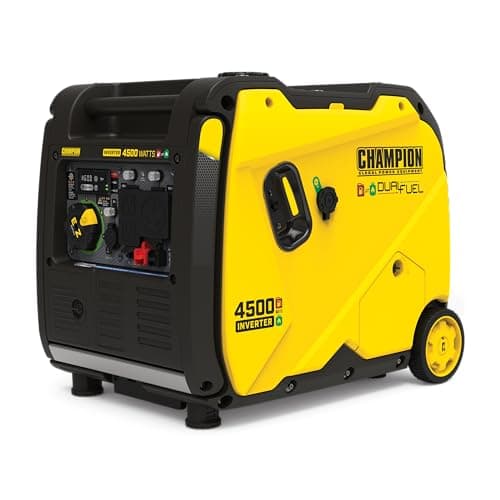
Champion 4500W dual fuel inverter generator

Champion's best all-rounder

Champion 4500W dual fuel inverter generator

4,500 starting / 3,500 running watts of dual-fuel inverter power with electric start and a TT-30R.

An RV, a tailgate and a short outage
$988.62 · Check price on Amazon

#ad how this is funded · price as of October 21, 2026

2
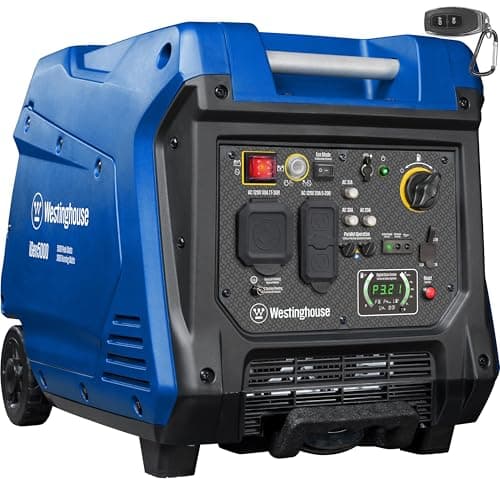
Westinghouse iGen4500

Westinghouse's answer at the same size

Westinghouse iGen4500

3,700 running watts of inverter power with a telescoping handle and wheels.

Quiet running next to neighbors
$849.00 · Check price on Amazon

#ad how this is funded · price as of October 21, 2026

3
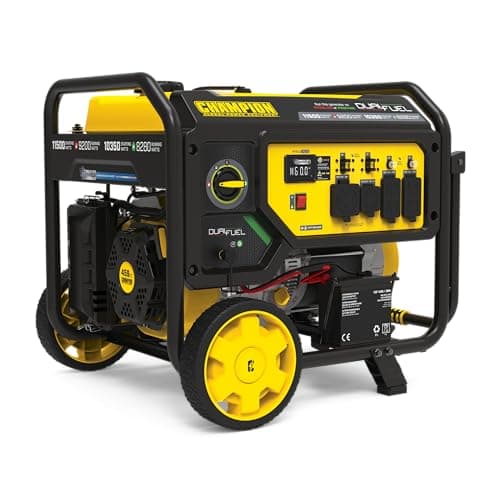
Champion 11,500W dual fuel generator

Champion's house machine

Champion 11,500W dual fuel generator

11,500 starting watts of dual fuel with electric start.

Knowing what the machine is doing
$1,159.00 · Check price on Amazon

#ad how this is funded · price as of October 21, 2026

4
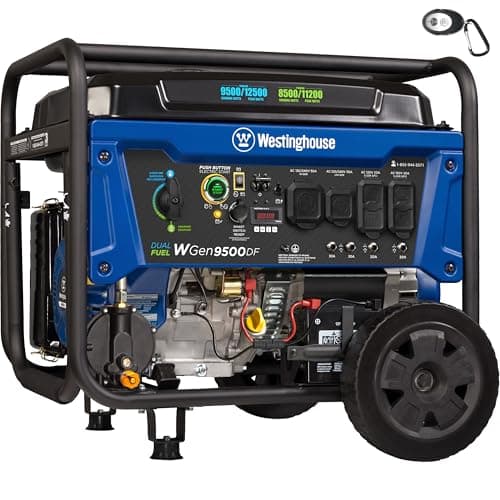
Westinghouse WGen9500DF

Westinghouse's house machine

Westinghouse WGen9500DF

9,500 running watts, dual fuel, with both an L14-30R and a 50A 14-50R, plus remote electric start.

Central air and a well pump
$999.00 · Check price on Amazon

#ad how this is funded · price as of October 21, 2026

5
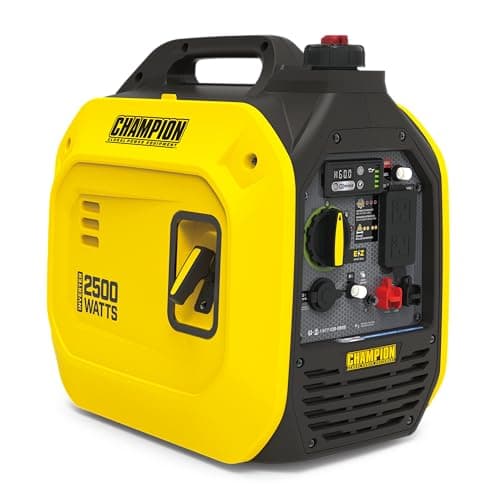
Champion 2500W Ultralight Inverter

The lightest thing either brand makes here

Champion 2500W Ultralight Inverter

2,500 starting watts in an ultralight case — genuinely carryable inverter power.

One person, one hand, one trip
$514.41 · Check price on Amazon

#ad how this is funded · price as of October 21, 2026

Prices come from the retailer at page-build time and change constantly. Where no live price is available the button reads “Check price” rather than showing a number we cannot stand behind.

The short answer

Champion if you want metering, parallel capability and lifetime technical support, or if dual fuel matters at the small end.

Westinghouse if you want the larger house machines, the 50A outlet, remote start, or published noise figures on the inverter line.

Both build to a price, both are honest about what that price buys, and neither is the brand you buy to impress a mechanic. For that conversation, see the generator brands page.

Tier by tier

TierChampionWestinghouseThe difference that matters
Ultralight inverter100692 — 2,000 starting W, 39 lbiGen2800 — 1,800 running W, 46 lbChampion is lighter; Westinghouse publishes a dB figure
Mid inverter200988 — 3,500 running W, dual fuel, electric startiGen4500 — 3,700 running W, wheeledDual fuel against 200 more watts
House machine100165 — 7,500 running W, IntelligaugeWGen9500DF — 9,500 running W, L14-30 + 50AMetering against headroom and a 50A outlet
Parallel kitsParaLINK 50A kit sold for its inverter lineNot covered on this siteChampion, for doubling up later

Every figure is the manufacturer's published specification from the pages listed below. Rows marked "not covered on this site" mean we carry no such product, not that none exists.

Where Champion is the better buy

Metering you can act on

Intelligauge reports voltage, frequency and accumulated run hours. Frequency is the number that tells you the engine is governing properly, and run hours is the number that makes an oil change schedule real rather than aspirational. Most machines at this price show you nothing.

Dual fuel further down the range

Champion puts propane capability on smaller machines, including the inverter models. Propane does not go stale, which makes it the sensible fuel for a generator used twice a year — the propane roundup covers the trade.

Lifetime technical support

Champion publishes free lifetime technical support with its warranty. For equipment that spends 360 days a year in a garage and fails on day 361, being able to phone someone is worth more than a year of extra coverage.

Where Westinghouse is the better buy

The top of the range

The WGen9500DF carries 9,500 running watts, an L14-30R for a transfer switch and a 14-50R for 50A service. If the plan is to back up a panel rather than run cords, that pairing is the clearest reason to choose Westinghouse.

Remote electric start

A key fob on the large dual-fuel machines. It sounds like a gimmick until the outage starts at 3am in horizontal rain.

Published noise figures

Westinghouse publishes decibel ratings on its inverter machines, and a brand willing to print a number is a brand you can hold to it. The quiet generator roundup explains why a 3dB difference is not a small one.

What both get right

  • Dual fuel at the house sizes. Both offer it, and it is the single most useful feature on a machine bought for storms.
  • Transfer-switch outlets where it matters. Both put L14-30R connectors on their larger machines.
  • Three-year warranties across the ranges compared here.
  • Parts availability. Both are common enough that carburetors, plugs and filters are easy to find, which is not true of cheaper imports.

The question that actually decides it

Not the brand. The connector.

If you are backing up a house through a transfer switch, you need a 120/240V outlet — an L14-30R at minimum, a 14-50R if you want 50A. That requirement eliminates most inverter machines from both brands immediately, and it points at the larger Westinghouse units or Champion's bigger dual-fuel machines.

If you are running an RV, you need a TT-30R, and Champion's RV-ready inverters are built for exactly that.

If you are running extension cords to a refrigerator and a couple of lamps, buy the lightest, quietest machine either brand sells and stop reading comparison pages. The sizing page turns your own list into a number first, which is the order these decisions should happen in.

The short version

  • Champion: metering, parallel kits, dual fuel further down the range, lifetime support.
  • Westinghouse: more watts at the top, the 50A outlet, remote start, published noise figures.
  • Both are value brands with three-year warranties and easy parts.
  • Choose the outlet first, then the brand. The connector decides more than the badge does.

The picks in full

01 — Champion's best all-rounder

Champion 4500W dual fuel inverter generator

4,500 starting / 3,500 running watts of dual-fuel inverter power with electric start and a TT-30R.

Inverter output, dual fuel and electric start in one machine is a rare combination at this size, and the RV-ready TT-30R is the connector most campgrounds want.

Champion's three-year warranty comes with free lifetime technical support, which is a real thing when a carburetor misbehaves in year six.

The honest catch: 3,500 running watts is a camper and a critical-load answer, not a house answer.

Skip it ifyou are backing up a panel. This has no 120/240V transfer-switch outlet.

Champion 4500W dual fuel inverter generator
$988.62 · Check price on Amazon

#ad how this is funded · price as of October 21, 2026

Published specifications for the Champion 4500W dual fuel inverter generator
SpecificationPublished figure
Output4,500 starting W / 3,500 running W (gasoline)
TypeInverter, RV ready
FuelGasoline or propane (dual fuel)
StartingElectric start
RV outlet120 V TT-30R, 30 A
Warranty3-year limited with free lifetime technical support

Source: Champion Power Equipment — 4500-watt dual fuel inverter specifications. These are the manufacturer's published figures, not ours — we have not tested this unit.

02 — Westinghouse's answer at the same size

Westinghouse iGen4500

3,700 running watts of inverter power with a telescoping handle and wheels.

Two hundred more running watts than the Champion and a chassis designed to be wheeled rather than carried, which matters at this weight.

Westinghouse is the brand more willing to publish decibel figures across its inverter line, and that transparency is worth something.

The honest catch: no propane option, so no long-storage fuel plan.

Skip it ifyou need dual fuel. This one is gasoline.

Westinghouse iGen4500
$849.00 · Check price on Amazon

#ad how this is funded · price as of October 21, 2026

Published specifications for the Westinghouse iGen4500
SpecificationPublished figure
Output (gasoline)3,700 running W / 4,500 peak W
TypeInverter (pure sine wave)
StartingRemote electric start with auto choke
RV outlet120 V TT-30R, 30 A
ParallelCapable with a second unit

Source: Westinghouse — iGen4500 product specifications. These are the manufacturer's published figures, not ours — we have not tested this unit.

03 — Champion's house machine

Champion 11,500W dual fuel generator

11,500 starting watts of dual fuel with electric start.

Electric start and dual fuel are the headline features, and the size is the real argument: 11,500 starting watts covers air conditioning as well as the critical list.

Dual fuel matters on a machine this size, because propane stores indefinitely between storm seasons.

The honest catch: this is more machine than most critical-load lists need, and it burns fuel accordingly.

Skip it ifyou want a 50A outlet for an RV or a larger inlet.

Champion 11,500W dual fuel generator
$1,159.00 · Check price on Amazon

#ad how this is funded · price as of October 21, 2026

Published specifications for the Champion 11,500W dual fuel generator
SpecificationPublished figure
Output11,500 starting W
FuelGasoline or propane (dual fuel)
StartingElectric start
UseWhole-panel backup through a transfer switch

Source: Champion — 11,500-watt dual fuel listing. These are the manufacturer's published figures, not ours — we have not tested this unit.

04 — Westinghouse's house machine

Westinghouse WGen9500DF

9,500 running watts, dual fuel, with both an L14-30R and a 50A 14-50R, plus remote electric start.

Two thousand more running watts than Champion's equivalent, and the 50A outlet that Champion's 7,500W machine does not carry.

Remote start by key fob is the small luxury you notice in bad weather.

The honest catch: more machine, more fuel, more noise. Buy the headroom only if a compressor needs it — the full review works through who does.

Skip it ifyour list is a fridge, a furnace and the internet.

Westinghouse WGen9500DF
$999.00 · Check price on Amazon

#ad how this is funded · price as of October 21, 2026

Published specifications for the Westinghouse WGen9500DF
SpecificationPublished figure
Output (gasoline)9,500 running W / 12,500 peak W
FuelGasoline or propane (dual fuel)
Engine457cc 4-stroke OHV, cast iron sleeve
Tank6.6 gal (25 L)
Run timeup to 12 h on a full tank
Transfer-switch outlet120/240 V L14-30R, 30 A
RV outlet120/240 V 14-50R, 50 A
StartingPush-button electric with remote key fob
Warranty3-year limited

Source: Westinghouse — WGen9500DF product specifications. These are the manufacturer's published figures, not ours — we have not tested this unit.

05 — The lightest thing either brand makes here

Champion 2500W Ultralight Inverter

2,500 starting watts in an ultralight case — genuinely carryable inverter power.

Thirty-nine pounds is the difference between a generator you take camping and one you talk about taking camping.

Inverter output also means it is safe for laptops and control boards without a separate surge protector.

The honest catch: 2,500 starting watts is a one-appliance-at-a-time machine.

Skip it ifa refrigerator and a furnace both have to run.

Champion 2500W Ultralight Inverter
$514.41 · Check price on Amazon

#ad how this is funded · price as of October 21, 2026

Published specifications for the Champion 2500W Ultralight Inverter
SpecificationPublished figure
Output2,500 starting W
TypeEnclosed inverter, parallel capable
UseCamping, tailgating and a small critical list

Source: Champion — 2500-watt Ultralight inverter listing. These are the manufacturer's published figures, not ours — we have not tested this unit.

How these were chosen

We did not test these. Nobody at Watt & Warden has plugged one in. What we did instead: read the manufacturer's published specifications, compile them into a table where the figures line up, and compute the numbers manufacturers leave out — runtime against a real appliance load, and what an hour of running actually costs.

Anything that could not be sourced was left out rather than estimated, and every pick names the buyer who should skip it. The full method is here, including where it is weaker than a publisher with a test bench.

Questions people actually ask

Is Champion or Westinghouse more reliable?

Neither publishes failure-rate data, so anyone ranking them on reliability is guessing. What is on the record: both offer three-year warranties on the machines compared here, Champion adds free lifetime technical support, and both are common enough that spare parts are easy to find. Maintenance matters more than badge -- stale fuel kills more generators than manufacturing does.

Which brand is better for home backup?

Westinghouse, at the top of the range. The WGen9500DF carries 9,500 running watts with both an L14-30R transfer-switch outlet and a 50A 14-50R, which is more headroom and more connection options than Champion's 7,500W dual-fuel machine. For smaller critical-load lists the two are closely matched.

Which brand is better for an RV?

Champion, for most RV owners. Its RV-ready inverter machines carry the TT-30R outlet campgrounds expect, offer dual fuel at that size, and have a published parallel kit if you later need more than one machine's output.

Do both brands make dual-fuel generators?

Yes, and both do it well at house sizes. Champion extends propane capability further down its range, including inverter models. Propane's advantage is storage: it does not degrade in the cylinder, which suits a generator that runs twice a year.

Can I connect either brand to my house?

Only through a transfer switch or an interlock kit, and only if the machine has a 120/240V outlet -- typically an L14-30R. Backfeeding through a dryer or range outlet is illegal in most jurisdictions and can kill utility workers. Both brands put the correct outlet on their larger machines.

Sources

Every figure on this page comes from a published source. We have not tested this equipment, so the specifications are the manufacturer's and the statistics are the dataset's — the arithmetic on top of them is ours, and it is shown in full so you can check it. How we work this out.