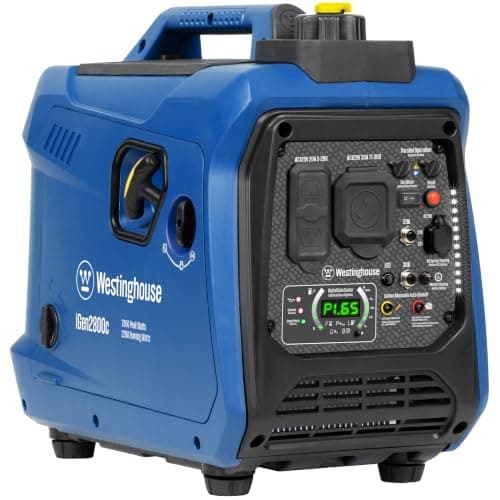
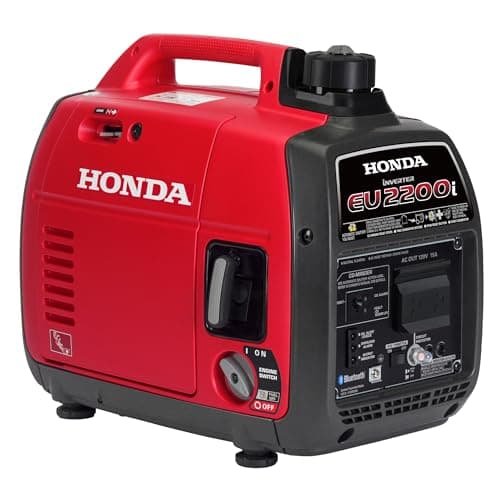
The two machines, side by side
| Honda EU2200i | Westinghouse iGen2800 |
|---|
| Output | 2,200 W | 2,800 peak / 2,200 running W |
|---|
| Published noise | 48-57 dB(A) across the load range | 52 dBA |
|---|
| Weight | 47 lb | 46.3 lb |
|---|
| Waveform | Inverter | Inverter, under 3% THD published |
|---|
| Tank / run time | Not published here | 0.98 gal, up to 10 h at 25% load |
|---|
| Warranty | Not published here | 3-year limited residential, lifetime technical support |
|---|
Manufacturer figures from the pages cited below. Where a maker does not publish a number on the page we cite, the cell says so rather than carrying an estimate. Note that Honda publishes a load-dependent range and Westinghouse publishes a single figure — they are not directly comparable.
What the Honda premium actually buys
Three things, and it is worth being precise because two of them rarely appear on a spec sheet.
1. The quiet end of the range. At light loads Honda publishes 48 dB(A), which is meaningfully quieter than anything in the value bracket. Decibels are logarithmic, so a handful of dB is a large perceived difference — the quiet generator roundup explains why.
2. Service life and parts. Honda's small engines have a long reputation for running for decades, and parts and service are available essentially everywhere. This is not a number we can cite, and we will not pretend otherwise — but it is the reason contractors buy them.
3. Resale. A used Honda sells quickly at a high fraction of its price. If you buy one, use it for five years and sell it, the real cost of ownership closes much of the gap to the value brand.
What Westinghouse gets right
- Watts per dollar. More running watts than the Honda, for a fraction of the price.
- Published specifications. Noise, THD, tank size, run time and warranty are all stated, which is not universal in this bracket.
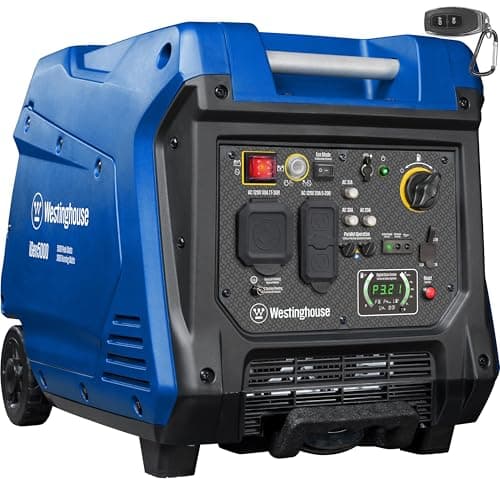
- A range that keeps going. The same brand sells the 3,700W machine above and the large dual-fuel house generators, so growing does not mean switching brands.
- Lifetime technical support alongside a three-year warranty.
The honest way to choose
Ask how many hours the machine will run in its life.
Under a few hundred hours — storm backup, a couple of camping trips a year — and the value machine is very hard to argue with. It will not accumulate the hours where engine pedigree starts to matter, and the money saved buys a transfer switch or a battery.
Hundreds of hours a year — a work van, a market stall, a boat, an off-grid cabin — and the Honda's service life, parts network and resale change the arithmetic. Machines that earn money are bought differently from machines that wait in a garage.
The short version
- Similar watts, similar weight, very different prices.
- Honda buys quiet, longevity and resale — two of which are not on any spec sheet.
- Westinghouse buys watts, published numbers and a range you can grow within.
- Occasional use favors Westinghouse; heavy use favors Honda.