Skip to content
Watt Warden

Generators

The Best Quiet Generators (2026)

Every generator is marketed as quiet. Decibels are logarithmic, so the gap between 50 and 70 is not a fifth — it is roughly four times as loud, and it decides whether anyone sleeps.

By Sawyer V.Updated Published How we work this out
A quiet suburban street of houses at night.

Watt & Warden earns a commission on qualifying purchases made through links on this page, at no extra cost to you. It never changes a ranking, and our picks include products we tell you to skip. Full disclosure.

Quick picks

#ProductBest forPrice
1
No photo

Quietest published figure here

Honda EU2200i

2,200W at a published 48–57 dB(A) and 47.4 lb — the quietest machine on this site.

Campgrounds with decibel limits, and close neighbors
2
No photo

Quiet at house-sized output

Westinghouse iGen4500

3,700 running watts of enclosed inverter power, with a telescoping handle and wheels.

A critical load without waking the street
3
No photo

Quiet plus fuel flexibility

Champion 200988 4500W dual fuel inverter

4,500 starting watts of dual-fuel inverter power with electric start.

Overnight running in a dense street
4
No photo

So you can still run it in rain

GenTent Safety Canopy, inverter

A canopy sized for a fully encased inverter, leaving airflow and exhaust clear.

Enclosed inverter generators

Prices come from the retailer at page-build time and change constantly. Where no live price is available the button reads “Check price” rather than showing a number we cannot stand behind.

Why decibels mislead people

The decibel scale is logarithmic. A 10 dB increase is roughly a doubling of perceived loudness, not a 10% increase.

So the gap between an enclosed inverter at around 50 dB and a conventional open-frame machine at around 70 dB is not "a bit quieter." It is roughly four times as loud. In practical terms it is the difference between a machine you can hold a conversation next to and one that is audible inside a neighbor's closed house at 2am.

SourceApproximate levelIn practice
Honda EU2200i (published)48–57 dB(A)Quieter than conversation at the low end
Normal conversation~60 dBReference point
Conventional open-frame generator~68–72 dBRoughly twice as loud as conversation
Gasoline lawnmower~90 dBHearing protection territory

The Honda figure is the manufacturer's published range, measured under its own test conditions at a stated distance and load. The other rows are conventional reference levels for scale — we have not measured any generator, and a manufacturer's dB figure is not a measurement of your yard.

What a published dB figure leaves out

Three things, and all three matter more than the number itself.

1. It is usually the quiet end of a range. Honda publishes 48–57 dB(A) precisely because load changes it. An inverter at quarter load and the same inverter at full output are meaningfully different machines acoustically, and marketing tends to quote the first.

2. Distance is doing work. dB figures are quoted at a stated distance — commonly around 23 feet — and sound falls off with distance. A figure without its distance is not a specification.

3. It says nothing about the character of the noise. A low-frequency drone carries further and through walls better than a higher-pitched sound at the same measured level. Two machines with identical dB ratings can be very differently annoying at 3am.

Which is why this page quotes exactly one manufacturer dB figure — the one we could verify — and describes the rest structurally rather than inventing numbers for them.

The engineering that makes an inverter quiet

A conventional generator holds its engine at 3,600 rpm because output frequency depends directly on engine speed. It runs at 3,600 rpm powering a whole house and at 3,600 rpm powering a single lamp.

An inverter generates AC, rectifies it to DC, and synthesizes a clean 60 Hz sine wave electronically. Frequency no longer depends on engine speed, so the engine is free to throttle down when the load is light — which is nearly all the time in a real outage.

Most are also enclosed in a sound-damping case rather than sitting in an open frame. The two effects compound. The full comparison covers what else follows from that architecture.

Things that make any generator quieter

  • Distance. The cheapest and largest lever, and you are already required to be twenty feet away for carbon monoxide reasons. Further is quieter and safer at the same time.
  • Run it at part load. An inverter throttles down; even a conventional machine is quieter not working hard.
  • Put something solid between it and the bedrooms. A fence, a garage wall, a shed — mass blocks sound. Never enclose it.
  • Point the exhaust away from houses. You are doing this for carbon monoxide anyway, and it helps acoustically.
  • Stand it on something soft-ish and level. A rubber mat or a pad on soil rather than a hard slab reduces transmitted vibration.
  • Run it in blocks, not continuously. Six hours a day keeps a fridge and freezer safe and buys everyone a quiet night — and costs a quarter as much in fuel.

What not to do: never build a box around it, never put it in a shed or garage to muffle it, and never drape anything over it. All of those trap exhaust and block cooling, and the carbon monoxide risk is not worth a quieter night.

The quietest option is not a generator

A power station runs at around 30 dB under load — quieter than a running refrigerator — makes no exhaust, and works indoors. If your outages are short enough for a battery to cover them, that is the actual answer to a noise problem.

The strongest arrangement for a multi-day outage is both: run the generator for two hours in the afternoon to carry the house and refill the battery, then run the essentials silently off the battery overnight. A quarter of the fuel, and nobody on the street hears anything after dark. The comparison and the charging arrangement.
The picks in full

01Quietest published figure here

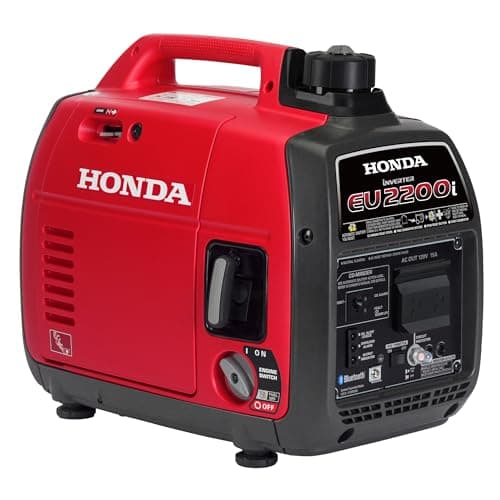
Honda EU2200i

2,200W at a published 48–57 dB(A) and 47.4 lb — the quietest machine on this site.

48–57 dB(A) is the number the whole category is measured against, and the low end of that range is quieter than ordinary conversation. Eco Throttle is why: engine speed tracks load, so a light load is both quiet and frugal.

8.1 hours on 0.95 gallons works out to about 0.117 gallons an hour, which no conventional machine of any size approaches.

The limits are honest ones. 1,800W rated is a camping and RV figure, and this is the most expensive watt on the site. What you are buying is the dB number and the resale value.

Skip it ifyou need to run a house. 1,800W rated will not start a fridge and a furnace fan together.

Published specifications for the Honda EU2200i
SpecificationPublished figure
Output2,200 W max / 1,800 W rated
TypeInverter (pure sine wave)
Noise48–57 dB(A)
Weight47.4 lb
Tank0.95 gal
Run timeup to 8.1 h on a full tank
FeaturesEco Throttle, CO-Minder, Bluetooth app monitoring

Source: Honda Power Equipment — EU2200i specifications. These are the manufacturer's published figures, not ours — we have not tested this unit.

02Quiet at house-sized output

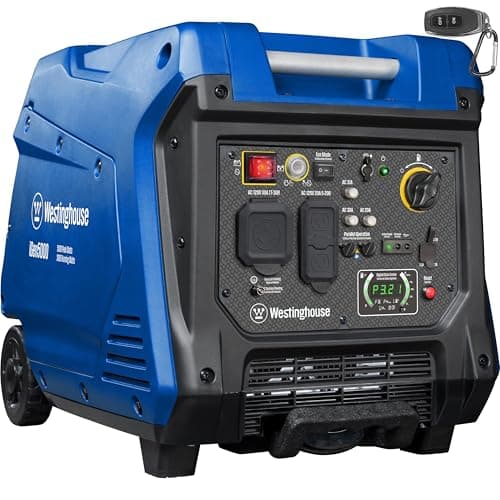
Westinghouse iGen4500

3,700 running watts of enclosed inverter power, with a telescoping handle and wheels.

This is the compromise most households actually want: enough output to cover a fridge, a furnace fan and lighting, in an enclosed inverter package rather than an open frame.

Remote electric start with auto choke, an RV-ready TT-30R outlet, and parallel capability with a second unit. The telescoping handle and wheels mean one person repositions it without lifting.

Westinghouse markets it as super quiet; we quote the output figures they publish and do not have a dB(A) figure from them in a form we could verify, so we are not putting a number on it.

Skip it ifyou want dual fuel. This is the gasoline model; the DF variant adds propane.

Published specifications for the Westinghouse iGen4500
SpecificationPublished figure
Output (gasoline)3,700 running W / 4,500 peak W
TypeInverter (pure sine wave)
StartingRemote electric start with auto choke
RV outlet120 V TT-30R, 30 A
ParallelCapable with a second unit

Source: Westinghouse — iGen4500 product specifications. These are the manufacturer's published figures, not ours — we have not tested this unit.

03Quiet plus fuel flexibility

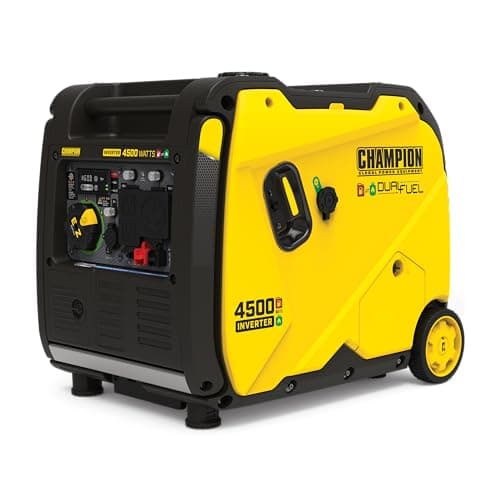
Champion 200988 4500W dual fuel inverter

4,500 starting watts of dual-fuel inverter power with electric start.

An inverter throttles its engine to the load instead of holding 3,600 rpm regardless, which is why it is substantially quieter at the partial loads a house draws overnight — and why it burns much less fuel there too.

Dual fuel on an inverter is uncommon and genuinely useful: propane availability and lower noise in one machine, without choosing.

Skip it ifyou need genuine near-silence at close range. An open-frame inverter is quieter than a conventional machine, not as quiet as an enclosed one.

Published specifications for the Champion 200988 4500W dual fuel inverter
SpecificationPublished figure
Output4,500 starting W / 3,500 running W (gasoline)
TypeInverter, RV ready
FuelGasoline or propane (dual fuel)
StartingElectric start
RV outlet120 V TT-30R, 30 A
Warranty3-year limited with free lifetime technical support

Source: Champion Power Equipment — 4500-watt dual fuel inverter specifications. These are the manufacturer's published figures, not ours — we have not tested this unit.

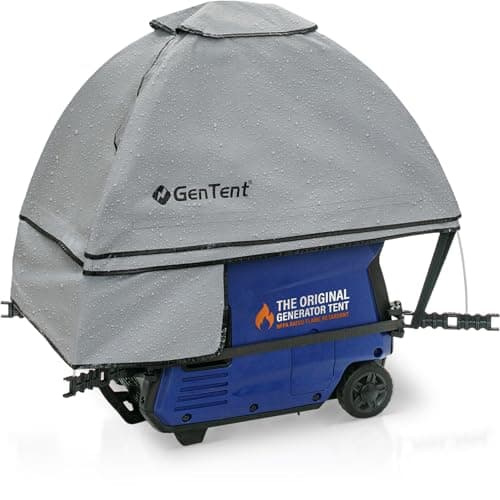
04So you can still run it in rain

GenTent Safety Canopy, inverter

A canopy sized for a fully encased inverter, leaving airflow and exhaust clear.

A quiet generator you cannot run in the weather is not much use, and rain is the weather that causes outages. Enclosed inverters need the inverter-specific cover — they have no frame posts for the open-frame kit to clamp to.

Skip it ifyou have an open-frame machine. That needs the open-frame kit, which mounts completely differently.

Published specifications for the GenTent Safety Canopy, inverter
SpecificationPublished figure
FitsFully encased inverter generators
FabricNFPA 701 flame-certified
PurposeRunning cover — keeps airflow and exhaust clear
InstallationTool-free mount

Source: GenTent — inverter Safety Canopy product page. These are the manufacturer's published figures, not ours — we have not tested this unit.

How these were chosen

We did not test these. Nobody at Watt & Warden has plugged one in. What we did instead: read the manufacturer's published specifications, compile them into a table where the figures line up, and compute the numbers manufacturers leave out — runtime against a real appliance load, and what an hour of running actually costs.

Anything that could not be sourced was left out rather than estimated, and every pick names the buyer who should skip it. The full method is here, including where it is weaker than a publisher with a test bench.

Questions people actually ask

How quiet is a quiet generator?

Honda publishes 48-57 dB(A) for the EU2200i at a stated distance and load, against roughly 68-72 dB for a comparable conventional open-frame machine. Because decibels are logarithmic, that gap is close to four times the perceived loudness rather than a modest difference.

Why are inverter generators quieter?

The engine can throttle to the load. A conventional generator holds 3,600 rpm because output frequency depends on engine speed; an inverter synthesizes the waveform electronically, so the engine slows when demand is light. Most are also in a sound-damping enclosure rather than an open frame.

How can I make my generator quieter?

Distance is the biggest lever and you are already required to be twenty feet away. Beyond that: run it at part load, put a solid barrier like a fence or wall between it and the bedrooms, point the exhaust away, stand it on a mat rather than a hard slab, and run it in blocks rather than continuously.

Can I build a box around my generator to quiet it?

No. Any enclosure traps exhaust and blocks the cooling airflow an air-cooled engine needs -- the same reasons a garage and a tarp are dangerous. Carbon monoxide poisoning from portable generators kills people every year, and a quieter night is not worth that trade.

What is the quietest way to get backup power?

A power station. Around 30 dB under load, quieter than a running fridge, no exhaust, and safe indoors. If your outages are short enough for a battery to cover them, that is the real answer to a noise problem rather than a quieter engine.

Sources

Every figure on this page comes from a published source. We have not tested this equipment, so the specifications are the manufacturer's and the statistics are the dataset's — the arithmetic on top of them is ours, and it is shown in full so you can check it. How we work this out.