Skip to content
Watt Warden

Generators

Inverter vs Conventional Generator: What Actually Differs

The difference is one engineering decision, and everything people notice about these machines follows from it. Once you see it, the buying decision is straightforward.

By Sawyer V.Updated Published How we work this out
Close-up of engine and mechanical parts.

Watt & Warden earns a commission on qualifying purchases made through links on this page, at no extra cost to you. It never changes a ranking, and our picks include products we tell you to skip. Full disclosure.

Quick picks

#ProductBest forPrice
1
No photo

The inverter argument at its clearest

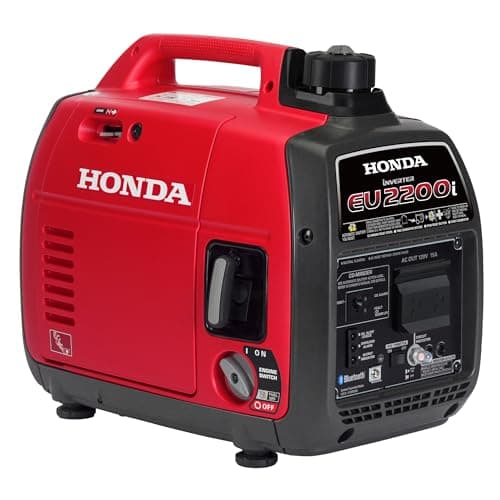
Honda EU2200i

2,200W at 48–57 dB(A), 47.4 lb, 8.1 hours on 0.95 gallons.

Anywhere noise is the constraint
2
No photo

The conventional argument

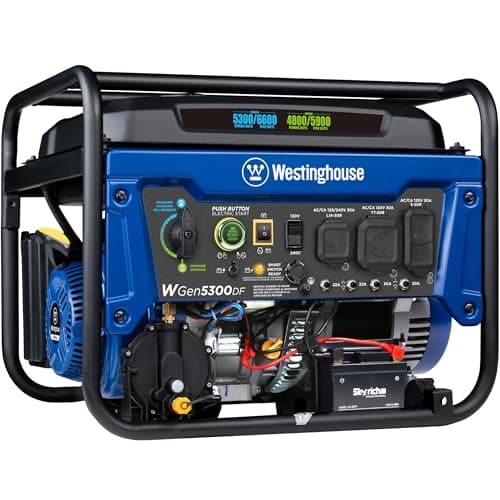
Westinghouse WGen5300DF

5,300 running watts, dual fuel, 14.5 hours a tank — capacity an inverter cannot match at the price.

Maximum watts per dollar for a house
3
No photo

The middle position

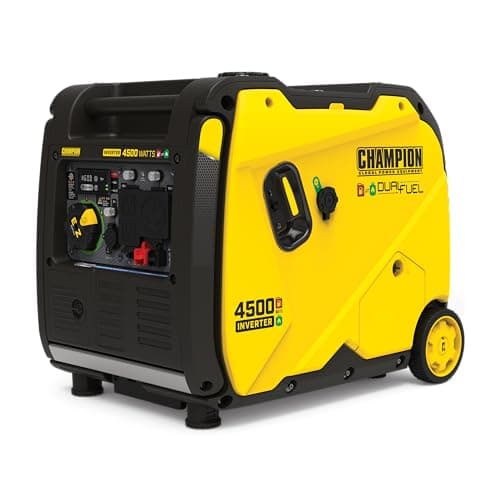
Champion 200988 4500W dual fuel inverter

4,500 starting watts of dual-fuel inverter power — the compromise that actually works.

House-sized load with inverter quiet

Prices come from the retailer at page-build time and change constantly. Where no live price is available the button reads “Check price” rather than showing a number we cannot stand behind.

The engineering difference in one paragraph

In a conventional generator, the alternator is mechanically coupled to the engine, so the frequency of the output depends directly on engine speed. 60 Hz requires 3,600 rpm, so the engine holds 3,600 rpm whatever the load — powering a whole house or a single lamp, it runs at the same speed.

In an inverter generator, the raw alternator output is rectified to DC and a clean 60 Hz sine wave is synthesized electronically from it. Frequency no longer depends on engine speed, so the engine is free to slow down when the load is light.

That is the entire difference. Everything below is a consequence of it.

Consequence one: noise

An engine at 1,800 rpm is much quieter than the same engine at 3,600 rpm, and inverter generators are usually enclosed in a sound-damping case as well. Honda publishes 48–57 dB(A) for the EU2200i, measured at a stated distance and load. A comparable conventional open-frame machine sits near 68–72 dB.

Decibels are logarithmic — every 10 dB is roughly a doubling of perceived loudness — so that gap is close to halving the noise. Practically: a conventional generator running overnight is audible inside a neighbor's house with the windows shut, and an enclosed inverter at partial load usually is not.

Two caveats. Manufacturer dB figures are measured under the manufacturer's own conditions, usually at a stated distance and a stated load, and we have not measured any of them. And an inverter at full load is much louder than the same inverter at quarter load — the headline figure is typically the quiet end of a range.

Consequence two: fuel economy at light load

This gets far less attention than noise and is worth as much over a multi-day outage. A conventional machine burns fuel to hold 3,600 rpm whether or not anything is drawing power. An inverter does not.

What it costs to actually run

The sticker price of a dual-fuel generator is a fraction of what it costs you. The sticker price of a battery is nearly all of it. Here is the arithmetic, with the inputs stated so you can redo it with your own fuel price.

UnitPublished consumptionCost per hourCost per 24 h
Honda EU2200i, Eco Throttle0.95 gal over 8.1 h = 0.117 gal/hr$0.48$11.44
Mid-size inverter, light load~0.25 gal/hr$1.02$24.43
Mid-size conventional, light load~0.55 gal/hr$2.24$53.74
Mid-size conventional, half load~0.75 gal/hr$3.05$73.28
Gasoline at $4.071/gal (EIA weekly retail, U.S. average, week ending 31 August 2026). The Honda row is computed directly from its published tank size and run time. The other rows are working estimates for machines of that size at the stated load, because manufacturers rarely publish consumption at a fraction of rated output. Your manual publishes its own figure — use it in preference to ours.

The middle two rows are the real comparison, and the difference over three days is roughly ninety dollars and about twenty gallons of fuel you do not have to source, carry and store. In a regional outage, the fuel you do not need is worth more than the money.

Consequence three: waveform

Because the output is synthesized electronically, an inverter produces a genuine sine wave — the same shape as grid power. A conventional generator produces a rougher approximation with more harmonic distortion.

For a heater, a fan, a lamp or a motor, this makes no practical difference. For a computer with an active-PFC power supply, a modern television, or medical equipment, it can matter: dirty power can cause shutdowns, running hot, or over time reduced component life.

If your critical list includes a home office you cannot lose, this is a real argument for an inverter. If it is a fridge, a furnace fan and lights, it is not.

Consequence four: price and capacity

Inverter generators cost roughly twice per watt, and the extra electronics get expensive quickly as output rises — which is why the inverter market thins out above about 5,000 watts while conventional machines run to 13,000 and beyond.

So the practical rule: below about 4,500 watts, both architectures are readily available and the choice is genuinely yours. Above about 7,500 watts, conventional is effectively the only option at a sane price.

Which to buy

If your constraint is…Buy
Close neighbors, overnight runningInverter
A campground with generator hoursInverter — often the only kind permitted
Computers and sensitive electronicsInverter
Long outages with limited fuelInverter, for the light-load economy
Maximum watts per dollarConventional
Over 5,000 running wattsConventional — inverters get expensive fast
A well pump or central air conditioningConventional
Running near full load anywayConventional — the throttling advantage disappears at full output

The honest summary

Inverter technology solves noise and waveform quality. It does not solve capacity, and it costs roughly double per watt. Buy it because you have a noise problem or an electronics problem — not because it sounds like the newer, better technology.

For a house that needs 5,000 watts and sits on a decent-sized lot, a conventional dual-fuel machine is the better purchase and it is not close. The under-$1,000 roundup includes both kinds, and the inverter roundup goes deeper if quiet is the deciding factor.

The picks in full

01The inverter argument at its clearest

Honda EU2200i

2,200W at 48–57 dB(A), 47.4 lb, 8.1 hours on 0.95 gallons.

Every advantage of the inverter architecture, concentrated. The published 48–57 dB(A) range is the quietest here; Eco Throttle tracks engine speed to load; and 8.1 hours from 0.95 gallons works out to about 0.117 gallons an hour, which no conventional machine of any size approaches.

It is also the most expensive watt on this site, which is the honest counterweight.

Skip it ifyou need to power a house. 1,800W rated is a camping and RV figure, not a critical-load one.

Published specifications for the Honda EU2200i
SpecificationPublished figure
Output2,200 W max / 1,800 W rated
TypeInverter (pure sine wave)
Noise48–57 dB(A)
Weight47.4 lb
Tank0.95 gal
Run timeup to 8.1 h on a full tank
FeaturesEco Throttle, CO-Minder, Bluetooth app monitoring

Source: Honda Power Equipment — EU2200i specifications. These are the manufacturer's published figures, not ours — we have not tested this unit.

02The conventional argument

Westinghouse WGen5300DF

5,300 running watts, dual fuel, 14.5 hours a tank — capacity an inverter cannot match at the price.

This is what the conventional architecture buys: 5,300 running watts for roughly what a 3,500W inverter costs. If the requirement is covering a critical load rather than being quiet, that is the correct trade.

Dual fuel, remote electric start, and both a 30A transfer-switch outlet and a 30A RV outlet. The 274cc engine is efficient for its output — it simply cannot throttle down when the load is light.

Skip it ifyou are in dense housing. An open-frame conventional machine running overnight is audible inside a neighbor's closed house.

Published specifications for the Westinghouse WGen5300DF
SpecificationPublished figure
Output (gasoline)5,300 running W / 6,600 peak W
Output (propane)4,800 running W / 5,900 peak W
Engine274cc 4-stroke OHV
Tank4.7 gal (18 L)
Run timeup to 14.5 h on a full tank
Transfer-switch outlet120/240 V L14-30R, 30 A
RV outlet120 V TT-30R, 30 A
StartingPush-button electric with remote key fob

Source: Westinghouse — WGen5300DF product specifications. These are the manufacturer's published figures, not ours — we have not tested this unit.

03The middle position

Champion 200988 4500W dual fuel inverter

4,500 starting watts of dual-fuel inverter power — the compromise that actually works.

An inverter sized for a house rather than a campsite, with dual fuel on top. 3,500 running watts covers a fridge, a furnace fan and lighting while throttling down overnight in a way a conventional machine cannot.

The compromise it does not resolve: an open-frame inverter is quieter than a conventional machine but not as quiet as an enclosed one like the Honda.

Skip it ifyou need over 3,500 running watts. That is the real number and it is the constraint.

Published specifications for the Champion 200988 4500W dual fuel inverter
SpecificationPublished figure
Output4,500 starting W / 3,500 running W (gasoline)
TypeInverter, RV ready
FuelGasoline or propane (dual fuel)
StartingElectric start
RV outlet120 V TT-30R, 30 A
Warranty3-year limited with free lifetime technical support

Source: Champion Power Equipment — 4500-watt dual fuel inverter specifications. These are the manufacturer's published figures, not ours — we have not tested this unit.

How these were chosen

We did not test these. Nobody at Watt & Warden has plugged one in. What we did instead: read the manufacturer's published specifications, compile them into a table where the figures line up, and compute the numbers manufacturers leave out — runtime against a real appliance load, and what an hour of running actually costs.

Anything that could not be sourced was left out rather than estimated, and every pick names the buyer who should skip it. The full method is here, including where it is weaker than a publisher with a test bench.

Questions people actually ask

What is the difference between an inverter and a conventional generator?

A conventional generator holds its engine at 3,600 rpm because output frequency depends on engine speed. An inverter generates AC, rectifies it to DC and synthesizes a clean sine wave electronically, which frees the engine to throttle to the load. Everything else -- noise, fuel economy at light load, waveform quality and price -- follows from that.

Are inverter generators more fuel efficient?

At partial load, substantially. Because the engine throttles down, an inverter at light load can use less than half the fuel of a conventional machine doing the same work. At full load the advantage largely disappears -- both engines are working hard.

Can I run a computer off a conventional generator?

Usually, but it is not ideal. A conventional generator's output has more harmonic distortion than grid power, which some active-PFC power supplies dislike -- symptoms range from shutdowns to running hot. An inverter generator produces a genuine sine wave and removes the question.

Are inverter generators worth double the price?

If noise is a real constraint or you are powering sensitive electronics, yes. If you need maximum capacity and have space between you and your neighbors, no -- you are paying twice per watt for a benefit you will not use.

Sources

Every figure on this page comes from a published source. We have not tested this equipment, so the specifications are the manufacturer's and the statistics are the dataset's — the arithmetic on top of them is ours, and it is shown in full so you can check it. How we work this out.