Skip to content
Watt Warden

Generators

How to Parallel Two Generators

Paralleling turns two small machines into one larger one you can also un-make - run a single unit on a light night, both when the load arrives. Only inverters can do it.

By Sawyer V.Updated Published How we work this out
Two machines standing side by side on a driveway.

Watt & Warden earns a commission on qualifying purchases made through links on this page, at no extra cost to you. It never changes a ranking, and our picks include products we tell you to skip. Full disclosure.

Only inverters can do this

This is the constraint that decides everything else, and it is worth understanding rather than memorizing.

Two AC sources can only be connected together if their waveforms are synchronized — same frequency, same phase, continuously. Two conventional generators each produce AC directly from a spinning alternator at whatever speed their governor happens to be holding. They will never stay in step, and connecting them causes very large circulating currents and destroys equipment.

An inverter generator does not produce its AC mechanically. It rectifies to DC and synthesizes the output electronically, which means two units can be told to synchronize with each other. That is what a parallel kit coordinates.

Never attempt to parallel conventional open-frame generators. Not with a cable, not with a splitter, not carefully. The architecture comparison covers why the two are so different.

What you actually get

One unitTwo in parallel
Running watts1,800~3,600
Weight to carry at once46 lbStill 46 lb — two trips
Fuel on a light nightOne engineOne engine — leave the second off
RedundancyNoneOne fails, you still have half
CostLowerTwo machines plus a kit
Noise at full loadOne engine working hardTwo engines working less hard

Wattage figures use the Westinghouse iGen2200's published 1,800 running watts. Combined output is not always exactly double — some manufacturers publish a slightly lower combined figure, so use theirs where they give one.

The real argument: you can un-make it

Everyone frames paralleling as a way to get more watts. The better argument is the reverse.

A single 4,000W generator runs one engine whatever the load. On a quiet night with a fridge and some lights, it is a large machine idling inefficiently and making noise for a job a small one would do.

A pair lets you match the machine to the evening: one unit for the overnight load, both when the air conditioner or the well pump comes on. Less fuel, less noise, and less wear on both engines.

That flexibility is why the pairing persists in RV and camping use, where quiet hours and site rules make it valuable in a way raw output does not.

How to do it

  1. Confirm both machines are parallel capable and compatible. Same brand, and usually the same or a listed compatible model. Kits are not universal.
  2. Buy the manufacturer's kit for your models. A generic cable without breakers is not the same product.
  3. Place both machines outdoors, at least twenty feet from windows, doors and attached garages, with clearance around each for cooling airflow. Two machines need two lots of clearance.
  4. Connect the parallel kit before starting either engine.
  5. Start both engines and let them settle before connecting any load.
  6. Connect the load to the kit's outlets, not to the individual generators.
  7. Shut down in reverse. Remove the load, stop the engines, then disconnect the kit.

What it does not solve

  • 240 volts. Most parallel kits combine two machines into more 120V capacity, not into split-phase 240V. If you need to feed a 240V transfer switch, check very carefully before assuming a pair will do it — many will not. The house connection guide covers what a house feed actually requires.
  • Fuel logistics. Two tanks means two refueling stops, two oil checks and two machines to maintain.
  • Storage space. Two machines and a kit take more room than one machine.
  • Total cost. Two 2,000W inverters plus a kit is frequently more than one 4,000W inverter. You are buying flexibility and redundancy, not value.
  • Carbon monoxide risk. Two engines produce more exhaust, not less. The twenty-foot rule applies to both, and so does a working CO alarm.

When a pair is the right answer

  • You already own one and need more. The strongest case — you are buying the delta rather than starting over.
  • Your load varies a lot. Camping most weekends, an air conditioner occasionally.
  • Weight matters. Two 46 lb machines are carryable; one 100 lb machine needs wheels and a ramp.
  • You want redundancy. For a medical load or a rural property, two independent machines failing is much less likely than one.

When to buy one bigger machine instead

  • You need 240V for a transfer switch. Buy a machine with an L14-30R outlet and be done.
  • You are starting from nothing and know your load. Size it once and buy that.
  • Simplicity matters to you. One machine, one tank, one oil change.

And the third option worth naming: a small generator plus a battery. The engine runs outdoors in blocks to carry the heavy loads and refill the battery; the battery runs the house silently overnight. That comparison often beats a second engine.

Quick picks

#ProductBest forPrice
1
No photo

The kit that does it properly

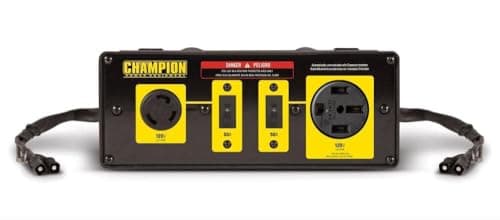
Champion 50A ParaLINK parallel kit

Clip-on connection with 50A RV and 30A locking outlets, and 30A and 50A breakers.

Linking two 2,500W or larger Champion inverters
2
No photo

The classic parallel pair

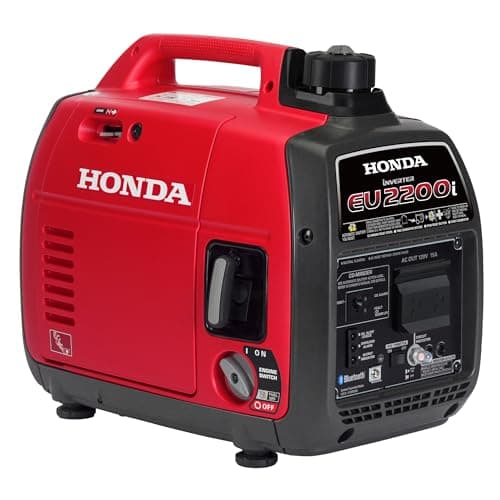
Honda EU2200i

2,200W at a published 48–57 dB(A) and 47.4 lb, parallel capable with a second unit.

Campgrounds, then an air conditioner when needed
3
No photo

The affordable pair

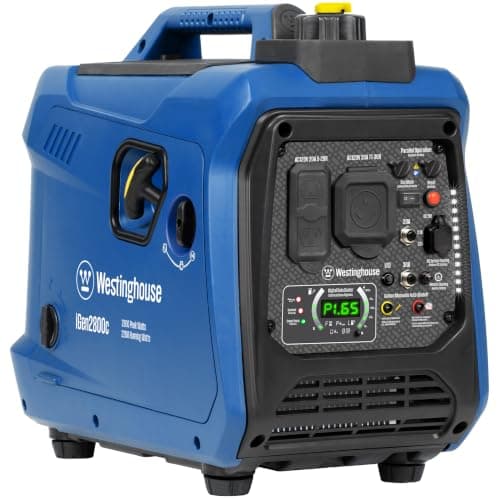
Westinghouse iGen2200

1,800 running watts at as low as 52 dBA and 46 lb, parallel capable.

Reaching 3,600W in two purchases

Prices come from the retailer at page-build time and change constantly. Where no live price is available the button reads “Check price” rather than showing a number we cannot stand behind.

The picks in full

02The classic parallel pair

Honda EU2200i

2,200W at a published 48–57 dB(A) and 47.4 lb, parallel capable with a second unit.

The reason this pairing is so common is the combination of the published dB(A) figure and 47.4 lb. Two units are still carried one at a time by one person, and together they clear the 3,000-3,500 starting watts an RV roof air conditioner needs.

0.117 gallons an hour each, and you only run the second when the load demands it — which is the real efficiency argument for a pair.

Skip it ifyou need house-sized output now. Two of these is still an expensive way to reach 3,600W.

Published specifications for the Honda EU2200i
SpecificationPublished figure
Output2,200 W max / 1,800 W rated
TypeInverter (pure sine wave)
Noise48–57 dB(A)
Weight47.4 lb
Tank0.95 gal
Run timeup to 8.1 h on a full tank
FeaturesEco Throttle, CO-Minder, Bluetooth app monitoring

Source: Honda Power Equipment — EU2200i specifications. These are the manufacturer's published figures, not ours — we have not tested this unit.

03The affordable pair

Westinghouse iGen2200

1,800 running watts at as low as 52 dBA and 46 lb, parallel capable.

Two of these is roughly 3,600 running watts — genuine house territory — for less than a single machine of that output in many cases, and with the flexibility a single machine cannot offer.

Buying the second a year later is a legitimate plan, and it is one of the better arguments for starting in the budget bracket rather than stretching.

Skip it ifyou need it all at once. One larger machine is cheaper than two of these.

Published specifications for the Westinghouse iGen2200
SpecificationPublished figure
Output1,800 running W / 2,200 peak W
Noiseas low as 52 dBA
Weight46 lb
Tank1.2 gal
Run timeup to 12 h
WaveformLess than 3% THD
ParallelCapable with a second unit

Source: Westinghouse — iGen2200 published specifications. These are the manufacturer's published figures, not ours — we have not tested this unit.

How these were chosen

We did not test these. Nobody at Watt & Warden has plugged one in. What we did instead: read the manufacturer's published specifications, compile them into a table where the figures line up, and compute the numbers manufacturers leave out — runtime against a real appliance load, and what an hour of running actually costs.

Anything that could not be sourced was left out rather than estimated, and every pick names the buyer who should skip it. The full method is here, including where it is weaker than a publisher with a test bench.

Questions people actually ask

Can you parallel any two generators?

No -- only inverter generators, and generally only compatible models from the same manufacturer. Conventional generators produce AC directly from a spinning alternator and will never stay synchronized, so connecting two causes very large circulating currents. Never attempt it with open-frame machines.

How many watts do you get from two generators in parallel?

Close to double, though not always exactly -- some manufacturers publish a slightly lower combined figure, so use theirs where given. Two 1,800W inverters give roughly 3,600 running watts, which is enough to start and run an RV roof air conditioner.

Do I need a parallel kit or just a cable?

A proper kit. What separates it from a cable is the outlets and the protection -- the Champion 50A kit carries 50A RV and 30A locking outlets plus 30A and 50A circuit breakers, so the combined output has somewhere sensible to go and something watching it. Kits are model specific.

Will two generators in parallel give me 240 volts?

Usually not. Most parallel kits combine two machines into more 120V capacity rather than split-phase 240V, so a pair often cannot feed a 240V transfer switch. Check the specific kit carefully before assuming, and if a house feed is the goal, buy a machine with an L14-30R outlet instead.

Is it cheaper to buy two small generators or one big one?

Usually one big one. Two 2,000W inverters plus a kit frequently costs more than a single 4,000W inverter -- what you are buying is flexibility and redundancy. Running only one unit on a quiet night uses less fuel and makes less noise than a large machine idling, and one failure still leaves you half.

Sources

Every figure on this page comes from a published source. We have not tested this equipment, so the specifications are the manufacturer's and the statistics are the dataset's — the arithmetic on top of them is ours, and it is shown in full so you can check it. How we work this out.