Skip to content
Watt Warden

Scenarios

Power for Off-Grid Living

Backup power asks how long you can last. Off-grid asks a harder question: can you generate as much as you use, every day, in the worst week of the year - because there is no grid to fall back to.

By Sawyer V.Updated Published How we work this out
A red cabin in a snowy forest.

Watt & Warden earns a commission on qualifying purchases made through links on this page, at no extra cost to you. It never changes a ranking, and our picks include products we tell you to skip. Full disclosure.

Off-grid is a different question from backup

Everything else on this site asks how long you can last without the grid. Off-grid asks whether your generation matches your consumption, every day, forever.

That changes what matters. In backup, capacity is king — how many kilowatt-hours you have stored. Off-grid, the binding constraint is almost always generation, and battery capacity is just the buffer that carries you from one sunny day to the next.

Which is why the sizing exercise runs in the opposite direction: start with what you use, then size the array to produce it in the worst month, then size the battery to bridge the gap between good days.

Step one: measure, do not estimate

This is the step people skip and it is the one that decides whether the system works.

Off-grid consumption is usually counted in kilowatt-hours per day. A frugal small dwelling runs on 2 to 4 kWh; a normal suburban household transplanted unchanged uses 20 to 30 and will bankrupt any realistic array.

HouseholdDaily useArray needed in summer
Frugal cabin — LED, laptop, pump, propane fridge1-2 kWhRoughly 300-500 W
Small off-grid home — electric fridge, well pump, tools3-6 kWhRoughly 800-1,500 W
Full household, propane heat and cooking8-12 kWhRoughly 2,000-3,000 W
Anything with electric heat or air conditioning25 kWh and upNot a realistic off-grid design

Array figures use the 400-500Wh per 100W of panel per good summer day figure used across this site. Winter output in most of the United States is a fraction of that, which is what the next section is about.

Step two: size for December, not July

This is the arithmetic that catches people. Solar output in midwinter at northern latitudes can be a quarter of the midsummer figure or less, once you account for short days, low sun angle and weather.

An array that comfortably covers 4 kWh a day in July may deliver 1 kWh in December. You have three ways to close that gap and every real system uses some mix of them.

Oversize the array. Effective, expensive, and means dumping enormous surplus for eight months of the year.

Tilt for winter. A steeper panel angle favors the low winter sun at some cost to summer output — the angle page covers the trade, and off-grid is the case where winter bias usually wins.

Run a generator. The pragmatic answer. A few hours a week in the darkest months is far cheaper than the array that would avoid it.

Step three: the battery is the buffer

Battery capacity off-grid is sized in days of autonomy — how long the system runs with no generation at all.

Two days is the common design target. It covers a run of overcast weather without forcing a generator start, and it does not commit you to the cost of a week's storage you will rarely use.

So a household using 4 kWh a day wants roughly 8 kWh of usable storage, which is where expansion batteries and multi-unit systems start being the realistic answer rather than a single box. The 3000Wh class page covers the bottom of that range.

What to make non-electric

The cheapest kilowatt-hour is the one you do not use, and off-grid that principle is worth more than anywhere else because you are paying for generation rather than consumption.

  • Heat. Wood, propane or oil. Electric heat off-grid is not a design, it is a mistake — the space heater arithmetic shows why.
  • Cooking. Propane. An induction cooktop is a two-kilowatt load for the sake of convenience.
  • Water heating. Propane on demand, or solar thermal, which is a different and much more efficient technology than photovoltaic.
  • Refrigeration. This one is worth keeping electric — a modern efficient fridge is a few hundred watt-hours a day and a propane absorption fridge is finicky.

Where this differs from a cabin

A weekend cabin has a completely different problem: intermittent use, a system that sits idle for months, and the freedom to simply not go when the weather is bad.

Off-grid living has none of that slack. The system runs every day, is maintained by you, and has to work in February. The off-grid cabin page covers the intermittent case, and the cabin generator page covers starting after a long sit.

The short version

  • Generation is the constraint, not storage.
  • Measure your daily kilowatt-hours before buying anything.
  • Size for December. Winter output is a fraction of summer.
  • Two days of autonomy plus a generator is the design that actually pencils.
  • Heat, cooking and hot water should not be electric.

Quick picks

#ProductBest forPrice
1
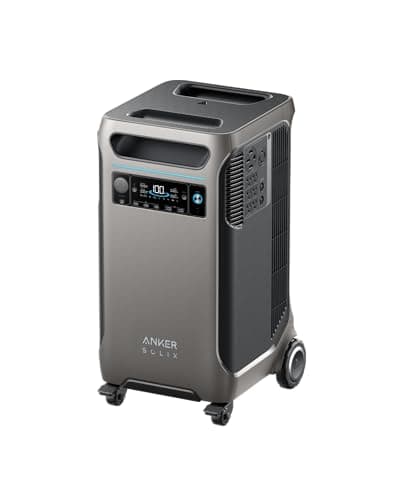
Anker SOLIX F3800

Best all-in-one

Anker SOLIX F3800

3,840Wh of LiFePO4 with 6,000W at 120/240V, 2,400W solar input and expansion to 26.9kWh.

A small off-grid dwelling without a component build
$1,759.99 · Check price on Amazon

#ad how this is funded · price as of October 20, 2026

2
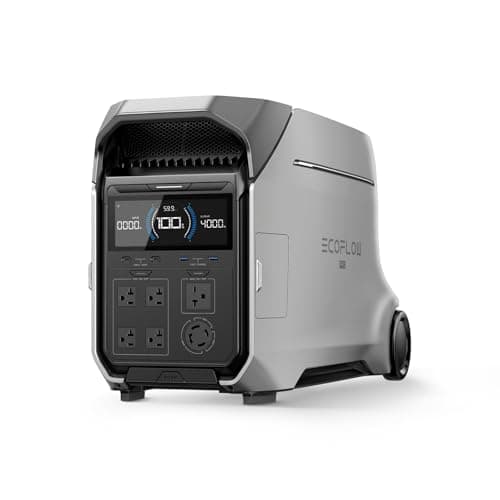
EcoFlow DELTA Pro 3

Best solar input

EcoFlow DELTA Pro 3

4,096Wh at 120/240V with 2,600W of solar input and a one-hour AC recharge.

Somewhere with real sun and a large array
$2,799.00 · Check price on Amazon

#ad how this is funded · price as of October 20, 2026 · $3,699.00 24% off

3
Renogy 100W N-Type Monocrystalline Solar Panel

The unit you count in

Renogy 100W N-Type Monocrystalline Solar Panel

100W of rigid monocrystalline — the standard block of a home array.

Building an array that fits the roof you have
$89.99 · Check price on Amazon

#ad how this is funded · price as of October 20, 2026 · $99.99 10% off

4
Victron SmartSolar MPPT 100/30

Best monitoring

Victron SmartSolar MPPT 100/30

30A MPPT at up to 98% efficiency with Bluetooth and 30 days of history.

Knowing whether the budget balanced today
5
DuroMax XP13000HXT tri-fuel generator

The backup to the backup

DuroMax XP13000HXT tri-fuel generator

Tri-fuel with published ratings on gasoline, propane and natural gas.

December, and the week the array produces nothing
$1,499.00 · Check price on Amazon

#ad how this is funded · price as of October 20, 2026 · $2,499.00 40% off

Prices come from the retailer at page-build time and change constantly. Where no live price is available the button reads “Check price” rather than showing a number we cannot stand behind.

The picks in full

01 — Best all-in-one

Anker SOLIX F3800

3,840Wh of LiFePO4 with 6,000W at 120/240V, 2,400W solar input and expansion to 26.9kWh.

All-in-one units have become genuinely viable for small off-grid dwellings, and this is the strongest of them: split-phase output, a real solar input, and an expansion path that reaches whole-house capacity.

The argument for one box is that it is a single warranty, a single support line and a single thing to understand, which matters when the nearest electrician is an hour away.

The honest catch: you pay a premium per kilowatt-hour against a rack of LiFePO4 cells and a separate inverter, and you cannot service it yourself.

Skip it ifyou are building a component system. Then buy batteries, an inverter and a controller separately.

Anker SOLIX F3800
$1,759.99 · Check price on Amazon

#ad how this is funded · price as of October 20, 2026

Published specifications for the Anker SOLIX F3800
SpecificationPublished figure
Capacity3,840 Wh
Cell chemistryLiFePO4
AC output6,000 W continuous, 9,000 W surge
Voltage120V / 240V split-phase
Cycle life3,000+ cycles to 80% capacity
Recharge1,800 W AC, up to 2,400 W solar
ExpansionUp to six expansion batteries, 26.9 kWh total
Warranty5 years
Current Amazon listingRenewed. Anker's new first-party F3800 listing is currently unavailable and the model has been succeeded by the F3800 Plus; the unit itself is unchanged

Source: Anker SOLIX — F3800 product specifications. These are the manufacturer's published figures, not ours — we have not tested this unit.

02 — Best solar input

EcoFlow DELTA Pro 3

4,096Wh at 120/240V with 2,600W of solar input and a one-hour AC recharge.

2,600W of solar input is the number that decides whether a battery is a store or a budget. At that level a good day genuinely refills the pack, which is the whole game off-grid.

The fast AC recharge also matters, because it means a generator run of an hour puts most of the capacity back rather than a third of it.

The honest catch: 2,600W of panel is a substantial array with a substantial mounting job. The battery is the cheap part of that sentence.

Skip it ifyour site is heavily shaded. Then input capability is not the constraint.

EcoFlow DELTA Pro 3
$2,799.00 · Check price on Amazon

#ad how this is funded · price as of October 20, 2026 · $3,699.00 24% off

Published specifications for the EcoFlow DELTA Pro 3
SpecificationPublished figure
Capacity4,096 Wh
Cell chemistryLiFePO4 (LFP)
AC output4,000 W, 120V / 240V
Cycle life4,000+ cycles to 80% capacity
Wall recharge0-80% in about 1 hour
Max solar input2,600 W
Expansion4 kWh to 48 kWh

Source: EcoFlow — DELTA Pro 3 product listing. These are the manufacturer's published figures, not ours — we have not tested this unit.

03 — The unit you count in

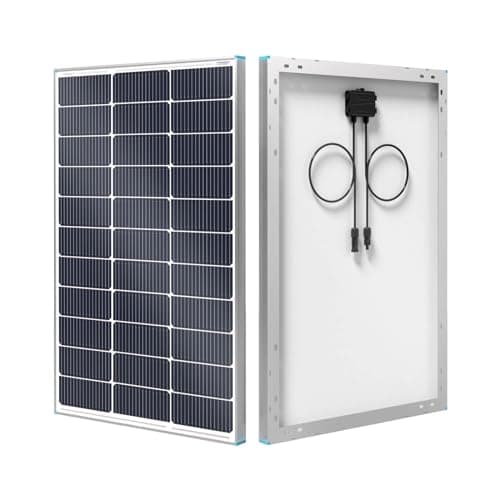
Renogy 100W N-Type Monocrystalline Solar Panel

100W of rigid monocrystalline — the standard block of a home array.

Building from 100W panels keeps the array tractable: you fit around obstructions, you can add incrementally, and every mount and bracket on the market assumes this format.

The honest planning figure is 400 to 500Wh per 100W of panel across a good summer day, and considerably less in winter — the panel arithmetic page covers why.

The honest catch: lots of small panels means lots of connections, and every connection is a place for resistance and water to get in.

Skip it ifyou are having a roof array professionally installed. Those use much larger panels.

Renogy 100W N-Type Monocrystalline Solar Panel
$89.99 · Check price on Amazon

#ad how this is funded · price as of October 20, 2026 · $99.99 10% off

Published specifications for the Renogy 100W N-Type Monocrystalline Solar Panel
SpecificationPublished figure
Rated output100 W
Cell typeN-type monocrystalline, 16BB
Conversion efficiencyUp to 25%
Ingress ratingIP67
DesignSmaller and lighter than the previous generation, per the listing
Nominal system voltageNot stated in the listing we checked

Source: Renogy — 100W N-type 16BB solar panel retail listing. These are the manufacturer's published figures, not ours — we have not tested this unit.

04 — Best monitoring

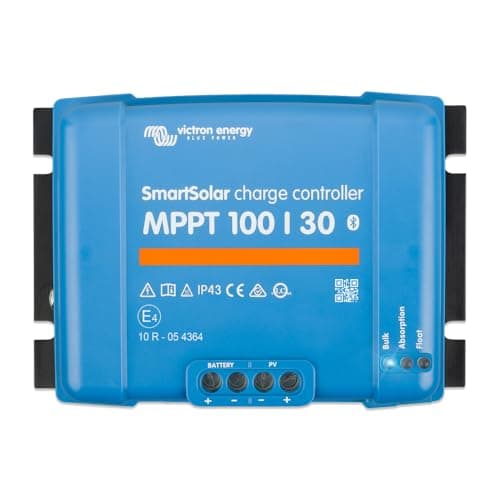
Victron SmartSolar MPPT 100/30

30A MPPT at up to 98% efficiency with Bluetooth and 30 days of history.

Off-grid is a budgeting exercise, and you cannot budget what you cannot measure. Thirty days of harvest history tells you whether the array is actually producing what you assumed when you sized it.

Passive cooling with no fan is the right design somewhere dusty and remote.

The honest catch: 30A at 12V caps the array at 440W. A house-scale system runs at 24V or 48V, and wants a larger controller.

Skip it ifyour battery is an all-in-one. Those have a controller built in.

Published specifications for the Victron SmartSolar MPPT 100/30
SpecificationPublished figure
Rating30 A charge current, 12V or 24V automatic
PV inputUp to 100 V open circuit
Array ceiling440 W at 12V, 880 W at 24V
EfficiencyUp to 98%
MonitoringBluetooth with the VictronConnect app, 30-day history
CoolingPassive heatsink, no fan, with over-temperature protection
ProtectionPV short circuit, reverse polarity and reverse current

Source: Victron Energy — SmartSolar MPPT 100/30 product page. These are the manufacturer's published figures, not ours — we have not tested this unit.

05 — The backup to the backup

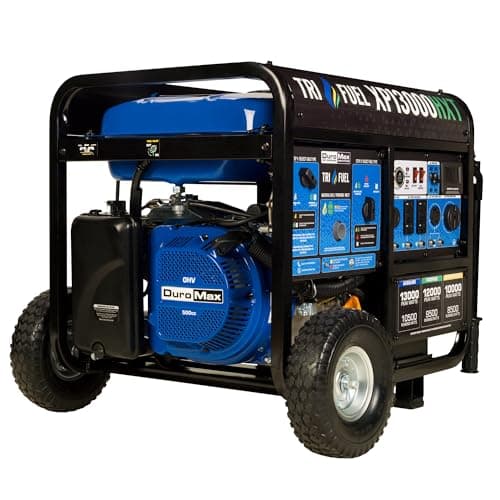
DuroMax XP13000HXT tri-fuel generator

Tri-fuel with published ratings on gasoline, propane and natural gas.

Every honest off-grid system has a generator, because sizing an array for the worst week of December means grossly oversizing it for the other fifty-one.

The economically rational design is an array sized for most of the year plus a generator that runs a handful of times each winter to top the battery up.

The honest catch: it needs fuel delivered and stored somewhere remote, and it needs exercising monthly or it will not start in the January you need it.

Skip it ifyou have enough array and battery for the worst week. Almost nobody does.

DuroMax XP13000HXT tri-fuel generator
$1,499.00 · Check price on Amazon

#ad how this is funded · price as of October 20, 2026 · $2,499.00 40% off

Published specifications for the DuroMax XP13000HXT tri-fuel generator
SpecificationPublished figure
Gasoline13,000 peak W / 10,500 running W
Propane12,000 peak W / 9,500 running W
Natural gas10,000 starting W / 8,500 running W
Engine500cc OHV, 100% copper windings
Tank8.3 gal
Run time8.82 h on gasoline at 50% load, 7.63 h on propane
OutletsTransfer-switch-ready 50 A outlet
StartingPush-button electric with remote start
SafetyBuilt-in CO Alert shutdown

Source: DuroMax — XP13000HXT tri-fuel generator listing. These are the manufacturer's published figures, not ours — we have not tested this unit.

How these were chosen

We did not test these. Nobody at Watt & Warden has plugged one in. What we did instead: read the manufacturer's published specifications, compile them into a table where the figures line up, and compute the numbers manufacturers leave out — runtime against a real appliance load, and what an hour of running actually costs.

Anything that could not be sourced was left out rather than estimated, and every pick names the buyer who should skip it. The full method is here, including where it is weaker than a publisher with a test bench.

Questions people actually ask

How much solar do you need to live off grid?

Work back from daily consumption. A frugal cabin at 1 to 2 kWh a day needs roughly 300 to 500W of panel in summer; a small off-grid home at 3 to 6 kWh needs 800 to 1,500W. Then size up substantially for winter, because output in December can be a quarter of the July figure or less.

How big a battery do you need for off-grid living?

Two days of autonomy is the common design target -- so a household using 4 kWh a day wants roughly 8 kWh of usable storage. That covers a run of overcast weather without forcing a generator start, without paying for a week of storage you would rarely use.

Do you still need a generator if you live off grid?

Almost always, and it is the economically rational choice. Sizing an array to cover the worst week of December means grossly oversizing it for the other fifty-one weeks. A generator that runs a few hours a week in the darkest months costs far less than the panels that would avoid it.

What should not be electric in an off-grid house?

Heat, cooking and water heating. Those are the three big resistive loads, and propane or wood handles all of them at a fraction of the generation they would otherwise require. Refrigeration is worth keeping electric -- a modern efficient fridge is only a few hundred watt-hours a day.

Is off-grid the same as backup power?

No, and treating them the same is the commonest planning error. Backup asks how long you can last without the grid, so capacity is king. Off-grid asks whether generation matches consumption every day forever, so generation is the binding constraint and the battery is just the buffer between good days.

Sources

Every figure on this page comes from a published source. We have not tested this equipment, so the specifications are the manufacturer's and the statistics are the dataset's — the arithmetic on top of them is ours, and it is shown in full so you can check it. How we work this out.