Why angle matters so much
A solar panel is rated for light arriving perpendicular to its face. As the angle between the panel and the sun's rays opens up, the effective area the sunlight sees shrinks — and the output falls with it.
The practical version: a panel lying flat on the ground in the morning or late afternoon is receiving light at a glancing angle and producing a fraction of what it would tilted toward the sun.
This is the largest single variable you control, and it is free. Every other improvement in this category — more panels, better cells, an MPPT controller — costs money.
Orientation: point it toward the equator
In the northern hemisphere, a fixed panel should face true south. Not magnetic south — the two differ by up to twenty degrees depending where you are, and a phone compass reads magnetic.
For a folding panel this hardly matters, because you can move it. For a fixed mount it is worth getting right:
- True south is the reference. Most phone compass apps can display true rather than magnetic bearing.
- Southeast or southwest is not a disaster. Output falls off gradually rather than sharply, and a modest deviation costs little.
- West-facing favors the afternoon, which can suit a load that peaks late — air conditioning, for instance.
- East-facing favors the morning, which suits a battery you want full early.
- North-facing is a bad idea in the northern hemisphere and there is no way around it.
Tilt: a rule of thumb and two seasonal adjustments
The conventional starting point for a fixed panel is a tilt angle roughly equal to your latitude, which produces a reasonable annual average.
Because the sun sits higher in summer and lower in winter, two seasonal adjustments improve on it:
| Goal | Tilt | Why |
|---|
| Best annual average | About your latitude | The conventional fixed-mount compromise |
|---|
| Favor summer | Latitude minus roughly 15° | Flatter, to meet a high summer sun |
|---|
| Favor winter | Latitude plus roughly 15° | Steeper, to meet a low winter sun — and it sheds snow |
|---|
These are conventional rules of thumb rather than a calculation for your specific site. NREL's PVWatts calculator models tilt and azimuth for an actual location and month, and it is the free authoritative tool if you want a real number rather than a heuristic.
For backup power specifically, the winter setting is usually the right one. Summer output is already surplus to a battery's needs; December is when the array either works or does not. A steeper tilt also sheds snow, which is worth more than the degrees.
The sizing page explains why seasonal variation matters more than the state-to-state difference in sun hours.
Adjusting a folding panel through the day
The sun moves. A folding panel aimed at 9am is badly aimed by 3pm.
Repositioning two or three times a day captures meaningfully more than setting it once, and it takes seconds:
- Morning: aim east-southeast and a little steeper.
- Midday: due south at your latitude tilt.
- Afternoon: west-southwest, steeper again.
The zero-equipment way to check: look at the shadow the panel casts. When the panel is square to the sun, its own shadow is at its smallest. Adjust until the shadow shrinks and stop. No app, no protractor.
Shade costs more than angle ever will
Worth putting in proportion. Angle is the biggest lever you control; shade is the biggest problem you can accidentally create.
Cells in a panel are wired in series, so the string is limited by its worst-performing cell. A branch shadow across one corner, or a single shroud line on a boat, costs far more than its area suggests.
Which means the order of operations is:
- Find somewhere with no shade at all for the whole period you care about.
- Then worry about angle.
A panel flat in full sun beats a perfectly angled one with a branch shadow across it, every time. And where dappled shade is unavoidable, parallel wiring handles it better than series.
Fixed versus adjustable, honestly
Adjustable mounts exist, and for most people they are not worth it.
The gain from adjusting a fixed array seasonally — twice a year, between the summer and winter settings — is real but modest. The gain from adjusting daily is larger but requires somebody to do it daily.
In practice:
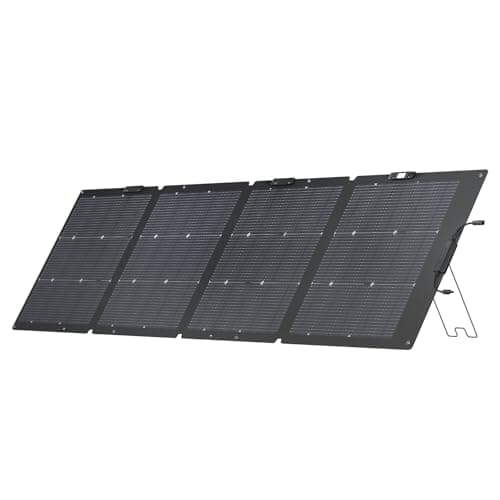
- Folding panels: adjust freely, it costs nothing, do it two or three times a day when you are there.
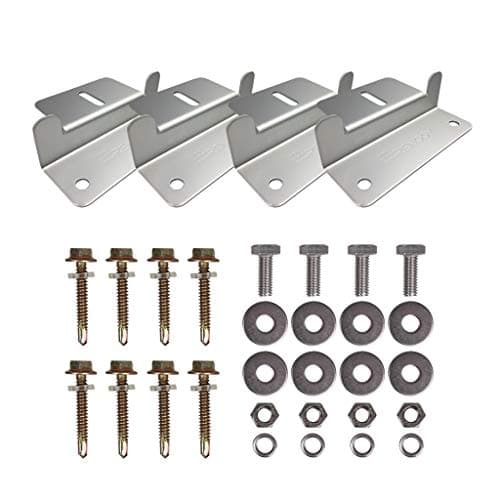
- Fixed arrays: pick the winter-favoring angle, mount it properly, and forget it. A seasonal adjustment mechanism is a moving part on a roof, and moving parts on roofs leak.
- A cabin array: definitely fixed. The whole point is that it produces on the days nobody is there. The cabin page covers why.
Bifacial panels add a second surface to think about
A bifacial panel collects light on its rear face as well as its front, and that changes what is under it into a specification.
- Snow, sand, light gravel and concrete reflect well. A bifacial panel over any of those genuinely earns its rear rating.
- Grass and dark asphalt reflect very little. The rear face contributes almost nothing.
- Height off the ground matters. A panel flat on the ground has nothing reaching its back at all.
Which is a reason to tilt a bifacial panel on a stand rather than lay it down, separate from the front-face argument. How bifacial panels work covers it properly.
The five-minute version
- Find full sun with no shade for the hours that matter.
- Point it true south in the northern hemisphere.
- Tilt it to about your latitude, or steeper if you care about winter — which for backup power you do.
- Check the shadow. Smallest shadow means best aim.
- Move it two or three times a day if it folds and you are there.
- Put something light-colored under it if it is bifacial.
None of that costs anything, and together it is worth more than the difference between two panels of similar rating. Choosing the panel matters less than aiming it well.