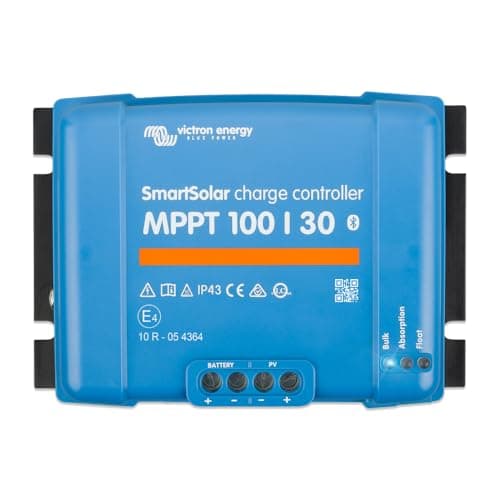
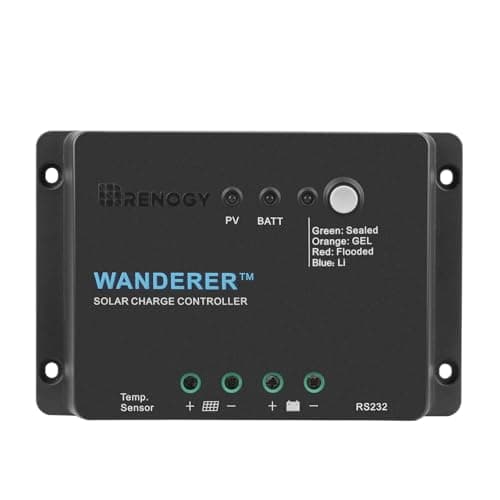
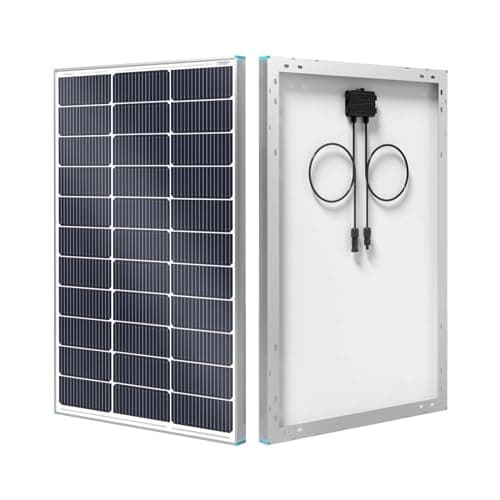
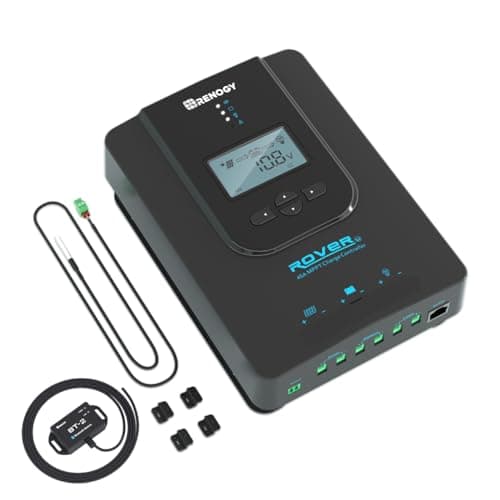
What a charge controller does
Two jobs, and the second is the one that protects your investment.
1. It stops the battery being overcharged. A panel wired directly to a battery keeps pushing current in after the battery is full, which destroys lead-acid cells and is dangerous with lithium.
2. It matches the panel to the battery. A nominal 12V panel actually produces somewhere near 18-22V in open circuit. Something has to reconcile that with a battery that wants 13-14.6V depending on chemistry and state of charge, and how it does that is the entire MPPT versus PWM argument.
MPPT or PWM
The short version: PWM throws the surplus voltage away as heat. MPPT converts it into extra current.
| PWM | MPPT |
|---|
| How it works | Connects panel to battery, pulsing to regulate | Converts excess voltage into additional current |
|---|
| Best when | Panel voltage is close to battery voltage | Panel voltage is well above battery voltage |
|---|
| Cold and cloudy | Loses more | Recovers meaningfully more |
|---|
| Higher-voltage arrays | Wastes the surplus | Uses it |
|---|
| Cost | Considerably less | Considerably more |
|---|
The practical rule: one or two nominal 12V panels on a 12V battery is legitimate PWM territory. Anything fixed at an imperfect angle, anything in a cold or cloudy climate, and anything wired in series for higher voltage wants MPPT.
Sizing it, in amps
Controllers are rated in charge amps, not panel watts, and the conversion trips people up.
Divide total array watts by battery voltage, then add margin. A 400W array on a 12V battery is 400 / 12, which is about 33A — so a 40A controller, not a 30A one.
| Array | On a 12V battery | On a 24V battery |
|---|
| 100 W | About 8 A | About 4 A |
|---|
| 200 W | About 17 A | About 8 A |
|---|
| 400 W | About 33 A | About 17 A |
|---|
| 600 W | About 50 A | About 25 A |
|---|
Two things follow from that table. Buy one size up, because arrays grow. And note how much less controller a 24V battery bank needs for the same array — which is a large part of why bigger systems run at 24V or 48V.
The setting people get wrong
Every controller here has a battery chemistry setting, and it is not cosmetic. Lead-acid, AGM, gel and LiFePO4 all want different charge voltages and different behavior at the end of the charge.
The specific hazard is equalization. Lead-acid banks benefit from a periodic controlled overcharge to balance the cells; applying that to a LiFePO4 pack is actively harmful. A controller left on its lead-acid default with a lithium battery attached will do exactly that.
Set the chemistry when you install it, and check it again if you ever change the battery. The chemistry page covers why the two families behave so differently.
When you do not need one at all
Worth saying plainly: if your battery is a portable power station, the charge controller is already inside it. Plugging a panel into a power station's solar input connects to an integrated MPPT controller, and adding an external one does nothing except lose you some output.
Charge controllers are for building a system from parts — panels, a battery bank, an inverter — rather than for feeding an all-in-one unit. The solar generator comparison covers where that boundary falls.
The short version
- MPPT for fixed, angled, cold or high-voltage arrays. PWM for one or two matched panels.
- Size in amps: watts divided by battery voltage. Then go one size up.
- Set the chemistry. Equalization on lithium is destructive.
- Power stations already have one. Do not add a second.