Skip to content
Watt Warden

Power Stations

Power Stations for a Tiny House

A tiny house is not a camper and not a normal house. It draws less than one and lives more permanently than the other, and that changes which battery makes sense.

By Sawyer V.Updated Published How we work this out
A wooden cabin surrounded by forest.

Watt & Warden earns a commission on qualifying purchases made through links on this page, at no extra cost to you. It never changes a ranking, and our picks include products we tell you to skip. Full disclosure.

Size on consumption, not on outage length

For a normal house, the question is "how long is the outage?" For a tiny house running partly or wholly on batteries, the question is "how much do we use in a day, and how much comes back in?" That reframing changes which specifications matter.

LoadTypical daily energy
Compact refrigerator0.6-1.2 kWh
LED lighting, evening0.1-0.3 kWh
Laptop and phones0.2-0.4 kWh
Water pump, intermittent0.1-0.3 kWh
Induction cooking, one meal0.3-0.6 kWh
Mini split, mild weather2-6 kWh

Daily figures are derived from the running watts in the appliance wattage chart applied to normal duty cycles. Measure your own with a metering plug before buying at this scale — estimates compound quickly.

Add the first five rows and a modest tiny house lands around 1.3 to 2.8kWh a day. That is why the 2kWh class is the common answer, and why the mini split row is the one that changes everything.

The three decisions that matter

1. Does anything need 240V?

A well pump, a full-size mini split, or a hardwired water heater says yes, and that rules out every 120V unit regardless of capacity. Check before shopping, because it is the one requirement that cannot be worked around.

2. Will it cycle daily?

If yes, cycle life stops being a marketing number and becomes the specification that determines when you buy the next battery. At one cycle a day, 6,000 cycles is roughly sixteen years and 3,000 is about eight — the lifespan page works that through.

3. What recharges it?

Shore power makes this easy. Solar makes it a system: you need enough panel to replace daily consumption plus losses, in the worst month you intend to live there, not in June.

Why a power station rather than a wired system

A traditional off-grid installation — batteries, a charge controller, an inverter, a distribution panel — is more efficient and more permanent. A power station is none of those things, and it wins on three points that matter in a tiny house:

  • No installation. It works the day it arrives, which matters when the house is not finished.
  • It moves. If the house is towed, sold or rebuilt, the battery comes with you.
  • It is a known quantity. One box with published specifications and a warranty, rather than five components you have to integrate correctly.

The trade is efficiency and cost per kilowatt-hour at scale — the off-grid cabin page covers where the line falls.

The setup that works

  1. Measure for a month on shore power with a metering plug or a panel monitor.
  2. Buy roughly 1.5 times your daily consumption in battery, so a cloudy day does not empty it.
  3. Add panel until generation covers consumption in your worst intended month.
  4. Keep cooking and heating off the battery where you can. Propane does both for a fraction of the stored energy.

The short version

  • Size on daily kWh, not on outage hours.
  • 1.3 to 2.8kWh a day is typical without climate control.
  • Cycle life matters here in a way it does not for storm backup.
  • Check for 240V loads first. They decide the whole purchase.

Quick picks

#ProductBest forPrice
1
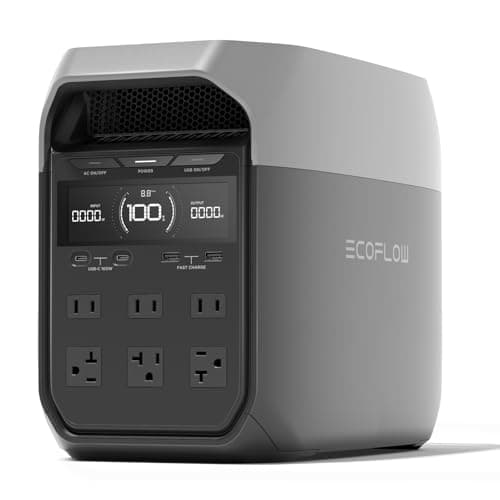
EcoFlow DELTA 3

Best starting point

EcoFlow DELTA 3

1,024Wh expandable to 5kWh, 1,800W continuous with 3,600W surge and 500W of solar input.

Living with it before committing to a size
$629.00 · Check price on Amazon

#ad how this is funded · price as of October 21, 2026 · $699.00 10% off

2
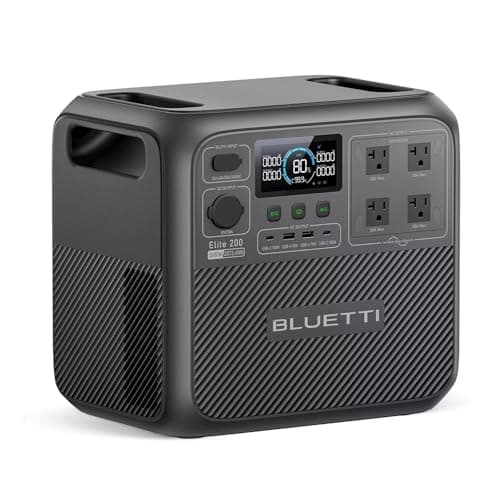
BLUETTI Elite 200 V2

Best for daily cycling

BLUETTI Elite 200 V2

2,073.6Wh and 2,600W continuous with a 6,000+ cycle rating.

A battery that gets used every day
$1,399.00 · Check price on Amazon

#ad how this is funded · price as of October 21, 2026

3
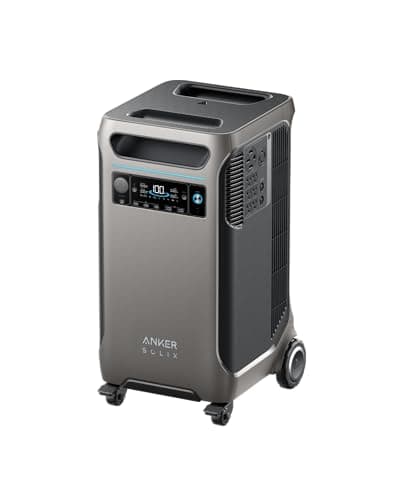
Anker SOLIX F3800

When the house has 240V circuits

Anker SOLIX F3800

3,840Wh with 6,000W of 120/240V split-phase output, expandable to 26.9kWh.

A well pump, a mini split or a hardwired connection
$1,759.99 · Check price on Amazon

#ad how this is funded · price as of October 21, 2026

4
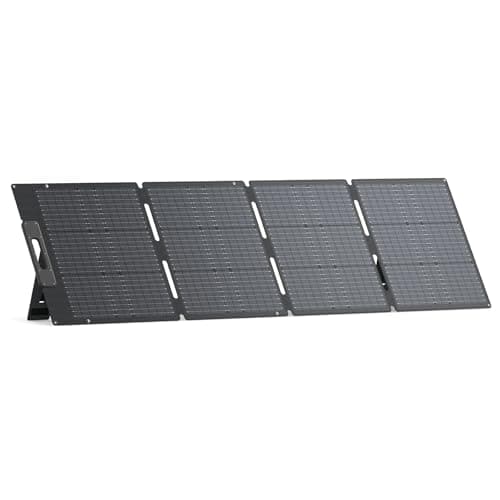
BLUETTI 200W solar panel

The part that makes it sustainable

BLUETTI 200W solar panel

A 200W folding panel from BLUETTI.

Refilling every day rather than every outage
$399.00 · Check price on Amazon

#ad how this is funded · price as of October 21, 2026

Prices come from the retailer at page-build time and change constantly. Where no live price is available the button reads “Check price” rather than showing a number we cannot stand behind.

The picks in full

01 — Best starting point

EcoFlow DELTA 3

1,024Wh expandable to 5kWh, 1,800W continuous with 3,600W surge and 500W of solar input.

The expandability is the point in a tiny house: start at 1kWh, measure a month of real use, and add capacity against evidence rather than a guess.

1,800W of output covers a small fridge, lighting, a laptop and a water pump — which is most of a tiny house's list.

The honest catch: expansion batteries cost close to a second unit, so budget the whole path before starting it.

Skip it ifyou already know your daily consumption and it is large.

EcoFlow DELTA 3
$629.00 · Check price on Amazon

#ad how this is funded · price as of October 21, 2026 · $699.00 10% off

Published specifications for the EcoFlow DELTA 3
SpecificationPublished figure
Usable capacity1,024 Wh, expandable to 5 kWh
Cell chemistryLiFePO4 (LFP)
AC output1,800 W continuous / 3,600 W surge
X-Boost output2,200 W for resistive loads
Cycle life4,000 cycles to 80%+
AC rechargeFull in 56 minutes at 1,500 W input
Max solar input500 W
Weight27.6 lb (12.5 kg)
Outlets13 total
Warranty5 years

Source: EcoFlow — DELTA 3 product specifications. These are the manufacturer's published figures, not ours — we have not tested this unit.

02 — Best for daily cycling

BLUETTI Elite 200 V2

2,073.6Wh and 2,600W continuous with a 6,000+ cycle rating.

This is the one case where the 6,000-cycle rating genuinely earns its keep. A tiny house cycles its battery daily, and at that rate the difference between 3,000 and 6,000 cycles is years.

2,600W also starts an induction cooktop or a small air conditioner where smaller units refuse.

The honest catch: no expansion path. What you buy is what you have.

Skip it ifthe unit will be cycled a handful of times a year. You will never spend that life.

BLUETTI Elite 200 V2
$1,399.00 · Check price on Amazon

#ad how this is funded · price as of October 21, 2026

Published specifications for the BLUETTI Elite 200 V2
SpecificationPublished figure
Usable capacity2,073.6 Wh
Cell chemistryAutomotive-grade LiFePO4 (LFP)
AC output2,600 W continuous / 3,900 W power lifting
Cycle life6,000+ cycles
Fast charge0–80% in 50 min via dual AC/DC input

Source: BLUETTI — Elite 200 V2 product specifications. These are the manufacturer's published figures, not ours — we have not tested this unit.

03 — When the house has 240V circuits

Anker SOLIX F3800

3,840Wh with 6,000W of 120/240V split-phase output, expandable to 26.9kWh.

Tiny houses on permanent foundations often have a well pump or a 240V mini split, and no quantity of 120V batteries covers those.

Feeding the house through a transfer switch turns this into genuine whole-dwelling backup — the review covers the wiring reality.

The honest catch: 132.3 lb, and it needs a permanent home rather than a shelf.

Skip it ifeverything in the house runs on 120V. Then this is more machine than you need.

Anker SOLIX F3800
$1,759.99 · Check price on Amazon

#ad how this is funded · price as of October 21, 2026

Published specifications for the Anker SOLIX F3800
SpecificationPublished figure
Capacity3,840 Wh
Cell chemistryLiFePO4
AC output6,000 W continuous, 9,000 W surge
Voltage120V / 240V split-phase
Cycle life3,000+ cycles to 80% capacity
Recharge1,800 W AC, up to 2,400 W solar
ExpansionUp to six expansion batteries, 26.9 kWh total
Warranty5 years
Current Amazon listingRenewed. Anker's new first-party F3800 listing is currently unavailable and the model has been succeeded by the F3800 Plus; the unit itself is unchanged

Source: Anker SOLIX — F3800 product specifications. These are the manufacturer's published figures, not ours — we have not tested this unit.

04 — The part that makes it sustainable

BLUETTI 200W solar panel

A 200W folding panel from BLUETTI.

A tiny house that runs on batteries needs generation, not just storage. Two hundred watts is a meaningful daily contribution in good sun and honest about being one panel.

The panel-count page turns daily consumption into an array size.

The honest catch: folding panels are a compromise against roof-mounted ones for a permanent dwelling.

Skip it ifthe house has reliable shore power. Then the grid is a cheaper charger.

BLUETTI 200W solar panel
$399.00 · Check price on Amazon

#ad how this is funded · price as of October 21, 2026

Published specifications for the BLUETTI 200W solar panel
SpecificationPublished figure
Rated output200 W
TypeFoldable monocrystalline panel
Sold forBLUETTI stations including the AC180, AC200L and AC70

Source: BLUETTI — 200W solar panel listing. These are the manufacturer's published figures, not ours — we have not tested this unit.

How these were chosen

We did not test these. Nobody at Watt & Warden has plugged one in. What we did instead: read the manufacturer's published specifications, compile them into a table where the figures line up, and compute the numbers manufacturers leave out — runtime against a real appliance load, and what an hour of running actually costs.

Anything that could not be sourced was left out rather than estimated, and every pick names the buyer who should skip it. The full method is here, including where it is weaker than a publisher with a test bench.

Questions people actually ask

What size power station does a tiny house need?

Most tiny houses without climate control use 1.3 to 2.8kWh a day -- a compact fridge, lighting, devices, a water pump and some induction cooking. Buying roughly 1.5 times daily consumption gives margin for a cloudy day, which puts the 2kWh class at the center of the range.

Can a power station run a mini split in a tiny house?

For a few hours, not a day. A mini split uses 2 to 6kWh daily in mild weather, which exceeds what a single portable holds. Running one sustainably means a larger battery bank, a solar array sized against it, or accepting that climate control runs only on shore power or a generator.

Do I need a 240V power station for a tiny house?

Only if something in the house is 240V -- typically a well pump, a hardwired water heater or a full-size mini split. Everything else in a tiny house is 120V, and a split-phase unit would be capability you pay for and never use. Check the panel before shopping.

Is a power station better than a wired off-grid system?

For a tiny house, often yes. It needs no installation, it moves with you and it is one warranted product rather than five components to integrate. A wired system wins on efficiency and cost per kilowatt-hour once you get past a few kWh of storage.

How much solar does a tiny house need?

Enough to replace daily consumption plus conversion losses in the worst month you intend to live there. At 2kWh a day that is several hundred watts of panel in summer and considerably more in winter, when short days and low sun angle cut output sharply.

Sources

Every figure on this page comes from a published source. We have not tested this equipment, so the specifications are the manufacturer's and the statistics are the dataset's — the arithmetic on top of them is ours, and it is shown in full so you can check it. How we work this out.