What a garage actually needs during an outage
Be honest about this first, because it is smaller than the shopping list people arrive with.
| Item | Running watts | Does it need backing up? |
|---|
| Chest freezer | 150-400 W cycling | Yes — this is usually the real reason |
|---|
| Garage door opener | 350-1,000 W while moving | Briefly, and there is a manual release |
|---|
| Work lighting, LED | 50-150 W | Yes, and it is trivial |
|---|
| Cordless tool chargers | 50-100 W each | Convenient rather than urgent |
|---|
| Corded circular saw or router | 1,200-1,800 W | No. Nobody needs this at 2am |
|---|
| Air compressor | 1,500-2,200 W, much higher to start | No, unless the work is urgent |
|---|
| Welder | Thousands, at 240 V | No |
|---|
Ranges are typical for domestic equipment; the plate on your own tool is authoritative. Freezer figures are cycling averages, not continuous draw.
The top three rows total a few hundred watts. The bottom three are what make people buy a machine four times larger than they need, for work that can wait until the power returns.
The garage freezer is the whole point
Most households that back up a garage are really backing up one appliance — a chest freezer holding a side of beef, a season of fishing, or a year of batch cooking.
The good news is that a full freezer holds temperature for roughly 48 hours unopened, and half full for about 24. That means you do not need continuous power; you need a few hours of running per day. The freezer page covers the food-safety timings properly.
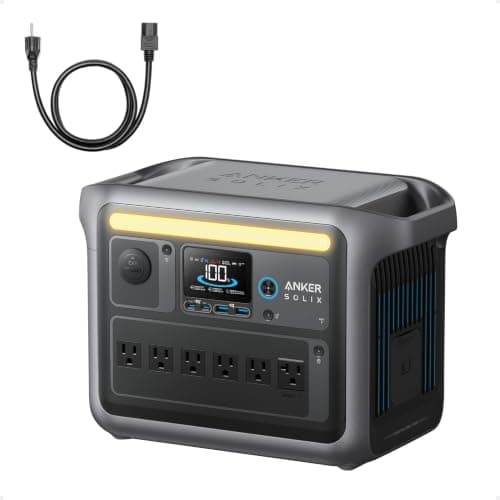
A 1,000Wh battery running a 200W-average freezer covers about four and a half hours, which — used in blocks — comfortably keeps it frozen across a multi-day outage.
The garage door has a manual release
Worth saying plainly because people panic about this and it is a solved problem. Every residential opener has a red emergency release cord that disconnects the trolley from the motor, letting the door be lifted by hand.
Two things to know. Pull it with the door closed, not open, unless you want to discover how heavy an unbalanced door is. And re-engage it properly afterwards or the opener will run without moving the door.
The garage door page covers battery-backup openers, which are now common and solve this automatically.
Compressors are the load that catches people
An air compressor is the single hardest thing in a domestic workshop to start on backup power. The motor is an induction motor starting against a load, and the surge is large and sustained enough that many inverters simply give up.
If running a compressor matters, two rules. Check the plate rather than the horsepower on the label, and drain the tank before starting it on a generator so the motor starts unloaded. The starting watts page explains why that makes such a difference.
Where the generator goes
Not in the garage. Not in the garage with the door open. Not in the garage with the door open and a fan.
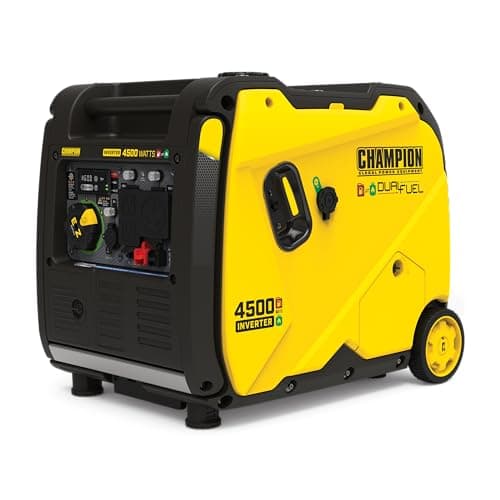
This is the single most common fatal mistake in backup power, and a garage is where it happens, because it is the obvious sheltered place to put a machine in bad weather. Carbon monoxide accumulates in an attached garage and moves into the house.
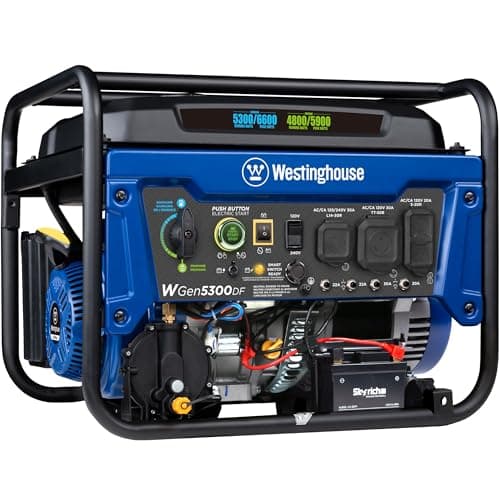
Twenty feet from the building with the exhaust pointing away, a cord through a door sweep or a proper inlet, and a battery-powered CO alarm inside. The CO safety page is the one to read before the first run.
If the workshop is the business
A different calculation applies if the garage is where you earn. Then running tools during an outage has a value, the machine gets sized for the compressor and the 240V circuits, and a transfer switch stops being optional.
The job site page covers tool loads properly, and the small business page covers the continuity side.
The short version
- The freezer is the real reason. A few hundred watts, run in blocks.
- The door has a manual release. Not a power problem.
- Tools can wait. Sizing for a table saw buys a machine you will not use.
- Never run a generator in the garage. Not even with the door open.