Skip to content
Watt Warden

Scenarios

Backup Power for a Job Site

A circular saw draws almost nothing until the blade meets wood. Sizing for tools is about the surge and the duty cycle, not the watt-hours - and a job site adds rules a house does not have.

By Sawyer V.Updated Published How we work this out
A construction site with power tools.

Watt & Warden earns a commission on qualifying purchases made through links on this page, at no extra cost to you. It never changes a ranking, and our picks include products we tell you to skip. Full disclosure.

Tools do not behave like appliances

Every other page on this site sizes for loads that run steadily. Tools do the opposite, and it changes the arithmetic completely.

  • Enormous surge, brief. A universal motor spinning up under no load draws several times its running figure for a fraction of a second — the same mechanism as a compressor start, but happening dozens of times an hour.
  • Tiny duty cycle. A circular saw runs for four seconds a cut. Across an hour it may draw power for three minutes.
  • Unpredictable coincidence. Nobody coordinates. Two trades start two tools in the same second and the peak doubles.

So: size on the surge, budget fuel on the duty cycle. A machine that handles the biggest tool plus margin will use far less fuel than its rating suggests, because it spends most of the day at near-idle.

Typical tool draws

ToolRunning wattsStarting watts
Circular saw, 7¼ in1,4002,300
Air compressor, 1 HP1,6004,500
Miter saw, 10 in1,8001,800
Reciprocating saw960960
Electric drill, ½ in600900
Battery charger~100
Work light, LED20-100

Tool figures are Champion Power Equipment's published ranges from the same wattage chart used across this site. Charger and LED light rows are working estimates from typical equipment ratings. Your tools' own nameplates are the figures that count, and a well-used tool draws more than a new one.

The marked row is the one that sizes the machine. A 1 HP compressor at 4,500 starting watts is larger than any two hand tools together, and it cycles on its own schedule rather than yours.

Waveform matters more on a site than at home

Cordless tool chargers, laser levels and laptops all contain switch-mode power supplies, and a dirty waveform from a cheap conventional generator can damage them or refuse to charge at all.

An inverter generator publishes total harmonic distortion — the Westinghouse iGen2200 quotes under 3% — and that specification is the difference between a machine that charges a van full of batteries reliably and one that quietly kills chargers.

If the site load is only resistive — lights, heaters, a corded drill — a conventional machine is fine and cheaper. The architecture comparison covers the trade.

What a job site adds that a house does not

Working under OSHA construction standards changes the rules, and the answers differ from the residential ones on this site.

  • GFCI protection is required for receptacle outlets on construction sites, either through GFCI devices or an assured equipment grounding conductor program.
  • Cords are inspected, not assumed. Damaged insulation and missing ground pins are among the most cited electrical violations there are.
  • Grounding follows the regulation. For cord-and-plug use, OSHA 1926.404(f)(3)(i) permits the bonded generator frame to serve as the grounding electrode — the grounding page covers the detail, but on a site take the answer from the regulation and your site safety plan rather than from a consumer guide.
  • Carbon monoxide risk rises indoors. Generators inside partially enclosed structures kill workers every year. Outside, twenty feet, exhaust away.

Noise is a scheduling constraint

On residential work it is not a comfort question — it is whether you can start at seven.

Many municipalities set construction noise hours, and a complaint can stop work for a day. An enclosed inverter at 53 dBA measured from 23 feet is a different proposition from an open-frame machine at close to 70 dB, and because decibels are logarithmic that gap is much wider than it looks.

Security, which nobody plans for

Generators are among the most stolen items on a site, and an unattended one overnight is a target.

  • Chain it to something structural, not to a fence panel.
  • Take it in overnight where you can. A 39 lb inverter goes in the van; a 200 lb open-frame machine does not.
  • Mark it. Engraved identification makes resale harder and recovery possible.
  • Propane is harder to steal than gasoline, which is a small but real argument for dual fuel on an unsecured site.

Batteries have taken over part of this job

Worth being honest about how much the category has changed. Cordless platforms now cover most hand tools, which means a lot of sites need power for chargers rather than for tools.

That is a much smaller load — roughly 100W per charger — and it is steady rather than surging. A kilowatt-hour battery charges a van full of packs across a day, silently, indoors, with no fuel.

The generator then becomes the thing you bring out for the compressor, the table saw and the concrete work, rather than the thing that runs all day. That split is cheaper, quieter and better for the neighbors than one machine idling from seven to five.

The general comparison applies, with the site-specific difference that the surge loads here are genuinely beyond any portable battery.

Quick picks

#ProductBest forPrice
1
No photo

Best all-round site machine

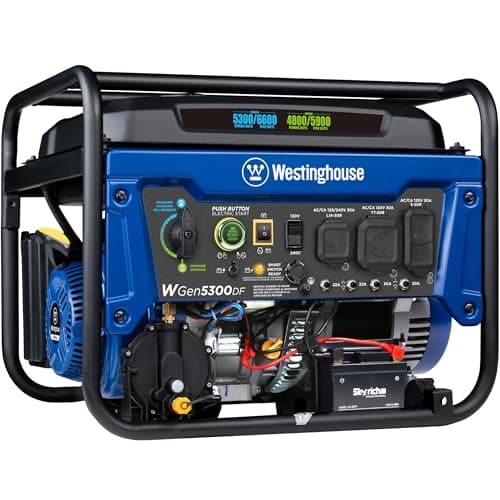
Westinghouse WGen5300DF

5,300 running watts, dual fuel, at about 0.32 gal/hr averaged across a tank.

Several tools and a compressor
2
No photo

Lightest to move around

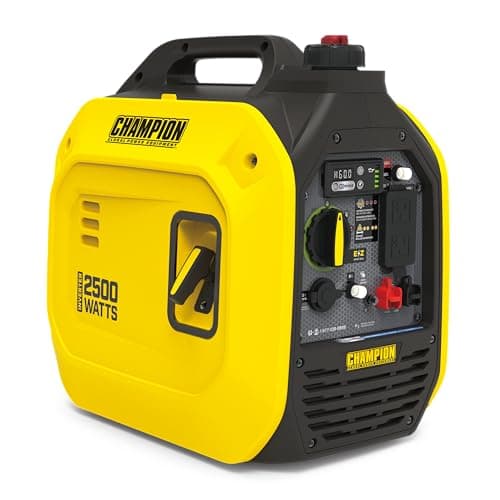
Champion 100692 2000W Ultralight Inverter

2,000 starting watts and 1,700 running at 39 lb, rated 53 dBA from 23 feet.

One trade, one van, one person
3
No photo

Best for indoor and finish work

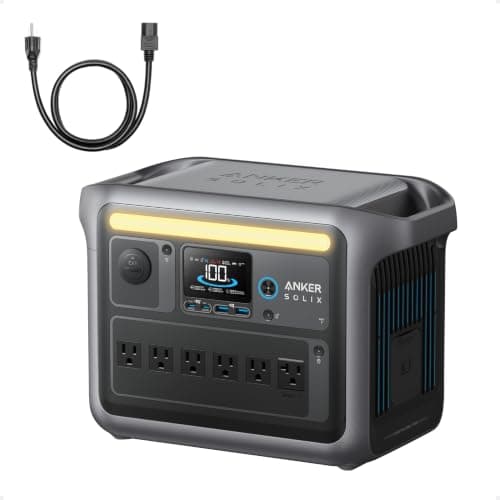
Anker SOLIX C1000

1,056Wh of LiFePO4 with 1,800W output and a fast recharge.

No exhaust, no noise, inside an occupied building
4
No photo

Between the machine and the tools

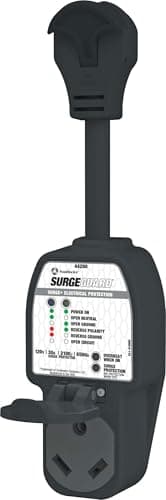
Southwire Surge Guard 44280 portable surge protector

30A, 2,100 joules, with fault display for reverse polarity, open ground and open neutral.

Reading the supply before your equipment does

Prices come from the retailer at page-build time and change constantly. Where no live price is available the button reads “Check price” rather than showing a number we cannot stand behind.

The picks in full

01Best all-round site machine

Westinghouse WGen5300DF

5,300 running watts, dual fuel, at about 0.32 gal/hr averaged across a tank.

Headroom is what a site machine is bought for. Tools are unpredictable — a compressor kicks in while someone starts a saw — and a generator with margin absorbs that where a tightly-sized one trips.

Dual fuel is useful on a site for a different reason than at home: propane cylinders are easier to keep secure and harder to siphon than a tank of gasoline.

0.32 gal/hr averaged means a five-gallon can is most of a working week at typical site duty cycles, because tools are off far more than they are on.

Skip it ifyou only ever run one cordless charger and a light. That is battery territory.

Published specifications for the Westinghouse WGen5300DF
SpecificationPublished figure
Output (gasoline)5,300 running W / 6,600 peak W
Output (propane)4,800 running W / 5,900 peak W
Engine274cc 4-stroke OHV
Tank4.7 gal (18 L)
Run timeup to 14.5 h on a full tank
Transfer-switch outlet120/240 V L14-30R, 30 A
RV outlet120 V TT-30R, 30 A
StartingPush-button electric with remote key fob

Source: Westinghouse — WGen5300DF product specifications. These are the manufacturer's published figures, not ours — we have not tested this unit.

02Lightest to move around

Champion 100692 2000W Ultralight Inverter

2,000 starting watts and 1,700 running at 39 lb, rated 53 dBA from 23 feet.

39 lb is the specification that matters for a solo trade. It goes in and out of a van without a second person, and 53 dBA keeps you welcome on residential jobs where noise complaints stop work.

An inverter also gives clean power for chargers and laptops, which a cheap open-frame machine does not reliably do.

Skip it ifyou run a compressor or a table saw. 1,700W will not carry either.

Published specifications for the Champion 100692 2000W Ultralight Inverter
SpecificationPublished figure
Output2,000 starting W / 1,700 running W
Weight39 lb
Noise53 dBA from 23 feet
Engine79cc Champion 4-stroke
TypeEnclosed inverter, parallel capable

Source: Champion — 100692 2000-Watt Ultralight Inverter listing. These are the manufacturer's published figures, not ours — we have not tested this unit.

03Best for indoor and finish work

Anker SOLIX C1000

1,056Wh of LiFePO4 with 1,800W output and a fast recharge.

The case a generator cannot cover: working inside an occupied building, in a basement, or anywhere exhaust is unacceptable. A battery runs cordless chargers, lights, a laptop and small tools with nothing to vent.

1,800W handles most single hand tools. It will not handle a compressor, and it will not last a day of continuous cutting.

Skip it ifyou need to run a compressor or cut all day. A battery is a bridge, not a supply.

Published specifications for the Anker SOLIX C1000
SpecificationPublished figure
Usable capacity1,056 Wh
Cell chemistryLiFePO4 (LFP)
AC output1,800 W continuous / 2,400 W SurgePad
Cycle life3,000 cycles
Wall recharge80% in 43 min, full in 58 min
Max solar input600 W (full solar recharge ~1.8 h)
Ports11 total, including 6 AC on panel-equipped bundles

Source: Anker — SOLIX C1000 product specifications. These are the manufacturer's published figures, not ours — we have not tested this unit.

04Between the machine and the tools

Southwire Surge Guard 44280 portable surge protector

30A, 2,100 joules, with fault display for reverse polarity, open ground and open neutral.

Open ground and reverse polarity are exactly the faults a temporary site supply produces, and they are invisible without something that reads them.

2,100 joules of surge protection between a generator and a few thousand dollars of battery chargers is cheap insurance.

Skip it ifeverything you plug in is cheap and replaceable. It is protecting the tools, not the generator.

Published specifications for the Southwire Surge Guard 44280 portable surge protector
SpecificationPublished figure
Rating30 A, 120 V
Surge protection2,100 joules
DiagnosticsFault display for reverse polarity, open ground and open neutral
UseBetween a generator or pedestal and the load
FormPortable, weather-resistant housing

Source: Southwire — Surge Guard 44280 listing. These are the manufacturer's published figures, not ours — we have not tested this unit.

How these were chosen

We did not test these. Nobody at Watt & Warden has plugged one in. What we did instead: read the manufacturer's published specifications, compile them into a table where the figures line up, and compute the numbers manufacturers leave out — runtime against a real appliance load, and what an hour of running actually costs.

Anything that could not be sourced was left out rather than estimated, and every pick names the buyer who should skip it. The full method is here, including where it is weaker than a publisher with a test bench.

Questions people actually ask

What size generator do I need for power tools?

Size on the largest single surge, not the total. Champion publishes 4,500 starting watts for a 1 HP air compressor and 2,300 for a 7-1/4 inch circular saw, so a compressor alone sets the machine. A 5,000W-class generator covers a typical mixed-trade site with margin for coincidence.

Can a power station run power tools?

Hand tools, yes -- an 1,800W inverter handles most single corded tools and charges cordless packs all day. A compressor or a table saw, no. Batteries have quietly taken over a lot of site power because cordless platforms mean many sites now need chargers rather than tools, which is a small steady load.

Do I need an inverter generator for a job site?

If you charge cordless packs, run laser levels or use a laptop, yes -- switch-mode supplies can be damaged by a dirty waveform, and inverters publish total harmonic distortion for exactly that reason. If the load is only lights, heaters and corded drills, a conventional machine is fine and cheaper.

How much fuel does a generator use on a job site?

Far less than its rating suggests, because tools have tiny duty cycles -- a circular saw draws power for perhaps three minutes an hour. At Westinghouse's published 0.32 gal/hr averaged for a 5,300W machine, a five-gallon can is most of a working week at typical site duty.

What are the OSHA rules for generators on a construction site?

GFCI protection is required for receptacle outlets, through GFCI devices or an assured equipment grounding conductor program; cords are inspected rather than assumed; and for cord-and-plug use 1926.404(f)(3)(i) permits the bonded frame to serve as the grounding electrode. Take the answer from the regulation and your site safety plan.

Sources

Every figure on this page comes from a published source. We have not tested this equipment, so the specifications are the manufacturer's and the statistics are the dataset's — the arithmetic on top of them is ours, and it is shown in full so you can check it. How we work this out.