Skip to content
Watt Warden

Accessories

The Best Power Inverters for a Car (2026)

You already own a backup power source and it is parked outside. An inverter turns it into household AC for a fraction of what any other route costs, with two rules you have to respect.

By Sawyer V.Updated Published How we work this out
BESTEK 300W Pure Sine Wave Inverter

Watt & Warden earns a commission on qualifying purchases made through links on this page, at no extra cost to you. It never changes a ranking, and our picks include products we tell you to skip. Full disclosure.

Quick picks

#ProductBest forPrice
1
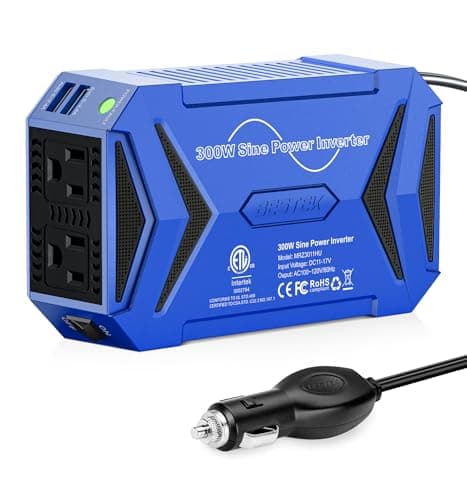
BESTEK 300W Pure Sine Wave Inverter

Best overall

BESTEK 300W Pure Sine Wave Inverter

300W of pure sine wave through the cigarette socket, with 4.8A of USB alongside.

A laptop, a CPAP, chargers — anything under 150 watts
$41.99 · Check price on Amazon

#ad how this is funded · price as of October 20, 2026 · $51.99 19% off

2
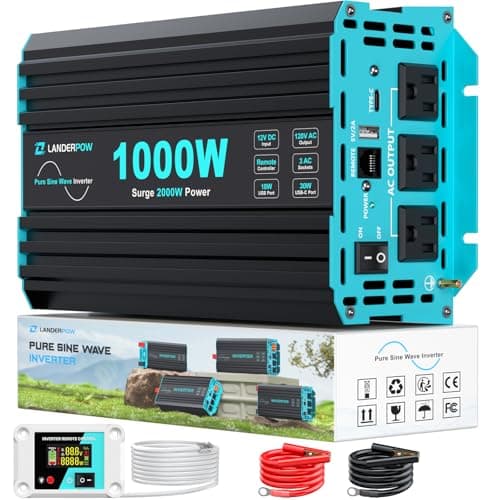
LANDERPOW 1000W Pure Sine Wave Inverter

Best for real appliances

LANDERPOW 1000W Pure Sine Wave Inverter

1,000W of pure sine wave with 2,000W peak, three AC outlets and a wired remote.

A refrigerator, a sump pump, power tools
$84.99 · Check price on Amazon

#ad how this is funded · price as of October 20, 2026 · $99.99 15% off

3
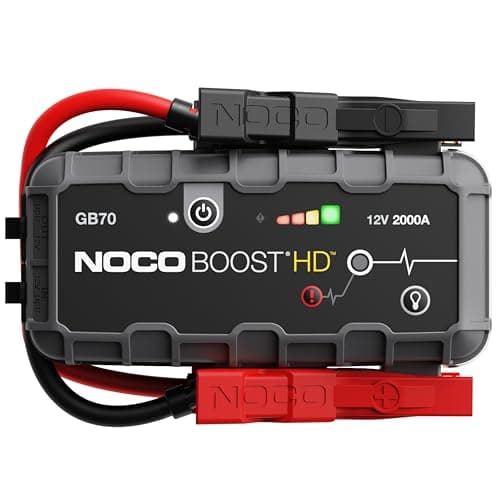
NOCO Boost HD GB70

The insurance policy

NOCO Boost HD GB70

2,000 amps of lithium jump start, up to 40 starts, with a 12V output of its own.

Starting the car you just drained
$194.99 · Check price on Amazon

#ad how this is funded · price as of October 20, 2026

4
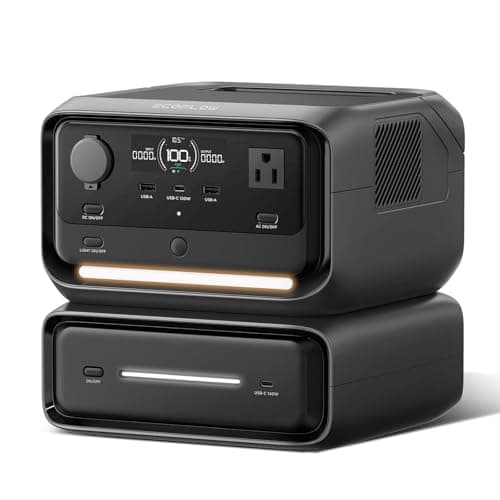
EcoFlow RIVER 3 Max

The purpose-built alternative

EcoFlow RIVER 3 Max

572Wh of LiFePO4 with 500W output and a one-hour recharge.

The same job without risking the car
$318.99 · Check price on Amazon

#ad how this is funded · price as of October 20, 2026 · $399.00 20% off

Prices come from the retailer at page-build time and change constantly. Where no live price is available the button reads “Check price” rather than showing a number we cannot stand behind.

Why a car is a good backup power source

A typical car battery holds roughly 500 to 700 watt-hours — comparable to a mid-size power station. That on its own is unremarkable.

What makes it interesting is the alternator. Start the engine and you have a generator producing something like 1,000 to 2,000 watts of charging capacity, refilling the battery continuously. A car is not a battery; it is a battery with a generator bolted to it, and you already own one.

For a household with no backup equipment at all, an inverter is the cheapest meaningful step available — an order of magnitude less than a power station and two orders less than a standby generator.

The two limits that decide everything

1. The cigarette socket is fused at 10 to 15 amps. At 12V that is 120 to 180 watts of real throughput, minus conversion losses. Every inverter above about 150W that plugs into a socket is selling you a rating the socket cannot deliver.

2. Above that, it wires to the battery. Heavy cable, short runs, an inline fuse close to the positive terminal. A 1,000W inverter draws over 80 amps at 12V, which is more current than most household circuits carry.

Inverter sizeConnectionWhat it runs
150-300 WCigarette socketLaptop, CPAP, chargers, lighting
500 WBattery terminals, or a heavy socketAbove plus a small TV, a fan
1,000 WBattery terminals with an inline fuseA refrigerator, a sump pump, corded tools
2,000 W and upTerminals, heavy cable, often a second batterySeveral appliances — and a real installation job

Pure sine or modified sine

The same distinction that decides a UPS purchase, for the same reason.

A modified sine wave is a stepped approximation, and it is fine for anything that just makes heat or spins a simple motor. It is not reliable for switch-mode power supplies, which is nearly everything electronic you would plug into a car.

The specific things to be careful about: CPAP machines, laptop chargers, anything with a microprocessor, and induction motors, which run hotter on a stepped waveform. The battery backup page covers the underlying waveform problem in detail.

Pure sine costs meaningfully more and removes the entire question. On a device you will use rarely and under stress, that is worth paying for.

How long the car will last

Two very different answers, depending on whether the engine is running.

ModeAvailable energyLimit
Engine offRoughly 200-300 Wh usable before starting is at riskA starting battery is not a deep-cycle battery
Engine idlingEffectively unlimited, at roughly 0.3-0.5 gal/hFuel in the tank, and carbon monoxide

Usable energy from a starting battery is deliberately conservative: discharging a lead-acid starting battery deeply damages it and leaves you unable to start. Idle fuel consumption varies widely by engine.

The practical pattern is a fridge on the inverter with the engine run for twenty or thirty minutes every few hours, rather than continuously. That keeps the battery topped and the fuel bill sane.

The safety rules, which are not negotiable

  • Never run the engine in a garage. Not with the door open. A car idling in an attached garage is the same carbon monoxide hazard as a generator, and it is how people die during outages — the CO safety page applies exactly.
  • Fuse the positive lead close to the battery. An unfused cable from a car battery can deliver hundreds of amps into a short, and the failure mode is a fire.
  • Do not run the cable through a closed window or door. Crushed insulation on a high-current DC cable is the other fire.
  • Watch the input voltage. Below about 11.8 volts at rest you are into territory where the engine may not start.
  • Modern cars may cut the socket. Many vehicles power down accessory sockets when the ignition is off, which is a feature rather than a fault.

Where this fits against the alternatives

An inverter is the cheapest backup power in existence and it has real limits: the exhaust means it lives outside, the noise is an idling engine, and running your only vehicle's battery down during an emergency is a genuine risk.

A power station does the same job silently and indoors for more money — the 500Wh class is the directly comparable size. A generator does it with more output and more noise.

The case where an inverter clearly wins is the household that owns nothing, needs something before the next storm, and has a car in the driveway. The beginners page covers where to go from there.

The short version

  • 150W is the real cigarette socket ceiling. Anything bigger wires to the terminals.
  • Pure sine wave for a CPAP, a laptop or anything with a chip in it.
  • Engine off gives you a few hundred watt-hours. Idling gives you as much as the tank holds.
  • Never idle in a garage, and always fuse the positive lead.
The picks in full

01 — Best overall

BESTEK 300W Pure Sine Wave Inverter

300W of pure sine wave through the cigarette socket, with 4.8A of USB alongside.

This is the size that matches the connection. A cigarette lighter socket is fused at 10 or 15 amps, which is 120 to 180 watts of real output — so a 300W inverter on that socket is already at the ceiling and anything larger is marketing.

Pure sine wave matters more than people expect for the things you actually plug in here. A CPAP, a laptop charger and a camera battery are all switch-mode supplies, and a cheap modified-sine unit can make them run hot or refuse.

No wiring and no tools is the practical advantage. It plugs in, and anybody in the household can use it.

The honest catch: respect the socket's fuse rather than the inverter's badge. Draw 250W through a 15A socket and you will blow the fuse, not get 250W.

Skip it ifyou want to run a refrigerator. That needs terminals, not a socket.

BESTEK 300W Pure Sine Wave Inverter
$41.99 · Check price on Amazon

#ad how this is funded · price as of October 20, 2026 · $51.99 19% off

Published specifications for the BESTEK 300W Pure Sine Wave Inverter
SpecificationPublished figure
Output300 W
WaveformPure sine wave
ConnectionCigarette lighter plug — no wiring required
InputDC 12 V
Output voltage110 V AC
Charging4.8 A dual USB fast charging ports

Source: BESTEK — 300W pure sine wave car inverter listing. These are the manufacturer's published figures, not ours — we have not tested this unit.

02 — Best for real appliances

LANDERPOW 1000W Pure Sine Wave Inverter

1,000W of pure sine wave with 2,000W peak, three AC outlets and a wired remote.

Above about 150W you have to leave the cigarette socket behind and connect directly to the battery with heavy cable and an inline fuse. That is the step that makes 1,000W possible.

At that level it will run a refrigerator, keeping a freezer frozen through a multi-day outage using a vehicle you already own.

The LCD is genuinely useful here, because watching the input voltage is how you avoid flattening the starting battery.

The honest catch: 1,000W out of a 12V battery is over 80 amps in. That is a real installation with real cable, not a plug-in accessory.

Skip it ifyou are not willing to wire to the battery terminals. This will not run from a socket.

LANDERPOW 1000W Pure Sine Wave Inverter
$84.99 · Check price on Amazon

#ad how this is funded · price as of October 20, 2026 · $99.99 15% off

Published specifications for the LANDERPOW 1000W Pure Sine Wave Inverter
SpecificationPublished figure
Output1,000 W continuous / 2,000 W peak
WaveformPure sine wave
InputDC 12 V
Output voltage120 V AC
AC outlets3
Charging30 W USB-C plus a 5 V / 3.1 A USB-A port
ControlWired remote control included

Source: LANDERPOW — 1000W pure sine wave car inverter listing. These are the manufacturer's published figures, not ours — we have not tested this unit.

03 — The insurance policy

NOCO Boost HD GB70

2,000 amps of lithium jump start, up to 40 starts, with a 12V output of its own.

Included because it addresses the specific failure this page creates. Run an inverter long enough with the engine off and the starting battery will not start the engine.

A jump pack turns that from a disaster into an inconvenience, and it is far smaller and cheaper than the inverter it protects.

The honest catch: it needs to be charged. A jump pack that has been in a glovebox for three years is a paperweight — the jump starter page covers keeping one alive.

Skip it ifyou have a second vehicle and jumper cables.

NOCO Boost HD GB70
$194.99 · Check price on Amazon

#ad how this is funded · price as of October 20, 2026

Published specifications for the NOCO Boost HD GB70
SpecificationPublished figure
Peak current2,000 A at 12 V
Engine rangeUp to 8.0 L gasoline, 6.0 L diesel
Jump startsUp to 40 on a single charge
SafetySpark-proof connections and reverse polarity protection
ExtrasUSB charging, 12 V output, 400-lumen LED with seven modes
Warranty1 year

Source: NOCO — Boost HD GB70 product listing. These are the manufacturer's published figures, not ours — we have not tested this unit.

04 — The purpose-built alternative

EcoFlow RIVER 3 Max

572Wh of LiFePO4 with 500W output and a one-hour recharge.

Worth the comparison. A power station does the same job with no wiring, no engine running, no exhaust, and no risk of stranding yourself — and it recharges from the car while you drive.

The inverter wins decisively on price and on total energy available, because a car battery plus an engine is effectively unlimited while a 572Wh pack is not.

The honest catch: 572Wh is a few hours of a refrigerator. The car can do that for days.

Skip it ifbudget is the constraint. An inverter is a fraction of this.

EcoFlow RIVER 3 Max
$318.99 · Check price on Amazon

#ad how this is funded · price as of October 20, 2026 · $399.00 20% off

Published specifications for the EcoFlow RIVER 3 Max
SpecificationPublished figure
Usable capacity572 Wh
AC output990 W
ClassCompact station for electronics, lights and a CPAP

Source: EcoFlow — RIVER 3 Max listing. These are the manufacturer's published figures, not ours — we have not tested this unit.

How these were chosen

We did not test these. Nobody at Watt & Warden has plugged one in. What we did instead: read the manufacturer's published specifications, compile them into a table where the figures line up, and compute the numbers manufacturers leave out — runtime against a real appliance load, and what an hour of running actually costs.

Anything that could not be sourced was left out rather than estimated, and every pick names the buyer who should skip it. The full method is here, including where it is weaker than a publisher with a test bench.

Questions people actually ask

What size power inverter can I run from a cigarette lighter?

About 150W of real output. The socket is fused at 10 to 15 amps, which at 12V is 120 to 180 watts before conversion losses. A 300W inverter plugged into that socket is already at the ceiling, and anything larger has to be wired directly to the battery terminals with heavy cable and an inline fuse.

Can a car inverter run a refrigerator?

A 1,000W inverter wired to the battery terminals will, which makes a car a genuine multi-day backup for a fridge or freezer. It draws over 80 amps at 12V, so it is a real installation rather than a plug-in accessory, and you need to run the engine periodically to avoid flattening the starting battery.

Do I need a pure sine wave inverter for a car?

For anything electronic, yes. Modified sine wave is a stepped approximation that suits heating elements and simple motors but is unreliable with switch-mode supplies -- CPAP machines, laptop chargers and anything with a microprocessor. Pure sine costs more and removes the question entirely.

How long can I run an inverter with the engine off?

Roughly 200 to 300 watt-hours before starting the car is at risk. A starting battery is not a deep-cycle battery and discharging it deeply both damages it and strands you. With the engine idling it is effectively unlimited at around 0.3 to 0.5 gallons an hour -- the practical pattern is running the engine twenty minutes every few hours.

Is it safe to run a car inverter in the garage?

Only with the engine off, and even then only briefly. An idling car in an attached garage produces the same carbon monoxide hazard as a generator, and an open door is not ventilation. If the engine needs to run, the car goes outside and the cable comes to you -- fused close to the battery and never through a closed window.

Sources

Every figure on this page comes from a published source. We have not tested this equipment, so the specifications are the manufacturer's and the statistics are the dataset's — the arithmetic on top of them is ours, and it is shown in full so you can check it. How we work this out.