Skip to content
Watt Warden

Outage Prep

Emergency Water Storage for Power Outages

It costs almost nothing, needs no maintenance and works when every other item on this site has failed. It is also the thing people skip.

By Sawyer V.Updated Published How we work this out
Stacked water storage jugs.

Watt & Warden earns a commission on qualifying purchases made through links on this page, at no extra cost to you. It never changes a ranking, and our picks include products we tell you to skip. Full disclosure.

How much, per the guidance

Ready.gov specifies one gallon of water per person per day for several days, for drinking and sanitation, with at least a three-day supply for evacuation and a two-week supply at home.

Worked through for a household:

Household3 days2 weeksIn 7-gallon containers
1 person3 gal14 gal2 containers
2 people6 gal28 gal4 containers
4 people12 gal56 gal8 containers
4 people plus a dog~14 gal~63 gal9 containers

Calculated from Ready.gov's one gallon per person per day. Pets need water too and are routinely left out of the arithmetic — allow roughly a gallon a day for a large dog. Ready.gov also notes that hot weather, pregnancy and illness all increase the requirement.

The two-week figure looks like a lot of plastic. In practice most households store the three-day figure permanently and fill the bath and every pan when an outage is forecast — which costs nothing and closes most of the gap.

Why this matters more on a well

On municipal water, pressure usually survives a local outage because the utility has its own backup and its own storage. You may get a boil notice; you rarely get nothing.

On a well, the pump is electric and the pressure tank holds minutes rather than hours. When the power goes, so does every tap in the house — no drinking water, no washing, and no flushing after the cistern refills once.

That is the difference between an inconvenience and a genuine problem, and it is why a rural property should treat water storage as a first purchase rather than an afterthought.

Tall buildings have a version of the same problem: booster pumps are electric, so upper floors lose pressure while lower floors keep it. The apartment page covers it.

What to store it in

  • Purpose-made food-grade containers. Rectangular ones stack and store far better than round jugs, which matters more than any other feature because it decides whether you keep enough of them.
  • Commercially bottled water, unopened, is the simplest option of all — no filling, no treatment, and a printed date.
  • Not milk jugs. They are not designed for storage, the plastic degrades, and residual protein and sugar support bacterial growth however well you rinse them.
  • Not containers that held anything else. Juice bottles and detergent containers are both bad ideas for opposite reasons.
  • A larger drum if you have space and a way to move water from it. Fifty-five gallons is convenient to store and impossible to carry.

Where to keep it

  • Cool and dark. Heat and light degrade plastic and encourage growth.
  • Off a concrete floor if the container is plastic — conventional advice, and cheap to follow with a board or a pallet.
  • Away from fuel, pesticides and solvents. Vapors can permeate plastic over time.
  • Somewhere you can reach it in the dark, and somewhere you will not have to lift 58 lb down from a shelf.
  • Split across two locations if you can. One flooded basement should not take the whole supply.

Rotation

Stored water does not spoil in the way food does, but containers and seals age and taste degrades. The practical routine:

  1. Label every container with the fill date in permanent marker.
  2. Replace tap-filled water every six months, at the same time you exercise the generator and test the alarms.
  3. Use the old water on the garden rather than pouring it away, and refill immediately rather than later.
  4. Follow the printed date on commercially bottled water, which is a quality date rather than a safety one.

Folding it into the same twice-a-year routine as the generator service is what makes it actually happen.

Free storage you already have

When an outage is forecast — which for a hurricane or a winter storm is usually a day or more — these cost nothing:

  • Fill the bath. Not for drinking. A bath of water is a flushing reservoir, and a bucket into the bowl works with no pressure at all.
  • Fill every pan, jug and bottle in the kitchen.
  • Freeze water containers in the empty space in the freezer. They extend the 48-hour holding time and become drinking water as they thaw.
  • Run the ice maker and bag the ice.
  • Do the laundry and the dishes before it starts.

The forecast window is the biggest advantage a planned outage gives you, and water is the cheapest thing to do with it. The shutoff page makes the same argument for equipment.

Water heaters hold a lot

Worth knowing, and worth being careful with.

A conventional tank water heater holds 40 to 80 gallons, and that water is potable. It has a drain valve at the base intended for maintenance.

Three cautions if you plan to use it:

  • Turn off the power or gas to the heater first. Draining a tank with the element still energized destroys it.
  • Shut off the cold inlet so it does not refill with whatever is in the mains.
  • Open a hot tap somewhere to let air in, or nothing will flow.

Sediment in the bottom of an older tank means the first water out is not pleasant. It is a reserve rather than a plan.

Treatment

If you are ever unsure about stored water — a container of unknown age, or a supply under a boil notice — the CDC and Ready.gov both publish emergency disinfection guidance covering boiling, unscented household bleach and commercial tablets.

We are not going to reproduce dosages here, because getting them slightly wrong matters and the authoritative versions are one click away and current. Both sources are linked below, and it is worth reading them before you need them rather than during.

Quick picks

#ProductBest forPrice
1
No photo

Best container for the job

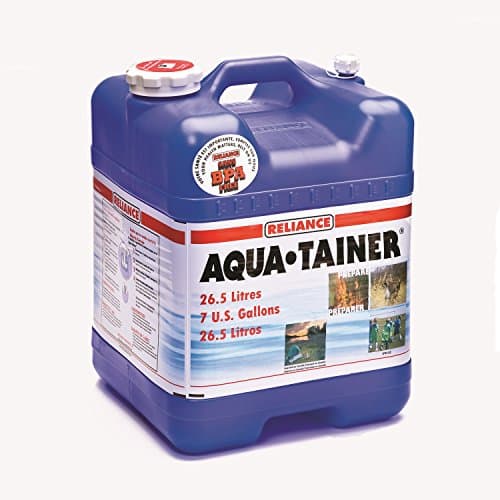
Reliance Aqua-Tainer 7 gallon water container

7 gallons in a rectangular case that stacks, with a screw-on vent and a hideaway spigot.

Storing and dispensing at home
2
No photo

What refills them on a well

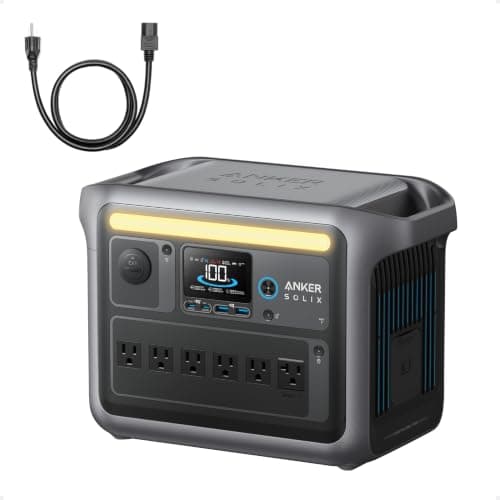
Anker SOLIX C1000

1,056Wh of LiFePO4 with 1,800W output and a fast recharge.

Running a pump long enough to fill containers
3
No photo

What actually refills a well

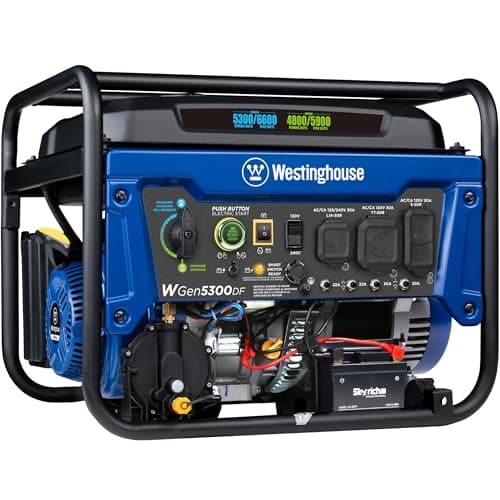
Westinghouse WGen5300DF

5,300 running watts, dual fuel, at about 0.32 gal/hr averaged across a tank.

A 240V pump, in blocks

Prices come from the retailer at page-build time and change constantly. Where no live price is available the button reads “Check price” rather than showing a number we cannot stand behind.

The picks in full

01Best container for the job

Reliance Aqua-Tainer 7 gallon water container

7 gallons in a rectangular case that stacks, with a screw-on vent and a hideaway spigot.

The rectangular shape is the reason this beats a round jug. It stacks, it stores flat against a wall, and it does not waste the space around it — which is what decides whether you actually keep four of them or give up after one.

The spigot matters more than it sounds. Pouring from a full seven gallon container is awkward and wasteful; a tap you can hold a pan under is not.

Full, it is about 58 lb. Decide where they will live before buying several, and do not put them somewhere you would have to lift them down from.

Skip it ifyou only need a couple of days for one person. Then bottled water in the cupboard is simpler.

Published specifications for the Reliance Aqua-Tainer 7 gallon water container
SpecificationPublished figure
Capacity7 gallons (26 L)
Dimensions11.3 x 11.0 x 15.3 in
DispensingScrew-on vent and hideaway spigot
ShapeRectangular — stacks, and stores flat against a wall
Full weightabout 58 lb — plan where it lives

Source: Reliance Products — Aqua-Tainer 7 gallon listing. These are the manufacturer's published figures, not ours — we have not tested this unit.

02What refills them on a well

Anker SOLIX C1000

1,056Wh of LiFePO4 with 1,800W output and a fast recharge.

Included with a caveat. Most well pumps are 240V and hardwired, which puts them beyond a portable battery entirely — the well pump page explains why that is a generator problem.

Where a battery does help is everything else water-related: a booster pump, a filter, or a small transfer pump moving stored water where you need it.

Skip it ifyou are on municipal water, or your well pump is 240V — most are.

Published specifications for the Anker SOLIX C1000
SpecificationPublished figure
Usable capacity1,056 Wh
Cell chemistryLiFePO4 (LFP)
AC output1,800 W continuous / 2,400 W SurgePad
Cycle life3,000 cycles
Wall recharge80% in 43 min, full in 58 min
Max solar input600 W (full solar recharge ~1.8 h)
Ports11 total, including 6 AC on panel-equipped bundles

Source: Anker — SOLIX C1000 product specifications. These are the manufacturer's published figures, not ours — we have not tested this unit.

03What actually refills a well

Westinghouse WGen5300DF

5,300 running watts, dual fuel, at about 0.32 gal/hr averaged across a tank.

The realistic pairing on a well: run the generator for a couple of hours twice a day, and fill every container you own while the pump is running.

Storage is what makes that pattern work. Without containers you are tied to running the generator whenever anyone wants water.

Skip it ifyou are on municipal water.

Published specifications for the Westinghouse WGen5300DF
SpecificationPublished figure
Output (gasoline)5,300 running W / 6,600 peak W
Output (propane)4,800 running W / 5,900 peak W
Engine274cc 4-stroke OHV
Tank4.7 gal (18 L)
Run timeup to 14.5 h on a full tank
Transfer-switch outlet120/240 V L14-30R, 30 A
RV outlet120 V TT-30R, 30 A
StartingPush-button electric with remote key fob

Source: Westinghouse — WGen5300DF product specifications. These are the manufacturer's published figures, not ours — we have not tested this unit.

How these were chosen

We did not test these. Nobody at Watt & Warden has plugged one in. What we did instead: read the manufacturer's published specifications, compile them into a table where the figures line up, and compute the numbers manufacturers leave out — runtime against a real appliance load, and what an hour of running actually costs.

Anything that could not be sourced was left out rather than estimated, and every pick names the buyer who should skip it. The full method is here, including where it is weaker than a publisher with a test bench.

Questions people actually ask

How much water should I store for a power outage?

Ready.gov specifies one gallon per person per day for drinking and sanitation -- at least three days for evacuation and two weeks at home. For a family of four that is 12 gallons for three days and 56 for two weeks. Pets need water too, roughly a gallon a day for a large dog.

Do I lose water in a power outage?

On a well, immediately -- the pump is electric and the pressure tank holds minutes, so every tap stops including the toilet after one flush. On municipal water, pressure usually survives because the utility has its own backup, though upper floors of tall buildings lose it when booster pumps stop.

Can I store water in milk jugs?

No. They are not designed for storage, the plastic degrades, and residual protein and sugar support bacterial growth however well you rinse them. Use purpose-made food-grade containers -- rectangular ones stack and store far better -- or simply keep unopened commercially bottled water.

How often should I replace stored water?

Replace tap-filled water every six months, folded into the same routine as exercising the generator and testing the alarms. Label every container with the fill date, use the old water on the garden and refill immediately. Commercially bottled water carries its own printed date.

Can I use the water in my water heater?

Yes, and a conventional tank holds 40 to 80 potable gallons with a drain valve at the base. Turn off the power or gas to the heater first, because draining with the element energized destroys it; shut the cold inlet; and open a hot tap to let air in or nothing flows. Sediment makes the first water unpleasant.

Sources

Every figure on this page comes from a published source. We have not tested this equipment, so the specifications are the manufacturer's and the statistics are the dataset's — the arithmetic on top of them is ours, and it is shown in full so you can check it. How we work this out.