Skip to content
Watt Warden

Outage Prep

Backup Power for a Well Pump

On municipal water an outage is inconvenient. On a well it means no drinking water, no washing and no flushing, because the pump is electric and the pressure tank holds minutes.

By Sawyer V.Updated Published How we work this out
A water pressure tank and pipework.

Watt & Warden earns a commission on qualifying purchases made through links on this page, at no extra cost to you. It never changes a ranking, and our picks include products we tell you to skip. Full disclosure.

Why this is different from every other appliance

On municipal water, an outage is about food and light. On a well, it is about water — and the consequences arrive faster than people expect.

  • No drinking water beyond what is stored.
  • No flushing. A toilet cistern refills once from the pressure tank and then does not.
  • No washing, of people, dishes or anything else.
  • No water for livestock, which on a smallholding is an urgent problem rather than a comfort one.

The pressure tank buys you minutes, not hours. Its job is to stop the pump cycling constantly, and it typically holds a small usable volume at pressure — a couple of toilet flushes and some handwashing. Once that is gone, nothing comes out of any tap until the pump runs.

The surge is the whole problem

A submersible well pump is an inductive motor starting under load, deep in a shaft, against a column of water. That combination produces one of the harder starting surges in a house.

Champion's published chart does not carry a single well-pump figure because the answer depends entirely on horsepower and depth — which is the honest position. What matters practically:

What decides itEffect
Pump horsepowerThe dominant factor for both running and starting watts — it is on the nameplate
Well depthDeeper wells need higher-horsepower pumps
VoltageMany are 240V, which rules out 120V-only generators entirely
Starting methodSome have soft-start or control boxes that reduce the surge

Find your pump's nameplate — usually on the control box or pressure switch in the basement or well house — and read the horsepower and voltage off it. That is the number to size against, and we would rather tell you to go and read it than publish a guess.

Why a battery usually is not the answer

Three reasons, and the first is decisive:

  • The surge. Most portable battery inverters cannot start a well pump, and an inverter that cannot start it does not run it slowly — it shuts off.
  • The voltage. Many well pumps are 240V. Most portable power stations are 120V only.
  • The connection. The pump is hardwired, so even a capable battery needs a transfer switch to reach it — at which point a generator is usually the better thing on the other end.

There are large 240V-capable batteries and home battery systems that do handle this, and they are a different purchase at a different price. Generator versus home battery covers that comparison.

The arrangement that works

Run the pump in blocks, not continuously. This is the key insight and it makes the whole problem smaller.

A pump only runs when the pressure tank calls for it — minutes at a time, a handful of times a day for normal use. So you do not need the generator running all day to have water. You need it running when the tank needs filling.

  1. Run the generator twice a day, morning and evening, for a couple of hours.
  2. During those blocks, use water deliberately. Fill containers, run the washing machine if you must, shower, refill the bath as a flushing reservoir.
  3. Refill the battery at the same time, so the fridge and lights run silently overnight.
  4. Between blocks, use stored water.

That pattern uses about a quarter of the fuel of continuous running and means the engine is off at night — which on a rural property with neighbors a long way off still matters for your own sleep.

Store water anyway

The cheapest thing on this page, and the one that works when the generator does not.

  • Fill the bath when an outage is forecast. Not for drinking — for flushing. A bucket into the toilet bowl works regardless of pressure.
  • Keep drinking water stored and rotated. This is standard guidance for everyone and it matters more on a well.
  • Freeze water containers in the empty space in your freezer. They extend the 48-hour holding time and become drinking water as they thaw.
  • Keep a hand pump or a bucket rig if your well head allows it. Rare, but the only genuinely power-free option.

Test it before you need it

This is the step people skip, and a well pump is the load most likely to surprise you.

  1. Read the nameplate. Horsepower and voltage.
  2. Have the electrician confirm the pump circuit is on the transfer switch when it is installed. It is the circuit most often left off by accident, because it is not in the kitchen.
  3. Actually run it on the generator, on a clear day, with the fridge also running. If it trips, you have found something important at a good time.
  4. Note what else you can have on while the pump starts. The transfer switch's watt meters make this easy to see.

Why the surge is so much larger than the running figure explains what you are watching for, and the whole-house tiers put the pump in context with everything else.

If you are on a well, buy for this first

Households on municipal water can treat backup power as a food-and-light problem and choose a battery on comfort grounds. Households on a well cannot.

The pump is the load that decides your equipment, and it points at a generator with 240V output and a transfer switch. Everything else — the battery, the panels, the lanterns — is built around that decision rather than instead of it.

Quick picks

#ProductBest forPrice
1
No photo

The realistic answer

Westinghouse WGen5300DF

5,300 running watts, dual fuel, at about 0.32 gal/hr averaged across a tank.

A well pump plus the rest of the critical circuits
2
No photo

How the generator reaches the pump

Reliance Controls 31410CRK Pro/Tran

A 10-circuit manual transfer switch rated 30A / 7,500W with two watt meters.

Hardwired circuits — which a well pump always is
3
No photo

For a deep well or a large pump

Westinghouse WGen9500DF

9,500 running watts with 240V outlets and push-button electric start.

Higher horsepower submersibles
4
No photo

The indoor half of the arrangement

BLUETTI Elite 200 V2

2,073Wh of LiFePO4 with 2,600W output and a ten-year design life.

Everything that is not the pump

Prices come from the retailer at page-build time and change constantly. Where no live price is available the button reads “Check price” rather than showing a number we cannot stand behind.

The picks in full

01The realistic answer

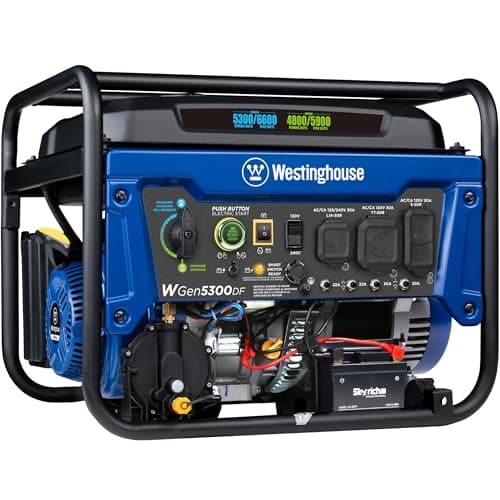
Westinghouse WGen5300DF

5,300 running watts, dual fuel, at about 0.32 gal/hr averaged across a tank.

A well pump is a hard-starting inductive load, and 5,300 running watts gives the headroom to absorb its surge while a refrigerator and a furnace blower are already running.

Dual fuel matters on a rural property specifically. If your outages are long and the nearest open gas station is thirty miles away, propane you already store is worth more than a slightly larger gasoline machine.

Six hours a day at 0.32 gal/hr is about 1.9 gallons — and a pump only runs for minutes at a time, so it barely adds to that.

Skip it ifyour pump is unusually large. Check its nameplate before assuming any machine covers it.

Published specifications for the Westinghouse WGen5300DF
SpecificationPublished figure
Output (gasoline)5,300 running W / 6,600 peak W
Output (propane)4,800 running W / 5,900 peak W
Engine274cc 4-stroke OHV
Tank4.7 gal (18 L)
Run timeup to 14.5 h on a full tank
Transfer-switch outlet120/240 V L14-30R, 30 A
RV outlet120 V TT-30R, 30 A
StartingPush-button electric with remote key fob

Source: Westinghouse — WGen5300DF product specifications. These are the manufacturer's published figures, not ours — we have not tested this unit.

02How the generator reaches the pump

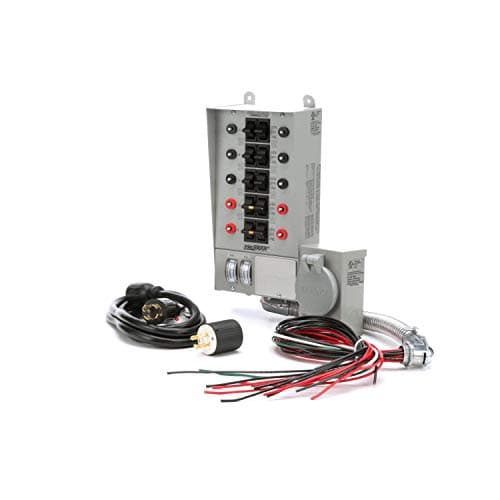
Reliance Controls 31410CRK Pro/Tran

A 10-circuit manual transfer switch rated 30A / 7,500W with two watt meters.

A well pump has no plug. It is wired to a dedicated circuit, usually 240V, which means no extension cord can ever reach it. This is the single most important item on the page.

The two watt meters let you see how close the pump start takes you to the limit, which is genuinely useful when you are deciding what else can be on at the same time.

The connection guide covers the whole chain, and interlock kits are the other valid route.

Skip it ifnothing — if you have a well pump and a generator, you need one of these or an interlock.

Published specifications for the Reliance Controls 31410CRK Pro/Tran
SpecificationPublished figure
Circuits10 — six 15 A and four 20 A single-pole breakers
Rating30 A, up to 7,500 W
MeteringTwo watt meters for balancing the load
SwitchingBreak-before-make double-throw, Line / Off / Gen
BackfeedMechanically prevented — the grid cannot be energized
InstallationLicensed electrician; a permit is usually required

Source: Reliance Controls — Pro/Tran 31410CRK product page. These are the manufacturer's published figures, not ours — we have not tested this unit.

03For a deep well or a large pump

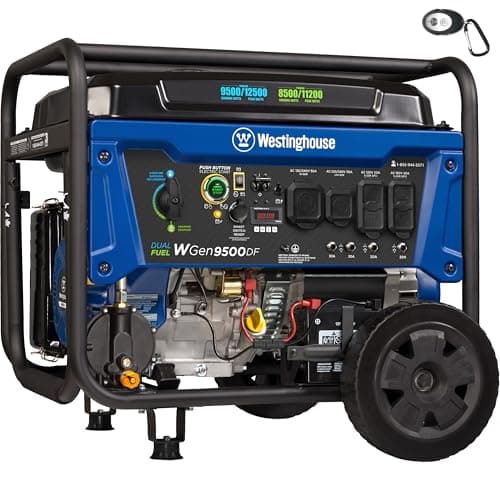
Westinghouse WGen9500DF

9,500 running watts with 240V outlets and push-button electric start.

Deep wells need higher-horsepower submersible pumps, and horsepower drives both the running draw and the surge. If your well is several hundred feet deep, check the pump nameplate before deciding 5,300W is enough.

Remote electric start is worth having on a rural property where the generator may live some distance from the door.

Skip it ifyour pump is a ½ HP shallow-well unit. You would be buying fuel consumption you do not need.

Published specifications for the Westinghouse WGen9500DF
SpecificationPublished figure
Output (gasoline)9,500 running W / 12,500 peak W
FuelGasoline or propane (dual fuel)
Engine457cc 4-stroke OHV, cast iron sleeve
Tank6.6 gal (25 L)
Run timeup to 12 h on a full tank
Transfer-switch outlet120/240 V L14-30R, 30 A
RV outlet120/240 V 14-50R, 50 A
StartingPush-button electric with remote key fob
Warranty3-year limited

Source: Westinghouse — WGen9500DF product specifications. These are the manufacturer's published figures, not ours — we have not tested this unit.

04The indoor half of the arrangement

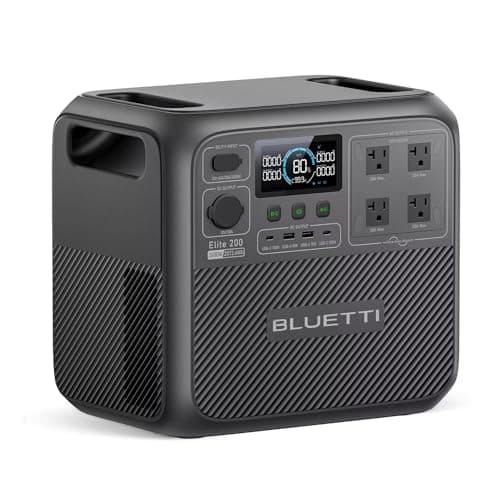
BLUETTI Elite 200 V2

2,073Wh of LiFePO4 with 2,600W output and a ten-year design life.

Named to be clear about the limit. A battery is excellent for the fridge, lights and communications overnight — and a poor fit for a well pump, whose surge defeats most portable inverters and whose draw empties them quickly.

The arrangement that works is both: the generator runs outside twice a day to pump water and refill the battery, and the battery covers the quiet hours indoors.

Skip it ifyou expect it to run the well pump. Most will not start one, and none will run one for long.

Published specifications for the BLUETTI Elite 200 V2
SpecificationPublished figure
Usable capacity2,073.6 Wh
Cell chemistryAutomotive-grade LiFePO4 (LFP)
AC output2,600 W continuous / 3,900 W power lifting
Cycle life6,000+ cycles
Fast charge0–80% in 50 min via dual AC/DC input

Source: BLUETTI — Elite 200 V2 product specifications. These are the manufacturer's published figures, not ours — we have not tested this unit.

How these were chosen

We did not test these. Nobody at Watt & Warden has plugged one in. What we did instead: read the manufacturer's published specifications, compile them into a table where the figures line up, and compute the numbers manufacturers leave out — runtime against a real appliance load, and what an hour of running actually costs.

Anything that could not be sourced was left out rather than estimated, and every pick names the buyer who should skip it. The full method is here, including where it is weaker than a publisher with a test bench.

Questions people actually ask

Will a power station run a well pump?

Usually not. A submersible pump starting under load produces one of the harder surges in a house, most portable inverters cannot clear it, and many pumps are 240V while most stations are 120V only. The pump is also hardwired, so it needs a transfer switch regardless of what is on the other end.

What size generator do I need for a well pump?

Size against your pump's nameplate rather than a general figure -- horsepower and well depth drive both the running draw and the surge, and voltage decides whether a machine can feed it at all. A 5,300W dual-fuel machine covers a typical residential pump plus a fridge and a furnace blower; deep wells with larger pumps need more.

How long does water last without a well pump?

Minutes, not hours. The pressure tank exists to stop the pump cycling constantly, not to store a supply -- typically a couple of toilet flushes and some handwashing. After that nothing comes out of any tap until the pump runs, which is why storing water matters more on a well than anywhere else.

Do I need to run the generator all day for water?

No, and this makes the problem much smaller. A pump only runs when the pressure tank calls for it -- minutes at a time. Run the generator for a couple of hours morning and evening, use water deliberately during those blocks and store some for between, and refill the battery at the same time.

Is the well pump circuit included on a transfer switch?

Only if you ask for it. It is the circuit most often left off by accident because it is not in the kitchen and does not feel like an appliance. Confirm it with the electrician at installation, then actually test the pump on the generator with the fridge also running before you need it.

Sources

Every figure on this page comes from a published source. We have not tested this equipment, so the specifications are the manufacturer's and the statistics are the dataset's — the arithmetic on top of them is ours, and it is shown in full so you can check it. How we work this out.