Skip to content
Watt Warden

Generators

The Best Dual Fuel Generators (2026)

In a widespread outage the gas stations are out too, because their pumps are electric. Propane you already own does not care.

By Sawyer V.Updated Published How we work this out
A propane tank standing beside equipment outdoors.

Watt & Warden earns a commission on qualifying purchases made through links on this page, at no extra cost to you. It never changes a ranking, and our picks include products we tell you to skip. Full disclosure.

Quick picks

#ProductBest forPrice
1
No photo

Best for a whole house

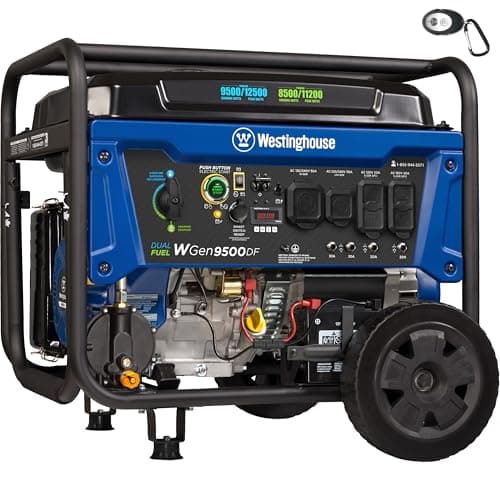
Westinghouse WGen9500DF

9,500 running watts on gasoline from a 457cc engine, with both a 30A transfer-switch outlet and a 50A RV outlet.

Large critical loads and long outages
2
No photo

Best value dual fuel

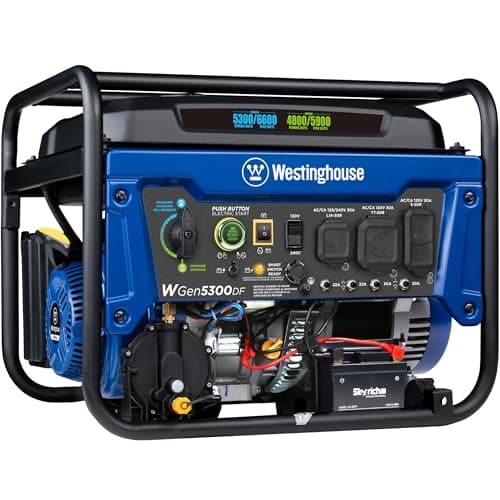
Westinghouse WGen5300DF

5,300 running watts on gasoline and up to 14.5 hours on 4.7 gallons — about 0.32 gal/hr.

A critical load, economically
3
No photo

Best dual fuel inverter

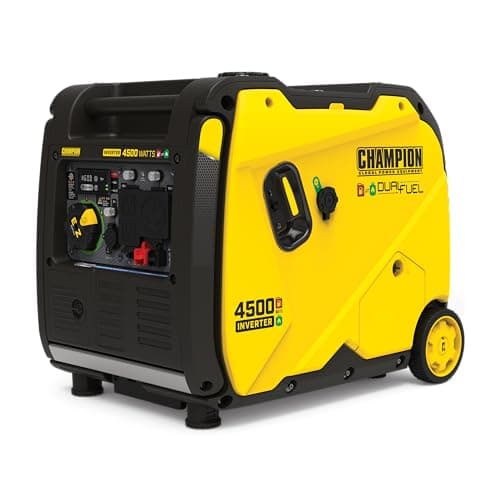
Champion 200988 4500W dual fuel inverter

4,500 starting watts of dual-fuel inverter power with electric start.

Quiet overnight running
4
No photo

Most output

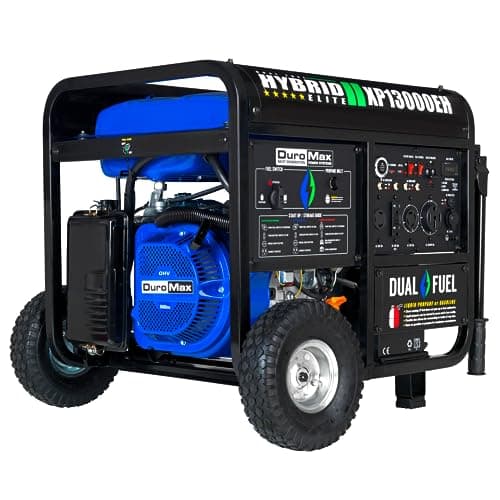
DuroMax XP13000EH

Dual fuel at the top of the portable range, with electric start.

Very large loads

Prices come from the retailer at page-build time and change constantly. Where no live price is available the button reads “Check price” rather than showing a number we cannot stand behind.

The argument, in one sentence

Gas station pumps run on electricity. In a widespread outage the stations near you are out too, and the queues at the ones that are not are the thing people remember from every hurricane.

Propane sidesteps that entirely. A 20 lb cylinder in the garage, or a 500-gallon tank if you already heat with it, is fuel you own before the storm and can use without leaving the house.

What it costs you

Dual fuel is not free, and the cost is output. An engine produces less power on propane than on gasoline — commonly around 10 to 15% less.

Westinghouse publishes the figures for the WGen5300DF directly: 5,300 running watts on gasoline, 4,800 on propane. That is about a 9% reduction, and it is the kind of gap to size around rather than discover.

Practically: if your critical load needs 4,900W and you plan to run on propane, this machine does not cover it even though its headline figure says it does. Size against the propane number if propane is your default fuel.

The second advantage nobody mentions

Propane does not go off. Gasoline oxidizes, absorbs water and forms gum that varnishes a carburetor shut — the single most common reason a stored generator will not start.

A dual-fuel machine can be stored and exercised on propane, with the gasoline system run dry. Do that and the entire fuel half of generator maintenance stops applying to you.

For a machine that sits eleven months a year and must start on the twelfth, that is arguably a bigger practical benefit than fuel availability. The maintenance schedule covers the storage procedure.

What it costs to actually run

The sticker price of a dual-fuel generator is a fraction of what it costs you. The sticker price of a battery is nearly all of it. Here is the arithmetic, with the inputs stated so you can redo it with your own fuel price.

UnitPublished consumptionCost per hourCost per 24 h
WGen9500DF on gasoline0.55 gal/hr (computed from published figures)$2.24$53.74
WGen9500DF on propane0.55 gal/hr equivalent, propane priced separately$1.47$35.29
WGen5300DF on gasoline0.32 gal/hr (computed from published figures)$1.30$31.27
WGen5300DF on propane0.32 gal/hr equivalent, propane priced separately$0.86$20.53
Gasoline at $4.071 a gallon, the U.S. Energy Information Administration's weekly retail average for the week ending 31 August 2026. Propane at $2.674 a gallon, the EIA's weekly residential average for the week ending 30 March 2026, the most recent in a series that publishes through the winter heating season only. Propane rows apply the same volumetric consumption at the propane price; propane carries less energy per gallon than gasoline, so treat these as an indication of the price direction rather than a precise equivalence. A 20 lb exchange cylinder costs considerably more per gallon than the bulk residential figure — refilling beats exchanging.

The propane practicalities people miss

  • Refill, do not exchange. Exchange cylinders are usually filled to less than capacity and cost much more per gallon, because you are paying for the cylinder service.
  • Cold slows vaporization. Propane draws less readily in severe cold, so a larger tank performs better than a small cylinder in winter. Keep it out of the wind.
  • A 20 lb cylinder is not much runtime at house-sized loads. Plan several, or a larger tank.
  • Cylinders live outdoors. Never in a basement or an attached garage.
  • If you already have a house propane tank, ask your supplier about a tap for the generator. That is the arrangement that makes dual fuel genuinely excellent.

Tri-fuel, and whether it is worth it

Some machines add natural gas as a third option. Where a house has a gas main, that is effectively unlimited runtime with no storage at all, which is the single strongest argument in the whole category.

The catches are real: a natural-gas connection for a portable generator is plumbing work, output on natural gas is lower again than on propane, and gas mains can be interrupted by the same events that take the power out. Treat it as an excellent primary with a stored-fuel fallback rather than as a complete answer.

Is dual fuel worth it for you?

Yes, if your outages are storm-driven and widespread, you already keep propane for a grill or heating, or the machine will sit unused for most of the year and you would rather not manage stale gasoline.

Probably not, if your outages are short and local so fuel is easy to get, you are at the edge of your load calculation and cannot afford the propane output penalty, or you want maximum watts per dollar and will genuinely run gasoline.

For most households with real storm exposure, the price premium is small and buys two things at once: fuel you can get when nobody can get gasoline, and a machine that starts because its fuel never went stale.
The picks in full

01Best for a whole house

Westinghouse WGen9500DF

9,500 running watts on gasoline from a 457cc engine, with both a 30A transfer-switch outlet and a 50A RV outlet.

The outlet panel is what makes this a house machine: an L14-30R for a transfer switch and a 14-50R for 50A service. Plenty of generators at this output have neither.

Push-button electric start with a remote key fob is a genuine feature rather than a luxury. Starting a 457cc engine by pull cord in sleet, in the dark, wearing gloves, is where people give up and do something unsafe instead.

6.6 gallons over up to 12 hours works out to about 0.55 gallons an hour — roughly 70% more per hour than the 5,300W machine below. That is the honest price of the extra capacity.

Skip it ifyour critical load fits inside 5,300W. You would be buying fuel consumption you do not need.

Published specifications for the Westinghouse WGen9500DF
SpecificationPublished figure
Output (gasoline)9,500 running W / 12,500 peak W
FuelGasoline or propane (dual fuel)
Engine457cc 4-stroke OHV, cast iron sleeve
Tank6.6 gal (25 L)
Run timeup to 12 h on a full tank
Transfer-switch outlet120/240 V L14-30R, 30 A
RV outlet120/240 V 14-50R, 50 A
StartingPush-button electric with remote key fob
Warranty3-year limited

Source: Westinghouse — WGen9500DF product specifications. These are the manufacturer's published figures, not ours — we have not tested this unit.

02Best value dual fuel

Westinghouse WGen5300DF

5,300 running watts on gasoline and up to 14.5 hours on 4.7 gallons — about 0.32 gal/hr.

The best hours-per-gallon figure of any house-sized machine on this site, and hours per gallon is what matters in an outage where fuel availability is the real constraint.

5,300 running watts covers a fridge, a furnace fan, a sump pump and lighting simultaneously, which is what most households actually need.

Westinghouse publishes 5,300W on gasoline and 4,800W on propane for this machine, which is the clearest available illustration of the output penalty discussed below.

Skip it ifyou need to run central air conditioning or an electric water heater.

Published specifications for the Westinghouse WGen5300DF
SpecificationPublished figure
Output (gasoline)5,300 running W / 6,600 peak W
Output (propane)4,800 running W / 5,900 peak W
Engine274cc 4-stroke OHV
Tank4.7 gal (18 L)
Run timeup to 14.5 h on a full tank
Transfer-switch outlet120/240 V L14-30R, 30 A
RV outlet120 V TT-30R, 30 A
StartingPush-button electric with remote key fob

Source: Westinghouse — WGen5300DF product specifications. These are the manufacturer's published figures, not ours — we have not tested this unit.

03Best dual fuel inverter

Champion 200988 4500W dual fuel inverter

4,500 starting watts of dual-fuel inverter power with electric start.

Dual fuel on an inverter is an uncommon combination and a genuinely useful one: propane availability and much lower noise at part load, without having to choose between them.

An inverter throttles its engine to the load instead of holding 3,600 rpm regardless, which is why it is both quieter and far more frugal at the partial loads a house draws overnight.

Skip it ifyou need maximum watts per dollar. Inverters cost more for the same output.

Published specifications for the Champion 200988 4500W dual fuel inverter
SpecificationPublished figure
Output4,500 starting W / 3,500 running W (gasoline)
TypeInverter, RV ready
FuelGasoline or propane (dual fuel)
StartingElectric start
RV outlet120 V TT-30R, 30 A
Warranty3-year limited with free lifetime technical support

Source: Champion Power Equipment — 4500-watt dual fuel inverter specifications. These are the manufacturer's published figures, not ours — we have not tested this unit.

04Most output

DuroMax XP13000EH

Dual fuel at the top of the portable range, with electric start.

Included for completeness rather than as a general recommendation. Machines at this output make sense for a large house with a well pump and central air, or for a worksite.

Everything scales with it — weight, noise, fuel consumption and the size of the transfer switch you need. Size the load first.

Skip it ifyou have not sized your actual load. This is far more machine than most houses need.

Published specifications for the DuroMax XP13000EH
SpecificationPublished figure
Output13,000 running W / 16,000 peak W
FuelGasoline or propane (dual fuel)
Engine500cc OHV DuroMax
Transfer-switch outlet50 A
FrameAll-metal, no plastic panels
SafetyLow-oil shutoff; 5 ft propane hose with ACME connector

Source: DuroMax — XP13000EH product specifications. These are the manufacturer's published figures, not ours — we have not tested this unit.

How these were chosen

We did not test these. Nobody at Watt & Warden has plugged one in. What we did instead: read the manufacturer's published specifications, compile them into a table where the figures line up, and compute the numbers manufacturers leave out — runtime against a real appliance load, and what an hour of running actually costs.

Anything that could not be sourced was left out rather than estimated, and every pick names the buyer who should skip it. The full method is here, including where it is weaker than a publisher with a test bench.

Questions people actually ask

Do dual fuel generators produce less power on propane?

Yes, commonly around 10 to 15% less. Westinghouse publishes 5,300 running watts on gasoline and 4,800 on propane for the WGen5300DF -- about 9%. If propane is your default fuel, size your critical load against the propane figure rather than the headline gasoline one.

Is a dual fuel generator worth it?

For storm-driven, widespread outages, usually yes. Gas station pumps are electric, so in the outages that matter most the stations near you are out too. Propane also does not go stale, which removes the most common reason a stored generator will not start.

How long does a 20 lb propane tank run a generator?

Not long at house-sized loads -- plan on several cylinders or a larger tank. If you already have a house propane tank, ask your supplier about a tap for the generator; that arrangement is what makes dual fuel genuinely excellent rather than merely convenient.

Does propane work in cold weather generators?

It works, but vaporization slows in severe cold, so a larger tank performs better than a small cylinder and keeping it out of the wind helps. That is worth knowing because winter storms are exactly when you will be relying on it.

Should I store my generator on gasoline or propane?

Propane, if the machine is dual fuel. Run the gasoline system dry and exercise it monthly on propane -- propane does not oxidize, gum or absorb water, so the fuel half of generator maintenance stops applying to you entirely.

Sources

Every figure on this page comes from a published source. We have not tested this equipment, so the specifications are the manufacturer's and the statistics are the dataset's — the arithmetic on top of them is ours, and it is shown in full so you can check it. How we work this out.