The four routes in
1. Wall charging — fastest, and useless mid-outage
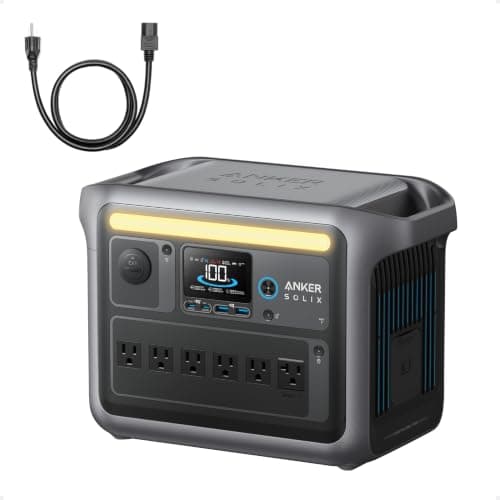
Every station charges from a household outlet, and modern units are dramatically faster than they were. Anker publishes 80% in 43 minutes and a full charge in 58 for the SOLIX C1000. Jackery publishes about 1.7 hours for the Explorer 1000 v2, or roughly one hour in emergency mode. BLUETTI publishes 0–80% in 45 minutes for the AC180.
The practical value of a fast wall charge is not convenience — it is that a storm usually gives you warning. A watch or a forecast is enough time to fill a station from empty on any of these, which turns a half-remembered battery in a closet into a full one.
2. Solar — slowest, and the only one that works with no grid
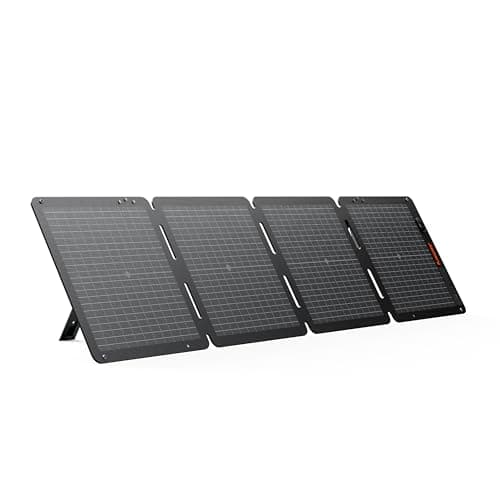
A folding panel connects directly to the station's solar input. The important thing to understand is that a panel's rating is measured under standard test conditions — 1,000W per square meter at 25°C cell temperature — which a backyard does not reproduce. Real output is meaningfully lower.
Plan on roughly 400–500Wh a day from a 100W panel in good summer conditions with sensible placement. Two panels roughly refill a 1,000Wh station across a day. In winter, in cloud, at a northern latitude, it can be a small fraction of that.
Check the station's accepted input range before buying a panel from a different brand — voltage and current both have to fall inside what the charge controller accepts, and the connector has to match or adapt.
3. Car charging — slow, and you already own the car
Almost every station accepts 12V charging from a car's accessory outlet, typically at 100–120W. That is slow — call it eight to ten hours for a 1,000Wh unit — but a car is a very large fuel tank with an alternator attached, and it is sitting on your drive.
Two practical points. Run the engine while charging rather than draining the starter battery, and observe the same carbon monoxide rules that apply to a generator: never in an attached garage, never with the door shut. The CO guide applies here too.
4. Generator charging — the underrated combination
Running a generator to charge a battery sounds circular and is genuinely the best answer for a multi-day outage. Run the generator for an hour or two in the afternoon, fill the station, shut the generator down, and run the house silently off the battery all night.
You get generator endurance with battery silence, you burn far less fuel than running the generator continuously, and your neighbors can sleep. The fuel arithmetic is compelling: at the EIA's reported $4.071 a gallon for the week ending 31 August 2026, two hours of a generator burning 0.75 gallons an hour is about $6.11 — considerably less than running it all night. The full fuel arithmetic is here.
Charging rates side by side
| Method | Typical rate | 1,000Wh from empty | Works mid-outage? |
|---|
| Wall outlet | 600–1,500 W | 45 min – 1.7 h | No |
|---|
| Solar, 100 W panel | ~50–80 W realized | 2 days | Yes |
|---|
| Solar, 400 W array | ~200–320 W realized | 4–6 h of good sun | Yes |
|---|
| Car 12 V outlet | 100–120 W | 8–10 h | Yes |
|---|
| Generator, via wall charger | 600–1,500 W | 45 min – 1.7 h | Yes |
|---|
Wall and solar input maxima are the manufacturers' published figures. Realized solar output is a working estimate at roughly 50–80% of panel rating, reflecting temperature, angle and controller losses — your conditions will differ, and the honest range is wide.
Do stations arrive charged?
Partially. Lithium batteries ship at a partial state of charge — commonly around 30% — because shipping regulations restrict transporting them full and because cells age fastest held at 100%.
So a station out of the box will run something immediately but is not ready for an outage. Charge it fully when it arrives, confirm everything works, then discharge it a little for storage. Which leads to the part most people skip.
The maintenance charge nobody does
Set a reminder every three months: top the unit up, run something off it for ten minutes, put it back. It takes five minutes and it is the whole maintenance schedule.
Store between 60% and 80% rather than full, indoors at room temperature rather than in a garage. Heat is the dominant factor in battery aging, and a unit that spends its life in a hot garage will not have its rated capacity when you need it. More on what actually shortens a battery's life.
The failure mode this prevents is not degradation. It is finding, on the second evening of an outage, that the station in the basement has been flat since last summer.