Skip to content
Watt Warden

Generators

The Best Generators Under $2,000 (2026)

This is the budget where the category stops being a compromise and starts being a choice - because at two thousand dollars you can afford either serious output or serious civility, and not both.

By Sawyer V.Updated Published How we work this out
Westinghouse WGen9500DF

Watt & Warden earns a commission on qualifying purchases made through links on this page, at no extra cost to you. It never changes a ranking, and our picks include products we tell you to skip. Full disclosure.

Quick picks

#ProductBest forPrice
1
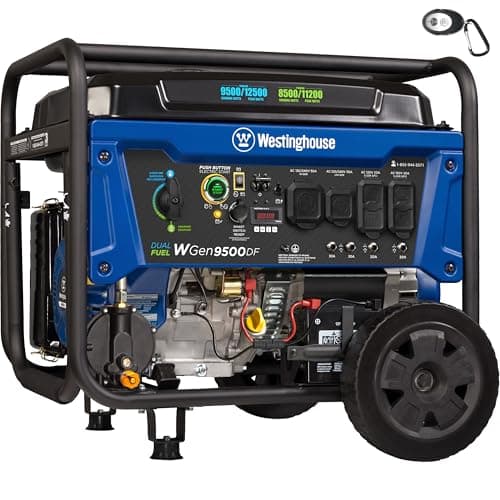
Westinghouse WGen9500DF

Best overall

Westinghouse WGen9500DF

9,500 running watts of dual fuel with both 240V outlets and a wireless remote start.

Whole-house backup with margin
$999.00 · Check price on Amazon

#ad how this is funded · price as of October 21, 2026

2
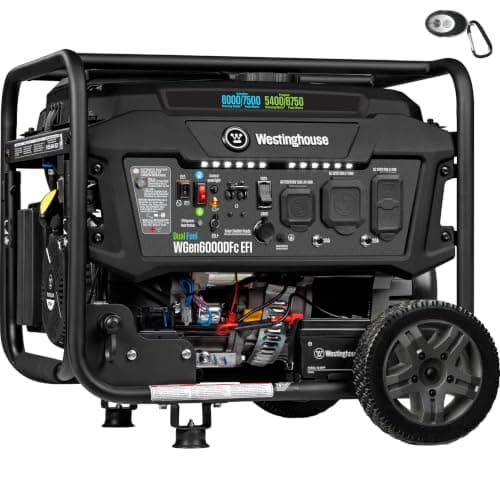
Westinghouse 7500 EFI dual fuel generator

Best match to a standard connection

Westinghouse 7500 EFI dual fuel generator

7,500 peak watts of EFI dual-fuel power with remote start.

A house on a 30A transfer switch
$1,049.00 · Check price on Amazon

#ad how this is funded · price as of October 21, 2026

3
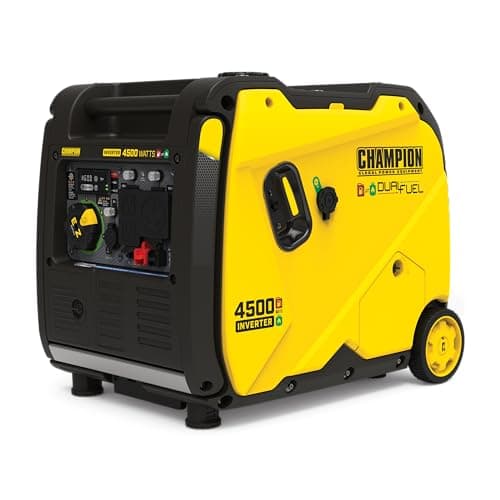
Champion 4500W dual fuel inverter generator

Best if noise matters more than watts

Champion 4500W dual fuel inverter generator

4,500 peak and 3,500 running watts of inverter-clean dual fuel output.

Neighbors, campgrounds, and sleeping
$988.62 · Check price on Amazon

#ad how this is funded · price as of October 21, 2026

4
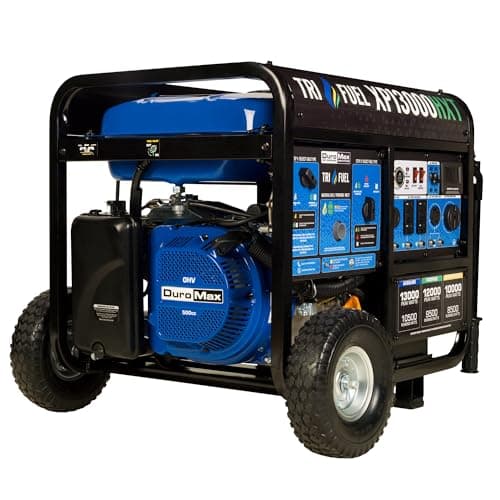
DuroMax XP13000HXT tri-fuel generator

Most fuel flexibility

DuroMax XP13000HXT tri-fuel generator

Tri-fuel with published ratings on gasoline, propane and natural gas.

A rural property with propane or a gas line
$1,499.00 · Check price on Amazon

#ad how this is funded · price as of October 21, 2026 · $2,499.00 40% off

Prices come from the retailer at page-build time and change constantly. Where no live price is available the button reads “Check price” rather than showing a number we cannot stand behind.

The fork this budget creates

Below this level the category is mostly compromise — you buy what you can afford and accept its limits. At two thousand dollars there is genuinely enough money for two very different machines, and picking the wrong one is the expensive mistake.

Route one: maximum output. A large open-frame conventional machine, 7,500 to 10,500 running watts, dual or tri fuel, with 240V outlets. It backs up a whole house. It is loud, heavy and needs somewhere to live.

Route two: maximum civility. A 3,500 to 4,500W inverter machine. Quiet enough for a campground, clean enough for electronics, light enough to move. It covers a critical-loads list and nothing more.

The question that resolves it is not budget — you can afford either. It is whether anything on your list is hardwired at 240V.

The test that decides it

Go and look at what you want to back up and sort it into two piles.

If your list isYou wantBecause
Fridge, freezer, network, lighting, a few outletsThe inverter machineEverything has a plug, and quiet is worth real money
Any of: well pump, furnace, sump pump, water heaterThe open-frame machineThose are hardwired, and most need 240V
Central air conditioningThe largest open-frame machine, or standby3,000-5,000W of starting surge on its own
Camping or an RV as well as the houseThe inverter machineAn open-frame unit is unwelcome at most campgrounds

The sizing page works a real house through the arithmetic, and the square footage page explains why floor area is the wrong input.

What the budget buys that cheaper tiers do not

Worth naming, because these are the features that appear at this level and are missing below it.

  • Electric and remote start. Under $1,000 you are mostly pulling a cord. Here it is standard, and it is what makes block running practical — the remote start page covers why that matters.
  • Dual or tri fuel. Nearly universal at this budget, and it removes the stale-gasoline failure that kills seasonal machines.
  • Both 240V connectors. An L14-30R and often a 14-50R, which is what lets a machine feed a transfer switch at either amperage.
  • Real instrumentation. Hour meters, voltmeters and frequency displays, which are what make maintenance happen on schedule.
  • Three-year warranties. Standard here, against one or two years lower down.

Budget the rest of the project

The machine is not the whole cost, and a household that spends the entire budget on the generator often cannot use it properly.

A transfer switch and an inlet are what reach the hardwired circuits the big machines exist for. That is an electrician and usually a permit — the installation cost page covers it.

A heavy cord, rated for the amperage and long enough to keep the machine twenty feet from the house — the cord page covers gauge.

A running cover, because the weather that caused the outage is the weather the machine has to work in — the rain page explains why a tarp is dangerous.

Fuel cans, a stabilizer and oil, plus a carbon monoxide alarm indoors. The alarm is the cheapest item on this site and the only one that is genuinely non-negotiable.

Where the money stops helping

Above this budget the next meaningful step is not a bigger portable — it is a standby installation, which is a different product with a different cost structure.

A larger portable buys watts you probably cannot pass through a 30A switch anyway. What standby buys is automation: it starts itself with nobody home and switches over in seconds. The worth-it page covers whether that is your problem.

The other direction is worth considering too. If your real requirement is a few short outages a year and quiet matters, a battery does that job silently with no fuel and no maintenance — the power station roundup covers that side.

The short version

  • The fork is output versus quiet, not price.
  • Anything hardwired at 240V sends you to the open-frame machine.
  • Budget the switch, the cord and the cover before spending everything on the machine.
  • Match the machine to the switch. A 30A switch caps you at 7,500W however big the generator is.
The picks in full

01 — Best overall

Westinghouse WGen9500DF

9,500 running watts of dual fuel with both 240V outlets and a wireless remote start.

This is the most capability available at the budget. 9,500 running watts covers a genuine whole-house critical list — well pump, furnace, fridge, freezer, lighting — with enough margin that you are not sequencing loads.

Both 240V outlets mean it feeds a transfer switch at either standard amperage, and remote start matters more than it sounds because block running means several start cycles a day in bad weather.

Dual fuel is the quiet advantage: propane stores indefinitely and never gums a carburetor, which is the commonest reason a backup machine fails to start.

The honest catch: it is a large open-frame machine, it is loud, and on a quiet street during an outage it is the loudest thing for a block.

Skip it ifyour transfer switch is 30A. It caps this machine at 7,500W.

Westinghouse WGen9500DF
$999.00 · Check price on Amazon

#ad how this is funded · price as of October 21, 2026

Published specifications for the Westinghouse WGen9500DF
SpecificationPublished figure
Output (gasoline)9,500 running W / 12,500 peak W
FuelGasoline or propane (dual fuel)
Engine457cc 4-stroke OHV, cast iron sleeve
Tank6.6 gal (25 L)
Run timeup to 12 h on a full tank
Transfer-switch outlet120/240 V L14-30R, 30 A
RV outlet120/240 V 14-50R, 50 A
StartingPush-button electric with remote key fob
Warranty3-year limited

Source: Westinghouse — WGen9500DF product specifications. These are the manufacturer's published figures, not ours — we have not tested this unit.

02 — Best match to a standard connection

Westinghouse 7500 EFI dual fuel generator

7,500 peak watts of EFI dual-fuel power with remote start.

A 30A transfer switch is rated at 7,500 watts, so this machine matches the standard residential connection exactly. Nothing is wasted at either end.

6.6 gallons and up to 11 hours means one fill covers a night, which is the practical unit of generator operation.

The honest catch: on propane it drops to 6,750 running watts. Size against the fuel you will actually use.

Skip it ifyou have a 50A switch and want to use all of it.

Westinghouse 7500 EFI dual fuel generator
$1,049.00 · Check price on Amazon

#ad how this is funded · price as of October 21, 2026

Published specifications for the Westinghouse 7500 EFI dual fuel generator
SpecificationPublished figure
Output7,500 peak W
FuelGasoline or propane (dual fuel)
Fuel systemElectronic fuel injection (EFI)
StartingRemote electric start
UseHome backup through a transfer switch

Source: Westinghouse — 7500 peak watt EFI dual fuel listing. These are the manufacturer's published figures, not ours — we have not tested this unit.

03 — Best if noise matters more than watts

Champion 4500W dual fuel inverter generator

4,500 peak and 3,500 running watts of inverter-clean dual fuel output.

The other side of the fork. An inverter throttles the engine to the load, so an evening running a fridge and lights is genuinely quiet rather than merely tolerable.

Clean output also protects the electronics in modern appliances, and dual fuel gives you the propane storage advantage without giving up gasoline.

The honest catch: 3,500 running watts is a critical-loads machine. It will not do whole-house, and no amount of load management changes that.

Skip it ifyou need to run a well pump. 3,500 running watts is not that machine.

Champion 4500W dual fuel inverter generator
$988.62 · Check price on Amazon

#ad how this is funded · price as of October 21, 2026

Published specifications for the Champion 4500W dual fuel inverter generator
SpecificationPublished figure
Output4,500 starting W / 3,500 running W (gasoline)
TypeInverter, RV ready
FuelGasoline or propane (dual fuel)
StartingElectric start
RV outlet120 V TT-30R, 30 A
Warranty3-year limited with free lifetime technical support

Source: Champion Power Equipment — 4500-watt dual fuel inverter specifications. These are the manufacturer's published figures, not ours — we have not tested this unit.

04 — Most fuel flexibility

DuroMax XP13000HXT tri-fuel generator

Tri-fuel with published ratings on gasoline, propane and natural gas.

Publishing honest figures for all three fuels — 10,500W gasoline, 9,500W propane, 8,500W natural gas — is unusual and genuinely useful, because most machines advertise the gasoline number and stay quiet about the rest.

A natural gas connection changes backup power fundamentally: a supply line does not run out and needs no storage.

The honest catch: heavy, loud and thirsty, and connecting a portable to a gas line is a plumber and a permit rather than a hose from a cylinder.

Skip it ifyou only ever run gasoline. You would be paying for capability you never use.

DuroMax XP13000HXT tri-fuel generator
$1,499.00 · Check price on Amazon

#ad how this is funded · price as of October 21, 2026 · $2,499.00 40% off

Published specifications for the DuroMax XP13000HXT tri-fuel generator
SpecificationPublished figure
Gasoline13,000 peak W / 10,500 running W
Propane12,000 peak W / 9,500 running W
Natural gas10,000 starting W / 8,500 running W
Engine500cc OHV, 100% copper windings
Tank8.3 gal
Run time8.82 h on gasoline at 50% load, 7.63 h on propane
OutletsTransfer-switch-ready 50 A outlet
StartingPush-button electric with remote start
SafetyBuilt-in CO Alert shutdown

Source: DuroMax — XP13000HXT tri-fuel generator listing. These are the manufacturer's published figures, not ours — we have not tested this unit.

How these were chosen

We did not test these. Nobody at Watt & Warden has plugged one in. What we did instead: read the manufacturer's published specifications, compile them into a table where the figures line up, and compute the numbers manufacturers leave out — runtime against a real appliance load, and what an hour of running actually costs.

Anything that could not be sourced was left out rather than estimated, and every pick names the buyer who should skip it. The full method is here, including where it is weaker than a publisher with a test bench.

Questions people actually ask

What is the best generator under $2,000?

It depends on one question: is anything you want to back up hardwired at 240V? If yes -- a well pump, furnace, sump pump or water heater -- you want a large open-frame dual fuel machine with 240V outlets. If everything has a plug, a 3,500 to 4,500W inverter machine is quieter, cleaner and more pleasant to own.

How many watts can I get for $2,000?

Around 9,500 to 10,500 running watts in an open-frame dual or tri fuel machine, which is genuine whole-house critical-load capability. Or about 3,500 running watts in an inverter machine, where you are paying for quiet operation, clean power and portability rather than output.

Should I buy a bigger generator or spend the money on a transfer switch?

The switch, almost always. A large generator with no transfer switch reaches only what an extension cord reaches, which excludes the furnace, well pump and sump pump those machines exist for. Budget the switch, a heavy cord and a running cover before spending the whole amount on the machine itself.

Is it worth spending more than $2,000 on a portable generator?

Rarely. A larger portable buys watts a standard 30A transfer switch cannot pass anyway. The next genuinely different step is a standby installation, which buys automation -- starting itself with nobody home and switching over in seconds -- rather than more capability.

What features do I get at this budget that cheaper generators lack?

Electric and remote start, dual or tri fuel operation, both 240V connectors, real instrumentation including an hour meter, and typically a three-year warranty. Remote start and dual fuel are the two that change ownership most -- one makes block running practical, the other removes the stale-gasoline failure that kills seasonal machines.

Sources

Every figure on this page comes from a published source. We have not tested this equipment, so the specifications are the manufacturer's and the statistics are the dataset's — the arithmetic on top of them is ours, and it is shown in full so you can check it. How we work this out.