Skip to content
Watt Warden

Accessories

The Best Generator Extension Cords (2026)

The cord is what makes the twenty-foot carbon monoxide rule possible. It is also the one accessory where buying the cheap option has a failure mode that involves the fire department.

By Sawyer V.Updated Published How we work this out
A coiled orange extension cord on concrete.

Watt & Warden earns a commission on qualifying purchases made through links on this page, at no extra cost to you. It never changes a ranking, and our picks include products we tell you to skip. Full disclosure.

Quick picks

#ProductBest forPrice
1
No photo

Best for a house connection

GearIT 30A L14-30 generator cord, 25 ft

10/4 SJTW twist-lock, L14-30P to L14-30R, rated the full 30A at 125/250V across 25 feet.

Feeding a transfer switch or inlet box
2
No photo

What the cord should plug into

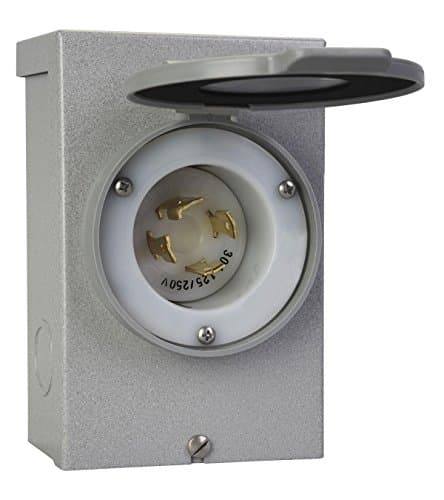
Reliance Controls PB30 power inlet box

A NEMA 3R weatherproof inlet box with an L14-30P inlet and a spring-loaded cap.

Ending the run-a-cord-through-a-window habit
3
No photo

A generator with the right outlet

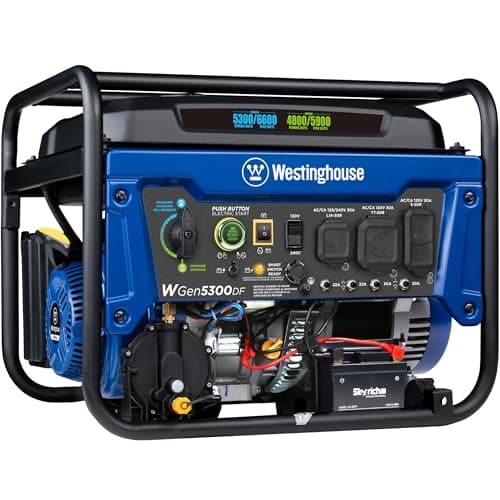
Westinghouse WGen5300DF

5,300 running watts with a 30A twist-lock outlet that matches the cord above.

Anyone buying the machine and the cord together

Prices come from the retailer at page-build time and change constantly. Where no live price is available the button reads “Check price” rather than showing a number we cannot stand behind.

Gauge is the whole question

American Wire Gauge runs backwards: a smaller number is a thicker conductor. 10 AWG is thicker than 12, which is thicker than 14.

Thicker cable has less resistance, so less of your power turns into heat in the cord instead of arriving at the appliance. Over a long run with a heavy load, a thin cord gets hot along its whole length — inside the insulation, where you cannot see it — and the generator's breaker has no reason to trip because the current is within its rating.

GaugeTypical useNotes
10 AWG30A house connection, long runsThe standard for an L14-30 generator cord
12 AWGIndividual heavy appliances at moderate distanceThe minimum worth buying for generator use
14 AWGLight loads, short runsLamps and device chargers only
16 AWG and thinnerIndoor household useNot for generator use at any length

This table is general guidance on conductor sizing, not a code table. The correct gauge for a specific run depends on the load, the distance and the ambient temperature. Where a cord's own printed rating is lower than what you need, that rating is the answer.

Length works against you

Voltage drop increases with distance, so the same cord that is fine at 25 feet may not be at 100. Two consequences that matter in practice:

  • Buy one cord of the right length rather than joining two. Every junction adds resistance and one more thing to sit in a puddle.
  • Go thicker as you go longer. If you need distance, the answer is a heavier gauge, not a second cord.

But do not solve distance by moving the generator closer. Twenty feet from windows, doors and attached garages is a safety minimum, not a suggestion.

Connector types you will meet

ConnectorRatingWhat it is for
NEMA L14-3030 A, 125/250 VThe house connection — feeds a 240V transfer switch
NEMA TT-3030 A, 120 VRV connection only — cannot feed a 240V switch
NEMA 5-2020 A, 120 VIndividual appliances
NEMA 14-5050 A, 125/250 VLarger machines and 50A RV service

Ratings are the connector standards. Your generator's own rated output and your transfer switch's rating are separate limits and may be lower — Reliance rates both its PB30 inlet box and its 31410CRK switch at 30 A and 7,500 W.

What to look for on the jacket

  • SJTW or STW. The W means weather and water resistant. Indoor-rated cord outdoors is a different product.
  • The gauge and conductor count printed on the jacket. 10/4 means 10 AWG, four conductors. Read it rather than trusting the listing.
  • Copper, not copper-clad aluminum. CCA is cheaper, carries less current for the same gauge, and is not what generator cords should be.
  • A cold-weather rating if you are in a winter region. Cheap PVC jackets stiffen and crack below freezing.

Using cords safely during an outage

  • Uncoil it completely. A coiled cord under load is a heating element — heat cannot escape from the middle of the coil.
  • Keep connections out of standing water. Elevate the joint on a brick if the ground is wet.
  • Never run it under a rug or through a closing door. Crushed insulation is the common cause of cord fires.
  • Check it warm. Run your hand along the cord an hour in. Warm is a warning; hot means unplug and use a heavier gauge.
  • Never use a double-male "suicide cord" into a dryer or range outlet. It energizes the utility line, can kill a lineworker, and is illegal everywhere in the United States. The legal ways to connect are a transfer switch or an interlock kit.

The picks in full

01Best for a house connection

GearIT 30A L14-30 generator cord, 25 ft

10/4 SJTW twist-lock, L14-30P to L14-30R, rated the full 30A at 125/250V across 25 feet.

This is the standard house connection and the reason is the four conductors: L14-30 carries two hot legs, a neutral and a ground, so it can feed a 240V transfer switch rather than a single 120V circuit.

10-gauge copper is what 30A requires. This is the specification that matters most and the one people economize on — an undersized cord heats inside its own insulation and the breaker never trips, because the current is within the generator's rating even while the cord is failing.

Twist-lock connectors rotate into a locked position and cannot be pulled apart by a foot catching the cable. Outdoors, in the dark, that is not a luxury.

Skip it ifyour generator has no 240V twist-lock outlet. Then this cannot connect to it at all.
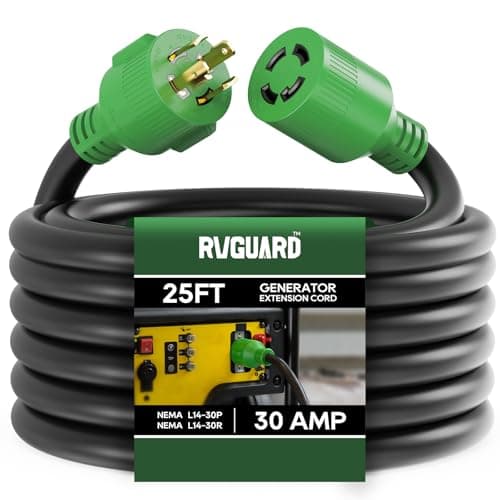
Published specifications for the GearIT 30A L14-30 generator cord, 25 ft
SpecificationPublished figure
ConnectorsNEMA L14-30P to L14-30R, 4-prong twist lock
Conductor10/4 SJTW copper
Rating30 A, 125/250 V, up to 7,500 W
Length25 ft
JacketOutdoor-rated SJTW, UV and oil resistant

Source: GearIT — 30A L14-30 generator cord listing. These are the manufacturer's published figures, not ours — we have not tested this unit.

02What the cord should plug into

Reliance Controls PB30 power inlet box

A NEMA 3R weatherproof inlet box with an L14-30P inlet and a spring-loaded cap.

A cord has to terminate somewhere. Running it through a window means leaving an opening in the house facing the machine producing carbon monoxide, and crushing the cable in the sash over time.

An inlet box is the fix: a weatherproof socket on the exterior wall, wired back to the transfer switch. NEMA 3R means genuinely rain-rated rather than merely outdoor-looking.

How inlet boxes work covers ratings and placement.

Skip it ifeverything you power has an ordinary plug and no hardwired circuit is involved.

Published specifications for the Reliance Controls PB30 power inlet box
SpecificationPublished figure
Rating30 A, for generators up to 7,500 running watts
InletNEMA L14-30P
EnclosureNEMA 3R, outdoor watertight
ConstructionSteel with anti-corrosive powder coat
CapSpring-loaded, keeps moisture out when not in use
WiringFour combination 1/2 in and 3/4 in knockouts

Source: Reliance Controls — PB30 power inlet box product page. These are the manufacturer's published figures, not ours — we have not tested this unit.

03A generator with the right outlet

Westinghouse WGen5300DF

5,300 running watts with a 30A twist-lock outlet that matches the cord above.

The mismatch that wastes money: a machine with only 120V household sockets and a TT-30 RV outlet cannot feed a 240V transfer switch, no matter what cord you buy.

Look for the four-prong twist-lock L14-30R on the panel. TT-30 looks similar and is 120V only.

Skip it ifyou already own a generator. Check its outlet panel before buying any cord.

Published specifications for the Westinghouse WGen5300DF
SpecificationPublished figure
Output (gasoline)5,300 running W / 6,600 peak W
Output (propane)4,800 running W / 5,900 peak W
Engine274cc 4-stroke OHV
Tank4.7 gal (18 L)
Run timeup to 14.5 h on a full tank
Transfer-switch outlet120/240 V L14-30R, 30 A
RV outlet120 V TT-30R, 30 A
StartingPush-button electric with remote key fob

Source: Westinghouse — WGen5300DF product specifications. These are the manufacturer's published figures, not ours — we have not tested this unit.

How these were chosen

We did not test these. Nobody at Watt & Warden has plugged one in. What we did instead: read the manufacturer's published specifications, compile them into a table where the figures line up, and compute the numbers manufacturers leave out — runtime against a real appliance load, and what an hour of running actually costs.

Anything that could not be sourced was left out rather than estimated, and every pick names the buyer who should skip it. The full method is here, including where it is weaker than a publisher with a test bench.

Questions people actually ask

What gauge extension cord do I need for a generator?

For a house connection, 10 AWG -- that is what a 30A L14-30 circuit requires. For individual appliances at moderate distance, 12 AWG is the practical minimum. Anything thinner than 14 AWG is for lamps and chargers, not generator use, at any length.

How long can a generator extension cord be?

Longer runs need heavier gauge, because voltage drop increases with distance. Buy one cord of the length you need rather than joining two -- every junction adds resistance and another connection to sit in water. Do not solve distance by moving the generator closer than twenty feet.

What is an L14-30 cord?

A four-conductor twist-lock cord rated 30A at 125/250V -- two hot legs, a neutral and a ground. The four conductors are what let it feed a 240V transfer switch rather than a single 120V circuit, which is why it is the standard house connection.

Can I plug a generator into a dryer outlet?

No. A double-male cord into a dryer or range outlet energizes the utility line outside your house, can kill a lineworker restoring power, and will destroy the generator when the grid returns. It is illegal everywhere in the United States. Use a transfer switch or an interlock kit.

Why does my extension cord get warm?

It is undersized for the load, coiled, or both. A coiled cord cannot shed heat from its middle, so uncoil it completely. If a fully uncoiled cord is warm an hour in, move to a heavier gauge -- the generator's breaker will not protect you, because the current is within its rating.

Sources

Every figure on this page comes from a published source. We have not tested this equipment, so the specifications are the manufacturer's and the statistics are the dataset's — the arithmetic on top of them is ours, and it is shown in full so you can check it. How we work this out.